Key takeaways
- Enterprise AEO tools split into two camps: monitoring-only dashboards and full optimization platforms. The distinction matters more than any individual feature.
- Profound and AthenaHQ are strong monitors with good enterprise credentials, but both leave the "now what?" question largely unanswered.
- Conductor adds AI visibility on top of an existing enterprise SEO platform, which works well if you're already in their ecosystem.
- Promptwatch is the only platform in this comparison that closes the loop from gap detection to content creation to traffic attribution -- making it the better fit for teams that need to move, not just measure.
- Pricing ranges from $99/mo (Promptwatch Essential) to $295/mo+ (AthenaHQ) to custom enterprise contracts (Profound, Conductor).
Why enterprise teams are rethinking their AEO stack
A year ago, most marketing teams were still treating AI search as a curiosity. That's changed fast. ChatGPT, Perplexity, Google AI Overviews, and a dozen other models now sit between your brand and your potential customers -- and they're making recommendations without you in the room.
The response from the software market has been predictable: a wave of "AI visibility" tools, most of which do roughly the same thing. They run prompts, check whether your brand appears, and show you a dashboard. That's useful. But for an enterprise team with real targets and real accountability, a dashboard that says "you're not showing up" without telling you what to do about it is only half a solution.
This guide focuses on four platforms that have earned serious attention from enterprise marketing and SEO teams in 2026: Promptwatch, AthenaHQ, Profound, and Conductor. They're not all the same, and the differences are worth understanding before you commit to a contract.
What "enterprise AEO" actually requires
Before comparing tools, it's worth being specific about what enterprise teams actually need -- because the requirements are different from a startup running 20 prompts a week.
Enterprise teams typically need:
- Coverage across multiple AI models (not just ChatGPT)
- Multi-site, multi-region, multi-language support
- Prompt volume at scale (hundreds of prompts, not dozens)
- Integration with existing reporting workflows (Looker Studio, APIs, GSC)
- Content workflows that connect visibility data to actual publishing
- Traffic attribution that ties AI citations to revenue, not just impressions
- Security and compliance standards that pass procurement review
With that frame in mind, here's how the four platforms compare.
The four platforms at a glance
Promptwatch
Promptwatch monitors 10 AI models -- ChatGPT, Perplexity, Google AI Overviews, Google AI Mode, Claude, Gemini, Meta/Llama, DeepSeek, Grok, and Mistral -- and has processed over 1.1 billion citations, clicks, and prompts. Used by 6,700+ brands and agencies including Booking.com and Center Parcs.
What separates it from the other three is the action loop. Most platforms stop at monitoring. Promptwatch goes further: Answer Gap Analysis shows you exactly which prompts competitors rank for that you don't, a built-in AI writing agent generates content engineered to get cited (not generic SEO filler), and page-level tracking shows whether that content actually moved the needle. Traffic attribution via GSC integration, code snippet, or server log analysis connects visibility to revenue.
It also has AI Crawler Logs -- real-time visibility into when ChatGPT, Claude, Perplexity, and others are crawling your site, which pages they're reading, and what errors they're hitting. Most competitors don't have this at all.
Pricing: Essential $99/mo, Professional $249/mo, Business $579/mo, with agency and enterprise custom plans available.

AthenaHQ
AthenaHQ is a Y Combinator-backed platform that covers 8+ AI models and has built a strong reputation in the mid-market and growth-stage enterprise segment. Customers include SoFi, ZoomInfo, and Wix, and it holds a 4.9 rating on G2.
The platform focuses on citation tracking, share-of-voice analysis, and competitive benchmarking. Its State of AI Search 2026 Report found that only 17.2% of AI responses mention any particular brand on average -- but teams using dedicated AEO tools are reaching up to 56.7% of AI answers. AthenaHQ is good at showing you where you stand relative to that range.
Where it falls short for enterprise teams is on the "what next" side. AthenaHQ is primarily a monitoring and analytics platform. It doesn't generate content, doesn't have crawler logs, and doesn't offer the kind of closed-loop attribution that connects AI visibility to actual pipeline.
Pricing starts at $295/mo (with a first-month discount), which is notably higher than Promptwatch's entry point for comparable monitoring functionality.

Profound
Profound positions itself as the enterprise-grade AEO platform, with customers like major B2B SaaS companies and a G2 Winter 2026 Leader badge. Its Growth plan covers 10+ AI platforms, and it offers prompt volume data -- a feature that's genuinely useful for prioritizing which queries to target.
The platform has invested in "Agents" (its term for AI-assisted content workflows), which puts it closer to Promptwatch on the optimization side than AthenaHQ. It also has shopping tracking and agent analytics for teams monitoring agentic AI interactions.
The criticism that surfaces most often from users: data reliability and consistency, and difficulty translating insights into concrete next steps. The pricing is also opaque -- Profound's enterprise plans are custom, and the Starter plan only covers ChatGPT, which limits its usefulness for teams that care about Perplexity, Claude, or Gemini.

Conductor
Conductor is an established enterprise SEO platform that added AI visibility tracking as the market shifted. If your team is already using Conductor for traditional SEO, the AI visibility layer integrates naturally into existing workflows and reporting.
The platform offers persona customization for AI monitoring (useful for enterprise brands serving multiple audience segments) and covers the major AI models. It's a reasonable choice for teams that want to consolidate tools rather than add a new vendor.
The limitation is that AI visibility feels like a feature addition rather than a core product. Conductor's roots are in traditional SEO, and the depth of its AEO capabilities -- particularly on the content optimization and attribution side -- doesn't match platforms built specifically for AI search.
Head-to-head comparison
| Feature | Promptwatch | AthenaHQ | Profound | Conductor |
|---|---|---|---|---|
| AI models covered | 10 | 8+ | 10+ (Growth+) | Major models |
| Starting price | $99/mo | $295/mo | $99/mo (ChatGPT only) | Custom |
| Answer gap analysis | Yes | Limited | Partial | No |
| AI content generation | Yes (built-in agent) | No | Yes (Agents) | No |
| AI crawler logs | Yes | No | No | No |
| Reddit/YouTube tracking | Yes | No | No | No |
| ChatGPT Shopping tracking | Yes | No | Yes | No |
| Traffic attribution | Yes (GSC, snippet, logs) | No | Partial | Partial |
| Prompt volume/difficulty | Yes | Limited | Yes | No |
| Multi-language/region | Yes | Yes | Yes | Yes |
| Looker Studio / API | Yes | Limited | Yes | Yes |
| Free trial | Yes | Yes (67% off first month) | Free AEO report | Demo only |
| Best for | Full optimization cycle | Mid-market monitoring | Enterprise monitoring | Existing Conductor users |
A few things stand out in this table. The price gap between Promptwatch and AthenaHQ is significant -- AthenaHQ's entry point is nearly 3x higher for what is, functionally, a monitoring-focused product. Profound's $99 Starter plan looks comparable to Promptwatch on price, but it only covers ChatGPT, which makes it a different product entirely at that tier.
The crawler logs row is worth pausing on. Knowing that an AI model is crawling your site but hitting errors on key pages -- or not crawling certain pages at all -- is actionable intelligence that monitoring dashboards can't give you. Promptwatch is the only platform here that surfaces this data.
Which platform fits which team
If you need the full optimization cycle
Promptwatch is the right choice. The combination of gap analysis, content generation grounded in real citation data, crawler logs, and closed-loop attribution makes it the only platform here that takes you from "we're not showing up" to "we published content and here's the traffic it drove." For enterprise teams with content resources and a mandate to grow AI visibility, that loop is the whole game.
If you're primarily a monitoring shop
AthenaHQ is well-built for teams that want clean dashboards, solid competitive benchmarking, and a strong G2 reputation to show stakeholders. If your team's job is to report on AI visibility rather than directly improve it, AthenaHQ does that well. Just be prepared for the price point.
If you're in a large B2B SaaS company with complex needs
Profound's enterprise tier is worth evaluating, particularly for teams that need prompt volume data and are running complex multi-stakeholder reporting. The Agents feature is a genuine attempt at closing the content gap. But read the user reviews carefully -- data consistency issues come up enough to warrant asking pointed questions during a trial.
If you're already in the Conductor ecosystem
Conductor makes sense as a consolidation play. Adding AI visibility to an existing enterprise SEO contract is lower friction than onboarding a new vendor. But if AI search is a primary growth channel for your team (and increasingly it should be), you'll likely outgrow Conductor's AEO capabilities within a year.
What enterprise teams often miss when evaluating AEO tools
Prompt coverage vs. prompt quality
Most platforms let you track a fixed set of prompts. The better question is whether the platform helps you find the right prompts -- the ones your actual customers are asking, at meaningful volume, where you have a realistic chance of winning visibility. Promptwatch's prompt intelligence includes volume estimates, difficulty scores, and query fan-outs (how one prompt branches into sub-queries). That's the difference between tracking 50 random prompts and tracking 50 prompts that actually matter.
The citation source question
AI models don't cite your homepage. They cite specific pages -- blog posts, comparison guides, product pages, Reddit threads, YouTube videos. Understanding which sources AI models actually pull from is essential for knowing where to invest content effort. Promptwatch's citation and source analysis surfaces this data, including Reddit and YouTube discussions that directly influence AI recommendations. Most platforms in this comparison ignore those channels entirely.
Attribution is not optional at enterprise scale
At the startup level, "our AI visibility score went up" might be enough. At enterprise scale, you need to connect that to pipeline. Which pages are being cited? By which models? How often? And what traffic and conversions are coming from AI referrals? Without that attribution layer, you're flying blind on ROI. This is where Profound and AthenaHQ both have gaps that matter.
The broader AEO tool landscape
These four platforms aren't the only options. The market has expanded quickly in 2026, and there are solid tools at different price points and use cases.
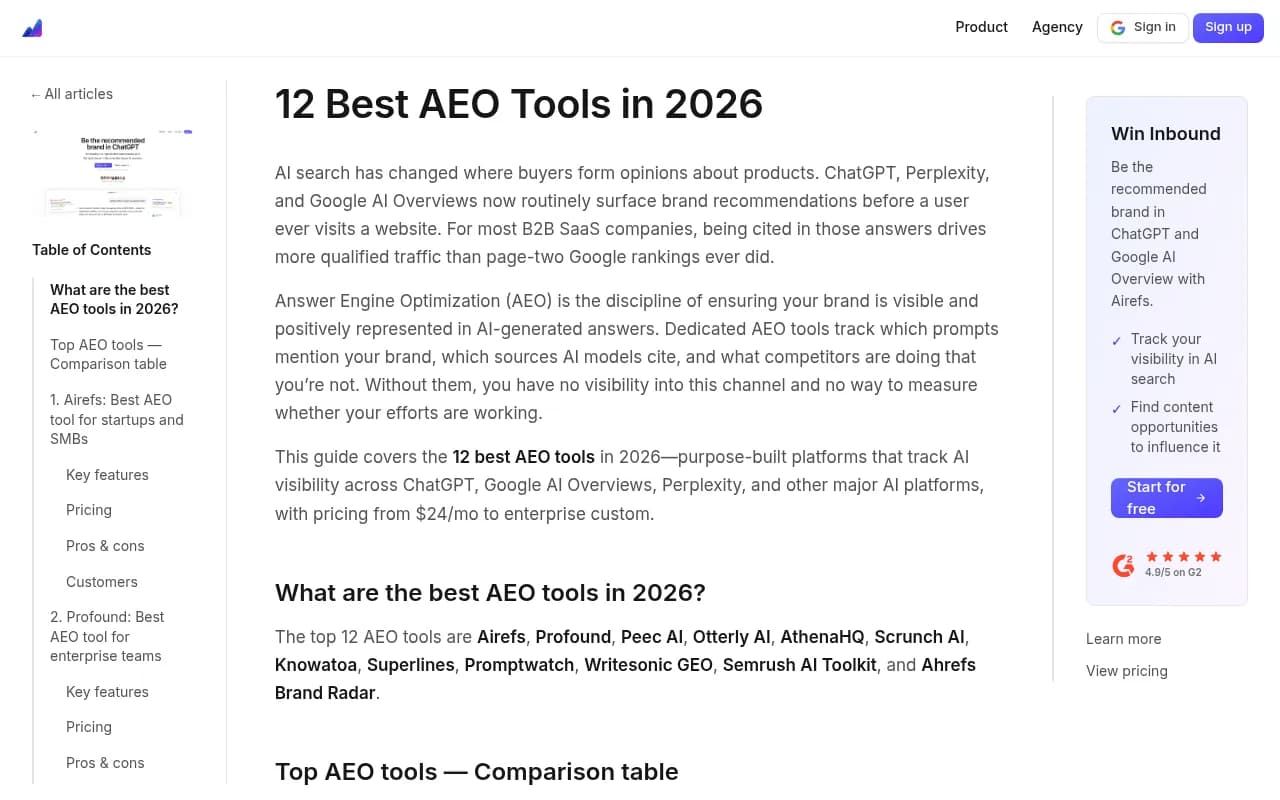
For teams that want broader monitoring coverage at a lower price point, Otterly.AI and Peec AI are worth looking at.


For enterprise teams that want a different take on the optimization side, Scrunch AI has built what it calls an "Agent Experience Platform" with a focus on active optimization rather than passive monitoring.
SE Ranking has added a solid AI visibility toolkit to its existing SEO platform, which is a reasonable option for teams already in that ecosystem.
Bottom line
The AEO tool market in 2026 has matured enough that the monitoring problem is largely solved. Most platforms can tell you whether you're showing up in ChatGPT or Perplexity. The harder problem -- and the one that actually drives business outcomes -- is what you do with that information.
Profound and AthenaHQ are good at the monitoring half. Conductor is a reasonable add-on for existing customers. But for enterprise teams that need to close the loop from visibility gap to published content to attributed revenue, Promptwatch is the most complete platform in this comparison. The crawler logs alone are worth the evaluation -- they surface a category of insight that the other three platforms simply don't offer.
Start with a trial, run your actual prompts, and see where your gaps are. The data will tell you what to do next.