Key takeaways
- Peec AI is a clean, focused monitoring tool — good for multi-client tracking, but it caps out quickly and has no content optimization features.
- Nightwatch is primarily a rank tracker that added AI visibility as a layer; useful if you're already in its ecosystem, but not built for GEO-first teams.
- Rankscale is a newer entrant focused on AI search ranking with a lighter feature set, suited for teams that want simple prompt tracking without complexity.
- Promptwatch is the only one of the four that closes the loop — it tracks visibility, identifies gaps, and generates content to fix them.
These four tools get mentioned in the same breath a lot. They all track how brands appear in AI search engines. They all have dashboards. They all produce numbers that look like "AI visibility."
But what they actually do with that data — and what they help you do next — is where they diverge sharply.
This comparison is for teams who've moved past the "should we track AI visibility?" question and are now asking the harder one: which tool will actually help us improve?
What we're comparing
Before getting into specifics, it's worth being clear about what each tool is at its core:
- Peec AI: a dedicated AI visibility monitoring platform, built for agencies managing multiple brands
- Promptwatch: an end-to-end GEO platform covering monitoring, gap analysis, content generation, and traffic attribution
- Nightwatch: a traditional rank tracker that added AI search monitoring to its existing feature set
- Rankscale: a newer AI search ranking platform focused on prompt-level tracking
They're not the same type of product. Comparing them directly is a bit like comparing a GPS to a full navigation system — both show you where you are, but only one helps you get somewhere.
Peec AI: strong monitoring, hard ceiling
Peec AI has earned its reputation in the GEO space. The interface is clean, the data is organized, and for agencies running multiple client accounts, it handles multi-brand tracking better than most.

The core offering tracks how brands appear across ChatGPT, Perplexity, Google AI Overviews, and DeepSeek on the Pro plan (€199/mo). Claude, Gemini, and Google AI Mode are available — but as Enterprise add-ons with custom pricing. That's a meaningful limitation if you're trying to get a complete picture of AI search behavior in 2026, when those models collectively handle a significant share of AI-assisted queries.
The other ceiling is prompt volume. The Pro plan caps at 100 prompts and 9,000 AI answers per month. For a small brand tracking a handful of topics, that's fine. For a mid-size company with a broad product line, or an agency managing several clients, you'll hit the limit faster than you'd expect.
What Peec AI doesn't have: content creation tools, site audits, shopping visibility tracking, crawler logs, or any mechanism to tell you what to do with the data it surfaces. You see your mention rate, your sentiment, your competitor comparisons — and then you're on your own to figure out what to change.
That's not a criticism exactly. Peec AI is honest about being a monitoring tool. But monitoring-only platforms have a natural stopping point, and teams that want to act on the data will need to bring in other tools.
Peec AI at a glance
| Feature | Peec AI |
|---|---|
| AI models covered (base plan) | 4 (ChatGPT, Perplexity, Google AI Overviews, DeepSeek) |
| Claude / Gemini / AI Mode | Enterprise add-on |
| Prompt volume (Pro) | 100 prompts / 9,000 AI answers |
| Content generation | No |
| Crawler logs | No |
| Traffic attribution | No |
| Multi-client support | Yes |
| Pricing (Pro) | €199/mo |
Nightwatch: rank tracker with AI visibility bolted on
Nightwatch has a 4.9/5 rating on G2, which is genuinely impressive for a rank tracking tool. It's been around long enough to have earned trust in the traditional SEO world, and its accuracy on Google SERP tracking is well-regarded.
The AI visibility features were added more recently, and that origin story shows in how they're structured. The tool tracks AI search mentions and can surface how your brand appears in AI-generated answers, but it's layered on top of an architecture designed primarily for keyword rank tracking. The prompt-based tracking that GEO-native tools are built around from the ground up feels more like an extension than a core feature.
Pricing starts at $49/mo, which makes it one of the more accessible options in this comparison. If your team is already using Nightwatch for traditional SEO and wants to add some AI visibility monitoring without switching platforms, that's a reasonable use case. But if AI search visibility is your primary concern, you're essentially paying for a lot of rank tracking infrastructure you may not need, while getting a lighter version of the AI monitoring features you do need.
Nightwatch also doesn't offer content generation, gap analysis, or crawler logs. Like Peec AI, it tells you where you stand — it doesn't help you change it.
Rankscale: prompt tracking for teams that want simplicity
Rankscale is the newest of the four, and it shows in both the feature set and the positioning. It's focused on AI search ranking and prompt-level tracking, with a cleaner, more streamlined interface than some of the more established platforms.
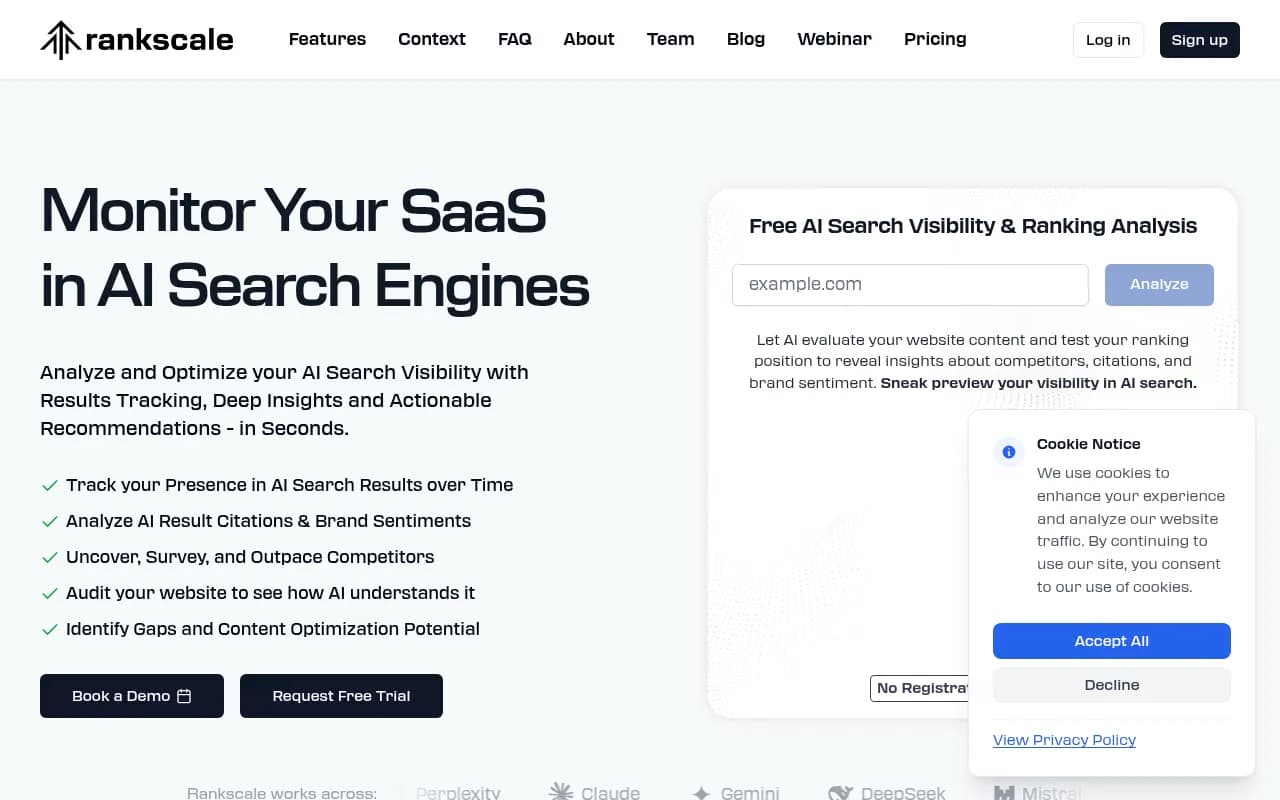
For teams that are just starting to take AI visibility seriously and want a simple way to track how they appear in ChatGPT, Perplexity, and similar engines, Rankscale is a reasonable starting point. It doesn't overwhelm you with data, and the setup is relatively quick.
The trade-off is depth. Rankscale doesn't offer the prompt volume metrics, difficulty scoring, or query fan-out analysis that more mature platforms provide. There's no content generation, no competitor heatmaps, no Reddit or YouTube tracking, and no traffic attribution. It's a tracker — a good one for its target audience, but a tracker nonetheless.
If you're a solo marketer or a small team that wants to answer "are we showing up in AI search?" without needing to answer "why not, and what do we do about it?" — Rankscale works. Once you need the second question answered, you'll outgrow it.
Promptwatch: the one that actually helps you fix things
The honest difference between Promptwatch and the other three tools in this comparison is that it doesn't stop at reporting.
Promptwatch is built around what it calls an action loop: find the gaps, create content to fill them, track the results. That cycle is what separates an optimization platform from a monitoring dashboard.

Here's what that looks like in practice:
The Answer Gap Analysis shows you exactly which prompts competitors are being cited for that you're not. Not in a vague "your competitor has higher visibility" way — in a specific "here are the questions AI models are answering about your category, and here's the content your site is missing" way. That's a fundamentally different kind of insight.
From there, Content Agents generate articles, listicles, comparisons, and briefs grounded in actual prompt data, citation patterns, and competitor analysis. This isn't generic content — it's built around the specific gaps the gap analysis identified. The content is designed to be cited by AI models, not just to rank in Google.
Then the tracking layer closes the loop. Page-level visibility tracking shows which specific pages are being cited, by which models, and how often. Agent Analytics logs when AI crawlers hit your site, which pages they read, and when those pages move from crawled to cited. Traffic attribution connects AI visibility to actual revenue.
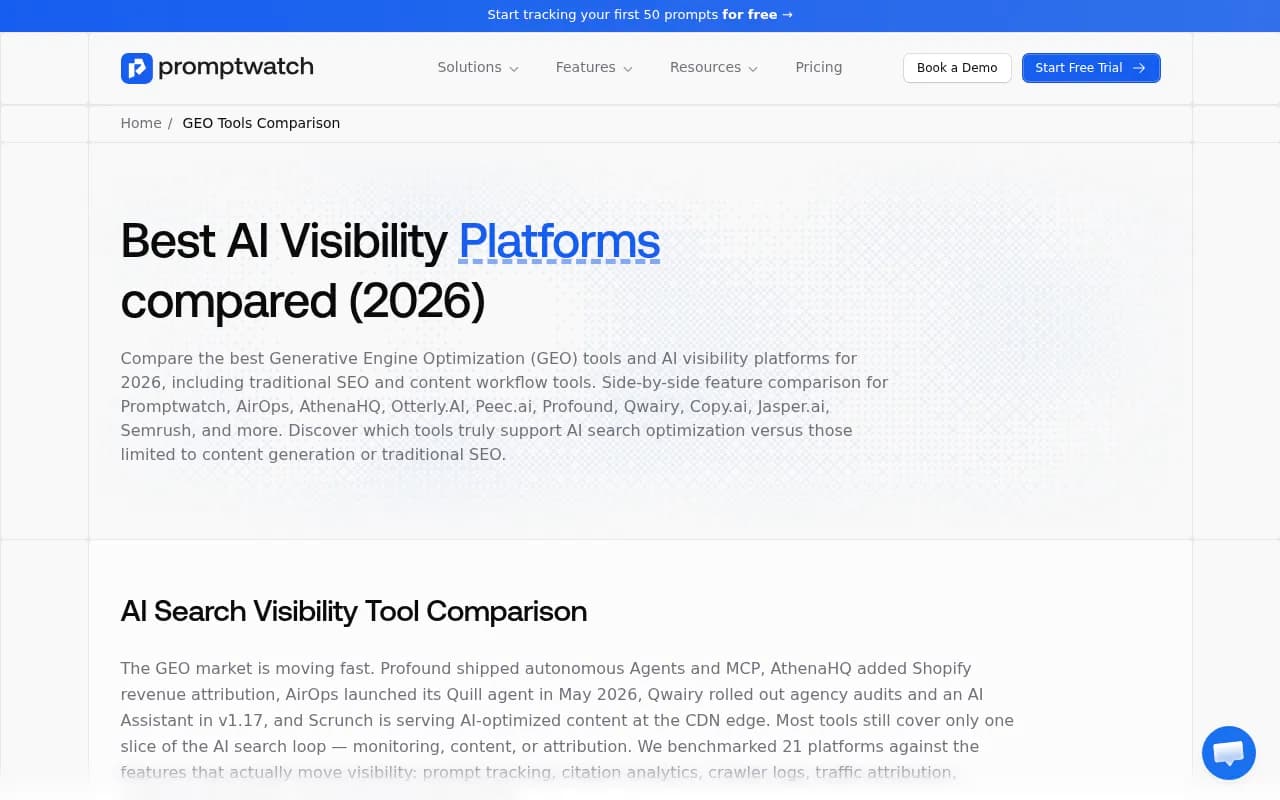
Promptwatch also covers more ground on the monitoring side than the other three. It tracks 10 AI models: ChatGPT, Perplexity, Google AI Overviews, Google AI Mode, Claude, Gemini, Meta/Llama, DeepSeek, Grok, and Mistral. It includes Reddit and YouTube insights (which influence AI recommendations more than most teams realize), ChatGPT Shopping tracking, offsite citation analysis, and competitor heatmaps.
Pricing runs from $99/mo (Essential: 1 site, 50 prompts, 5 articles) to $249/mo (Professional: 2 sites, 150 prompts, 15 articles, crawler logs) to $579/mo (Business: 5 sites, 350 prompts, 30 articles). A free trial is available.
Head-to-head comparison
| Peec AI | Nightwatch | Rankscale | Promptwatch | |
|---|---|---|---|---|
| Primary purpose | AI monitoring | Rank tracking + AI | AI rank tracking | GEO optimization |
| AI models (base plan) | 4 | Limited | Several | 10 |
| Prompt volume | 100 (Pro) | Varies | Varies | 50–350 |
| Content generation | No | No | No | Yes |
| Answer gap analysis | No | No | No | Yes |
| Crawler / agent logs | No | No | No | Yes |
| Traffic attribution | No | No | No | Yes |
| Reddit / YouTube tracking | No | No | No | Yes |
| ChatGPT Shopping | No | No | No | Yes |
| Competitor heatmaps | Basic | No | Basic | Yes |
| Multi-language | Yes | Yes | Limited | Yes |
| Starting price | €199/mo | $49/mo | Varies | $99/mo |
| Free trial | Yes | Yes | Yes | Yes |
Which tool fits which situation
The right answer depends on what you actually need to accomplish.
If you're an agency managing multiple clients and your main job is reporting on AI visibility — showing clients where they stand, tracking changes over time, benchmarking against competitors — Peec AI is a solid choice. It's built for that workflow. Just know you'll need separate tools for anything beyond monitoring.
If you're already a Nightwatch customer and you want to add basic AI visibility tracking without switching platforms, staying put makes sense. The AI features aren't as deep as dedicated tools, but the integration with your existing rank tracking data has value.
If you're a small team or solo marketer just getting started with AI visibility and you want something simple and low-friction, Rankscale is a reasonable entry point. You'll likely outgrow it, but it's a low-cost way to start building intuition for how AI search works.
If you need to actually improve your AI visibility — not just measure it — Promptwatch is the only one of the four that gives you the tools to do that. The gap analysis tells you what's missing. The content generation helps you create it. The crawler logs show you whether AI engines are finding and citing it. That's a complete workflow, not just a dashboard.
A note on what "rank tracking" means in AI search
One thing worth saying directly: the concept of "rank" works differently in AI search than in traditional SEO. There's no position 1 through 10. AI models either cite you or they don't, and the factors that determine that are different from what determines a Google ranking.
Tools that were built for traditional rank tracking and added AI visibility later tend to carry some of that old mental model with them. They show you "rank" in AI search in ways that can be misleading — as if there's a ladder to climb rather than a citation threshold to clear.
GEO-native platforms, by contrast, are built around prompts, citations, and content gaps from the start. That architectural difference matters when you're trying to understand why you're not being cited and what to do about it.
The bottom line
Peec AI, Nightwatch, and Rankscale are all legitimate tools for different audiences. None of them are bad choices within their intended scope. But if you're reading this comparison because you want to improve your brand's presence in AI search — not just measure it — the tool that actually supports that goal is Promptwatch.
The monitoring-only tools in this space will tell you your visibility score. Promptwatch tells you your visibility score, why it's where it is, what content you need to create to change it, and whether that content is working after you publish it. That's the difference between a report and a workflow.
For teams that are serious about AI search in 2026, that distinction is what the decision should hinge on.