Key takeaways
- Most AI visibility tools are built for single-brand teams -- agencies need workspaces, client separation, shareable reports, and scalable prompt libraries
- The tools that score best for multi-client work combine monitoring with content gap analysis and optimization, not just dashboards
- Pricing structures vary wildly: some tools charge per seat, others per brand, others per prompt -- understand which model breaks down at scale before committing
- Promptwatch is the only platform in this comparison rated as a "Leader" across all GEO categories, and the only one that closes the loop from gap detection to content generation to traffic attribution
- Free trials are available on most platforms -- test with a real client account before buying
Running AI visibility for one brand is manageable. Running it for 10 clients is a completely different operational challenge. You need clean workspace separation so Client A's data never bleeds into Client B's reports. You need shareable, white-label-ready dashboards that don't require a client to log in and interpret raw data. You need prompt libraries you can templatize across accounts instead of rebuilding from scratch every time. And you need pricing that doesn't punish you for growing.
Most AI visibility tools weren't designed with any of that in mind. They were built for in-house marketing teams tracking one brand across a handful of AI models. That's fine for what it is -- but it means agencies often end up duct-taping together workflows that should be native features.
This guide ranks 9 platforms specifically on what matters for multi-client agency work. Not just "does it track ChatGPT" (they all do), but: can you actually run a client services operation on it?
What agencies actually need from an AI visibility tool
Before getting into the rankings, it's worth being specific about the criteria. These are the features that separate tools built for agencies from tools that happen to have an "agency plan" on their pricing page.
Workspace and client separation. Can you create isolated environments per client? Or does everything live in one account with filters? True workspace separation means each client has their own prompt library, their own tracked brands, and their own reporting -- with no risk of cross-contamination.
Scalable prompt management. Agencies track similar question types across many clients ("best [category] tools", "who is the best [service] provider"). The ability to templatize prompts and deploy them across accounts saves hours every week.
Reporting and white-labeling. Can you generate a client-ready PDF or shareable link without exporting to Google Slides and reformatting everything? White-label options matter for agencies that want to present data under their own brand.
Content gap analysis and optimization. Monitoring is table stakes. The tools that actually justify their cost for agencies are the ones that tell you why a client isn't being cited and what to do about it -- ideally with content generation built in.
Pricing model at scale. Per-seat pricing is fine for small teams. Per-brand pricing scales better for agencies. Per-prompt pricing can get expensive fast. Understand the model before you sign a contract.
The 9 platforms ranked
1. Promptwatch
Promptwatch is the most complete platform in this comparison for agencies that want to move beyond monitoring. It's used by 6,700+ brands and agencies -- including Booking.com and Center Parcs -- and is the only tool in a 2026 comparison of 12 GEO platforms to be rated a "Leader" across every category.

What makes it different for agencies specifically: it doesn't stop at showing you where clients are invisible. The Answer Gap Analysis identifies exactly which prompts competitors appear for that your client doesn't -- and the built-in AI writing agent generates articles, listicles, and comparisons designed to close those gaps. That's a full deliverable workflow, not just a data export.
For multi-client operations, Promptwatch supports multiple sites per plan (up to 5 on Business, with custom Agency/Enterprise tiers), page-level citation tracking, AI crawler logs showing which pages AI bots are actually reading, and traffic attribution via GSC integration or server log analysis. It monitors 10 AI models: ChatGPT, Perplexity, Claude, Gemini, Google AI Overviews, Google AI Mode, Meta/Llama, DeepSeek, Grok, and Mistral.
Pricing starts at $99/mo (Essential, 1 site), $249/mo (Professional, 2 sites), and $579/mo (Business, 5 sites). Agency and Enterprise plans are custom. Annual billing discounts apply.
The honest caveat: if you just need a basic monitoring dashboard for one or two clients and have no interest in content optimization, Promptwatch is more tool than you need. But for agencies trying to show clients a clear ROI loop -- gap identified, content created, visibility improved, traffic attributed -- nothing else in this list does all four.
2. Profound
Profound is frequently cited as the best option for agencies that prioritize research depth over action. Its agency mode includes brand configurations, pitch environments, and a research layer with prompt volume data that helps you build a business case before a client even signs.
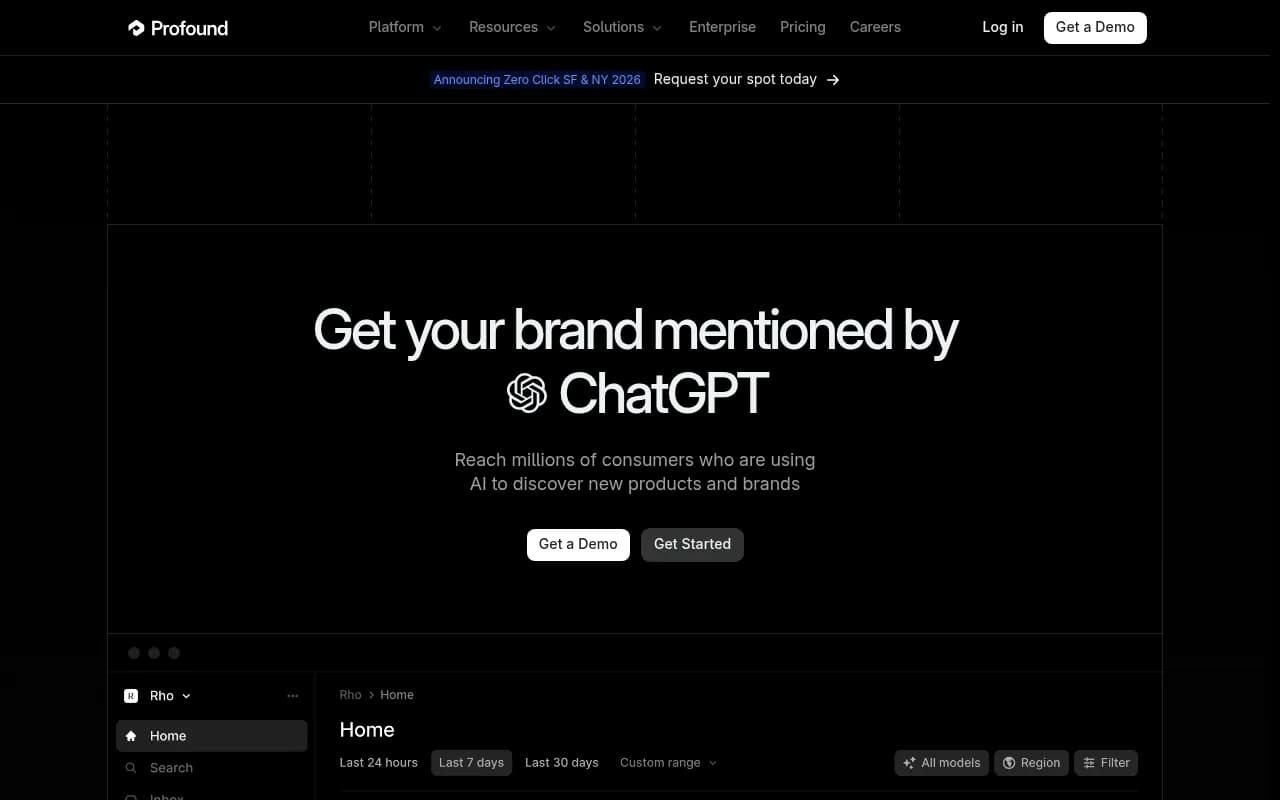
The platform tracks up to 10 AI models and has a strong citation analysis layer -- you can see which sources AI models are pulling from and why a competitor is being cited over your client. That "why" is genuinely useful for strategy.
Where it falls short for agencies: Profound is primarily a monitoring and research tool. There's no native content generation, and the pricing is on the higher end. It's a strong choice for enterprise-focused agencies doing deep competitive analysis, less so for agencies that need to ship content deliverables as part of their service.
3. Peec AI
Peec AI is a solid mid-market option with a few features that agencies specifically appreciate. Shareable reports and benchmarking-style views make client presentations cleaner, and the platform supports unlimited seats -- which matters when you have multiple account managers working across a client portfolio.

It tracks up to 10 AI models (with add-ons), supports multi-language monitoring, and has a flexible model selection that lets you prioritize the AI engines most relevant to each client's audience. Starting at EUR 85/mo, it's reasonably priced for what it offers.
The gap: like most tools in this space, Peec AI is monitoring-focused. You get good data on where clients stand, but the "what to do about it" is left to you.
4. Otterly.AI
Otterly.AI is the budget-friendly option that actually has agency-specific workflow features. It was named a Gartner Cool Vendor in 2025, which is a meaningful signal for agencies pitching AI visibility services to enterprise clients who want vendor credibility.

The agency-focused workspaces and dashboards are genuinely useful -- you can set up separate client environments and manage prompt libraries across accounts without too much friction. Starting at $29/mo, it's the lowest barrier to entry in this list.
The tradeoff is depth. Otterly.AI tracks 4 base AI models (with 2 add-ons), which is fewer than most competitors. For clients who care specifically about Perplexity or DeepSeek visibility, that's a real limitation. It's best suited for agencies just starting to offer AI visibility as a service and not yet ready to invest in a full-featured platform.
5. Scrunch AI
Scrunch AI is worth considering specifically for mid-to-large agency operations. It has a reputation for handling multi-client scale well, with features designed for teams managing multiple brands simultaneously rather than individual practitioners.
The platform focuses on AI search visibility monitoring with a clean interface that makes client reporting less painful than some alternatives. It's not the deepest tool in terms of content optimization, but it handles the operational side of multi-client management reasonably well.
6. SE Visible (by SE Ranking)
SE Visible is the AI visibility module built on top of SE Ranking's existing SEO platform. If your agency already uses SE Ranking for traditional SEO tracking, this is a natural extension -- you get multi-brand dashboards and unlimited seats without switching tools.
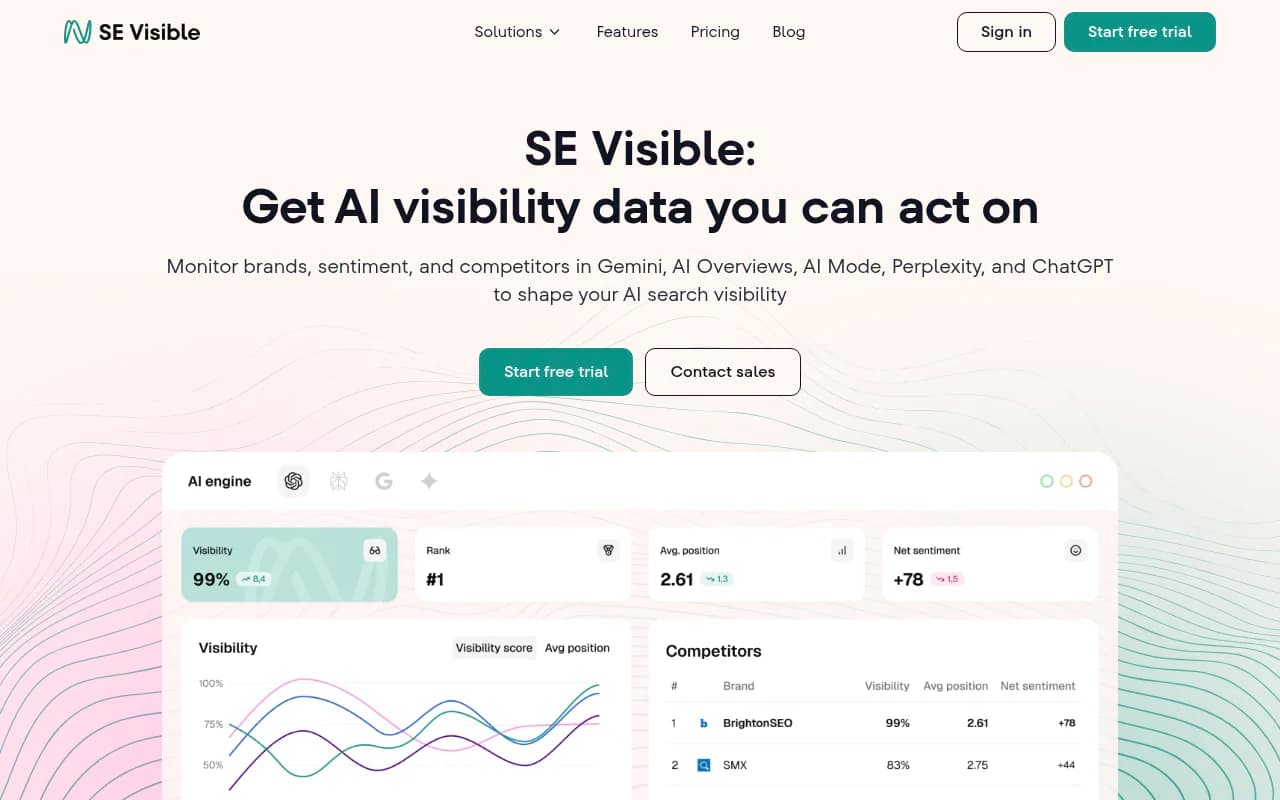
It tracks 5 AI models and starts at $99/mo ($79 annual). The main appeal is consolidation: one platform for SEO rank tracking and AI visibility, which simplifies reporting and reduces the number of tools in your stack. The depth of AI-specific features is shallower than dedicated GEO platforms, but for agencies that want a unified view without managing two separate subscriptions, it's a reasonable choice.
7. AthenaHQ
AthenaHQ tracks 8+ AI search engines and has a clean interface that's easy to hand off to clients for self-service viewing. It's monitoring-focused, which is both its strength (simple, fast to set up) and its limitation (no content optimization or gap analysis built in).
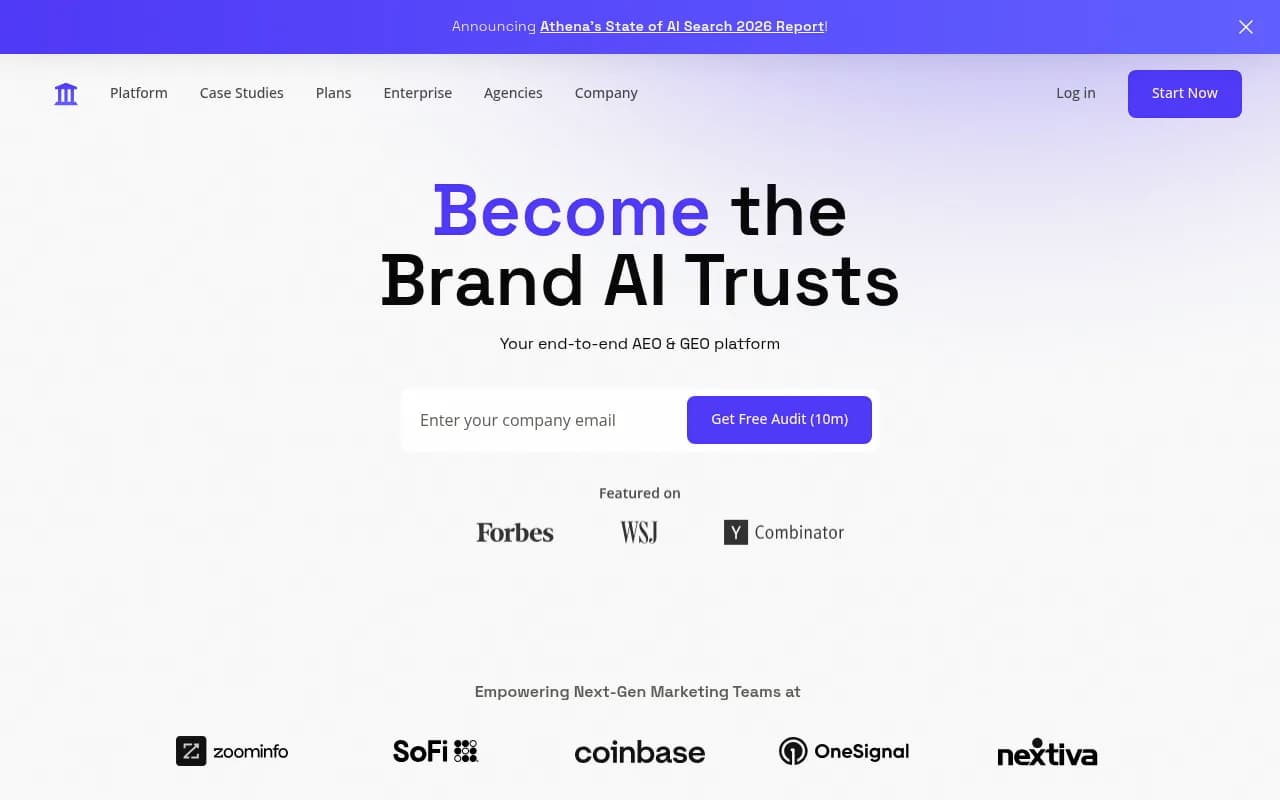
For agencies that want to offer AI visibility reporting as a lightweight add-on to existing SEO services -- without building a full GEO content workflow -- AthenaHQ is a reasonable fit. It's not the right tool if you're trying to build a differentiated AI optimization service.
8. Rankability
Rankability positions itself specifically for agencies and has a price-to-value profile that makes it worth evaluating. The platform focuses on AI search visibility analytics with reporting features designed for client-facing use.
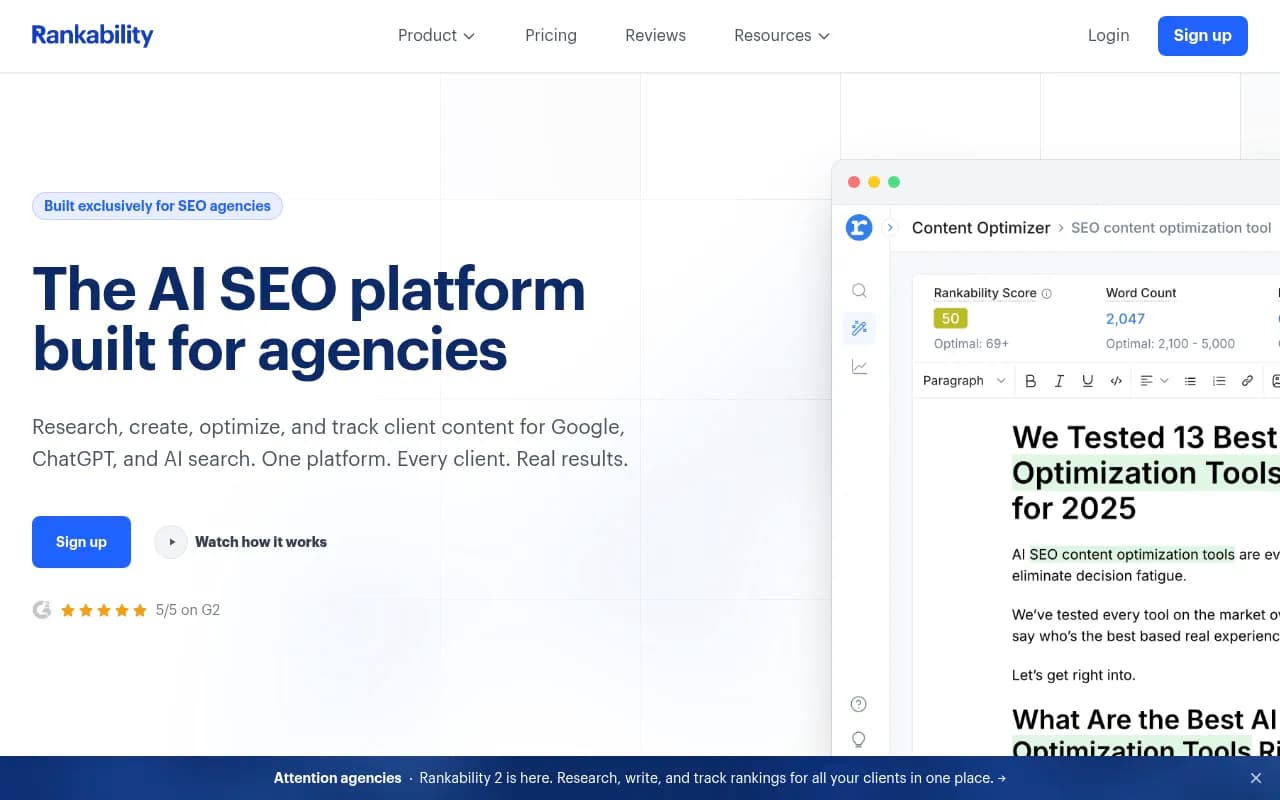
It's one of the few tools in this space that explicitly targets the agency market in its positioning, which means the feature set is more aligned with multi-client workflows than tools that retrofitted an "agency plan" onto a single-brand product.
9. Nightwatch
Nightwatch is primarily an SEO rank tracking tool that added AI search monitoring as an add-on. Starting at $32/mo for the base plan plus $99/mo for the AI add-on, it's a reasonable option for agencies that are already using Nightwatch for traditional SEO and want to layer in AI visibility without switching platforms.
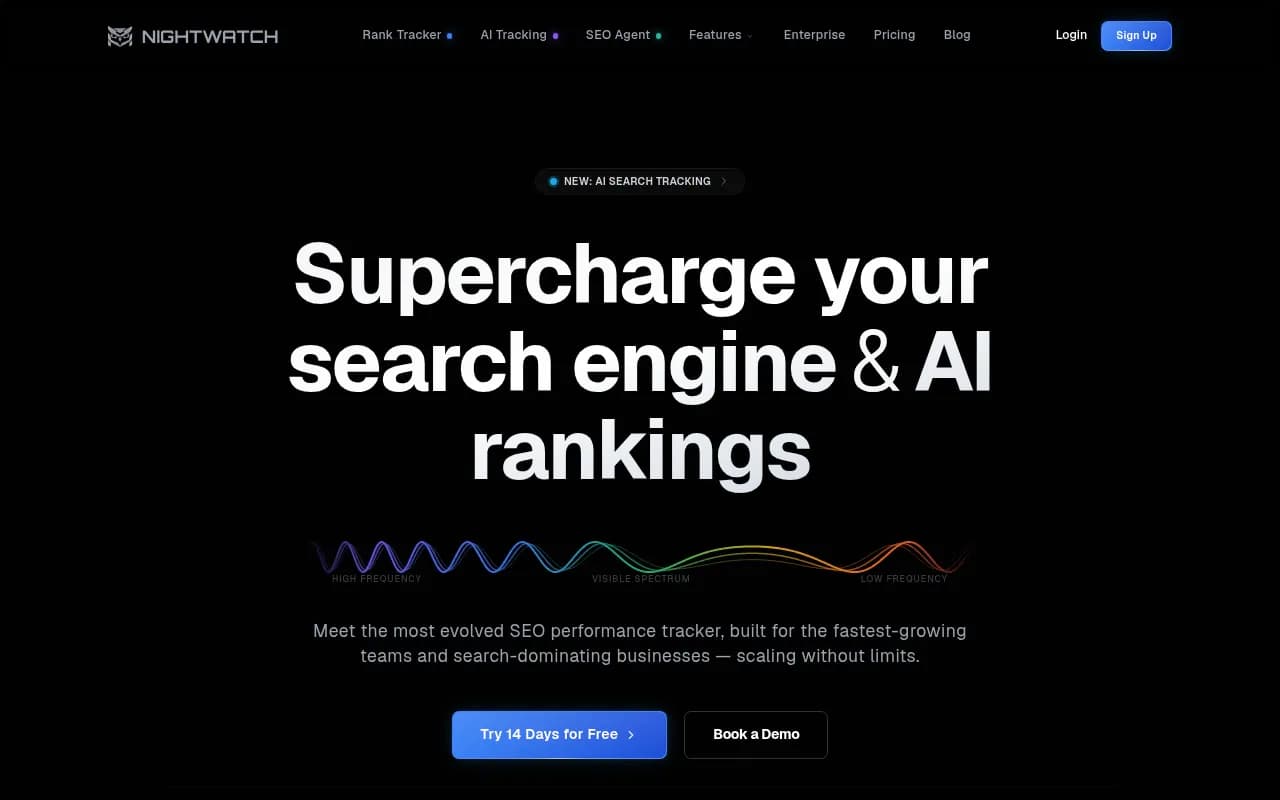
The AI monitoring covers 4 models, which is on the lower end. But if your agency's primary service is still traditional SEO and AI visibility is a secondary offering, the combined SEO + AI tracking in one subscription is a practical choice.
Head-to-head comparison
| Platform | AI models tracked | Multi-client workspaces | Content generation | Crawler logs | Starting price | Best for |
|---|---|---|---|---|---|---|
| Promptwatch | 10 | Yes (multi-site plans) | Yes (built-in AI writer) | Yes | $99/mo | Full-service GEO agencies |
| Profound | Up to 10 | Yes (agency mode) | No | No | $99/mo | Research-heavy enterprise agencies |
| Peec AI | Up to 10 | Yes (unlimited seats) | No | No | EUR 85/mo | Mid-market agencies, multi-language |
| Otterly.AI | 4 base + 2 add-ons | Yes (agency workspaces) | No | No | $29/mo | Agencies new to AI visibility |
| Scrunch AI | Varies | Yes | No | No | Custom | Mid-to-large agency operations |
| SE Visible | 5 | Yes (multi-brand) | No | No | $99/mo | Agencies already on SE Ranking |
| AthenaHQ | 8+ | Limited | No | No | Custom | Lightweight reporting add-on |
| Rankability | Varies | Yes | No | No | Custom | Agency-focused analytics |
| Nightwatch | 4 | Limited | No | No | $32/mo + $99 add-on | SEO-first agencies adding AI tracking |
How to choose
The honest answer is that most of these tools do the monitoring part adequately. The real differentiator is what happens after the monitoring.
If your agency's value proposition is "we track your AI visibility and report on it," most tools in this list will serve you fine. Otterly.AI at $29/mo is a reasonable starting point. Peec AI or Profound if you need more depth.
If your agency's value proposition is "we improve your AI visibility," you need a tool that helps you identify what's missing and create content to fix it. That's a much shorter list. Promptwatch is the only platform here that does all three: find the gaps, generate the content, and track the results back to traffic and revenue. For agencies trying to build a differentiated GEO service -- not just a monitoring dashboard -- that matters.
One practical note on pricing: always model out what a platform costs at your expected client volume before signing up. Per-prompt pricing can look cheap at 50 prompts and expensive at 500. Per-site pricing scales predictably. Know which model you're buying into.
What to watch in 2026
The AI visibility tool market is moving fast. A few things worth watching:
Reddit and YouTube tracking is becoming a real differentiator. AI models increasingly cite Reddit threads and YouTube videos in their responses, and most monitoring tools ignore these channels entirely. Platforms that surface this data give agencies a content placement strategy that goes beyond just optimizing their client's own website.
ChatGPT Shopping is an emerging channel. As ChatGPT's product recommendation features grow, tracking when a client's products appear in shopping carousels becomes a meaningful visibility metric -- especially for e-commerce clients.
Traffic attribution is still the missing link for most tools. Showing a client that their AI visibility score went up is good. Showing them that it drove 200 additional website visits and 15 leads is what justifies the retainer. Tools that connect visibility data to actual traffic (via GSC integration, server logs, or code snippets) will have a significant advantage in client retention.
The agencies that build a repeatable GEO workflow now -- gap analysis, content creation, tracking, attribution -- will be well positioned as AI search continues to take share from traditional search. The tools that support that full loop are the ones worth investing in.