Key takeaways
- Most AI visibility platforms stop at monitoring -- they show you data but leave you to figure out what to do with it. Only a handful close the loop with content optimization.
- Competitor benchmarking quality varies enormously: some tools give you a simple share-of-voice bar chart, others show you exactly which prompts competitors win that you don't.
- Promptwatch is the only platform in this comparison rated as a "Leader" across all evaluation categories, largely because it combines gap analysis, AI content generation, and tracking in one workflow.
- Pricing ranges from ~$49/mo for basic monitoring tools to $579/mo+ for full-stack platforms. Enterprise tiers from Profound and Scrunch AI can run significantly higher.
- If you're an agency or marketing team that needs to act on data -- not just report it -- the platform choice matters a lot more than it did a year ago.
The AI search visibility space has gotten crowded fast. Eighteen months ago, a handful of tools were doing this. Now there are 150+, and most of them look similar on a features page. The real differences show up when you try to answer a specific question: "My competitor is showing up in ChatGPT for this category of prompts and I'm not -- what do I do about it?"
Some platforms answer that question well. Most don't.
This guide focuses specifically on competitor benchmarking depth -- how well each platform lets you understand why a competitor is winning in AI search and what you can do about it. We've also factored in content optimization capabilities, because monitoring without action is just expensive anxiety.
Eight platforms made the cut. Here's how they stack up.
How we evaluated these platforms
Competitor benchmarking in AI visibility is more complex than traditional rank tracking. You're not just checking positions -- you're comparing citation rates, share of voice across multiple AI models, which specific prompts trigger competitor mentions, and what content is actually being cited. We evaluated each platform on:
- Depth of competitor comparison (prompt-level vs. aggregate only)
- Number of AI models tracked
- Whether the platform surfaces content gaps, not just visibility gaps
- Content optimization or generation capabilities
- Traffic attribution (can you connect AI visibility to actual revenue?)
- Pricing transparency and value
The 8 best AI visibility platforms for competitor benchmarking in 2026
1. Promptwatch
Promptwatch is the most complete platform in this comparison. What separates it from the field isn't the monitoring -- it's what happens after the monitoring.
The Answer Gap Analysis feature is where competitor benchmarking gets genuinely useful. Instead of showing you a generic share-of-voice score, it shows you the specific prompts your competitors appear for that you don't. You can see the exact questions, the competitor that's winning them, and what content gap on your site is causing the miss. That's a fundamentally different kind of intelligence than "your competitor has 34% share of voice."
From there, Promptwatch's built-in AI writing agent generates content -- articles, listicles, comparisons -- grounded in citation data from 880M+ analyzed citations. This isn't generic content; it's built around the specific prompts and angles that AI models are actually citing. The loop closes when you track which pages start getting cited after publishing, and connect that to traffic via a code snippet, GSC integration, or server log analysis.
Other things worth knowing: Promptwatch tracks 10 AI models (ChatGPT, Perplexity, Claude, Gemini, Grok, DeepSeek, Copilot, Meta AI, Google AI Overviews, Google AI Mode), has real-time AI crawler logs showing which pages each AI bot is reading, and includes Reddit and YouTube source tracking -- a channel most competitors ignore entirely. ChatGPT Shopping tracking is also included, which matters if you're in e-commerce.
In a 2026 comparison of 12 GEO platforms, Promptwatch was the only tool rated as a "Leader" across all categories. After personally testing 15+ AI visibility solutions, the team at Generate More named it their top overall pick for B2B SaaS companies needing daily tracking and attribution.
Pricing: Essential $99/mo (1 site, 50 prompts, 5 articles), Professional $249/mo (2 sites, 150 prompts, 15 articles, crawler logs), Business $579/mo (5 sites, 350 prompts, 30 articles). Free trial available.

2. Profound
Profound is the strongest enterprise option in this list. It's built for large organizations with complex brand monitoring needs across multiple product lines, regions, and stakeholders. The platform covers major AI models and gives solid share-of-voice comparisons against competitors.
Where Profound earns its enterprise reputation: the data quality is high, the reporting is polished, and it handles multi-brand setups well. Where it falls short relative to Promptwatch: it's primarily a monitoring and reporting tool. There's no content generation capability, no answer gap analysis that tells you which specific content to create, and no AI crawler logs. You get excellent data on where you stand; you're largely on your own figuring out how to improve.
Pricing is on the higher end and typically requires a sales conversation for enterprise tiers.

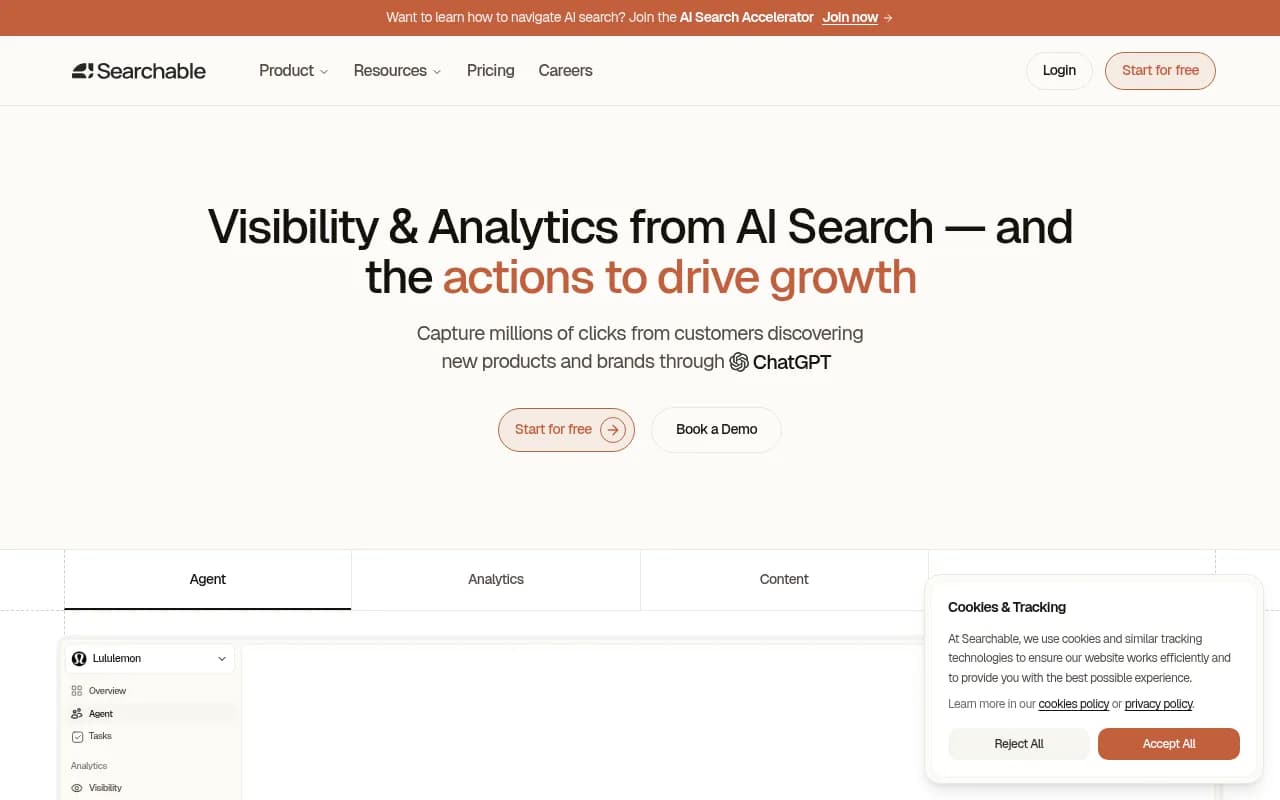
3. Searchable
Searchable sits in an interesting middle position -- it has both monitoring and some content optimization features, making it more action-oriented than pure monitoring tools. The competitor benchmarking gives you visibility comparisons across AI models, and the platform has been building out its content recommendation capabilities.
It's a reasonable choice for mid-market teams that want more than a dashboard but aren't ready to commit to a full-stack platform. The main limitation is depth: the content optimization features aren't as developed as Promptwatch's, and the citation data pool is smaller.
4. Scrunch AI
Scrunch AI is well-regarded for multi-engine citation monitoring with strong prompt-level insights. Agencies and enterprises use it for detailed breakdowns of which sources AI models are citing and how that changes over time. The competitor benchmarking is solid -- you can compare citation rates across models and see where competitors are pulling ahead.
The gap is on the action side. Scrunch AI doesn't have content generation built in, and there's no equivalent to Promptwatch's Answer Gap Analysis. You get good data on what's happening; the "what to do about it" is still a manual exercise. Pricing is also higher than most mid-market tools, which makes it harder to justify for smaller teams.
5. AthenaHQ
AthenaHQ tracks 8+ AI search engines and gives clean, well-organized visibility data. The competitor comparison features are functional -- you can see share-of-voice breakdowns and track how your position changes over time relative to named competitors.
The honest assessment: AthenaHQ is monitoring-focused. It doesn't have content optimization, content generation, or AI crawler logs. For teams that just need clean reporting and don't need the platform to help them act on the data, it's a solid option. For teams that want to close the loop between insight and improvement, it's a starting point, not a complete solution.

6. Otterly.AI
Otterly.AI is one of the more affordable options in this space, which makes it popular with smaller teams and early-stage companies dipping their toes into AI visibility tracking. The interface is clean, setup is fast, and you can get basic competitor comparisons running quickly.
The trade-off is depth. Otterly.AI is a monitoring tool -- no content generation, no crawler logs, no traffic attribution, no answer gap analysis. For the price point, that's fair. But if you're trying to understand why a competitor is winning specific prompts and what to do about it, you'll hit the ceiling quickly.

7. Peec AI
Peec AI has a strong multi-language and multi-region focus, which makes it genuinely useful for brands operating across markets. The competitor benchmarking covers major AI models and gives you share-of-voice comparisons with reasonable granularity.
Like Otterly.AI, Peec AI is primarily a monitoring platform. There's no content generation, no answer gap analysis, and no AI crawler logs. It's a good fit for international brands that need regional visibility data and don't need the platform to help them create content. For everything else, the feature set is limited compared to the top tier.

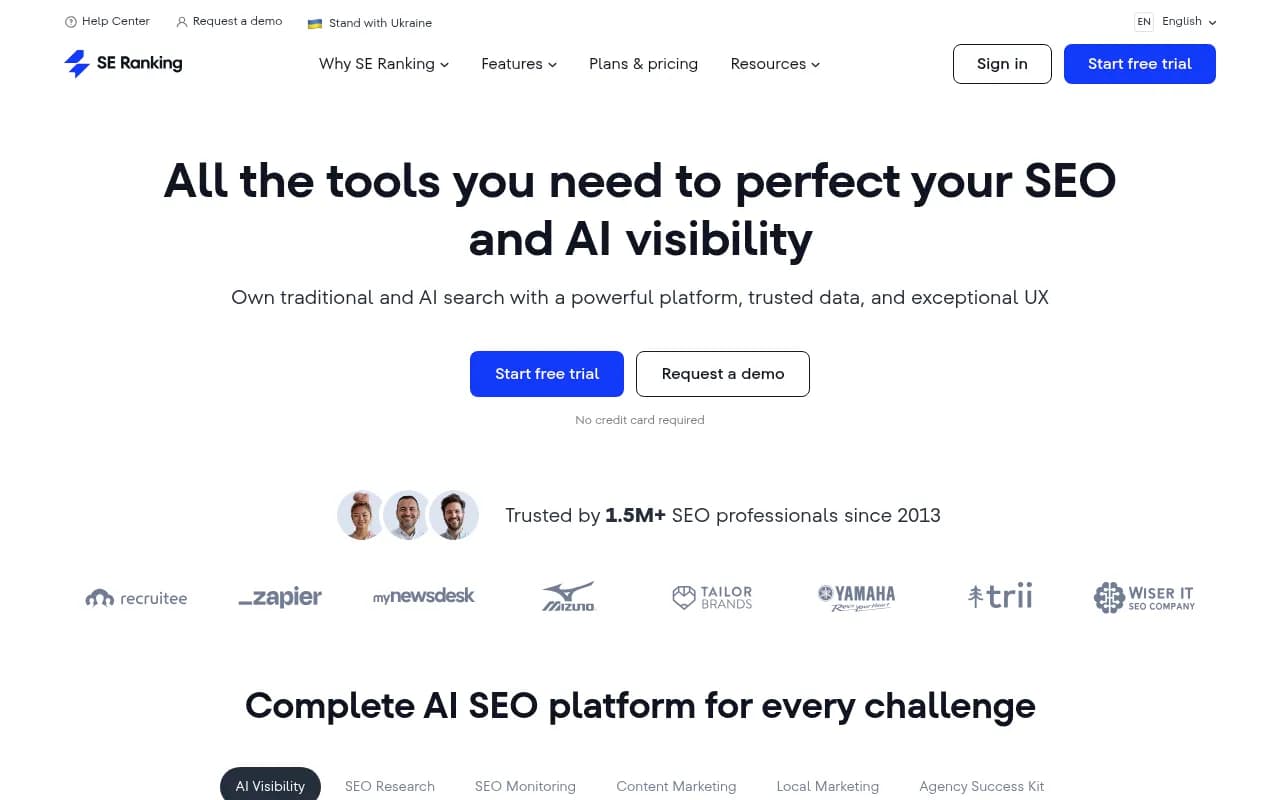
8. SE Ranking AI Visibility Tracker
SE Ranking's AI visibility tracker is worth including because it's the best option for teams already using SE Ranking for traditional SEO. Adding AI visibility tracking to an existing SEO workflow without buying a separate platform is genuinely convenient, and the competitor benchmarking features are more capable than you'd expect from a bundled add-on.
The limitation is that it's an add-on, not a purpose-built AI visibility platform. The depth of competitor analysis, the number of AI models tracked, and the content optimization capabilities all lag behind dedicated platforms. But if budget is tight and you're already in the SE Ranking ecosystem, it's a practical starting point.
Side-by-side comparison
| Platform | AI models tracked | Competitor benchmarking depth | Content gap analysis | AI content generation | Crawler logs | Traffic attribution | Starting price |
|---|---|---|---|---|---|---|---|
| Promptwatch | 10 | Prompt-level gap analysis | Yes | Yes | Yes | Yes | $99/mo |
| Profound | 6+ | Share of voice + citations | No | No | No | Limited | Custom |
| Searchable | 5+ | Share of voice | Partial | Partial | No | No | Custom |
| Scrunch AI | 6+ | Citation + prompt-level | No | No | No | No | Custom |
| AthenaHQ | 8+ | Share of voice | No | No | No | No | Custom |
| Otterly.AI | 5 | Basic share of voice | No | No | No | No | ~$49/mo |
| Peec AI | 5+ | Share of voice (multi-region) | No | No | No | No | ~$49/mo |
| SE Ranking AI Tracker | 4+ | Basic competitor comparison | No | No | No | No | Bundled |
What "competitor benchmarking" actually means in AI search
It's worth being specific about this, because the term gets used loosely.
At the basic level, competitor benchmarking in AI visibility means: "What percentage of AI responses mention my brand vs. my competitors?" That's share of voice, and almost every tool in this list does it.
The more useful level is prompt-level benchmarking: "For this specific question -- 'What's the best project management tool for remote teams?' -- which competitors appear in ChatGPT's response and which don't? And why?" This requires the platform to run real queries, analyze the actual AI responses, and map citations back to specific content.
The most useful level -- and this is where most platforms stop short -- is gap analysis: "Here are 47 prompts your top competitor appears for that you don't. Here's the content they have that you're missing. Here's what you should create." That's the difference between a reporting tool and an optimization platform.
Only Promptwatch does all three levels in a single workflow. Scrunch AI and Profound get close on the second level. Most others are doing share-of-voice math and calling it benchmarking.
Which platform should you choose?
The right answer depends on what you actually need to do with the data.
If you need to act on the data -- create content, fix gaps, improve AI visibility over time -- Promptwatch is the clear choice. The combination of Answer Gap Analysis, AI content generation grounded in citation data, and traffic attribution is genuinely unique. No other platform in this list closes the full loop from "here's where you're invisible" to "here's the content that will fix it" to "here's the traffic you gained."
If you're an enterprise with complex multi-brand reporting needs and a separate content team that can act on the insights, Profound is worth evaluating. The data quality is high and the reporting is polished.
If you're on a tight budget and just need basic visibility monitoring to start building a picture of where you stand, Otterly.AI or Peec AI are reasonable starting points. Just know you'll outgrow them.
If you're already in the SE Ranking ecosystem and want to add AI visibility without a new vendor relationship, the SE Ranking tracker is a practical bridge.
The one thing I'd push back on: the temptation to buy a monitoring-only tool because it's cheaper and "we just need the data first." In practice, data without a clear path to action tends to sit in dashboards. The platforms that force you to connect monitoring to content creation are the ones that actually move the needle.
The broader picture
AI search visibility is no longer optional for brands that care about organic discovery. According to data from WebFX, AI-referred visitors convert at 1.2x the rate of traditional organic traffic -- and Generate More's research puts that figure even higher for B2B companies. The brands building AI visibility now are securing citations before competitors catch up.
The good news is that the tooling has matured significantly. A year ago, most platforms were barely past the "we can tell you if you're mentioned" stage. Now the best ones are running the full optimization loop: find gaps, create content, track results, repeat.
The bad news is that the market is noisy and the feature claims are hard to verify without testing. The comparison table above is a starting point, but the best way to evaluate any of these platforms is to run a free trial with your actual brand, your actual competitors, and your actual target prompts. The differences become obvious fast.