Key takeaways
- Most AI visibility tools were built for single brands, not agencies -- multi-client workspace architecture and white-label reporting are the features that separate agency-ready platforms from everything else.
- White-label depth varies wildly: some tools offer basic PDF exports with a logo swap; others give you custom domains, branded live dashboards, and automated scheduled delivery.
- The platforms that go beyond monitoring (gap analysis, content generation, crawler logs) give agencies a way to show clients not just where they're invisible, but what to do about it.
- Pricing models matter as much as features -- per-project pricing punishes growth, while flat-tier models with generous prompt and site limits are more agency-friendly.
- Promptwatch is the only platform in this comparison rated as a "Leader" across all evaluation categories, and it's the one most agencies are using to build end-to-end AI visibility retainers.
Why white-label reporting is now a baseline requirement
A year ago, most agencies were still explaining to clients what AI search visibility even meant. Now it's a line item in proposals. Clients are asking "are we showing up in ChatGPT?" the same way they used to ask about page-one rankings.
That shift creates a real operational problem. You can't manually check ChatGPT, Perplexity, Gemini, and Claude for 30 clients every week. You need tooling that handles the tracking, surfaces the insights, and packages everything into a report that looks like it came from your agency -- not from some third-party SaaS platform with its own branding plastered across every page.
White-label reporting used to be a nice-to-have. In 2026, it's table stakes. The question is how deep the customization actually goes.
What "white-label" actually means (and what it doesn't)
The term gets thrown around loosely, so let's be specific. There are roughly four levels of white-label capability you'll encounter across these platforms:
- Level 1 -- Logo swap on exports: You can add your agency logo to a PDF export. That's it. The report still uses the tool's default layout, color scheme, and terminology.
- Level 2 -- Branded PDF reports with scheduling: Custom logo, colors, and agency name on scheduled PDF reports. Automated delivery to client email addresses. Most "white-label" tools sit here.
- Level 3 -- Branded live dashboards: Clients can view a live dashboard at a custom URL (or subdomain) that carries your branding. No mention of the underlying tool.
- Level 4 -- Full white-label platform: Custom domain, your agency's branding throughout the interface, client-facing login portals, and sometimes reseller pricing. This is rare in the AI visibility space specifically.
Most agencies need Level 2 at minimum and Level 3 for higher-value retainers. Level 4 is mainly relevant if you're building a productized service or reselling under your own brand.
The eight criteria that actually matter for agency use
Before getting into specific tools, here's the evaluation framework. These are the questions worth asking about any platform you're considering:
- Can you manage all clients from one login, or do you need separate accounts?
- How many AI models does it monitor? (ChatGPT, Perplexity, Gemini, Claude, Copilot, Grok, DeepSeek, and Google AI Overviews are the current baseline)
- What does white-label actually mean on this platform -- logo swap or full branded portal?
- Does it track competitor visibility alongside your client's brand?
- Can it generate content or content briefs, or does it just show you data?
- Does it have crawler logs or any way to see how AI agents interact with your client's site?
- How does pricing scale across clients -- per seat, per project, or flat tiers?
- Is there an agency partner program with co-marketing or referral benefits?
The top platforms ranked by white-label and agency readiness
Promptwatch -- best overall for agencies building AI visibility retainers
Promptwatch is the platform most serious agencies are gravitating toward in 2026, and the reason is straightforward: it's the only tool in this space that covers the full loop from gap identification to content creation to result tracking. Most competitors stop at monitoring. Promptwatch doesn't.

For agencies specifically, the multi-client architecture is solid. You can manage multiple brands from one workspace, track each client's AI visibility across 10 models (ChatGPT, Perplexity, Google AI Overviews, Google AI Mode, Claude, Gemini, Meta/Llama, DeepSeek, Grok, and Copilot), and export branded reports. The Looker Studio integration is particularly useful for agencies that already have a reporting stack -- you can pull Promptwatch data into custom dashboards that carry your agency's branding end-to-end.
What sets it apart from every other tool on this list is the action loop. Answer Gap Analysis shows exactly which prompts competitors are visible for but your client isn't. Content Agents then generate articles, listicles, and comparison pieces grounded in that gap data. Agent Analytics tracks when AI crawlers visit the new content and when it starts getting cited. That's a complete retainer workflow, not just a monitoring dashboard.
The AI Crawler Logs feature is something most competitors don't have at all -- real-time logs showing which AI crawlers (ChatGPT, Claude, Perplexity) are hitting your client's site, which pages they're reading, and what errors they're encountering. For agencies trying to explain to clients why they're not being cited, this is the kind of evidence that makes the conversation easy.
Pricing runs from $99/month (Essential, 1 site, 50 prompts) to $579/month (Business, 5 sites, 350 prompts, 30 articles). Agency and enterprise pricing is available on request, which is where the white-label and multi-client features get more flexible.
SE Ranking -- best for agencies that want white-label inside a full SEO platform
SE Ranking has been an agency favorite for traditional SEO reporting for years, and its AI visibility features have matured enough in 2026 to be worth considering for clients who need both.
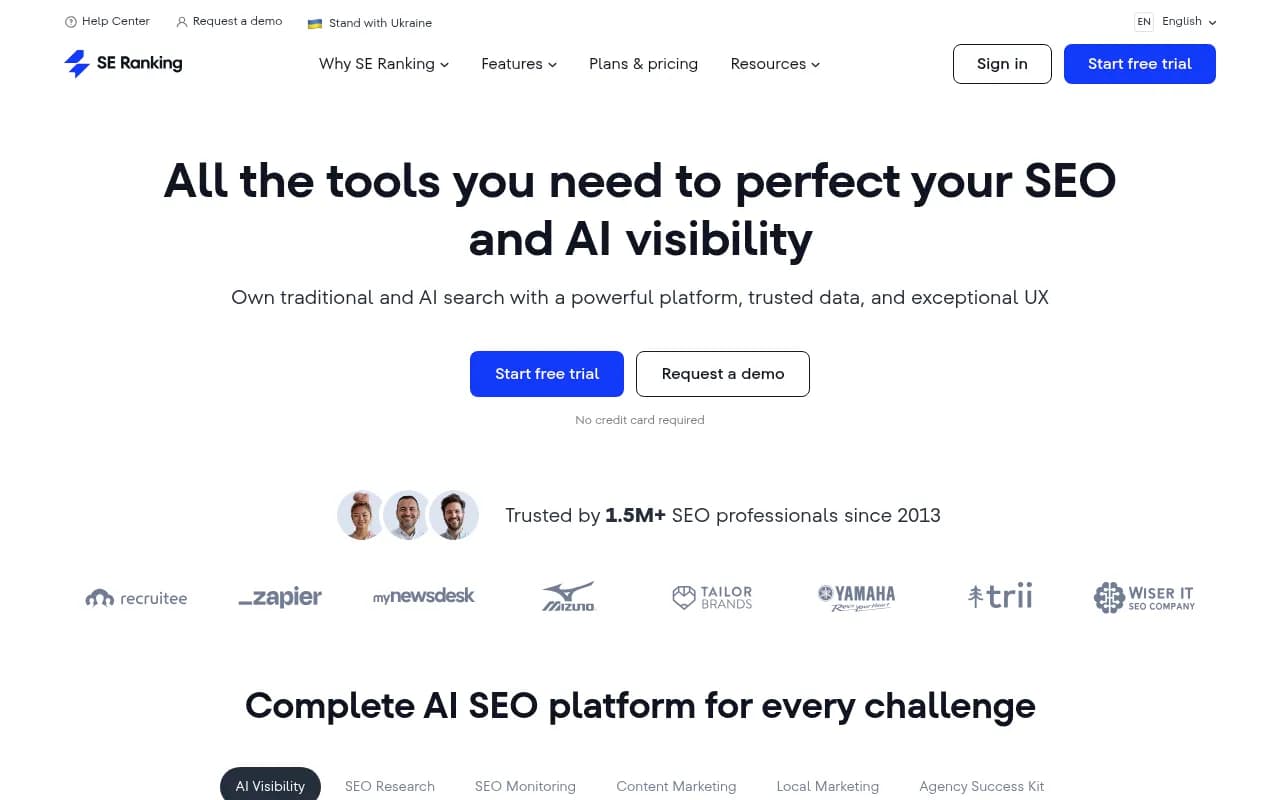
The white-label capabilities here are genuinely strong -- custom domain, branded client portals, logo and color customization, and automated scheduled reports. If you're already using SE Ranking for rank tracking and audits, adding AI visibility monitoring to the same white-label setup is a natural extension.
The limitation is depth. SE Ranking's AI visibility tracking covers the major models but doesn't go as deep on prompt intelligence, crawler logs, or content generation as a dedicated GEO platform. It's a good fit for agencies where AI visibility is one service line among many, not the core offering.
Starting price is around $129/month, with agency plans available.
Semrush -- best for agencies already in the Semrush ecosystem
Semrush added an AI Visibility Toolkit as a $99/month add-on to existing plans. If you're already paying for Semrush and managing client reporting through its My Reports builder, this is the path of least resistance.
The white-label reporting in Semrush is mature -- branded PDF reports, scheduled delivery, client portals. The AI visibility add-on plugs into that existing infrastructure reasonably well.
The honest limitation: Semrush uses fixed prompts for AI tracking rather than dynamic prompt intelligence, and there's no AI traffic attribution connecting visibility to actual revenue. For clients who want to know whether their AI visibility is driving business outcomes, that gap is noticeable.
Profound -- strong monitoring with enterprise-grade reporting
Profound has a solid feature set for AI visibility monitoring and is used by larger brands and agencies managing enterprise clients.

The reporting capabilities are polished, and the competitive intelligence depth is good. The tradeoff is price -- Profound sits at a higher price point than most of the other tools here, and it doesn't have Reddit tracking or ChatGPT Shopping monitoring. For agencies with enterprise clients who are primarily focused on brand visibility in the main AI models, it's a credible option.
Otterly.AI -- best entry-level option for smaller agencies
Otterly.AI is the most accessible starting point for agencies just beginning to offer AI visibility services. The monitoring is solid for the price, and the interface is clean enough to show clients without embarrassment.

The white-label story here is limited -- you're mostly working with exports rather than branded live dashboards. There are no crawler logs, no content generation, and no visitor analytics. But if you're running a small agency and need to add AI visibility monitoring to your service offering without a significant tool investment, Otterly.AI gets you started.
Rankability -- agency-focused with good multi-client structure
Rankability is worth a look specifically because it was designed with agencies in mind from the start, rather than being a single-brand tool that added multi-client features later.
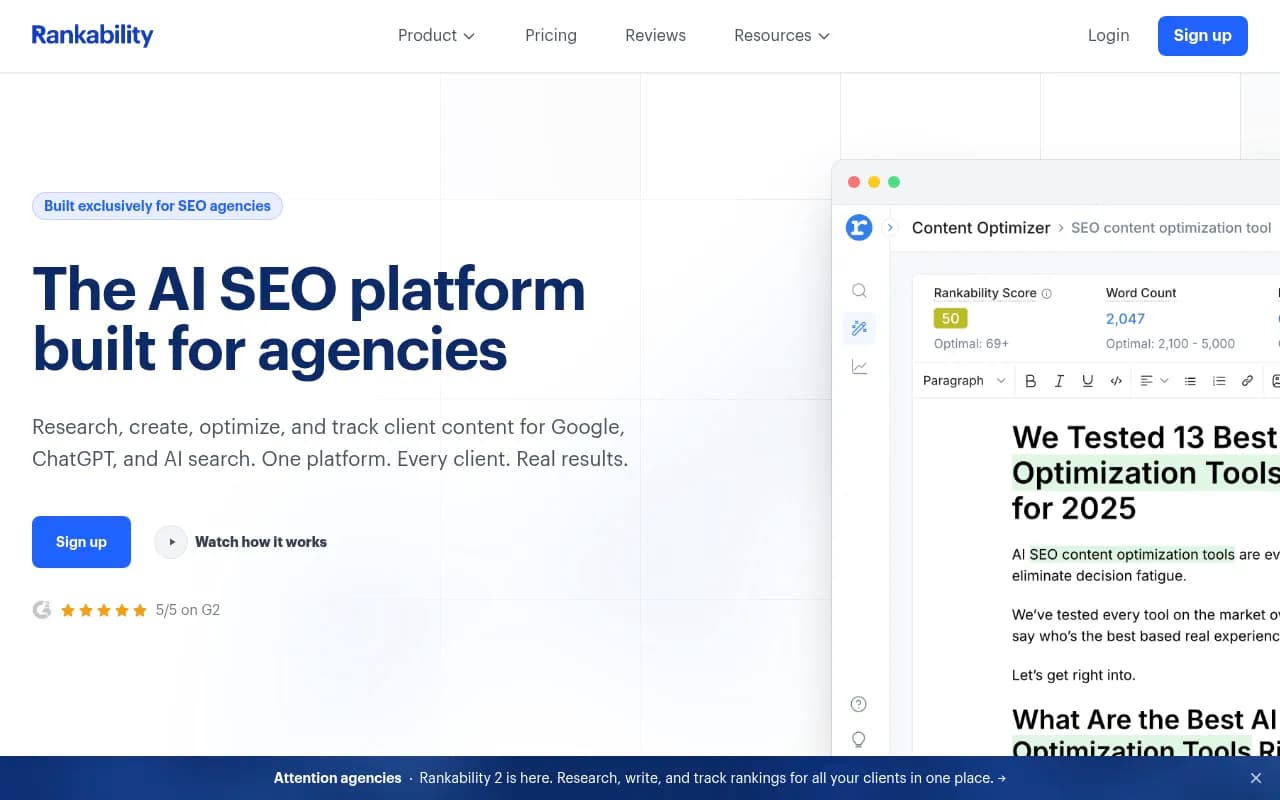
The workspace architecture handles multiple clients cleanly, and the reporting is designed to be client-presentable. It's not the deepest platform on this list in terms of AI model coverage or content generation, but the agency workflow is thoughtfully built.
Conductor -- good for persona-based tracking at scale
Conductor has been in the enterprise SEO space for a long time and has added AI visibility tracking with persona customization -- meaning you can track how AI responses differ based on user type, geography, or intent.
For agencies managing clients with complex audience segmentation (B2B clients with multiple buyer personas, for example), that persona layer is genuinely useful. The reporting is enterprise-grade. The price reflects that.
Cairrot -- built specifically for marketing agencies
Cairrot is one of the few platforms that explicitly positions itself as built for marketing agencies rather than individual brands. Worth evaluating if agency-specific workflow features are your top priority.
Comparison table: agency readiness and white-label depth
| Platform | White-label level | Multi-client workspace | AI models covered | Content generation | Crawler logs | Starting price |
|---|---|---|---|---|---|---|
| Promptwatch | Level 2-3 (Looker Studio, branded exports) | Yes | 10 | Yes (Content Agents) | Yes | $99/mo |
| SE Ranking | Level 3 (custom domain, client portal) | Yes | 4-5 | No | No | $129/mo |
| Semrush | Level 2 (branded PDF reports) | Yes | 4-5 (add-on) | No | No | $139.95/mo + $99 add-on |
| Profound | Level 2 | Yes | 6+ | No | No | Higher tier |
| Otterly.AI | Level 1-2 | Limited | 5-6 | No | No | Lower tier |
| Rankability | Level 2 | Yes | 5-6 | No | No | Mid-tier |
| Conductor | Level 2-3 | Yes | 5+ | No | No | Enterprise |
| Cairrot | Level 2 | Yes | 4-5 | No | No | Agency-focused |
What the research actually shows about agency tool selection

One pattern that comes up consistently in agency evaluations: the tools that win long-term client relationships are the ones that can show a clear line from visibility gap to content action to measurable improvement. A dashboard that shows "your brand was mentioned in 12% of relevant AI responses this month" is interesting. A platform that shows "here are the 8 prompts your competitors are winning that you're not, here's the content we generated to close those gaps, and here's the timeline from publish to first AI citation" is a retainer-justifying deliverable.
That's the distinction that matters most when you're pitching AI visibility services to a new client or defending the retainer to an existing one.

The WorkDuo research cited above found that 77% of agencies pull data from five different tools just to prepare for a single reporting meeting. The agencies getting the most out of AI visibility services are the ones who've consolidated that into one platform rather than stitching together monitoring tools, content tools, and reporting tools separately.
How to evaluate white-label depth before you commit
A few practical things to check during any trial period:
- Ask specifically: "Can my client log in and see their data without seeing your brand name?" If the answer involves a workaround, that's a Level 1 or Level 2 tool pretending to be Level 3.
- Check whether scheduled reports go out from your domain or the tool's domain. Client-facing emails from a third-party tool domain are a small thing that erodes perceived agency value over time.
- Test the Looker Studio or API integration if you have a custom reporting stack. Some tools advertise integrations that are technically functional but practically limited.
- Ask about agency pricing before you scale. A tool that's $99/month for one client can become $990/month for ten clients if the pricing model is purely per-project. Flat-tier models with generous limits are almost always better for agencies at scale.
Building an AI visibility retainer that actually holds
The agencies doing this well in 2026 have structured their AI visibility retainers around three deliverables:
- A monthly visibility report showing share of voice across the major AI models, competitive benchmarking, and trend data. This is the "here's where you stand" layer.
- A gap analysis and content plan showing which prompts competitors are winning and what content needs to be created to close those gaps. This is the "here's what we're doing about it" layer.
- A results review showing how new content has been crawled, cited, and whether AI visibility is connecting to traffic and revenue. This is the "here's what it's worth" layer.
Most monitoring-only tools can support layer one. Very few can support all three. Platforms like Promptwatch that combine monitoring, gap analysis, content generation, and crawler logs are the ones that make all three layers possible without stitching together separate tools.
The agencies that will win the AI visibility category over the next 12-18 months are the ones who can deliver that full loop -- not just the report, but the strategy and the results. The tool you choose determines whether that's operationally feasible or a manual nightmare.