Key Takeaways
- Promptwatch is the top alternative if you need more than monitoring—it finds content gaps, generates optimized articles, and tracks crawler logs that Writesonic doesn't offer
- Otterly.AI and Peec AI are cheaper options ($29-89/mo) but only monitor—no content creation or optimization features
- AthenaHQ offers strong tracking and competitor analysis but lacks the content generation tools that make Promptwatch and Writesonic actionable
- Scalenut and Frase combine SEO and GEO in one platform, making them good picks if you want traditional search optimization alongside AI visibility
- Surfer SEO and Jasper are primarily SEO/content tools that added AI tracking as a secondary feature—not purpose-built for GEO
Writesonic entered the AI visibility space as a content generation tool that added monitoring features. That's the opposite approach from most competitors, which started as trackers and bolted on content tools later. The result: Writesonic's monitoring is decent but not as deep as dedicated platforms, and its content generation is strong but not optimized specifically for AI citations. If you're hitting those limitations, here's what else is out there.
Promptwatch

Promptwatch is the market-leading AI visibility platform used by 6,700+ brands including Booking.com and Center Parcs. Unlike Writesonic's monitoring-first approach, Promptwatch is built around an action loop: find gaps, create content, track results.
The core difference is Answer Gap Analysis. Writesonic shows you where you're mentioned. Promptwatch shows you where competitors are mentioned but you're not—then tells you exactly what content you're missing. It analyzes 880M+ citations to identify the specific topics, angles, and questions AI models want answers to but can't find on your site. Then the built-in AI writing agent generates articles engineered to get cited by ChatGPT, Claude, and Perplexity.
Writesonic doesn't have crawler logs. Promptwatch does—real-time logs of ChatGPT, Claude, and Perplexity crawlers hitting your site, which pages they read, errors they encounter, how often they return. You can see exactly how AI engines discover your content and fix indexing issues before they hurt visibility.
Other capabilities Writesonic lacks: prompt volume estimates and difficulty scores (prioritize high-value prompts instead of guessing), Reddit and YouTube insights (surface discussions that influence AI recommendations), ChatGPT Shopping tracking (monitor product recommendation carousels), and traffic attribution via code snippet, GSC integration, or server log analysis.
Writesonic monitors 10+ AI models. Promptwatch monitors the same 10 (ChatGPT, Perplexity, Google AI Overviews, Google AI Mode, Claude, Gemini, Meta/Llama, DeepSeek, Grok, Mistral, Copilot) with deeper tracking—multi-language, multi-region, customizable personas, competitor heatmaps, Looker Studio integration, and API access.
Pricing: Writesonic starts at $39/mo (Lite) but limits you to basic tracking. Promptwatch Essential is $99/mo (1 site, 50 prompts, 5 AI articles). Professional is $249/mo (2 sites, 150 prompts, 15 articles, crawler logs, state/city tracking). Business is $579/mo (5 sites, 350 prompts, 30 articles). Both offer free trials, but Promptwatch's trial includes the full feature set.
Best for: Teams that want to optimize, not just monitor. If you're tired of dashboards that show problems but don't help you fix them, Promptwatch is the answer. It's the only platform rated as a "Leader" across all categories in a 2026 comparison of 12 GEO tools.
AthenaHQ

AthenaHQ is a Y Combinator-backed GEO platform used by ZoomInfo, Coinbase, and SoFi. It tracks 8+ AI models (ChatGPT, Perplexity, Google AI Overviews, Claude, Gemini, Copilot, AI Mode, and others) with metrics for visibility, position, and sentiment.
The interface is clean and the competitor benchmarking is solid—you can see exactly where rivals are winning and compare your share of voice across models. AthenaHQ also offers multi-language tracking and custom prompt sets, which Writesonic supports but doesn't emphasize as heavily.
What's missing: content generation and optimization tools. AthenaHQ shows you the data but doesn't help you create content that ranks in AI search. Writesonic at least has an AI writer (even if it's not GEO-specific). AthenaHQ has nothing. You're on your own to figure out what to write and how to structure it for citations.
No crawler logs either. You can't see which AI models are actually visiting your site or diagnose indexing issues. And no traffic attribution—you can track visibility but not connect it to revenue.
Pricing is higher than Writesonic: $295/mo self-serve or $95/mo annual. No free trial, just a 10-minute audit call. Enterprise pricing is custom.
Best for: Brands that already have a content engine and just need monitoring and competitor intelligence. If you're a larger team with dedicated writers and don't need AI-generated content, AthenaHQ's tracking is comprehensive. But if you want help creating content that actually gets cited, look elsewhere.
Otterly.AI

Otterly.AI is the budget option. It tracks ChatGPT, Perplexity, Google AI Overviews, Google AI Mode, Gemini, and Copilot with basic brand mention and citation monitoring. The interface is simple—no learning curve, just add your prompts and see where you show up.
Pricing starts at $29/mo (Lite: 15 prompts), $189/mo (Standard: 100 prompts), or custom for unlimited. That's significantly cheaper than Writesonic's $39/mo, which only includes 10 prompts on the Lite plan. Otterly also offers a 14-day free trial.
The trade-off: Otterly is monitoring-only. No content generation, no optimization suggestions, no crawler logs, no traffic attribution. It has a "GEO Audit" feature that analyzes 25+ on-page factors, but it's surface-level—more of a checklist than actionable recommendations. Writesonic's content tools are miles ahead.
Otterly also lacks prompt intelligence. You can't see search volumes, difficulty scores, or query fan-outs. You're guessing which prompts matter. And no Reddit or YouTube tracking—you miss the UGC discussions that influence AI recommendations.
Best for: Small businesses or solopreneurs who just want to know if they're being mentioned in AI search and don't need advanced features. If your budget is tight and you're comfortable creating content on your own, Otterly gets you basic visibility data without breaking the bank.
Peec AI

Peec AI is similar to Otterly but with better multi-language support and a slightly more polished interface. It tracks ChatGPT, Perplexity, Claude, Gemini, and Google AI Overviews with visibility, position, and sentiment metrics.
The standout feature is multi-language and multi-region tracking. Peec makes it easy to monitor how your brand appears in different countries and languages—something Writesonic supports but doesn't make as intuitive. If you're a global brand, Peec's interface for managing localized prompts is cleaner.
Pricing: Freemium model with a free trial, then €89/mo (Starter), €199/mo (Professional), or custom Enterprise. That's roughly $95-215/mo depending on exchange rates—cheaper than Writesonic's higher tiers but more expensive than Otterly.
Like Otterly, Peec is monitoring-focused. No content generation, no crawler logs, no traffic attribution. It has "smart suggestions" for improving visibility, but they're generic—not tailored to your specific content gaps. Writesonic's AI writer is more useful if you actually want to create content.
Best for: International brands that need multi-language AI visibility tracking without paying for a full-stack platform. If you're already creating content in-house and just need to monitor how it performs across regions, Peec is a solid mid-tier option.
Scalenut

Scalenut started as an SEO content platform and added GEO tracking as a separate module. You can buy the SEO Suite ($59/mo) or add GEO Tracking ($30/mo for 10 prompts) on top. That's cheaper than Writesonic if you only need basic AI monitoring, but the features are split across two products.
The SEO tools are strong—keyword research, content briefs, NLP optimization, competitor analysis. If you're doing traditional SEO alongside GEO, Scalenut gives you both in one platform. Writesonic is GEO-first with weaker SEO features.
The GEO module tracks brand mentions and citations across ChatGPT, Perplexity, and Google AI Overviews. It includes "actionable recommendations" and a GEO score, but the recommendations are surface-level compared to Promptwatch's Answer Gap Analysis. Scalenut tells you to "add more authoritative content." Promptwatch tells you exactly which topics and angles you're missing.
Scalenut has an AI article writer, but it's optimized for traditional SEO (keyword density, readability scores) rather than AI citations. Writesonic's writer is more GEO-aware.
Best for: SEO teams that want to add AI visibility tracking without switching platforms. If you're already using Scalenut for traditional search optimization, the GEO add-on is convenient. But if GEO is your primary focus, a dedicated platform like Promptwatch or Writesonic will serve you better.
Surfer SEO
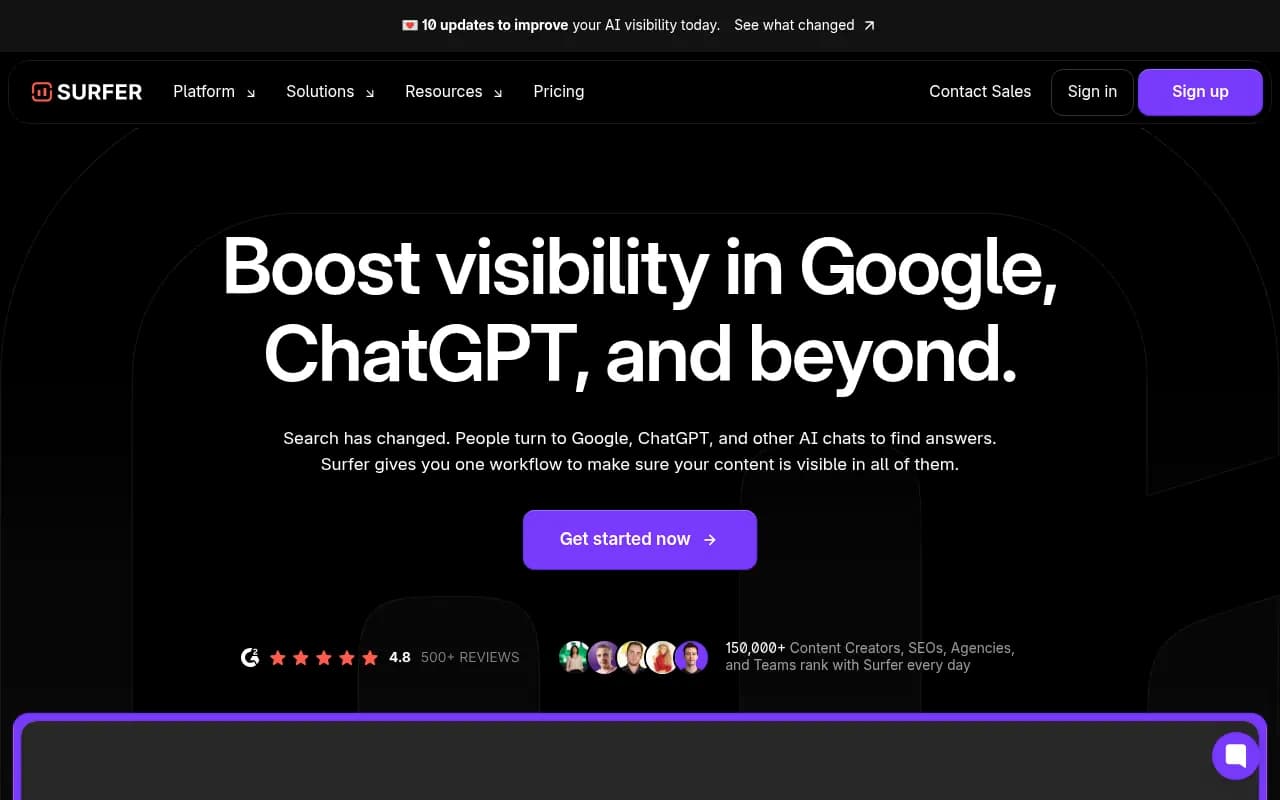
Surfer SEO is a well-established content optimization platform that added AI visibility tracking in 2025. It monitors Google, ChatGPT, Perplexity, and other AI models, but the AI features feel bolted on—the core product is still traditional SEO.
Surfer's strength is content optimization. The Content Editor analyzes top-ranking pages and gives you a checklist of keywords, headings, and structure to match. The AI writer (Surfer AI) generates articles based on that analysis. Pricing: $99/mo (Essential: 1 site, 360 AI prompts, 50 Content Editors, 5 AI articles) to $579/mo (Business: 5 sites, 1,440 AI prompts, 350 Content Editors, 30 AI articles). Surfer AI articles cost extra: $29/article (Essential), $20/article (Professional), $17/article (Business).
The AI visibility tracking is basic—brand mentions and citation counts, no deep analysis. No crawler logs, no prompt intelligence, no Reddit/YouTube tracking. Writesonic's GEO features are more developed. Surfer is better if you care more about ranking on Google than getting cited by ChatGPT.
Best for: Content teams focused on traditional SEO who want to dabble in AI visibility without committing to a GEO-first platform. If you're already paying for Surfer, the AI tracking is a nice bonus. But don't buy Surfer specifically for GEO—it's not the core competency.
Frase
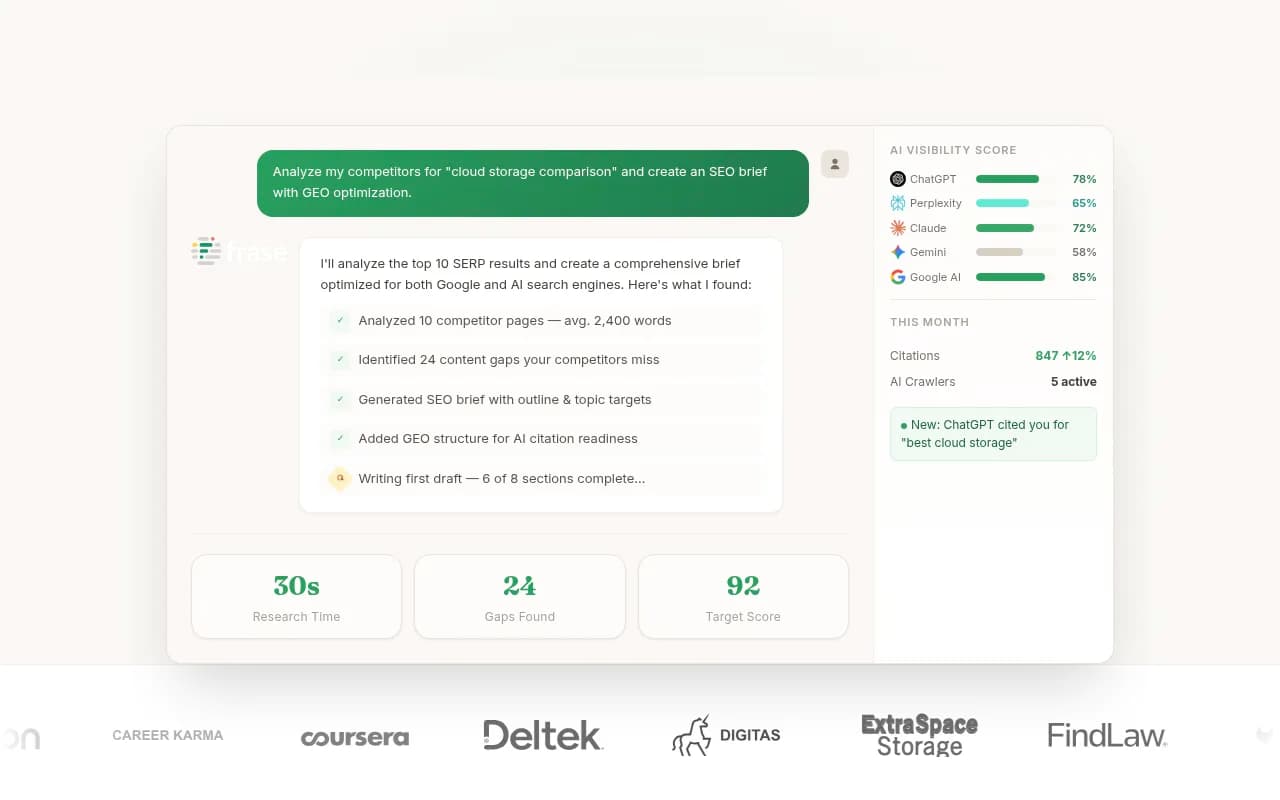
Frase calls itself an "agentic SEO & GEO platform" that researches, writes, and tracks visibility across Google, ChatGPT, and Perplexity. It's used by teams at Microsoft, GitLab, and ActiveCampaign.
The workflow is similar to Writesonic: research competitors, generate content briefs, write optimized articles, track performance. Frase's research tools are strong—it analyzes top SERP results and identifies content gaps. The AI writer generates drafts based on that analysis, and the GEO optimization suggests structure and topics that improve AI citation chances.
Pricing: $39/mo (Starter: 10 articles/month) to $103/mo (Professional: 30 articles/month with full AI tracking). That's cheaper than Writesonic's higher tiers, but the article limits are strict. If you need more than 30 articles/month, you're paying extra.
Frase's AI tracking is decent but not as deep as Promptwatch. No crawler logs, no Reddit/YouTube insights, no ChatGPT Shopping tracking. And the "agentic" branding is marketing fluff—it's not actually running autonomous agents, just automated workflows.
Best for: Content teams that want an all-in-one SEO and GEO platform without paying enterprise prices. If you like Writesonic's approach but want better SEO research tools, Frase is a solid alternative. The article limits are annoying, though.
Jasper
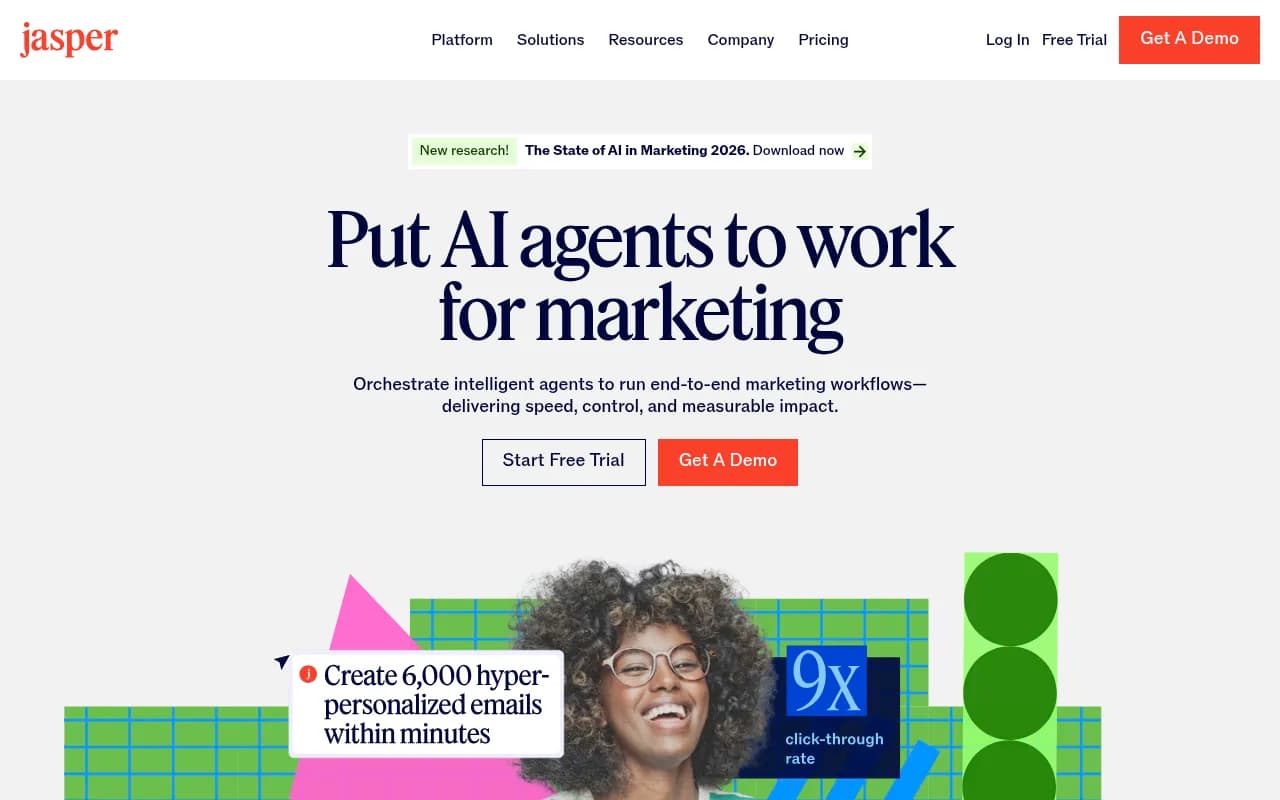
Jasper is an enterprise AI marketing platform used by Boeing, Wayfair, and L'Oréal. It orchestrates 100+ specialized agents to automate content creation, campaigns, and distribution. The focus is brand control and workflow automation, not AI visibility tracking.
Jasper added AI search monitoring as a feature, but it's not the core product. You can track mentions across ChatGPT and other models, but the analytics are basic—no competitor benchmarking, no prompt intelligence, no optimization suggestions. Writesonic's GEO tools are more developed.
What Jasper does well: brand consistency at scale. The Brand IQ system ensures every piece of content matches your voice, style, and visual guidelines. If you're an enterprise team creating hundreds of assets per month, Jasper's governance and approval workflows are valuable. But if your primary goal is improving AI visibility, you're paying for features you don't need.
Pricing: $59/mo (Creator), $69/mo (Pro), custom Business/Enterprise. The lower tiers don't include AI tracking—that's enterprise-only.
Best for: Large marketing teams that need end-to-end content automation with brand control. If you're already using Jasper for content creation and want to add basic AI visibility tracking, it's convenient. But don't buy Jasper specifically for GEO—it's overkill and underdelivers on the monitoring side.
How to choose the right Writesonic alternative
The decision comes down to what you actually need:
If you want optimization, not just monitoring: Promptwatch is the clear winner. It's the only platform that finds content gaps, generates GEO-optimized articles, tracks crawler logs, and connects visibility to revenue. Writesonic monitors and generates content, but Promptwatch's Answer Gap Analysis is more actionable.
If you're on a tight budget: Otterly.AI ($29/mo) or Peec AI (€89/mo) give you basic tracking without the price tag. You lose content generation and optimization features, but if you're comfortable creating content on your own, they're functional.
If you need enterprise features: AthenaHQ has strong competitor analysis and multi-language support, but no content tools. Jasper has brand governance and workflow automation, but weak GEO features. Promptwatch Business ($579/mo) gives you both—deep tracking and content generation with enterprise-grade controls.
If you want SEO and GEO in one platform: Scalenut or Frase combine traditional search optimization with AI visibility tracking. They're good if you're doing both, but neither is best-in-class for GEO specifically.
If you're already invested in an SEO tool: Surfer SEO's AI tracking is a convenient add-on if you're already using it for content optimization. Same with Frase if you like its research tools. But don't expect GEO to be the primary focus.
The biggest mistake is picking a monitoring-only tool and expecting it to help you improve. Otterly, Peec, and AthenaHQ show you data but leave you stuck. Writesonic at least has a content writer, even if it's not GEO-specific. Promptwatch is the only platform that closes the loop—find gaps, create content, track results. That's the difference between a dashboard and an optimization platform.