Key takeaways
- Promptwatch is the most complete option if you want to go beyond monitoring and actually fix your AI visibility gaps -- it includes content generation, crawler logs, traffic attribution, and Reddit/YouTube tracking that Xofu doesn't have.
- Xofu's free BOFU snapshot tool is genuinely useful for a quick competitive check with no signup required, but paid plans lack transparent pricing and the platform is still maturing.
- Otterly.AI and Peec AI are the most affordable monitoring-only alternatives, starting at $29/mo and €89/mo respectively -- good for teams that just need basic tracking.
- Profound and Semrush are the enterprise-grade options, with Profound being AI-search-native and Semrush offering AI visibility as part of a much broader marketing suite.
- SE Visible and Rankshift are solid mid-market picks with transparent pricing and strong multi-brand support -- worth considering for agencies.
Xofu does one thing well: it tracks bottom-of-funnel buyer prompts across ChatGPT, Google AIO, Gemini, and a few other platforms, then shows you where competitors show up instead of you. The free BOFU snapshot is a genuinely clever lead magnet -- you can run a competitive check in under two minutes without creating an account. That's rare in this space.
But there are real reasons people look for alternatives. Xofu's paid pricing isn't publicly listed, which makes it hard to budget. The platform is relatively new and the feature set is narrower than most competitors -- no AI crawler logs, no content generation, no traffic attribution, and no Reddit or YouTube source tracking. It's also closely tied to Citation Labs for the "fix it" part of the workflow, which means optimization work happens outside the platform entirely.
If you're evaluating what else is out there, here's an honest look at the main alternatives.
The alternatives
Promptwatch

Promptwatch is the most fully-featured AI search visibility platform available right now, and the one most worth comparing seriously against Xofu.
Where Xofu focuses on tracking buyer prompts and showing you citation gaps, Promptwatch closes the loop. It monitors your visibility across 10 AI models (ChatGPT, Claude, Perplexity, Gemini, Grok, DeepSeek, Copilot, Meta AI, Google AI Overviews, and Google AI Mode), but the part that sets it apart is what happens after you see the data. The Answer Gap Analysis shows you exactly which prompts competitors rank for that you don't -- and then the built-in content agent generates articles, listicles, and comparison pages designed to get cited by those models. That's the full loop: find the gap, create the content, track the improvement.
Xofu's approach to the "fix it" problem is to hand you off to Citation Labs, a separate agency. That works, but it's a different model -- you're paying for a tool and then separately engaging a service. Promptwatch keeps it in-platform.
A few specific things Promptwatch has that Xofu doesn't:
- AI crawler logs: Real-time logs showing when ChatGPT, Claude, Perplexity, and others crawl your pages, which pages they read, and any errors they hit. This is genuinely useful for diagnosing why you're not getting cited.
- Traffic attribution: Connect AI visibility to actual revenue via a code snippet, Google Search Console integration, or server log analysis. Xofu has no equivalent.
- Reddit and YouTube tracking: Surface the discussions and videos that AI models pull from when forming answers. Most tools ignore these channels entirely.
- ChatGPT Shopping tracking: Monitor when your brand appears in ChatGPT's product recommendation carousels.
- Prompt volume and difficulty scoring: Prioritize which prompts are worth targeting based on actual demand data, not guesswork.
Pricing is transparent: $99/mo (Essential, 1 site, 50 prompts), $249/mo (Professional, 2 sites, 150 prompts, crawler logs), $579/mo (Business, 5 sites, 350 prompts). There's a 7-day free trial. Xofu's pricing is project-based and not publicly listed, so direct comparison is hard -- but Promptwatch's tiers are at least predictable.
The honest trade-off: Promptwatch is more expensive than Xofu's entry tier is likely to be, and it has more to learn. If you just want a quick BOFU check, Xofu's free tool is faster to spin up. But for teams that need to actually move the needle on AI visibility, Promptwatch is the more complete platform.
Best for: Marketing teams, SEO teams, and agencies that want to track AI visibility and take action on it -- not just watch the numbers.
Semrush
Semrush is the obvious choice if you're already paying for a full SEO suite and want AI visibility bolted on. The AI Visibility Toolkit ($99/mo add-on, or included in Semrush One from $165/mo annually) tracks brand mentions across AI platforms and gives you share-of-voice data alongside your existing keyword rankings, backlink data, and content tools.
The integration is the main argument for it. If your team already lives in Semrush, having AI visibility data in the same dashboard alongside organic rankings and competitor analysis is genuinely convenient. You're not managing another login or another data export.
The weaknesses are real though. Semrush's AI visibility feature uses fixed prompt sets -- you can't define your own buyer-intent prompts the way Xofu or Promptwatch let you. That's a significant limitation if your category has specific language that matters. There's also no AI crawler log feature, no content generation tied to citation data, and no Reddit/YouTube source tracking. It's monitoring, not optimization.
Pricing is also a consideration. Semrush One starts at $165/mo annually, and that's before the AI Visibility Toolkit add-on. You're paying for a lot of features you may not need if AI visibility is your primary goal.
Best for: Teams already using Semrush for SEO who want basic AI visibility data without adding another tool to their stack.
Otterly.AI

Otterly.AI is one of the most affordable options in this space and has built a solid user base (25,000+ marketing pros according to their site). It tracks brand mentions across ChatGPT, Perplexity, Google AI Overviews, and a few others, with competitive benchmarking and citation tracking.
The pricing is genuinely accessible: $29/mo for 15 prompts (Lite), $189/mo for 100 prompts (Standard), with a 14-day free trial. For small teams or solo marketers who just want to know whether they're showing up in AI answers, this is a reasonable starting point.
What it doesn't do: no AI crawler logs, no content generation, no traffic attribution, no Reddit/YouTube tracking. It's a monitoring dashboard. That's fine if monitoring is all you need, but if you're comparing it to Xofu's BOFU-focused approach, Otterly.AI is more general-purpose -- it tracks brand mentions broadly rather than specifically targeting buyer-intent prompts.
The 15-prompt Lite plan is quite restrictive. For any meaningful competitive tracking across multiple prompts and competitors, you'll end up on the $189/mo Standard plan quickly.
Best for: Budget-conscious teams or individuals who want basic AI visibility monitoring without committing to a higher-priced platform.
Peec AI

Peec AI is a clean, well-designed monitoring platform aimed at marketing teams. It tracks visibility, position, and sentiment across ChatGPT, Perplexity, and Gemini, with multi-language and multi-country support that's more developed than most competitors at this price point.
Starting at €89/mo (Starter), it's in a similar range to Otterly.AI's Standard plan but with better international coverage. The Professional plan at €199/mo adds more prompts and deeper analytics. There's a free trial available.
The interface is polished and the onboarding is fast. Peec AI also has some smart suggestion features that help you identify which prompts to track -- useful if you're not sure where to start.
The limitations mirror Otterly.AI: it's a monitoring tool. No content generation, no crawler logs, no traffic attribution. The "fix it" workflow is entirely on you once you have the data.
One thing worth noting: Peec AI's multi-language support is genuinely strong. If you're tracking AI visibility across European markets in multiple languages, it handles that better than most tools at this price.
Best for: Marketing teams with international audiences who need solid multi-language AI visibility monitoring at a mid-range price.
Profound

Profound is the most direct enterprise competitor to Promptwatch in this space. It's used by MongoDB, Ramp, and Zapier, and it covers the full stack: visibility monitoring, prompt volume data, AI crawler analytics, and automated content creation via marketing agents.
The feature set is genuinely strong. Prompt Volumes shows you what millions of people are actually asking AI engines -- real demand data, not just the prompts you manually enter. The Agent Analytics feature tracks AI crawler behavior on your site. And the content agents can generate AEO-optimized content at scale.
The catch is pricing. Profound doesn't publish tiers, but estimates in the market put it at $1,000-$3,000+/month for enterprise contracts. There's no self-serve option and no free trial -- you have to go through a sales demo. That puts it out of reach for most SMBs and even many mid-market teams.
Compared to Xofu, Profound is in a completely different tier -- both in capability and cost. Xofu is a focused BOFU tracking tool; Profound is a full enterprise AEO platform. The comparison only makes sense if you're a larger organization evaluating whether to graduate from a simpler tool.
Best for: Enterprise marketing teams with significant budgets who need a full-stack AEO platform with content creation capabilities.
Ahrefs Brand Radar
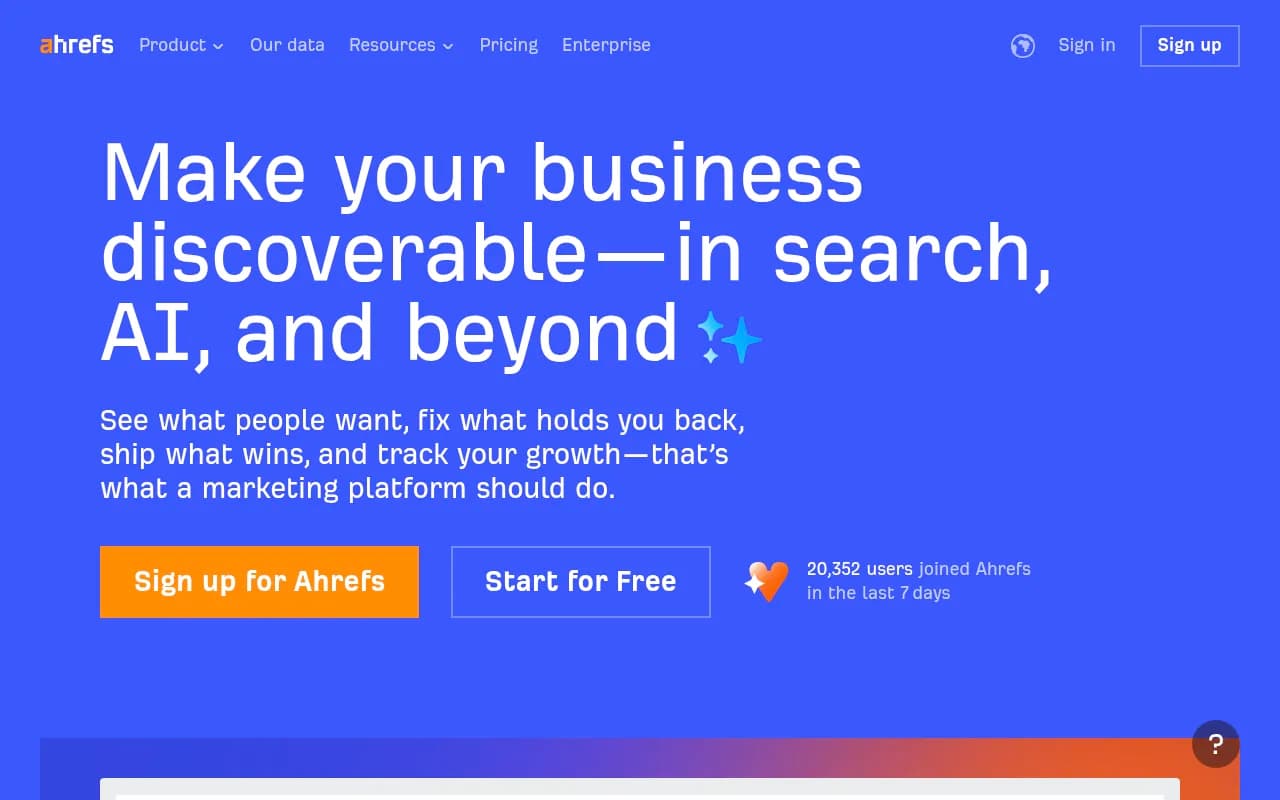
Ahrefs Brand Radar is the AI visibility component of Ahrefs' broader platform. Like Semrush, the argument for it is consolidation -- if you're already paying for Ahrefs (Lite from $129/mo, Standard from $249/mo), Brand Radar gives you AI mention tracking without adding another tool.
The AI visibility features are more limited than dedicated platforms. Brand Radar uses fixed prompts rather than custom buyer-intent prompts, and there's no AI traffic attribution, no crawler logs, and no content generation tied to citation data. It's useful for a high-level view of whether your brand is appearing in AI answers, but it won't tell you why you're losing to competitors on specific prompts.
One specific limitation worth flagging: no AI traffic attribution. You can see visibility data, but you can't connect it to actual website traffic or revenue. For teams that need to justify AI SEO investment to stakeholders, that's a real gap.
Best for: Teams already on Ahrefs who want a basic AI visibility overview without switching platforms.
SE Visible
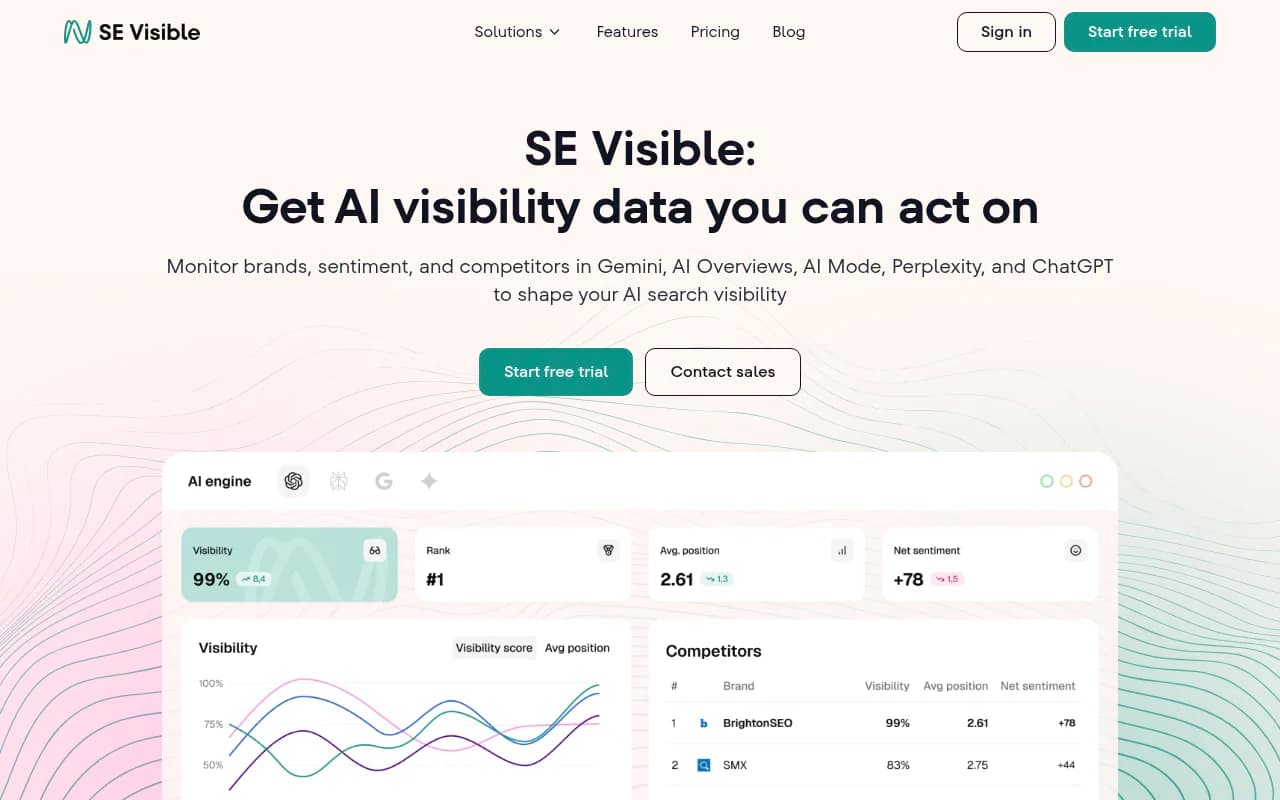
SE Visible is SE Ranking's standalone AI visibility product, and it's one of the better-value options in the mid-market. Starting at $79/mo (annual) for 200 prompts and 3 brands, it covers ChatGPT, Gemini, AI Overviews, AI Mode, and Perplexity with sentiment tracking, competitor benchmarking, and source analysis.
What makes SE Visible stand out at this price point: unlimited user seats on all plans. For agencies managing multiple clients, that's a meaningful cost advantage over tools that charge per seat. The reporting is clean and exportable, and the 10-day free trial is enough to evaluate it properly.
The feature set is monitoring-focused -- no content generation, no crawler logs, no traffic attribution. But within the monitoring category, it's more capable than Otterly.AI or Peec AI at a comparable price, particularly for agencies that need multi-brand management.
Compared to Xofu, SE Visible is more general-purpose (not specifically BOFU-focused) but has more transparent pricing and a more developed reporting layer.
Best for: Agencies managing multiple clients who need solid AI visibility monitoring with unlimited seats and clean client-facing reports.
Rankshift
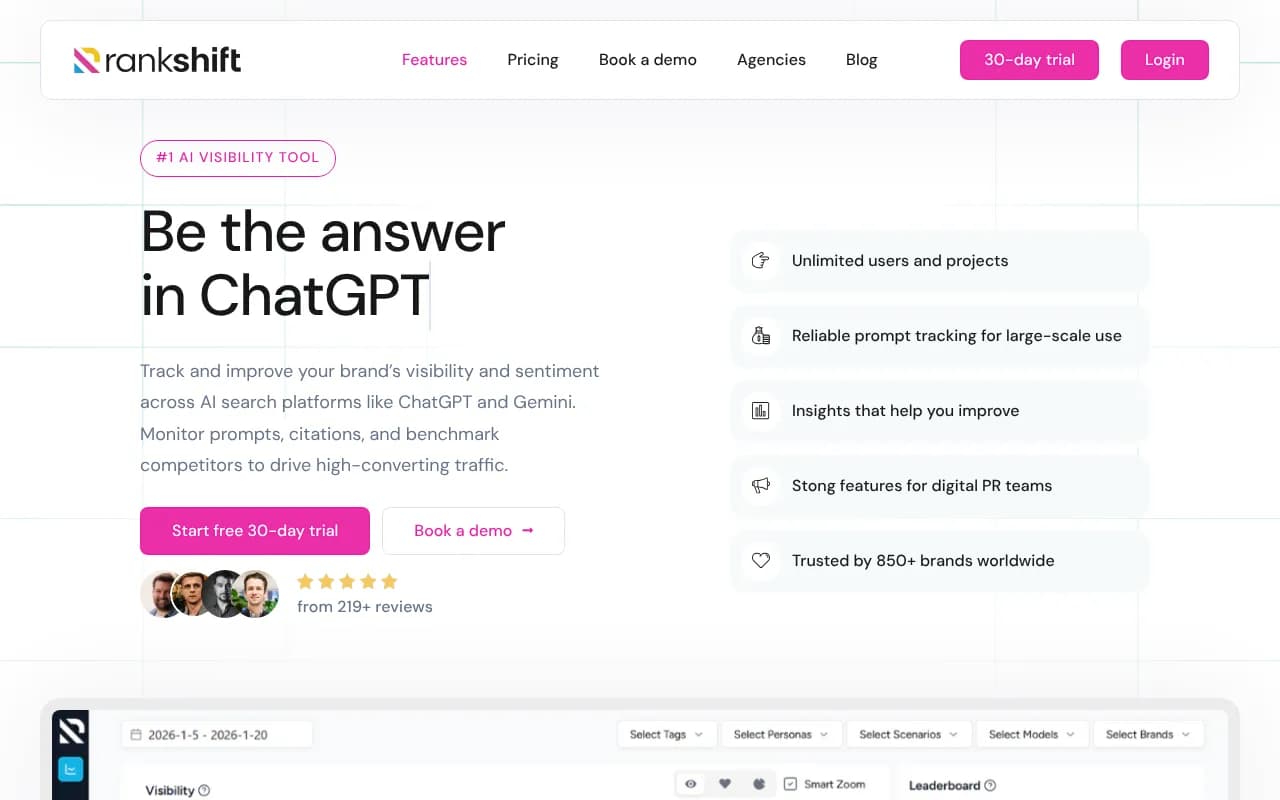
Rankshift is a European-built AI visibility platform (trusted by Coolblue, Gamma, and 850+ brands according to their site) with a 30-day free trial -- the longest in this comparison. Pricing runs from €69/mo (Starter: 150 prompts/day) to €359/mo (Business: 850 prompts/day), with unlimited users and projects on all plans.
The prompt-per-day model is different from most competitors, which use monthly prompt limits. For teams running frequent tracking across many prompts, this can work out favorably. The digital PR focus is also notable -- Rankshift specifically highlights features for PR teams trying to earn citations, which aligns with how AI visibility actually works (you need to be cited by the right sources).
It covers ChatGPT, Perplexity, Claude, Gemini, and AI Overviews. The 10% annual discount is modest, but the 30-day trial is genuinely generous for evaluating fit.
Limitations: like most tools in this tier, it's monitoring-focused. No built-in content generation, no crawler logs, no traffic attribution.
Best for: Teams that run high-frequency prompt tracking or have a digital PR angle to their AI visibility strategy.
Authoritas AI Tracker

Authoritas is interesting because it combines traditional SEO platform features with AI visibility tracking in a single product -- and it has a credit-based pricing model that's unusual in this space. The free tier (50 credits) lets you try it without a credit card, and paid plans start at £90/mo (2,000 credits).
The credit model means you pay for what you use rather than a fixed prompt quota. That can be more economical for teams with variable tracking needs, but it also makes budgeting less predictable. Different AI models cost different amounts per query, which adds complexity.
Authoritas covers ChatGPT, Perplexity, Claude, Gemini, DeepSeek, Google AI Overviews, and Bing AI -- one of the broader model sets in this comparison. It also has a specific publisher-focused product for tracking how AI platforms use your content, which is unique.
The SEO platform (separate pricing: Essential £99/mo, Advanced £399/mo) is a full traditional SEO suite. If you need both SEO and AI visibility in one place and prefer a UK-based vendor, Authoritas is worth evaluating.
Best for: Publishers tracking content usage across AI platforms, or UK/European teams that want combined SEO and AI visibility with a flexible credit-based model.
Scrunch AI
Scrunch AI is a monitoring platform built for marketing teams and agencies, starting at $250/mo for 350 prompts and 3 personas. It covers ChatGPT, Perplexity, Gemini, and other LLMs with competitive benchmarking and citation tracking.
The persona feature is worth noting -- you can define different customer personas and track how AI responds to prompts from each one. That's useful for brands with distinct audience segments who might prompt AI differently.
At $250/mo, Scrunch AI is priced similarly to Promptwatch's Professional plan ($249/mo) but without the content generation, crawler logs, or traffic attribution. For pure monitoring, it's a capable tool, but the value comparison against Promptwatch is unfavorable at that price point.
Best for: Marketing teams that want persona-based AI visibility monitoring and don't need content generation or traffic attribution features.
Which one should you pick?
Here's the honest summary:
If you're evaluating Xofu because you want to track buyer-intent prompts and see where competitors show up, the core question is: what do you want to do with that information?
If the answer is "just track it and report on it," Otterly.AI ($29-$189/mo) or Peec AI (from €89/mo) will do the job at a lower price point than most alternatives, with transparent pricing that Xofu doesn't offer.
If the answer is "track it and then fix it," Promptwatch is the most complete option -- it's the only platform in this comparison that combines monitoring, content gap analysis, AI content generation, crawler logs, and traffic attribution in a single product. The $249/mo Professional plan covers most team needs.
If you're already deep in Semrush or Ahrefs, their AI visibility features are worth trying before adding another tool -- just go in knowing the limitations around custom prompts and attribution.
For agencies managing multiple clients, SE Visible's unlimited seat model and Rankshift's unlimited projects make them worth a close look at their respective price points.
Profound is the right call for enterprise teams with budget to match -- but it's a different category of investment than Xofu.