Key takeaways
- Promptwatch is the strongest all-around alternative -- it goes beyond monitoring to actually help you fix visibility gaps with content generation, crawler logs, and traffic attribution. Best for marketing teams and agencies serious about AI search ROI.
- AthenaHQ is a solid monitoring platform with a clean workflow, backed by Y Combinator. Good for enterprise teams that want structured GEO management but don't need content generation built in.
- Otterly.AI is the most affordable entry point for teams just getting started with AI visibility tracking. Limited depth, but the price is right.
- Peec AI is worth a look if you need multi-language tracking or operate in non-English markets. Monitoring-focused with decent competitor benchmarking.
- Profound is the enterprise-grade option used by MongoDB and Zapier. Powerful, but pricing is opaque and likely out of reach for most small and mid-size teams.
- SE Ranking makes sense if you're already paying for an SEO suite and want AI visibility as an add-on rather than a standalone tool.
- GPT Rank Tracker and Brandlight round out the list -- one for quick free checks, the other for Fortune 500 brand monitoring at enterprise prices.
PromptReach positions itself as a free AI business listing service -- you add your business details, it generates schema markup, and the idea is that ChatGPT, Claude, and Gemini will eventually discover and cite you. It's a simple, low-friction entry point, and the freemium model (free listing, one-time founding member fee from $20) makes it accessible to basically anyone.
But that simplicity is also its ceiling. PromptReach doesn't tell you whether AI models are actually citing you. It doesn't show you which prompts your competitors are winning. It doesn't help you create content that earns citations, and it has no analytics to close the loop between visibility and revenue. For a small local business that just wants to exist in the AI ecosystem, it might be enough. For anyone who wants to actually measure and improve their AI search presence, it falls short quickly.
That's the gap these alternatives fill. Some are monitoring dashboards, some are full optimization platforms, and a few are enterprise tools with price tags to match. Here's how they compare.
The alternatives
Promptwatch

Promptwatch is the most complete alternative on this list, and the one most worth considering if you're moving beyond PromptReach's basic listing approach. Where PromptReach helps you get listed, Promptwatch helps you understand what's happening after that -- and then helps you do something about it.
The core difference is the action loop. Most AI visibility tools show you a dashboard of where you appear and where you don't. Promptwatch does that too, but it also tells you exactly which prompts your competitors are winning that you're not (Answer Gap Analysis), generates content designed to earn citations from those specific prompts, and then tracks whether that content actually starts getting cited. That cycle -- find the gap, create the content, measure the result -- is what separates it from monitoring-only tools.
A few specifics worth knowing: Promptwatch monitors 10 AI models including ChatGPT, Claude, Perplexity, Gemini, Grok, DeepSeek, and Copilot. It logs AI crawler activity in real time, so you can see which pages ChatGPT's crawler is reading, how often it returns, and whether it's hitting errors. It tracks Reddit and YouTube discussions that influence AI recommendations -- a channel most competitors ignore. And it connects AI visibility to actual traffic through GSC integration, a code snippet, or server log analysis.
Compared to PromptReach, it's a completely different category of tool. PromptReach is a listing service. Promptwatch is an optimization platform. The trade-off is price: Promptwatch starts at $99/month (Essential: 1 site, 50 prompts, 5 articles), with Professional at $249/month and Business at $579/month. There's a 7-day free trial.
Best for: Marketing teams, SEO teams, and agencies that want to measure AI visibility, understand why they're not being cited, and actually fix it.
AthenaHQ

AthenaHQ came out of Y Combinator and has built a reasonably complete GEO platform for enterprise and mid-market teams. It tracks visibility across 8+ AI models, gives you citation source analysis, and has a workflow management layer that's genuinely useful if you have a dedicated AEO/GEO manager coordinating across teams.
The platform is organized around different user roles -- there are specific views for CMOs, SEO teams, PR teams, and content marketers. That's a nice touch. It means the executive dashboard isn't cluttered with the same data the SEO team needs, and vice versa. Clients include ZoomInfo, Coinbase, and PagerDuty, which gives you a sense of the target market.
Where AthenaHQ falls short relative to Promptwatch is on the action side. It has content optimization recommendations, but it doesn't generate content for you. There's no built-in AI writing agent, no crawler log monitoring, and no Reddit/YouTube tracking. It's a strong monitoring and analysis tool, but you'll still need to take the insights somewhere else to act on them.
Pricing is also a friction point. Self-serve starts at $295/month (or $95/month on annual billing, which is a significant discount but requires a commitment). There's no free trial listed publicly.
Best for: Enterprise marketing teams that want structured GEO workflow management and don't mind handling content creation separately.
Otterly.AI

Otterly.AI is the budget-friendly option in this space, and it's honest about what it is: a monitoring tool. It tracks brand mentions and website citations across ChatGPT, Google AI Overviews, Perplexity, Google AI Mode, Gemini, and Copilot. It has a GEO Audit feature that analyzes 25+ on-page factors and flags what's holding your site back from earning more citations. There's also an AI keyword research tool for discovering conversational prompts your audience is using.
The Lite plan at $29/month covers 15 prompts, which is genuinely useful for a small brand or a freelancer testing the waters. The Standard plan at $189/month gets you 100 prompts, which is more workable for a real monitoring setup.
The honest trade-off: Otterly.AI doesn't have crawler logs, doesn't generate content, doesn't track Reddit or YouTube, and doesn't connect visibility to revenue. It's a monitoring dashboard with some audit capabilities. That's fine if that's what you need, but if you're comparing it to Promptwatch, you're comparing a speedometer to a full navigation system.
Still, the 14-day free trial and low entry price make it easy to evaluate without commitment.
Best for: Small businesses, freelancers, and teams just starting to track AI visibility who want something affordable and simple.
Peec AI

Peec AI tracks brand visibility across ChatGPT, Perplexity, and Gemini, with a focus on three core metrics: visibility (how often you appear), position (where you rank within responses), and sentiment (how AI describes your brand). The competitor benchmarking is clean -- you can see side-by-side how your visibility compares to specific competitors across models.
The standout feature is multi-language and multi-country support. If you're running campaigns in German, French, Spanish, or other languages, Peec AI handles that well. Most competitors in this space are English-first, so this is a real differentiator for international teams.
Pricing starts at €89/month for the Starter plan, with Professional at €199/month and Enterprise on custom terms. There's a free trial available. The platform is used by 2,000+ marketing teams, which is a reasonable signal of product-market fit.
What it doesn't do: no content generation, no crawler logs, no traffic attribution. Like Otterly.AI, it's monitoring-focused. The smart suggestions feature helps prioritize what to fix, but you're still doing the fixing yourself.
Best for: International marketing teams that need multi-language AI visibility tracking and solid competitor benchmarking.
Profound

Profound is the enterprise-grade option in this space. It's used by MongoDB, Ramp, and Zapier, and it covers the full stack: prompt volume data, answer engine insights, AI crawler analytics, and automated content creation through its Agents feature. The prompt volumes feature is particularly strong -- it shows you what millions of people are actually asking AI, which lets you align your content strategy with real demand rather than guessing.
The platform monitors visibility across ChatGPT, Perplexity, Claude, Gemini, Grok, Copilot, Meta AI, DeepSeek, and Google AI Overviews. The Agents feature can automate content workflows -- for example, generating AEO-optimized FAQ content based on Perplexity research and your existing pages.
The catch is price. Profound doesn't publish pricing publicly, but estimates put it in the $1,000-$3,000+/month range for enterprise contracts. There's no self-serve option and no free trial -- you have to go through a sales demo. For a mid-size marketing team, that's a significant barrier.
Compared to Promptwatch, Profound is similarly capable but more expensive and less accessible. Promptwatch's $249/month Professional plan covers a lot of the same ground that Profound charges enterprise rates for.
Best for: Large enterprises with dedicated AEO teams and budgets to match, particularly in competitive categories where prompt volume data and automated content workflows justify the cost.
Brandlight
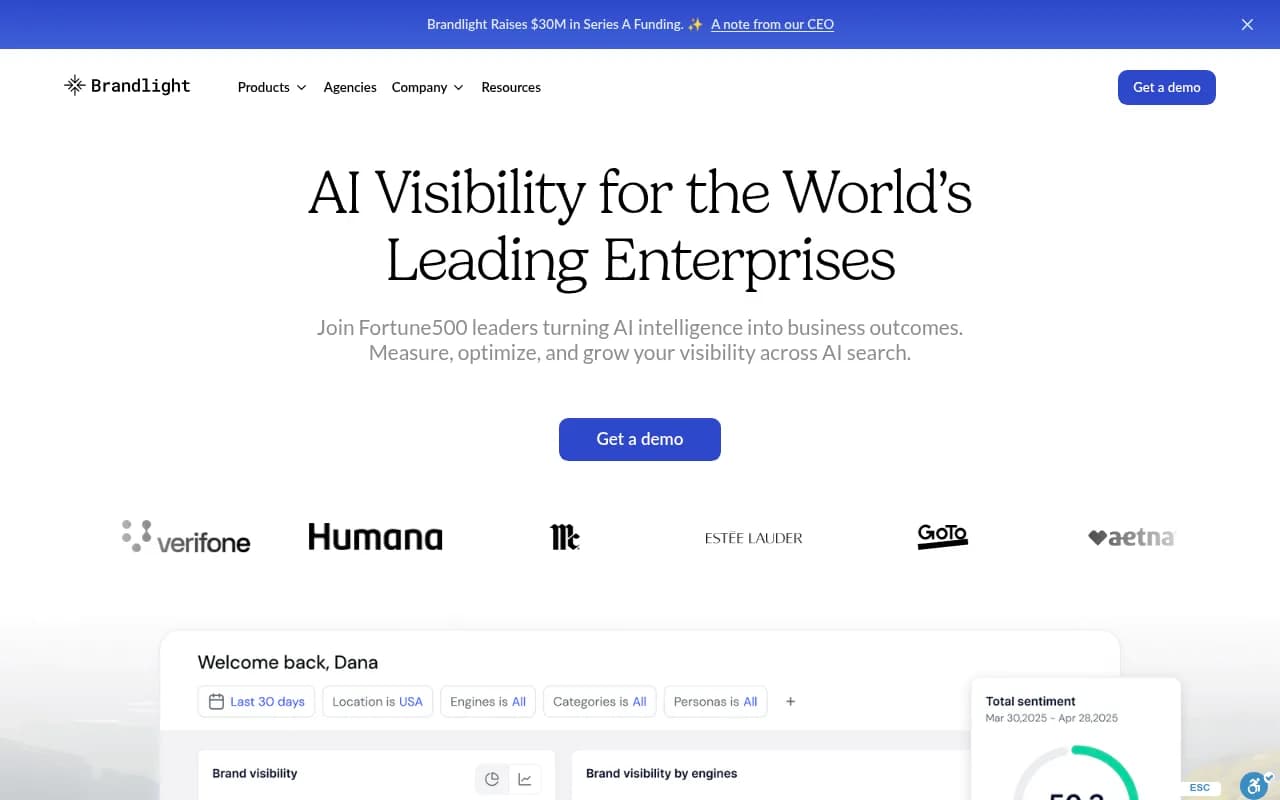
Brandlight recently raised $30M in Series A funding and is positioning itself firmly in the Fortune 500 market. Clients include Humana, Mastercard, and Estée Lauder, which tells you everything about the target audience. It measures and tracks brand visibility across AI search engines and provides optimization recommendations.
The platform is enterprise-only in practice. Pricing starts at $199/month for a base tier and goes up to $750/month for an activation plan, with custom enterprise pricing above that. There's no self-serve trial -- you go through a demo process.
What Brandlight does well is brand-level monitoring at scale, with the kind of reporting and governance features that large organizations need. What it doesn't do particularly well, relative to Promptwatch, is the action side: no built-in content generation, no crawler logs, no Reddit/YouTube tracking, and no traffic attribution.
For a Fortune 500 brand that needs enterprise-grade monitoring with proper security and compliance, Brandlight is worth evaluating. For everyone else, the price-to-capability ratio doesn't hold up against alternatives like Promptwatch or even Profound.
Best for: Fortune 500 brands and large enterprises that need AI visibility monitoring with enterprise-grade features and are willing to pay for it.
SE Ranking
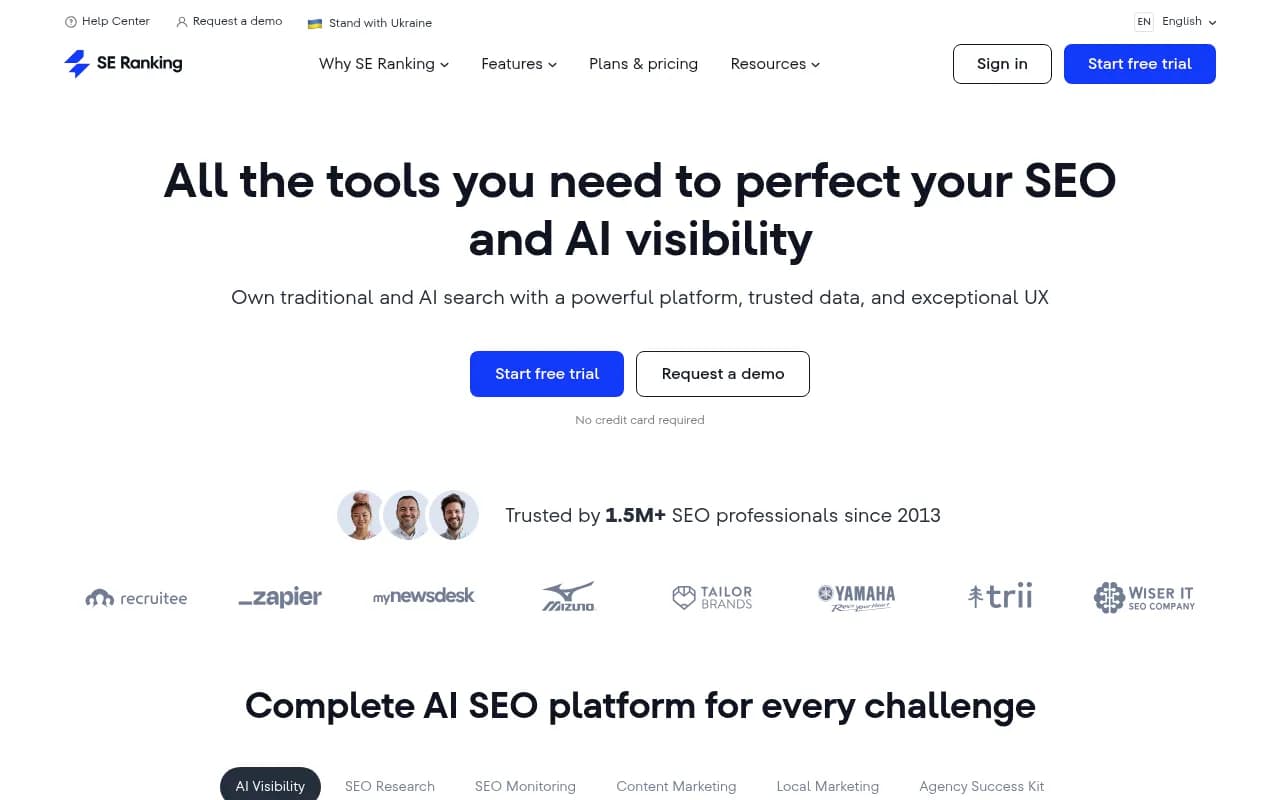
SE Ranking is primarily an SEO platform -- keyword tracking, site audits, backlink analysis, competitor research -- that has added AI visibility monitoring as a feature set. The AI Search add-on tracks how your brand appears in AI-generated responses and gives you visibility data alongside your traditional SEO metrics.
The appeal here is consolidation. If you're already paying for SE Ranking's Core plan ($103.20/month) and want to add AI visibility without subscribing to a separate tool, the AI Search add-on from $71.20/month is a reasonable way to do it. The 14-day free trial with no credit card required makes it easy to test.
The limitation is depth. SE Ranking's AI visibility features are an add-on to an SEO tool, not a purpose-built GEO platform. It uses fixed prompts rather than letting you define your own prompt strategy, and it doesn't have content generation, crawler logs, or traffic attribution. It's useful for getting a baseline read on AI visibility without adding another vendor, but it won't replace a dedicated platform if AI search is a real priority.
Best for: Teams already using SE Ranking for SEO who want to add basic AI visibility monitoring without switching tools or adding another subscription.
GPT Rank Tracker

GPT Rank Tracker is the most accessible tool on this list -- there's a free GPT Check that lets you enter any domain and get a snapshot of its GPT-driven visibility, including prompt presence, citation signals, and answer coverage. The paid tiers aren't publicly listed, which makes it hard to evaluate for ongoing use, but the free check is genuinely useful for a quick audit.
The platform tracks prompt visibility, answer inclusion, citation signals, and page-level GPT performance. It's built for marketers and SEO teams who want to understand how a specific domain is performing in GPT-style search without committing to a full platform.
Compared to everything else on this list, GPT Rank Tracker is the lightest option. It's good for spot checks and initial audits, but it's not a platform you'd run an ongoing AI visibility program on. No content generation, no competitor analysis, no multi-model tracking beyond GPT-focused experiences.
Best for: Anyone who wants a free, quick check of how a domain performs in GPT-driven search before deciding whether to invest in a more complete platform.
Which one should you pick?
Here's the honest summary:
If you're coming from PromptReach and want to actually measure and improve your AI visibility, the jump to a real platform is necessary. PromptReach gets you listed; it doesn't tell you what's working.
For most marketing teams and agencies, Promptwatch is the strongest choice. It's the only tool here that covers the full cycle: finding content gaps, generating content to fill them, and tracking whether that content earns citations. The $99/month entry point is accessible, and the 7-day free trial lets you see the data before committing.
If budget is the primary constraint, Otterly.AI at $29/month is a reasonable starting point for basic monitoring. If you need multi-language support, Peec AI is worth the extra cost. If you're at an enterprise with a real budget and a dedicated GEO team, Profound or AthenaHQ are worth evaluating seriously.
SE Ranking makes sense only if you're already a customer. GPT Rank Tracker is useful for a free audit but not as a long-term platform. Brandlight is for Fortune 500 teams with Fortune 500 budgets.
The category is moving fast. A tool that was adequate six months ago might be missing features that matter now. Whatever you pick, make sure it can actually show you what's changing -- not just what the current state is.