Key Takeaways
- Promptwatch is the only platform that combines monitoring with action -- it shows you content gaps, generates AI-optimized articles, and tracks results in one loop. Best for teams that want to actually improve visibility, not just watch it.
- Otterly.AI and Peec AI offer affordable monitoring ($29-89/mo) with basic tracking across major AI models. Good for small teams or agencies on a budget who need visibility data without optimization tools.
- Profound is the enterprise choice with prompt volume data, AI crawler analytics, and automated content creation. Expensive (likely $1k+/mo) but built for brands like MongoDB and Zapier that need scale.
- Hall AI itself is solid for quick free reports and basic monitoring, but lacks the depth and optimization features of competitors. Use it for initial audits, then upgrade if you want to take action.
- LLM Pulse and Radarkit sit in the middle -- more features than budget tools, less expensive than enterprise platforms. Good for mid-market SaaS companies that need multi-country tracking and competitor benchmarking.
Hall AI made a name for itself with free shareable reports that show how your brand appears in ChatGPT, Perplexity, Claude, and other AI engines. It's a decent starting point -- you get sentiment analysis, citation tracking, and basic crawler logs without signing up. But once you've seen the report, you're left with a question: now what?
That's where Hall AI hits a wall. It shows you the data but doesn't help you fix the problems. No content gap analysis. No optimization suggestions. No way to track whether your efforts are actually moving the needle. If you're serious about ranking in AI search, you'll need a platform that does more than monitor.
Here are the best alternatives, broken down by what they actually help you accomplish.
Promptwatch

Promptwatch is the only AI visibility platform that treats GEO as an optimization problem, not just a tracking exercise. Most competitors (including Hall AI) show you where you're invisible and leave you stuck. Promptwatch shows you what's missing, then helps you create the content that fixes it.
The core difference is the action loop. First, Answer Gap Analysis shows exactly which prompts competitors rank for but you don't -- the specific topics, angles, and questions AI models want answers to but can't find on your site. Then the built-in AI writing agent generates articles, listicles, and comparisons grounded in real citation data (880M+ citations analyzed), prompt volumes, and competitor research. Finally, page-level tracking shows your visibility scores improve as AI models start citing your new content. You close the loop with traffic attribution (code snippet, GSC integration, or server log analysis) to connect visibility to actual revenue.
Most competitors stop at step one. Otterly.AI, Peec AI, and Hall AI are monitoring dashboards -- they tell you what's happening but don't help you change it. Promptwatch is built around taking action.
Additional capabilities that support the loop: AI Crawler Logs (real-time logs of ChatGPT, Claude, Perplexity crawlers hitting your site -- which pages they read, errors they encounter, how often they return), Prompt Intelligence (volume estimates and difficulty scores for each prompt, plus query fan-outs that show how one prompt branches into sub-queries), Citation & Source Analysis (see exactly which pages, Reddit threads, YouTube videos, and domains AI models cite), Reddit & YouTube Insights (surface discussions that directly influence AI recommendations), ChatGPT Shopping Tracking (monitor when your brand appears in product recommendations and shopping carousels), Competitor Heatmaps (compare your AI visibility vs competitors across LLMs), Multi-language & Multi-region (monitor AI responses in any language, from any country, with customizable personas), Looker Studio Integration & API (export data for custom reporting or build on the API for custom workflows).
Monitors 10 AI models: OpenAI/ChatGPT, Perplexity, Google AI Overviews, Google AI Mode, Claude, Gemini, Meta/Llama, DeepSeek, Grok, Mistral, Copilot.
Pricing: Essential $99/mo (1 site, 50 prompts, 5 articles), Professional $249/mo (2 sites, 150 prompts, 15 articles, crawler logs, state/city tracking), Business $579/mo (5 sites, 350 prompts, 30 articles). Agency/Enterprise custom pricing available. Free trial available. Annual billing discounts.
Best for: Marketing teams, SEO teams, digital agencies, and any brand that wants to be visible and rank in AI search results -- not just monitor where they stand today.
Trade-offs: More expensive than budget tools like Otterly.AI or Peec AI. If you only need basic monitoring and don't care about optimization, you're paying for features you won't use. But if you want to actually improve your AI visibility, Promptwatch is the only platform that gives you the full toolkit.
Otterly.AI

Otterly.AI is the budget-friendly monitoring option. It tracks brand mentions and citations across ChatGPT, Perplexity, Google AI Overviews, AI Mode, Gemini, and Copilot. You get visibility scores, share of voice, sentiment analysis, and basic competitor benchmarking. The interface is clean and the setup is fast -- add your prompts, wait for the weekly refresh, and see where you rank.
What you don't get: content gap analysis, optimization suggestions, AI crawler logs, or any way to actually improve your visibility. Otterly.AI is a dashboard. It shows you the data but leaves you to figure out what to do with it. No content generation. No prompt volume estimates. No Reddit or YouTube tracking. No traffic attribution.
The GEO Audit tool analyzes 25+ on-page factors and tells you what's holding your site back, which is useful for identifying technical issues. But it doesn't help you create the content that AI models actually want to cite. You're still on your own for the hard part.
Pricing: Lite $29/mo (15 prompts), Standard $189/mo (100 prompts), Premium custom (unlimited prompts). 14-day free trial.
Best for: Small teams or agencies on a tight budget who need basic visibility data and don't have the resources to optimize. Also good for monitoring multiple clients if you're an agency -- the low price per project makes it easier to justify the cost.
Trade-offs: You get what you pay for. Otterly.AI is cheap because it doesn't do much beyond monitoring. If you want to actually rank higher in AI search, you'll need to pair it with other tools or upgrade to a platform like Promptwatch that handles optimization.
Peec AI

Peec AI is similar to Otterly.AI but with a few extra features that make it more useful for research. It tracks brand mentions across ChatGPT, Perplexity, Claude, Gemini, and Google AI platforms. You get visibility scores, position tracking, sentiment analysis, and share of voice. The interface is polished and the data is easy to read.
What sets Peec AI apart from Otterly.AI: smart suggestions for prompts to track (based on your industry and competitors), better multi-language support (useful if you operate in multiple countries), and slightly more detailed competitor analysis. You can see which brands are winning for each prompt and benchmark your performance against them.
What it still lacks: content gap analysis, optimization tools, AI crawler logs, prompt volume data, Reddit/YouTube tracking, or any way to generate content that ranks. Like Otterly.AI, Peec AI is a monitoring dashboard. It tells you where you stand but doesn't help you improve.
Pricing: Freemium -- free trial + paid from €89/mo (Starter €89/mo, Professional €199/mo, Enterprise custom).
Best for: Mid-market SaaS companies or agencies that need multi-language tracking and smart prompt suggestions. Good for teams that want a step up from Otterly.AI but aren't ready to pay for enterprise platforms like Profound or Promptwatch.
Trade-offs: More expensive than Otterly.AI but still lacks optimization features. You're paying for better monitoring, not better results. If you want to actually rank higher, you'll need to do the content work yourself or upgrade to a platform that handles it.
Profound

Profound is the enterprise Answer Engine Optimization (AEO) platform used by MongoDB, Ramp, and Zapier. It combines visibility tracking, prompt volume data, AI crawler analytics, and automated content creation in one platform. The goal is to help brands not just monitor AI search but actually rank higher in it.
The core features: Answer Engine Insights (track brand mentions, citations, and sentiment across ChatGPT, Perplexity, Claude, Gemini, Grok, Copilot, Meta AI, DeepSeek, Google AI Overviews), Prompt Volumes (see how many people are asking each prompt and prioritize high-value queries), Agent Analytics (real-time logs of AI crawlers hitting your site -- which pages they read, errors they encounter, how often they return), Shopping (monitor when your brand appears in ChatGPT's product recommendations), and Agents (automated content creation that generates articles, listicles, and comparisons tailored to rank in AI search).
The Agents feature is the big differentiator. You pick the topics, prompts, and audience segments you want to increase visibility for. Profound generates content using proven formats (listicles, how-tos, comparisons) and integrates with your existing tools (CMS, Slack, etc.). You can build custom workflows and add human-in-the-loop checkpoints. It's not just a content generator -- it's a content pipeline.
Pricing: Custom enterprise pricing (estimated $1,000-$3,000+/month based on positioning and competitor pricing). No public tiers or free trial. You have to book a demo.
Best for: Enterprise brands and high-growth startups that need scale and automation. If you're tracking hundreds of prompts, managing multiple sites, and need a platform that can generate content at volume, Profound is built for that. Also good for teams that want prompt volume data and AI crawler logs -- features most competitors don't offer.
Trade-offs: Expensive. If you're a small team or agency, the price is probably out of reach. Also, the lack of public pricing and free trial means you have to commit to a sales call before you can even see the platform. But if you're at the scale where you need enterprise features, Profound is one of the few platforms that delivers them.
AI Peekaboo
AI Peekaboo is a niche tool designed specifically for SaaS companies. It tracks brand visibility across ChatGPT, Gemini, Google AI Overviews, Perplexity, and Google AI Mode. You pick the prompts you want to monitor, and AI Peekaboo shows you when and how AI models mention your brand. The interface is simple and the setup is fast.
What makes it different from Otterly.AI or Peec AI: white-label support (useful if you're an agency and want to rebrand the tool for clients) and a focus on SaaS-specific prompts (e.g. "best CRM for startups", "top project management tools"). The prompt suggestions are tailored to SaaS use cases, which saves time if you're in that industry.
What it lacks: content gap analysis, optimization tools, AI crawler logs, prompt volume data, Reddit/YouTube tracking, or any way to generate content. Like most budget tools, AI Peekaboo is a monitoring dashboard. It tells you where you rank but doesn't help you improve.
Pricing: From $99/mo (Pro plan with white-label included).
Best for: SaaS companies and agencies that need basic monitoring with white-label support. Good for agencies that want to offer AI visibility tracking to clients without building their own tool.
Trade-offs: Limited feature set. You're paying for white-label support and SaaS-specific prompts, but the core monitoring capabilities are similar to cheaper tools like Otterly.AI. If you don't need white-label, you're better off with a cheaper alternative.
LLM Pulse
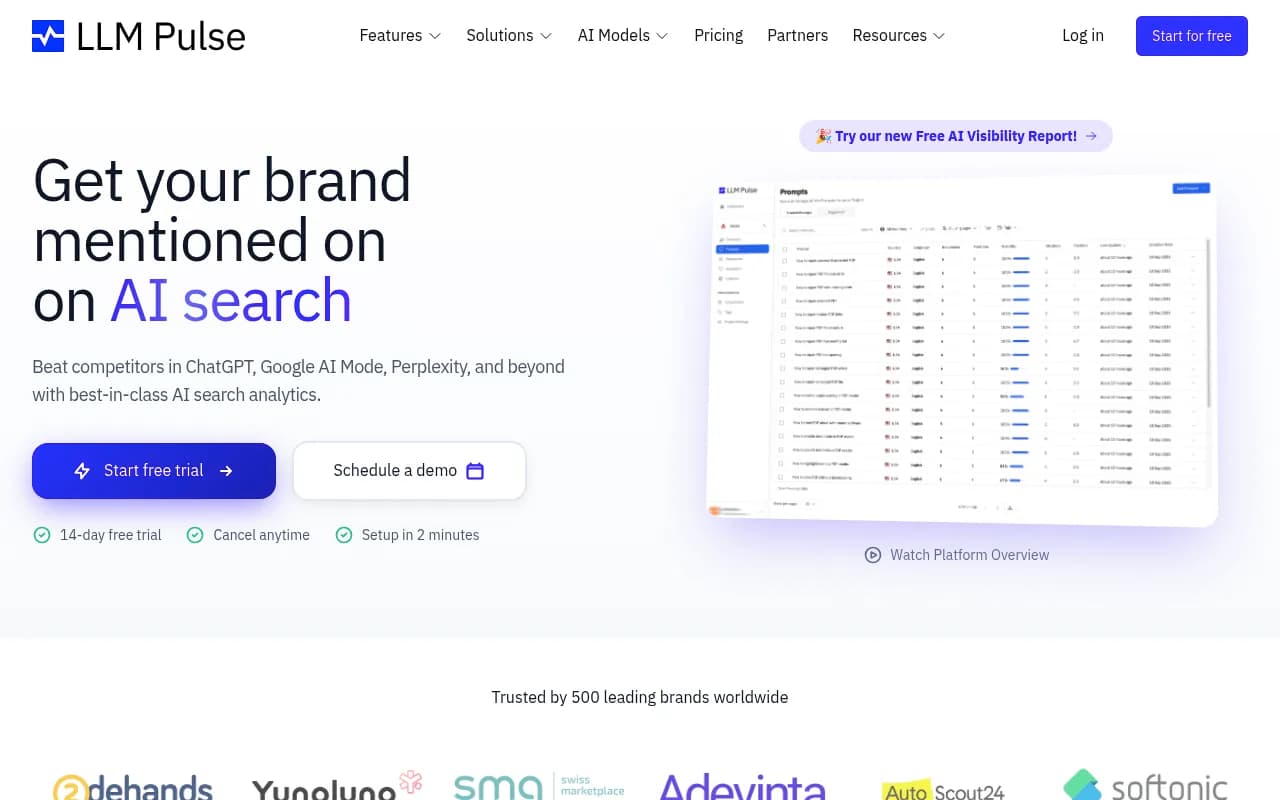
LLM Pulse is a comprehensive LLM response tracking platform that monitors ChatGPT, Perplexity, Gemini, Google AI Mode, AI Overviews, and (on Enterprise plans) DeepSeek, Grok, Claude, Copilot, and Meta AI. It tracks visibility scores, citation rates, sentiment, and share of voice. You can benchmark against competitors and see detailed responses (the exact words AI uses to describe your brand).
What sets LLM Pulse apart: AI-powered content recommendations. After tracking your prompts, LLM Pulse analyzes the responses and suggests content improvements to help you rank higher. It's not full content generation like Profound or Promptwatch, but it's more actionable than pure monitoring tools like Otterly.AI or Peec AI.
The interface is polished and the data is easy to read. You get weekly tracking, detailed citation analysis, and competitor benchmarking. The free AI Visibility Report is a nice touch -- similar to Hall AI's free report but with more detail.
Pricing: From €49/month (Starter: 40 prompts), Growth €99/mo (100 prompts), Scale €299/mo (300 prompts). 14-day free trial. Annual billing saves 17%.
Best for: Mid-market SaaS companies that want more than basic monitoring but don't need full enterprise features. Good for teams that want content recommendations without paying for full content generation.
Trade-offs: The content recommendations are helpful but not as actionable as Promptwatch's Answer Gap Analysis or Profound's Agents. You still have to do most of the content work yourself. Also, the Enterprise-only models (DeepSeek, Grok, Claude, Copilot, Meta AI) are locked behind custom pricing, which is frustrating if you want comprehensive coverage.
Passionfruit Labs
Passionfruit Labs is a full-service AI-native marketing agency that combines traditional SEO, Generative Engine Optimization (GEO), and paid ad management under one roof. It's not a self-serve tool like the others on this list -- it's a done-for-you service. You work with a team that handles everything from keyword research to content creation to AI visibility tracking.
The GEO monitoring component is self-serve and starts at $19/mo (20 prompts) to $99/mo (150 prompts). But the real value is the full-service agency retainers (likely $3k-$10k+/mo based on positioning). You get a dedicated team that builds your SEO and GEO strategy, creates content, manages Reddit engagement, and tracks results.
Pricing: Self-serve GEO monitoring from $19/mo (20 prompts) to $99/mo (150 prompts). Full-service agency retainers custom-priced (likely $3k-$10k+/mo).
Best for: E-commerce brands, SaaS companies, and high-growth startups that want a full-service agency to handle everything. Good for teams that don't have the time or expertise to manage GEO in-house.
Trade-offs: Expensive if you go the full-service route. The self-serve monitoring is cheap but limited -- you're better off with Otterly.AI or Peec AI if you just need basic tracking. The agency model makes sense if you want done-for-you service, but it's overkill if you just need a tool.
Radarkit
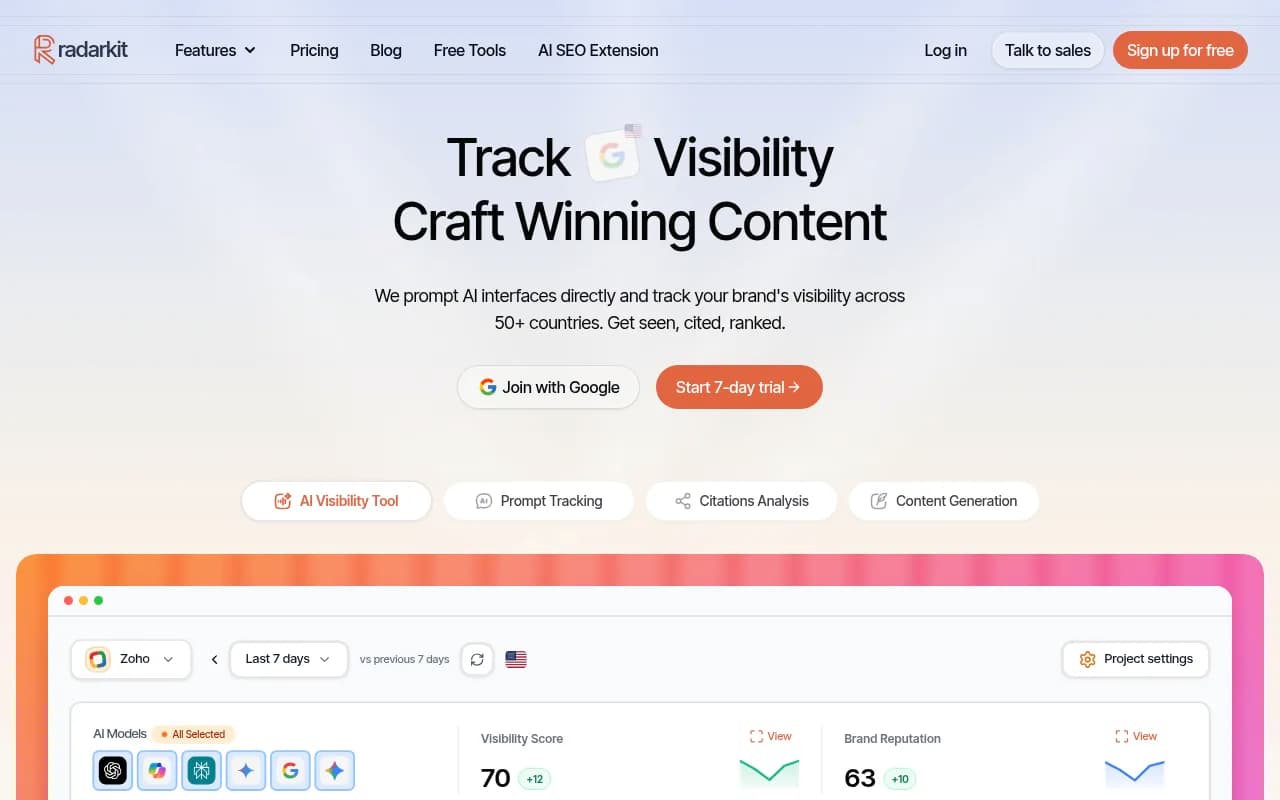
Radarkit is an AI search tracking and GEO content optimization platform that monitors brand visibility across ChatGPT, Perplexity, Gemini, Copilot, and Google AI Overviews in 50+ countries. It tracks citations, analyzes competitor presence, and generates content engineered to get cited by AI models.
The core features: visibility scores, brand reputation tracking, average position, sentiment analysis, and competitor benchmarking. You can track prompts across multiple countries and see how your brand appears in different regions. The content optimization tools are basic but useful -- Radarkit suggests topics and angles based on what's working for competitors.
What it lacks compared to Promptwatch or Profound: no Answer Gap Analysis, no prompt volume data, no AI crawler logs, no Reddit/YouTube tracking, no traffic attribution. The content generation is limited -- it suggests topics but doesn't write full articles like Promptwatch or Profound.
Pricing: From $29/mo (Lite), $99/mo (Pro), $299/mo (Business). Free trial available.
Best for: Mid-market SaaS companies that need multi-country tracking and basic content optimization. Good for teams that want a step up from pure monitoring tools but don't need full enterprise features.
Trade-offs: The content optimization tools are helpful but not as robust as Promptwatch's Answer Gap Analysis or Profound's Agents. You still have to do most of the content work yourself. Also, the multi-country tracking is useful but adds complexity -- if you only operate in one country, you're paying for features you don't need.
How to choose the right Hall AI alternative
If you just need basic monitoring and have a tight budget, go with Otterly.AI ($29/mo) or Peec AI (€89/mo). They track brand mentions and citations across major AI models and give you the data you need to understand where you stand. You won't get optimization tools, but you'll save money.
If you want to actually improve your AI visibility (not just monitor it), go with Promptwatch. It's the only platform that combines monitoring with action -- Answer Gap Analysis shows you what content is missing, the AI writing agent generates articles that rank, and page-level tracking shows your visibility improve. The price ($99-579/mo) is higher than budget tools but justified if you're serious about ranking in AI search.
If you're an enterprise brand with hundreds of prompts and need scale, go with Profound. It's expensive (likely $1k+/mo) but built for that use case. You get prompt volume data, AI crawler logs, and automated content creation at scale. Used by MongoDB, Ramp, and Zapier for a reason.
If you're a mid-market SaaS company and want something between budget tools and enterprise platforms, look at LLM Pulse (€49-299/mo) or Radarkit ($29-299/mo). They offer more features than Otterly.AI or Peec AI (content recommendations, multi-country tracking) but cost less than Promptwatch or Profound.
If you want a full-service agency to handle everything, go with Passionfruit Labs. The self-serve monitoring is cheap ($19-99/mo) but the real value is the done-for-you service (likely $3k-$10k+/mo). Good for teams that don't have the time or expertise to manage GEO in-house.
And if you're just getting started and want a free report to see where you stand, stick with Hall AI. The free shareable report is a decent starting point. But once you've seen the data, you'll need to upgrade to a platform that helps you take action.