Key Takeaways
- Promptwatch – Best overall alternative with content gap analysis, AI writing agent, and crawler logs. The only platform that helps you create content that ranks in AI, not just monitor visibility. From $99/mo.
- Profound – Enterprise-focused with prompt volume data and agent analytics, but expensive ($1,000-$3,000+/mo) and lacks content generation capabilities.
- AthenaHQ – Strong monitoring dashboard with 8+ AI models tracked, but no content creation tools or crawler logs. From $295/mo.
- Otterly.AI – Most affordable option at $29/mo, but basic monitoring only with no optimization features or traffic attribution.
- Peec AI – Multi-language support and smart suggestions, but limited actionable insights. From €89/mo.
GetMint launched in 2024 as a GEO platform targeting European brands, offering monitoring across major AI models like ChatGPT, Perplexity, and Google AI Overviews. But if you're evaluating GetMint, you're probably asking: does it actually help me improve my AI visibility, or just show me numbers?
The core problem with most GEO platforms (GetMint included) is they stop at monitoring. They show you dashboards, track citations, measure sentiment -- then leave you stuck figuring out what to do next. You see that competitors are ranking for prompts you're not, but you don't know which content gaps to fill or how to create articles that AI models will actually cite.
That's the difference between a monitoring tool and an optimization platform. Here's how the alternatives stack up.
Promptwatch

Promptwatch is the only platform in this comparison rated as a "Leader" across all categories in a 2026 analysis of 12 GEO tools. The core difference: it's built around taking action, not just tracking metrics.
The workflow is simple. Answer Gap Analysis shows you exactly which prompts competitors are visible for but you're not -- the specific content your site is missing. Then the built-in AI writing agent generates articles, listicles, and comparisons grounded in 880M+ citations analyzed, prompt volumes, persona targeting, and competitor data. This isn't generic SEO filler -- it's content engineered to get cited by ChatGPT, Claude, and Perplexity. Finally, page-level tracking shows your visibility scores improve as AI models start citing your new content, with traffic attribution (code snippet, GSC integration, or server log analysis) connecting visibility to revenue.
Additional capabilities that support this action loop:
- AI Crawler Logs: Real-time logs of ChatGPT, Claude, Perplexity crawlers hitting your site -- which pages they read, errors they encounter, how often they return. Most competitors lack this entirely.
- Prompt Intelligence: Volume estimates and difficulty scores for each prompt, plus query fan-outs showing how one prompt branches into sub-queries.
- Citation & Source Analysis: See exactly which pages, Reddit threads, YouTube videos, and domains AI models cite.
- Reddit & YouTube Insights: Surface discussions that directly influence AI recommendations.
- ChatGPT Shopping Tracking: Monitor when your brand appears in ChatGPT's product recommendations.
- Competitor Heatmaps: Compare your AI visibility vs competitors across LLMs.
- Multi-language & Multi-region: Monitor AI responses in any language, from any country, with customizable personas.
Monitors 10 AI models: ChatGPT, Perplexity, Google AI Overviews, Google AI Mode, Claude, Gemini, Meta/Llama, DeepSeek, Grok, Mistral, Copilot.
Pricing: Essential $99/mo (1 site, 50 prompts, 5 articles), Professional $249/mo (2 sites, 150 prompts, 15 articles, crawler logs), Business $579/mo (5 sites, 350 prompts, 30 articles). Free trial available.
Best for: Marketing teams and agencies that want to actually improve their AI visibility, not just track it. If you need content gap analysis, AI content generation, and crawler analytics in one platform, Promptwatch is the clear choice.
Profound

Profound is an enterprise Answer Engine Optimization platform used by MongoDB, Ramp, and Zapier. It combines visibility tracking, prompt volume data, AI crawler analytics, and automated content creation through its "Agents" feature.
The Agents feature is Profound's attempt at content optimization -- you can create AI-optimized content using templates (listicles, how-tos, comparisons) and integrate with your existing tools. But compared to Promptwatch's content gap analysis and AI writing agent, Profound's approach is more manual. You still need to figure out which prompts to target and what content to create.
Profound does offer strong prompt volume data (showing you how often specific prompts are asked) and agent analytics (tracking how AI bots crawl your site). The "Profound Index" provides research data on AI search trends. But the platform is expensive and aimed at enterprise buyers with custom pricing estimated at $1,000-$3,000+/month.
Monitors 9 AI models: ChatGPT, Perplexity, Claude, Gemini, Grok, Microsoft Copilot, Meta AI, DeepSeek, Google AI Overviews.
Pricing: Custom enterprise pricing (estimated $1,000-$3,000+/month). No public tiers or free trial.
Best for: Enterprise brands with large budgets who need prompt volume data and are willing to pay premium prices. Not ideal for mid-market companies or agencies managing multiple clients.
AthenaHQ

AthenaHQ is a comprehensive GEO platform that tracks visibility, position, and sentiment across 8+ AI search engines. Used by ZoomInfo, Coinbase, and SoFi, it's positioned as an end-to-end AEO/GEO platform.
The dashboard is clean and the metrics are solid -- you can see visibility trends, sentiment analysis, and position tracking across ChatGPT, Perplexity, Claude, Gemini, and others. AthenaHQ also offers prompt organization with tags and multi-country tracking.
But here's what's missing: no content gap analysis, no AI writing agent, no crawler logs, no visitor analytics. AthenaHQ shows you the data but doesn't help you act on it. You see that your visibility is 47% compared to a competitor's 65%, but you don't get specific recommendations on which content to create or how to optimize existing pages.
The platform is monitoring-focused. If you want to improve your AI visibility, you'll need to figure out the strategy yourself or use another tool for content creation.
Monitors 8+ AI models including ChatGPT, Perplexity, Claude, Gemini, Google AI Overviews.
Pricing: From $295/mo (self-serve) or $95/mo annual. Enterprise custom pricing. No free trial.
Best for: Brands that want a polished monitoring dashboard and are comfortable handling content optimization separately. Not ideal if you need help creating content that ranks in AI.
Otterly.AI

Otterly.AI is the most affordable option in this comparison, starting at $29/mo for 15 prompts. It's a straightforward monitoring tool that tracks brand mentions and website citations across ChatGPT, Google AI Overviews, Perplexity, Google AI Mode, Gemini, and Copilot.
The platform offers AI keyword research to identify search prompts your audience is asking, brand monitoring to see which brands get recommended, and a GEO Audit tool that analyzes 25+ on-page factors.
But Otterly.AI is basic. No crawler logs, no visitor analytics, no content generation, no prompt volume data. The GEO Audit tool gives you a checklist of on-page factors but doesn't show you which content gaps to fill or help you create new content. It's monitoring-only.
If you're just starting with GEO and want to understand your baseline visibility without spending much, Otterly.AI works. But you'll quickly outgrow it if you want to actually improve your rankings.
Monitors 6 AI models: ChatGPT, Google AI Overviews, Perplexity, Google AI Mode, Gemini, Copilot.
Pricing: From $29/mo (Lite: 15 prompts), $189/mo (Standard: 100 prompts), Custom (Premium: unlimited prompts). 14-day free trial.
Best for: Small businesses or solopreneurs who want basic monitoring on a tight budget. Not suitable for teams that need optimization features or content creation tools.
Peec AI

Peec AI is a multi-language AI search analytics platform used by 1,500+ marketing teams. It tracks visibility, position, and sentiment across ChatGPT, Perplexity, Claude, and Gemini.
The platform's strength is multi-language and multi-country tracking -- you can monitor AI responses in different languages and regions. Peec also offers prompt organization with tags and "smart suggestions" (though it's unclear what these suggestions entail based on the website).
But like AthenaHQ and Otterly.AI, Peec is monitoring-focused. No content gap analysis, no AI writing agent, no crawler logs. The dashboard shows you visibility percentages and sentiment scores, but you're left to figure out the optimization strategy yourself.
Peec does offer a freemium model with a free trial, which is useful for testing the platform before committing.
Monitors 4+ AI models: ChatGPT, Perplexity, Claude, Gemini.
Pricing: From €89/mo (Starter), €199/mo (Professional), Enterprise custom. Free trial available.
Best for: International brands that need multi-language tracking and want a monitoring dashboard with basic insights. Not ideal if you need help creating content or tracking AI crawler behavior.
Scrunch
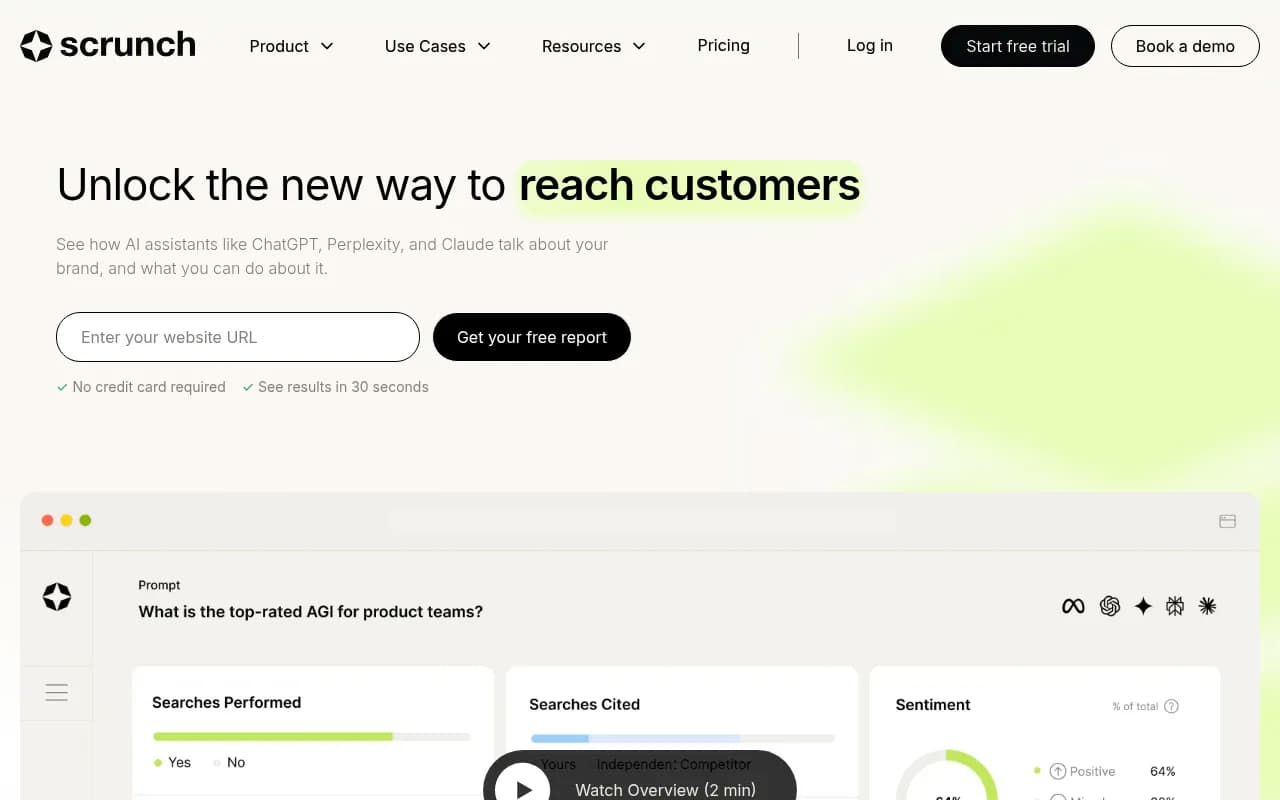
Scrunch positions itself as an "AI Customer Experience Platform" with three components: Monitoring, Insights, and Agent Experience Platform (AXP).
The Monitoring component tracks brand presence, performance, and position across LLMs. The Insights component provides optimization tips, citation analysis, and error detection when AI bots can't crawl your site. The AXP component is interesting -- it lets you create a parallel version of your site "translated for AI traffic," essentially optimizing how AI models read your content.
Scrunch is used by Lenovo, Clerk, and Penn State University. The platform offers AI traffic tracking (real-time feed of AI bots crawling your site) and actionable optimization tips.
But Scrunch is expensive, starting at $250/mo for the Starter plan (billed annually). And while the AXP concept is intriguing, it's not clear how much manual work is required to set up and maintain a parallel AI-optimized site. The platform also lacks content gap analysis and AI content generation.
Monitors multiple AI models including ChatGPT, Perplexity, and Claude.
Pricing: From $250/mo (Starter plan billed annually), $417/mo (Growth plan), Enterprise custom. 7-day free trial.
Best for: Brands with technical resources who want to experiment with creating AI-optimized versions of their site. Not ideal for teams that need straightforward content gap analysis and content creation.
Search Party
Search Party is an AI visibility and sentiment tracking platform starting at $95/mo. It monitors how brands appear in AI-generated responses across ChatGPT, Perplexity, Claude, and other LLMs.
The platform offers automated reports and visibility tracking, but details are limited. The website (searchparty.ai) is currently for sale, which raises questions about the platform's future and ongoing development.
Based on available information, Search Party appears to be a basic monitoring tool without advanced features like content gap analysis, AI writing agents, or crawler logs.
Pricing: From $95/mo.
Best for: Unclear given limited information and the domain being for sale. Proceed with caution.
Which GetMint alternative should you choose?
If you want to actually improve your AI visibility (not just track it), Promptwatch is the clear winner. It's the only platform that shows you which content gaps to fill, helps you create AI-optimized content, and tracks the results with crawler logs and traffic attribution. The pricing is competitive ($99-$579/mo) and the feature set is unmatched.
If you're an enterprise with a large budget and need prompt volume data, Profound is worth considering -- but expect to pay $1,000-$3,000+/month.
If you just want basic monitoring on a tight budget, Otterly.AI at $29/mo is the cheapest option, but you'll quickly hit its limitations.
AthenaHQ and Peec AI are solid monitoring dashboards, but they don't help you optimize. Scrunch has interesting ideas with its AXP platform, but the pricing is high and the setup seems complex.
The bottom line: most GEO platforms are monitoring-only dashboards that show you data but leave you stuck. Promptwatch is built around taking action -- find the gaps, create content that ranks, track the results. That's the difference between a tracker and an optimization platform.