Key takeaways
- Searchable offers AI visibility monitoring but lacks the content generation, crawler logs, and traffic attribution that modern GEO workflows require
- In 2026, AI Overviews reduce organic clicks by 34.5% -- monitoring alone isn't enough; you need tools that help you fix the gaps
- Most marketers switching away from Searchable are moving to platforms with a full action loop: find gaps, create content, track results
- Promptwatch is the most complete alternative, covering 10 AI models with built-in content generation, crawler logs, and revenue attribution
- Lighter alternatives like Otterly.AI, Peec AI, and AthenaHQ work for teams that only need monitoring
Why this is happening now
Search changed faster in the past 18 months than in the previous decade. According to a Medium analysis by Naeem Abbas, AI Overviews now reduce clicks to websites below them by 34.5%, and over 68% of Google searches end without a site visit (Statista). That's not a blip -- it's a structural shift in how people get information.
The response from the marketing industry was predictable: a wave of AI visibility tools launched promising to show brands where they appear (or don't appear) in ChatGPT, Perplexity, Claude, and Google AI Overviews. Searchable was one of them.
The problem is that most of these tools, Searchable included, answered only one question: "Are we showing up?" They didn't answer the harder follow-up: "What do we do about it?"
That gap is exactly why marketers are looking elsewhere.
What Searchable does well
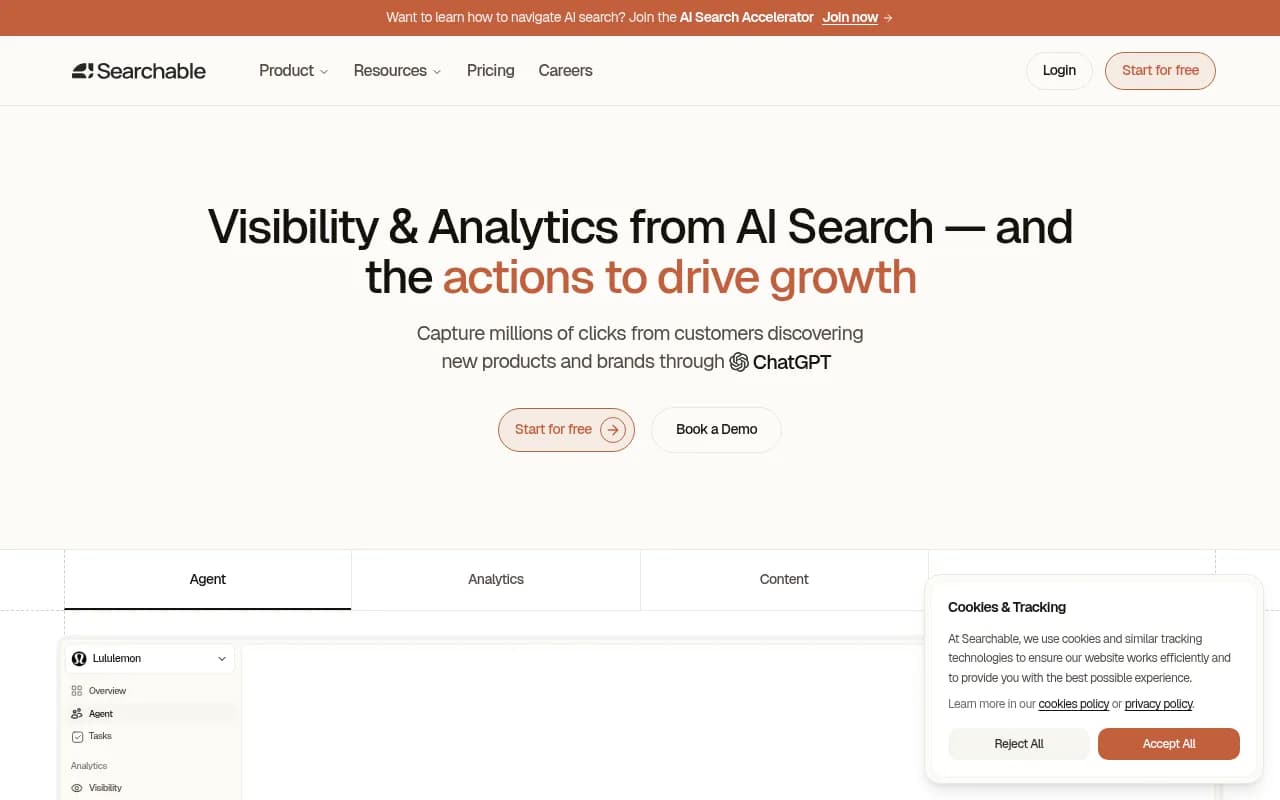
To be fair, Searchable isn't a bad product. It tracks brand mentions across AI models, gives you visibility scores, and lets you monitor how competitors appear in AI-generated responses. For a team that just wants a dashboard to report on AI visibility to leadership, it covers the basics.
But "the basics" is increasingly not enough.
Where Searchable falls short in 2026
Here's what teams consistently run into when they try to use Searchable as their primary GEO tool:
No content generation. Searchable can tell you that a competitor is getting cited for "best project management software for remote teams" and you're not. It cannot help you create the content that would change that. You're left exporting data and figuring out the writing yourself.
No crawler logs. Understanding which pages AI crawlers are actually visiting -- and which ones they're ignoring or hitting errors on -- is now a core diagnostic step. Searchable doesn't surface this. You can't fix what you can't see.
No traffic attribution. Knowing your AI visibility score went up is nice. Knowing that improvement drove 400 additional sessions and contributed to $12,000 in pipeline is what gets budget approved. Searchable doesn't connect visibility to revenue.
Limited prompt intelligence. Not all prompts are worth chasing. Prompt volume, difficulty, and query fan-outs (how one prompt branches into sub-queries) determine where to focus. Searchable's prompt data is thin compared to what dedicated GEO platforms now offer.
No Reddit or YouTube tracking. AI models don't only cite brand websites. They pull from Reddit threads, YouTube videos, and third-party sources. If you're not tracking what those sources say about your brand, you're missing a significant part of the picture.
These aren't edge cases. They're the things marketers actually need to move the needle.
The 2026 GEO tool landscape
Before jumping to recommendations, it helps to understand how the market is structured. There are roughly three tiers of AI visibility tools right now:
| Tier | What it does | Example tools |
|---|---|---|
| Monitoring only | Tracks brand mentions in AI responses, visibility scores | Otterly.AI, Peec AI, AthenaHQ |
| Monitoring + some optimization | Adds content suggestions or competitor gap analysis | AthenaHQ, Profound, Scrunch |
| Full action loop | Monitors, identifies gaps, generates content, tracks revenue | Promptwatch |
Most teams that leave Searchable are doing so because they've outgrown tier one and need tier two or three capabilities. Which tier you need depends on your team size, budget, and how seriously you're treating GEO as a channel.
The best Searchable alternatives in 2026
Promptwatch -- best for teams that want to actually fix their AI visibility
Promptwatch is the most complete GEO platform available right now. It monitors 10 AI models (ChatGPT, Claude, Perplexity, Gemini, Google AI Overviews, Google AI Mode, Grok, DeepSeek, Meta AI, Copilot, Mistral) and goes well beyond tracking.
The core difference is what Promptwatch calls the action loop. First, Answer Gap Analysis shows you the specific prompts where competitors are visible but you're not -- not vague categories, but the exact questions AI models are answering without citing your content. Second, a built-in AI writing agent generates articles, listicles, and comparisons grounded in citation data from 880M+ analyzed citations. Third, page-level tracking shows which of your pages are getting cited, by which models, and how often -- with traffic attribution via GSC integration, a code snippet, or server log analysis to connect visibility to actual revenue.
On top of that: real-time AI crawler logs (see exactly which pages ChatGPT and Perplexity are crawling and where they're hitting errors), Reddit and YouTube source tracking, ChatGPT Shopping monitoring, competitor heatmaps, and prompt volume and difficulty scoring.
Pricing starts at $99/month for the Essential plan (1 site, 50 prompts, 5 articles). Professional is $249/month and Business is $579/month. A free trial is available.

Otterly.AI -- best for budget-conscious monitoring
If you genuinely only need monitoring and Searchable's pricing doesn't justify itself, Otterly.AI is a solid, affordable alternative. It tracks brand mentions across the major AI models and gives you visibility trends over time. It won't help you create content or diagnose crawler issues, but it does the monitoring job cleanly.

AthenaHQ -- best for teams focused on competitive benchmarking
AthenaHQ tracks visibility across 8+ AI search engines and does a decent job of competitive benchmarking -- showing you how your brand stacks up against competitors across different models. It's more monitoring-focused than optimization-focused, but the competitive intelligence layer is more developed than Searchable's.

Profound -- best for mid-market teams with bigger budgets
Profound has a strong feature set and is well-regarded in the GEO space. It covers tracking, some content optimization guidance, and competitive analysis. The main friction is price -- it sits at a higher price point than Promptwatch for comparable or fewer features, and it doesn't have Reddit tracking or ChatGPT Shopping monitoring.

Peec AI -- best for multi-language teams
If your brand operates across multiple languages and regions, Peec AI is worth a look. Its multi-language tracking is one of the better implementations in the market. It's monitoring-focused, so you'll still need a separate content workflow, but for international visibility tracking it punches above its weight.

Scrunch AI -- best for agencies managing multiple brands
Scrunch AI is built with agency workflows in mind. If you're managing AI visibility for multiple clients and need clean reporting and multi-brand dashboards, it's a reasonable option. Like most of the monitoring-only tools, it doesn't help with content creation, but the reporting layer is polished.
Head-to-head comparison
| Feature | Searchable | Promptwatch | Otterly.AI | AthenaHQ | Profound |
|---|---|---|---|---|---|
| AI model coverage | Limited | 10 models | Major models | 8+ models | Major models |
| Content gap analysis | No | Yes | No | Limited | Limited |
| Built-in content generation | No | Yes | No | No | No |
| AI crawler logs | No | Yes | No | No | No |
| Traffic attribution | No | Yes | No | No | No |
| Reddit/YouTube tracking | No | Yes | No | No | No |
| ChatGPT Shopping tracking | No | Yes | No | No | No |
| Prompt volume/difficulty | No | Yes | No | No | Limited |
| Starting price | Varies | $99/mo | Lower tier | Varies | Higher tier |
The table makes the gap pretty clear. Searchable and most monitoring-only tools are stuck at the left side of the workflow. Promptwatch covers the full loop.
How to think about switching
Switching GEO tools isn't trivial. You'll lose historical baseline data (at least temporarily), need to re-configure your prompt sets, and spend time onboarding. Here's a practical approach:
Start with a gap audit. Before you switch anything, document what you're currently tracking in Searchable -- your prompt list, the competitors you're benchmarking, and your current visibility scores. This gives you a baseline to compare against after migration.
Run a parallel trial. Most platforms, including Promptwatch, offer free trials. Run both tools simultaneously for 2-4 weeks before fully committing. This lets you validate that the new platform is capturing the same (or more) data before you cancel the old subscription.
Prioritize the action loop. The reason to switch isn't to get a prettier dashboard -- it's to actually improve your AI visibility. When evaluating alternatives, focus on whether the tool helps you identify content gaps and take action on them, not just whether it shows you a visibility score.
Check crawler log support early. If your site has technical issues that are preventing AI crawlers from properly indexing your content, no amount of content creation will fix your visibility. Crawler log analysis should be one of the first things you do on a new platform.
The bigger picture
The shift away from Searchable is part of a broader pattern. In 2026, AI search isn't a side channel -- for many brands, it's becoming the primary way customers discover them. According to WTSFest London research covered by Design Monkey, zero-click searches and AI Overviews are fundamentally changing what "ranking" means.
In that environment, a monitoring dashboard is like a speedometer with no steering wheel. You can see how fast you're going, but you can't change direction.
The tools that are winning right now are the ones that close the loop between insight and action. That's the real reason marketers are leaving Searchable -- not because the data is bad, but because data without a path to improvement isn't enough anymore.
If you're evaluating alternatives, start with what you actually need to do: find the prompts you're missing, create content that AI models will cite, and track whether it's working. Pick the tool that covers all three steps, not just the first one.