Key takeaways
- Siftly split its product into Siftly Answers and Siftly Shopping in 2026, and the Shopping line's ecommerce focus left many B2B SaaS teams feeling like an afterthought.
- The most common practical complaints: a 150-prompt ceiling on public plans, Claude locked behind Enterprise, no Looker Studio connector, seat caps, and content-generation quotas bundled into every tier.
- Siftly's raw cost-per-response is actually good. The independent math says the problem isn't price per answer, it's statistical confidence at lower tiers and reporting depth.
- Teams leaving Siftly mostly went to LLM Pulse, Peec AI, Otterly.ai, Profound, AthenaHQ, or full-stack platforms like Promptwatch, depending on whether they wanted depth, agency features, or execution help.
- Before switching, run a 30-day overlap: track the same prompt set in both tools and compare. The differences in methodology will surprise you.
Siftly is a YC-backed AI visibility platform that does brand monitoring, prompt tracking, citation tracking, crawler traffic monitoring, and GEO content and outreach across ChatGPT, Google AI Overviews, Perplexity, Gemini, AI Mode, Copilot, Grok, and DeepSeek. On paper that's a solid stack, and for a lot of 2025 it was an easy recommendation for B2B SaaS teams who wanted AI search visibility without an enterprise contract.
Then 2026 happened, and the switch requests started showing up in comparison threads, agency Slack channels, and procurement reviews. This guide walks through what actually drove those switches, what the numbers say when you do the math yourself, and where teams ended up. If you're currently on Siftly and wondering whether to stay, this should give you a decision framework rather than a list of affiliate links.
Why B2B SaaS teams picked Siftly in the first place
To be fair to Siftly, it earned its customers honestly. Three things made it attractive:
- Bundled execution. Most AI visibility tools in 2025 were trackers with a roadmap slide about "content optimization coming soon." Siftly shipped actual content: blog posts, FAQ and schema markup, citation outreach, and social distribution to Reddit, LinkedIn, YouTube, Quora, and the rest. For a lean SaaS marketing team, that was the whole job in one subscription.
- The Siftly Agent. An agent that finds visibility gaps, proposes fixes, and proves the fix worked is a genuinely good idea, and it's the part of the product that competitors spent 2026 copying.
- Aggressive pricing. At $79/mo for 4,500 responses, the entry tier undercut most of the field on raw cost-per-response.
That combination works well for a self-serve SaaS company doing its first serious GEO program. The problems show up later, at scale, and they're specific.
What changed in 2026: the product split
The single biggest structural change is that Siftly divided itself into two products: Siftly Answers for general brand visibility and Siftly Shopping for SKU-level, ecommerce visibility.
For an ecommerce brand, that split makes sense. Product cards, SKU-level tracking, and shopping-optimized GEO are a real category, and Promptwatch's own data on ChatGPT shopping feature usage shows how much shopping surfaces have grown in AI answers.
But B2B SaaS companies don't have SKUs. They have a platform, a docs site, a pricing page, and a blog. When a vendor's roadmap energy visibly shifts toward product cards and geo-tracking for listings, SaaS teams start asking whether their use case is still the priority. That question gets louder when the Shopping line gets the multi-geography features while Answers customers wait.
This is the pattern that shows up in almost every "why we left" story: not a scandal, not a price hike, just a slow realization that the product is being built for someone else now.
The specific complaints, ranked by how often they come up
1. The prompt ceiling
Siftly's public plans cap at 150 prompts (Scale, $599/mo). Beyond that you're in Enterprise, talking to sales. For a SaaS company tracking buyer-intent prompts across segments, competitors, and use cases, 150 fills up fast. One of the odd things about AI search is that citation share is a long tail: Promptwatch's June 2026 ChatGPT citation share data shows no domain holding even 4% of total citations, with Reddit at 3.71% as the leader. In a market that fragmented, your prompt panel is your strategy. A hard cap at 150 is a real constraint, not a nitpick.
2. Claude is Enterprise-only
Claude tracking requires the Enterprise tier, which is quote-only. This isn't unique to Siftly; most of the category gates Claude behind top tiers. But it stings more now, because Claude's citation crawler has been growing as a share of AI crawler traffic, per Promptwatch's Claude crawler data. Teams who see Claude traffic converting on their site but can't see Claude in their monitoring tool have a legitimate grievance.
3. No Looker Studio connector
Siftly doesn't list a Looker Studio connector, while competitors like LLM Pulse and Peec AI include one from entry and mid tiers. If your growth team blends AI visibility data into existing dashboards alongside GA4 and spend data, this alone can be disqualifying. Exporting CSVs into a spreadsheet is not a 2026 workflow.
4. Bundled content you don't use
Every self-serve tier bundles content generation: 8 blog posts per month on Starter, scaling to 60 multi-language posts on Scale. If you already have a content operation, and most serious B2B SaaS teams do, you're paying for capacity you'll never use. It's the inverse of the old cable-bundle problem: you can't opt out, and the line item is a real chunk of the subscription.
5. Seat caps and reporting depth
Paid tiers cap seats (5 on Starter, scaling up on higher plans), and reporting lacks the multi-project dashboards and prompt-level historical drilldowns that agency-scale work needs. Fine for a five-person growth team. Thin for anything bigger.
What the math actually says about Siftly's numbers
Here's where it gets interesting, because Siftly's raw pricing is genuinely competitive, and one of the few independent analyses (from EchoWi, a competitor that discloses its bias) did the underlying statistics.
The headline: Siftly Scale works out to roughly $0.0055 per response tracked, the cheapest in their comparison set. Growth is about $0.0083, Starter about $0.0176. On cost-per-answer, Siftly wins.
But cost-per-answer isn't the whole story. The same analysis worked out how many observations you actually get per prompt per engine slot: roughly 1 run per day on Starter, 2.5 on Growth, 3 on Scale. At Starter's ~30 monthly observations per slot, a mention-rate reading carries a confidence interval of roughly ±16 percentage points. That's not a number you can make a per-prompt decision with. Scale's ~90 runs per month narrows it to about ±9 points, which is better but still wide if you're claiming precision to a board.
Siftly says it reports mention rates with confidence intervals, but doesn't disclose the method or confidence level, so you can't verify it. And it's unclear whether Siftly queries live web UIs or APIs, which matters because user-facing answers and citations can differ from API outputs.
So the honest summary is: Siftly is cheap per answer, but at lower tiers you're buying volume without statistical confidence, and at higher tiers you're paying for content capacity you may not use. That's the gap teams fell into.
Why this matters more for B2B SaaS specifically
Two things make AI visibility measurement unusually high-stakes for SaaS teams right now.
First, the citation slots are scarce. Promptwatch's data on average sources per response shows ChatGPT cites about 5 sources per web-search response, versus roughly 10 for Google AI Overviews and Perplexity. Fewer slots means each one is more contested, which means your monitoring data needs to be good enough to act on.
Second, what gets cited is shifting toward formats SaaS teams control. Product pages became the single most-cited content type on ChatGPT Search in July 2026 at 32.8% of daily citations, nearly double their March share, per Promptwatch's citation-type data. Listicles, how-tos, and comparison pages are all growing too. When your pricing page and comparison pages are the battleground, "roughly is my brand mentioned" stops being an acceptable answer. You need per-page, per-prompt, per-engine data with enough sample size to trust.
Where teams went: the actual alternatives
Here's the landscape, based on what switching teams actually bought. A comparison table first, then the details.
| Tool | Entry price | Standout strength | Watch out for |
|---|---|---|---|
| LLM Pulse | €49/mo | Depth per euro: visibility score, sentiment, Looker Studio | Claude and extra engines are paid add-ons |
| Peec AI | ~$95/mo | Unlimited seats, agency features, published Enterprise pricing | Extra engines cost more on higher tiers |
| Otterly.ai | $29/mo | Cheapest real entry, 7 engines, unlimited team members | AI Mode, Gemini, Claude are add-ons |
| Profound | $99/mo (yearly) | Enterprise-grade analysis | Multi-engine coverage requires custom pricing |
| AthenaHQ | $295/mo | Content optimization agent, SaaS-marketer focus | No free tier, credit-based pricing |
| Promptwatch | $95/mo | Full stack: crawler logs, visitor analytics, content agents, CMS publishing | More than a tracker; overkill if you only want mentions |
LLM Pulse
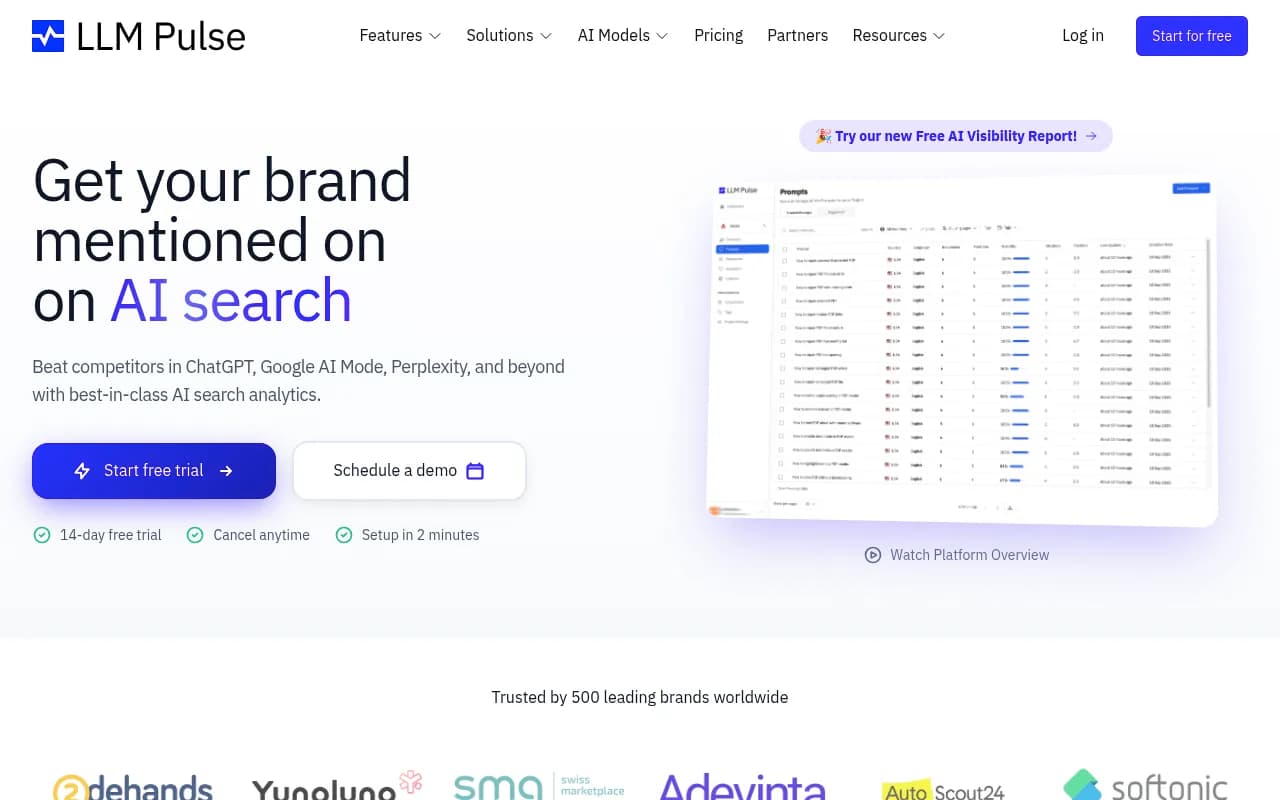
Positioned by several comparison roundups as the most direct Siftly alternative for teams that want monitoring depth without enterprise contracts. €49/mo gets you 50 prompts across five standard engines (ChatGPT, Perplexity, Gemini, Google AI Mode, Google AI Overviews), a position-weighted visibility score, citation drilldowns by domain and URL, share of voice against competitors, sentiment, and a Looker Studio connector with a ready-made template. Claude, Copilot, Grok, and DeepSeek are paid add-ons.
Peec AI
Peec repriced lower in 2026 and went hard after agencies: unlimited seats on every plan, white-label reporting, multi-project dashboards, and an actual published Enterprise price (from $499/mo), unlike Profound's quote-only approach. Starter runs about $95/mo for 50 prompts and 3 engines of your choice. If Siftly's seat caps and missing Looker Studio support were your pain points, Peec fixes both.

Otterly.ai
The cheapest genuine entry point at $29/mo, and the only one in this set with unlimited team members on every plan. Otterly monitors real web interfaces rather than APIs only, tracks 7 engines and 50+ countries, and its Standard tier ($189/mo) includes Agent Analytics and API/MCP access. The trade-off: Google AI Mode, Gemini, and Claude are paid add-ons, so the cheap tier is narrower than it looks.

Profound
The enterprise pick. Profound's analysis depth is the reference point in this category, but full multi-engine coverage (up to 9 engines) requires custom Enterprise pricing; the $99/mo Starter tier is ChatGPT-only. Teams that switched from Siftly to Profound were usually larger and willing to trade price transparency for depth.

AthenaHQ
Built specifically for SaaS marketers, with a credit-based model ($295/mo Starter, 3,600 response credits) and an Advanced Content Optimization Agent on Enterprise plans. No free tier, which is a friction point, but the SaaS-specific focus addresses the "built for ecommerce" complaint directly.

Promptwatch
Worth naming separately because it represents a different bet about what this category becomes. Promptwatch is a full-stack platform rather than a tracker: AI crawler logs showing which pages bots actually read and where they hit errors, visitor analytics tying AI traffic to conversions, Reddit and YouTube citation tracking, ChatGPT Shopping and ads monitoring, and Content Agents that plan, write, and publish GEO-optimized content straight to Webflow, Framer, or WordPress. If your complaint about Siftly was "it monitors but I still do the work," this is the direction that answers that. Professional at $245/mo includes automated content generation and state-level tracking.
Promptwatch is used by 1,840+ brands and agencies including Duolingo, Yelp, and Typeform, and it's the platform our publisher 1001 SEO Media uses for its own GEO work.

The bundled-suite option
Some teams didn't pick a dedicated GEO tool at all. Semrush's AI visibility add-on and SE Ranking's AI toolkit appeal to teams that want one subscription and one dashboard, and already pay for an SEO suite. The catch: bundled add-ons tend to be shallower. Semrush's add-on reportedly covers only ChatGPT and Google AI Mode and lacks MCP and data export. Fine for awareness, thin for a serious program.
How to choose: a framework that isn't a feature list
Multiple sources converge on roughly the same evaluation criteria, and they're worth adopting before you look at any demo:
- Engines on the entry plan. Four or more is the baseline in 2026. Check which engines are add-ons versus included, especially Claude.
- Cost per prompt at the tier you'll actually use. Not cost per response, cost per prompt with the engine count you need.
- Sampling rigor. Ask how many observations per prompt per engine per month, and whether confidence intervals are disclosed. This is the question almost nobody asks and the one that matters most.
- Citation depth. Can you drill from engine to prompt to domain to URL? Production-grade now, not "coming soon."
- Reporting integrations. Looker Studio, GA4 blending, API/MCP access.
- Execution support. Content briefs, generation, CMS publishing, outreach, and whether the tool can prove a fix changed your citation rate.
One more thing worth copying from Siftly, ironically: their own comparisons page openly states it's self-published and tells buyers to verify with vendor documentation, demos, and independent reviews. That's honest, and it's the right posture. Every comparison you read in this category, including this one, has an angle. Do the overlap test.
The switch playbook: how to migrate without losing your data
If you do decide to move, the process that works:
- Export everything first. Prompt lists, historical mention rates, citation URLs, competitor sets. Check your tier's data retention before you cancel: Siftly scales retention from 30 days (Free) to 12 months (Scale).
- Run a 30-day overlap. Track the identical prompt set in both tools simultaneously. You'll learn each tool's sampling behavior and get a baseline, and the discrepancies between tools are themselves informative.
- Rebuild your prompt panel deliberately. A migration is a natural moment to cut dead prompts and re-tier by intent. Given that citation share is a long tail with no dominant domain, breadth of relevant prompts beats repetition of a few vanity ones.
- Keep the content, drop the quota anxiety. If you're moving off a bundled-content plan, decide what content work stays in-house, goes to an agency, or moves to an automated content agent.
The bottom line
Teams didn't leave Siftly because it's a bad product. They left because it's becoming a different product, one aimed at ecommerce, while B2B SaaS buyers needed deeper monitoring, more prompts, Claude coverage, and BI integration that the roadmap didn't prioritize. The statistics underneath the pricing are respectable at the top tier and shaky at the bottom, which is a solvable problem, but the product split made SaaS teams question the fit before they ever got to the math.
If you stay, stay deliberately: push for disclosed confidence intervals and confirm your tier's engine count in writing. If you leave, leave with data: run the overlap, keep your history, and pick the alternative based on whether you need depth (LLM Pulse), agency features (Peec), price (Otterly), enterprise analysis (Profound), SaaS focus (AthenaHQ), or end-to-end execution (Promptwatch). The category is young enough that the best hedge is measurement discipline, not vendor loyalty.