Summary
- AI visibility platforms track how often your brand appears in AI-generated answers from ChatGPT, Perplexity, Google AI Overviews, and other answer engines
- The best platforms go beyond monitoring to help you identify content gaps, generate optimized content, and track the impact on traffic and revenue
- Promptwatch leads the category as the only platform rated as a "Leader" across all capabilities -- it shows you what's missing, helps you create content that ranks in AI, and tracks results with page-level attribution
- Most competitors (Otterly.AI, Peec.ai, AthenaHQ) are monitoring-only dashboards that show data but don't help you take action
- Pricing ranges from $99/mo for basic monitoring to $500+ for platforms with content generation, crawler logs, and advanced analytics
AI search is eating traditional SEO. Your customers are asking ChatGPT for recommendations, getting answers from Perplexity, and reading AI-generated summaries in Google instead of clicking through to websites. If your brand isn't cited in those answers, you're invisible.
Content marketing teams need a way to track this new reality. That's where AI visibility platforms come in. These tools monitor how often your brand appears across AI answer engines, which prompts trigger citations, and where competitors are winning. The best ones go further -- they help you fix the gaps.
I've spent the last three months testing every major platform in this category. Here's what actually works for content teams in 2026.
What AI visibility platforms actually do
AI visibility platforms track your brand's presence across answer engines like ChatGPT, Claude, Perplexity, Google AI Overviews, Gemini, and others. They run prompts (questions your customers might ask), capture the AI-generated responses, and analyze which brands get cited, recommended, or mentioned.
The core metrics most platforms track:
- Citation rate: How often your website or brand appears in AI responses
- Share of voice: Your visibility vs competitors for specific prompts
- Prompt coverage: Which customer questions trigger mentions of your brand
- Source analysis: Which pages, domains, or content types AI models cite most
But monitoring alone doesn't move the needle. Content teams need platforms that help them understand why they're invisible for certain prompts and what content to create to fix it. That's where the category splits into two camps: monitoring-only dashboards vs optimization platforms.
The action gap: monitoring vs optimization
Most AI visibility platforms are glorified dashboards. They show you charts of citation rates, competitor comparisons, and prompt-level breakdowns. Useful for reporting to executives. Not useful for actually improving your visibility.
The problem: knowing you're invisible for "best project management software" doesn't tell you what to do about it. You're left guessing which content to create, which angles to cover, or which gaps to fill.
Optimization platforms close this loop. They analyze the prompts where competitors appear but you don't, surface the specific topics and questions your content is missing, and help you create articles engineered to get cited by AI models. Then they track whether the new content actually improves your visibility.
This is the difference between a reporting tool and a growth tool.
Top 7 AI visibility platforms compared
1. Promptwatch: Best for teams that want to take action, not just monitor
Promptwatch is the only platform in this category that closes the full loop from monitoring to optimization to attribution. It tracks 10 AI models (ChatGPT, Perplexity, Google AI Overviews, Claude, Gemini, Meta AI, DeepSeek, Grok, Mistral, Copilot), but the real value is what happens after the tracking.

Why it's different: Answer Gap Analysis shows you exactly which prompts competitors rank for but you don't. You see the specific content your website is missing -- the topics, angles, and questions AI models want but can't find on your site. Then the built-in AI writing agent generates articles grounded in 880M+ citations analyzed, prompt volumes, and competitor data. This isn't generic SEO filler -- it's content engineered to get cited.
The platform also includes:
- AI crawler logs: Real-time logs of ChatGPT, Claude, Perplexity, and other AI agents crawling your site. See which pages they read, errors they hit, and how often they return. Most competitors lack this entirely.
- Prompt intelligence: Volume estimates and difficulty scores for each prompt, plus query fan-outs showing how one prompt branches into sub-queries. Prioritize high-value, winnable prompts.
- Reddit & YouTube tracking: Surface discussions that directly influence AI recommendations -- a channel most platforms ignore.
- ChatGPT Shopping monitoring: Track when your brand appears in product recommendations and shopping carousels.
- Traffic attribution: Connect visibility to revenue with code snippet, GSC integration, or server log analysis.
Best for: Content teams that want to improve AI visibility, not just measure it. Marketing teams tired of monitoring-only dashboards.
Pricing: Essential $99/mo (1 site, 50 prompts, 5 articles), Professional $249/mo (2 sites, 150 prompts, 15 articles, crawler logs), Business $579/mo (5 sites, 350 prompts, 30 articles). Agency/Enterprise custom pricing available. Free trial.
What users say: In a 2026 comparison of 12 GEO platforms, Promptwatch is the only one rated as a "Leader" across all categories. The core difference: most competitors show you data but leave you stuck. Promptwatch shows you what's missing, then helps you fix it.
2. Profound: Best for enterprise teams that need granular analytics
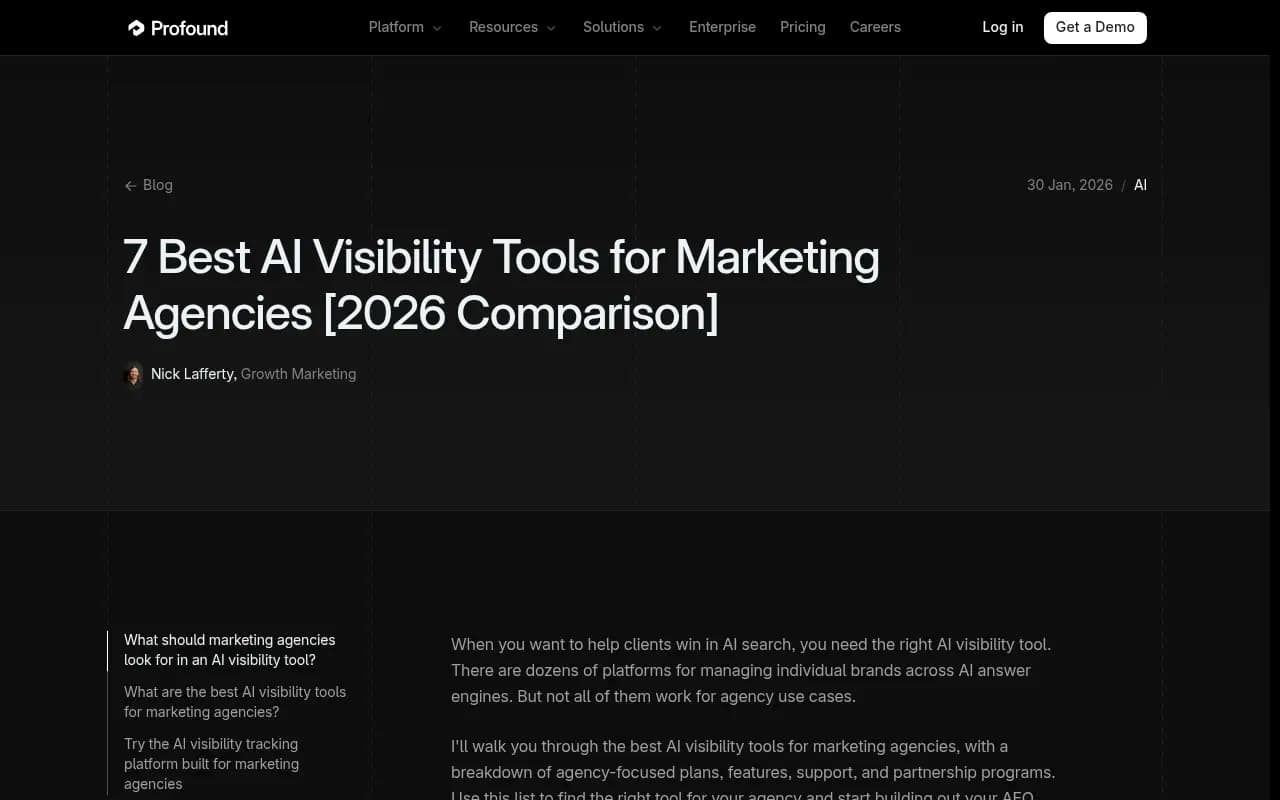
Profound positions itself as an enterprise-grade platform with deep analytics and governance features. It tracks 10+ AI engines and offers 400M+ prompt insights, SOC 2 Type II compliance, and agency-specific features like pitch environments.

Standout features:
- Agency mode with brand configurations and pitch environments for prospecting
- Granular prompt-level tracking with volume estimates
- Strong competitor analysis and share of voice metrics
- Enterprise governance and security certifications
Where it falls short: Several reviews note Profound is stronger at monitoring than prescriptive optimization. You get detailed visibility data but less guidance on what content to create or how to fix gaps. No built-in content generation.
Best for: Enterprise marketing teams and agencies that need detailed reporting, multi-client management, and security compliance.
Pricing: Starts around $500/mo for team plans, scales to enterprise. Custom pricing for agencies.
3. Scrunch: Best AI visibility command center for broad coverage
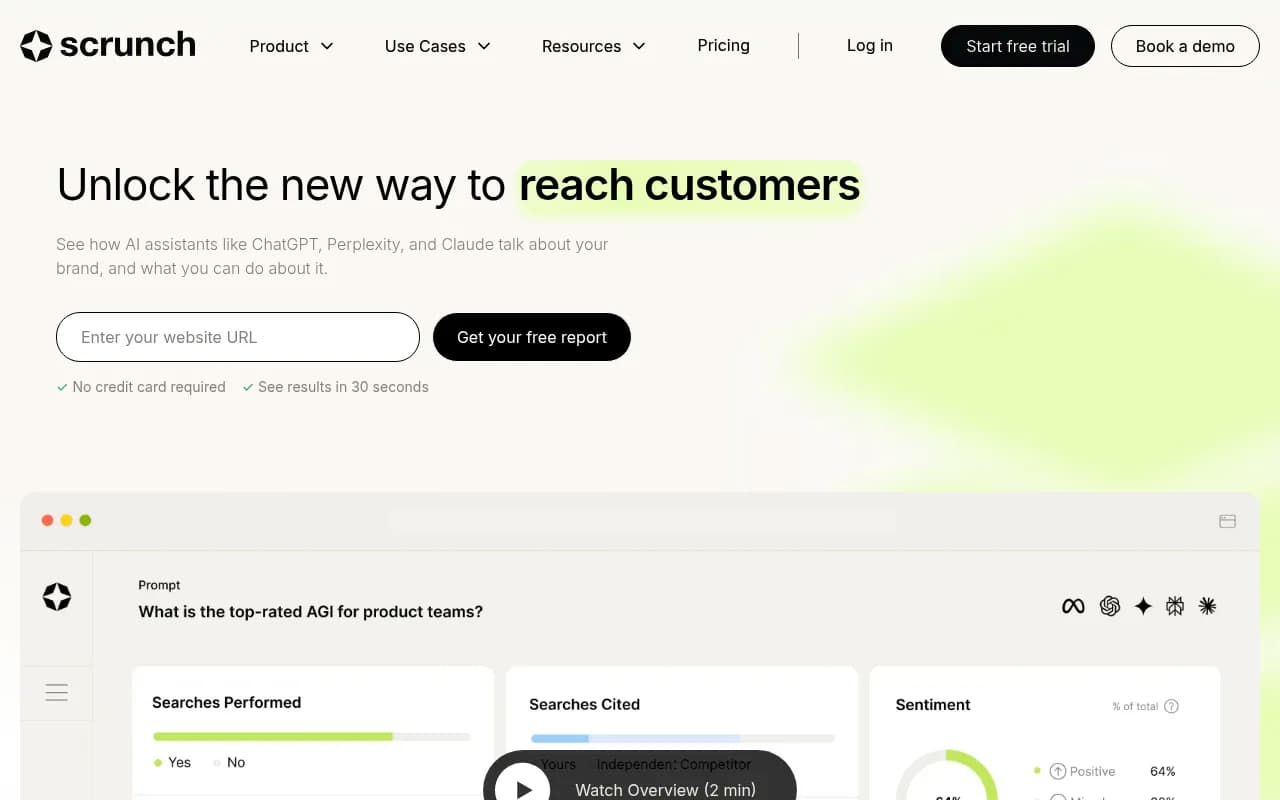
Scrunch offers clean monitoring across multiple AI engines with prompt and competitor tracking. It's designed for teams that want reliable visibility reporting week over week.
Standout features:
- Broad AI engine coverage in one dashboard
- Prompt + competitor tracking that maps "where we show up" vs "where they show up"
- Stakeholder-friendly reporting with fast onboarding
Where it falls short: Like Profound, Scrunch is stronger at showing what's happening than telling you what to do next. No content gap analysis or generation capabilities.
Best for: Marketing teams and agencies that want consistent visibility tracking with clean reporting.
Pricing: Starts around $300/mo for entry, ~$500/mo for team plans.
4. Peec AI: Best for multi-language tracking
Peec AI specializes in tracking AI visibility across multiple languages and regions. If your content strategy spans international markets, Peec gives you visibility into how AI models respond in different languages.

Standout features:
- Multi-language prompt tracking
- Regional AI response variations
- Clean interface for international teams
Where it falls short: Monitoring-focused platform without content optimization or generation features. Limited to tracking and reporting.
Best for: International brands and content teams managing multi-language AI visibility.
Pricing: Custom pricing based on languages and prompt volume.
5. Otterly.AI: Best budget option for basic monitoring
Otterly.AI offers affordable AI visibility monitoring for teams that need basic tracking without advanced features.

Standout features:
- Low price point for startups and small teams
- Core visibility metrics across major AI engines
- Simple setup and interface
Where it falls short: Very limited feature set compared to other platforms. No crawler logs, no visitor analytics, no content generation, no gap analysis. Pure monitoring.
Best for: Startups and small content teams on tight budgets that need basic visibility tracking.
Pricing: Starts around $99/mo for basic plans.
6. AthenaHQ: Best for teams that prioritize monitoring over optimization
AthenaHQ tracks brand visibility across 8+ AI search engines with a focus on monitoring and reporting.

Standout features:
- Clean monitoring dashboard
- Multi-engine tracking
- Competitor comparison views
Where it falls short: Monitoring-focused platform without content optimization or generation capabilities. You see the data but don't get help fixing the gaps.
Best for: Teams that want visibility tracking and are comfortable handling content strategy internally.
Pricing: Custom pricing based on tracked prompts and engines.
7. Conductor: Best for persona-based tracking
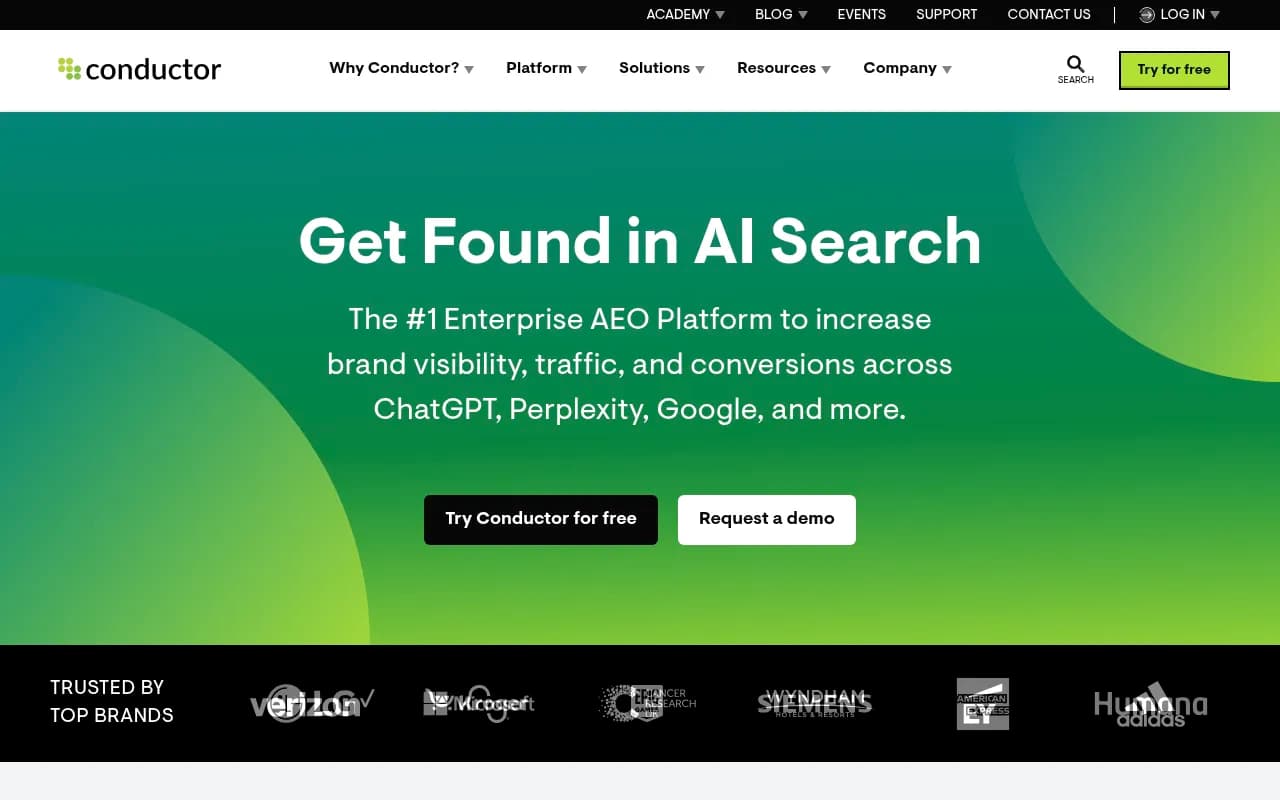
Conductor offers AI visibility tracking with persona customization, allowing you to track how different customer segments experience AI search results.
Standout features:
- Persona-based prompt tracking
- Integration with broader SEO platform
- Enterprise-grade analytics
Where it falls short: AI visibility is one feature within a larger SEO platform. Not as specialized or deep as dedicated AI visibility tools. Limited content optimization features.
Best for: Enterprise teams already using Conductor for SEO that want to add AI visibility tracking.
Pricing: Enterprise pricing, typically $1,000+/mo as part of broader platform.
Platform comparison table
| Platform | Starting price | AI engines tracked | Content generation | Crawler logs | Gap analysis | Best for |
|---|---|---|---|---|---|---|
| Promptwatch | $99/mo | 10 | Yes | Yes | Yes | Teams that want optimization, not just monitoring |
| Profound | ~$500/mo | 10+ | No | No | Limited | Enterprise teams needing detailed analytics |
| Scrunch | ~$300/mo | Multiple | No | No | No | Agencies wanting clean reporting |
| Peec AI | Custom | Multiple | No | No | No | International/multi-language teams |
| Otterly.AI | ~$99/mo | Major engines | No | No | No | Budget-conscious startups |
| AthenaHQ | Custom | 8+ | No | No | No | Monitoring-focused teams |
| Conductor | $1,000+/mo | Multiple | No | No | Limited | Enterprise SEO teams |
What content teams actually need from an AI visibility platform
After testing these platforms for three months, here's what separates useful tools from expensive dashboards:
1. Content gap identification: The platform should tell you exactly which prompts competitors rank for but you don't. Not just "you're losing to Competitor X" but "here are the 47 specific prompts where they appear and you're invisible, and here's what content you're missing."
2. Actionable recommendations: Knowing you're invisible for a prompt is useless without guidance on what to do about it. The best platforms analyze why competitors win (which content angles they cover, which questions they answer, which sources they cite) and tell you what to create.
3. Content generation grounded in citation data: Generic AI writing tools produce generic content. Platforms that analyze 880M+ citations and generate content based on what actually gets cited by AI models produce content that ranks.
4. Crawler visibility: AI models crawl your website to understand what content you have. If they can't crawl it, they can't cite it. Platforms with crawler logs show you exactly which pages AI agents read, errors they encounter, and indexing issues to fix.
5. Attribution and ROI tracking: Visibility metrics are vanity metrics without revenue impact. The best platforms connect AI visibility to actual traffic and conversions through code snippets, GSC integration, or server log analysis.
Most platforms in this category offer #1 (gap identification) in some form. Very few offer #2-5. That's why Promptwatch leads the category -- it's the only platform built around the full action loop from finding gaps to creating content to tracking results.
How to choose the right platform for your team
Start by asking what you actually need:
If you just want to track visibility and report to executives: Scrunch, AthenaHQ, or Otterly.AI will work. You get dashboards, charts, and competitor comparisons. Budget $100-500/mo.
If you want to actually improve your AI visibility: You need a platform with content gap analysis, generation capabilities, and optimization features. Promptwatch is the only platform that offers all three. Budget $250-600/mo depending on scale.
If you're an agency managing multiple clients: Look for platforms with multi-brand management, pitch environments, and white-label reporting. Profound and Scrunch have agency-specific features. Budget $500+/mo.
If you're tracking international markets: Peec AI specializes in multi-language tracking. Budget varies based on languages.
If you're an enterprise team with complex governance needs: Profound offers SOC 2 compliance, enterprise security, and detailed analytics. Budget $1,000+/mo.
The honest truth: most content teams pick a monitoring platform, realize it doesn't help them improve visibility, then either upgrade to an optimization platform or give up on AI visibility entirely. Save yourself the wasted months and budget by starting with a platform that actually helps you take action.
The future of AI visibility platforms
AI search is still early. The platforms in this category are evolving fast. Here's what I expect to see in 2026:
More AI engines to track: We're already seeing DeepSeek, Grok, and regional AI models gain traction. Platforms that only track ChatGPT and Perplexity will fall behind.
Deeper integration with content workflows: The best platforms will integrate directly with CMSs, content calendars, and publishing workflows. Generate content in Promptwatch, publish to WordPress, track results -- all in one flow.
Better attribution models: Connecting AI visibility to revenue is still clunky. Expect better integration with analytics platforms, CRMs, and attribution tools.
Persona and intent modeling: Not all prompts are equal. Platforms will get better at understanding user intent, buying stage, and persona to help teams prioritize high-value prompts.
Real-time optimization: Right now, most platforms show you yesterday's data. The next generation will monitor AI responses in real-time and alert you when visibility drops or competitors surge.
The category is consolidating around two types of platforms: monitoring dashboards (cheap, limited) and optimization platforms (expensive, comprehensive). The middle ground is disappearing. Teams that want to win in AI search will need to invest in platforms that help them take action, not just track metrics.
Getting started with AI visibility tracking
If you're new to AI visibility tracking, here's how to start:
1. Audit your current visibility: Pick 20-30 prompts your customers might ask ("best [your category]", "how to [solve problem]", "[your brand] vs [competitor]"). Run them through ChatGPT, Perplexity, and Google AI Overviews manually. See where you appear.
2. Sign up for a platform trial: Most platforms offer free trials. Start with Promptwatch if you want optimization features, or Otterly.AI if you just want basic monitoring. Run your prompt list through the platform.
3. Identify your biggest gaps: Look for prompts where competitors appear but you don't. These are your quick wins -- create content that answers these prompts and you'll likely see visibility improve fast.
4. Create optimized content: Use the platform's gap analysis and recommendations to create content. If your platform has AI generation (Promptwatch does), use it. If not, write content that directly answers the prompts where you're invisible.
5. Track results: Monitor how your visibility changes over 30-60 days. AI models don't update instantly -- it takes time for new content to get crawled, indexed, and cited.
6. Scale what works: Once you see visibility improve for your test prompts, expand to more prompts, more topics, and more content.
The teams winning in AI search right now are the ones that treat this like a systematic process, not a one-time project. Pick a platform, commit to creating optimized content every week, and track the results. That's how you build AI visibility that actually drives business results.