Key takeaways
- Most AI search visibility tools have a steep setup curve -- the best ones get you tracking prompts and seeing competitor gaps within hours, not weeks
- Time-to-value varies wildly: some tools require manual prompt configuration and CSV imports; others auto-generate prompts from your domain and start tracking immediately
- The tools that combine fast onboarding with content generation (not just monitoring) deliver compounding value -- you fix gaps instead of just watching them
- Promptwatch, SE Visible, Otterly.AI, Peec AI, and Gauge stand out for how quickly new users reach their "aha moment"
- If you want to go beyond monitoring and actually improve your AI visibility, pick a platform with built-in content tools -- not just a dashboard
There's a problem nobody talks about when evaluating AI search visibility tools: most of them are genuinely hard to start using.
You sign up, you're greeted with an empty dashboard, and then you spend the next two hours figuring out which prompts to track, how to set up competitors, and what any of the numbers actually mean. By the time you see your first real insight, you've already lost momentum.
That matters. Marketing teams don't have unlimited runway to evaluate new tools. If a platform doesn't show clear value in the first session, it gets deprioritized -- and your AI visibility problem stays unsolved.
This guide focuses specifically on which AI search visibility tools get you to value fastest. Not which ones have the most features, or the most enterprise integrations, or the biggest citation database. Which ones make it easy to go from "I just signed up" to "I know exactly what to fix."
The criteria used here:
- How quickly can you start tracking prompts after signup?
- Does the tool help you find the right prompts, or do you have to bring your own?
- How long before you see a meaningful competitive insight?
- Is there a clear next action after you see the data?
Let's get into it.
How onboarding actually works in this category
AI visibility tools are a relatively new category, and the onboarding patterns haven't fully matured yet. A few common patterns emerge:
Some tools are built for analysts. They give you raw data, API access, and deep segmentation -- but expect you to know what you're doing before you log in. Profound and BrightEdge fall into this bucket. Powerful, but the learning curve is real.
Other tools are built for speed. They make assumptions on your behalf, auto-generate prompts, and show you a pre-populated dashboard within minutes. These are the ones that score well on time-to-value.
The best tools in 2026 do something smarter: they combine fast setup with guided workflows that tell you what to do next. You're not just looking at data -- you're being walked through a process.
The top 5 tools for fast onboarding and time-to-value
1. Promptwatch
Promptwatch is the clearest example of a platform designed around getting to value fast -- and then keeping you there.
The onboarding flow starts with your domain. You enter it, and Promptwatch suggests prompts based on your industry, competitors, and the topics AI models are already answering in your space. You're not starting from a blank slate. Within one session, you can have 50+ prompts tracking across ChatGPT, Perplexity, Claude, Gemini, and seven other AI models.
What makes the time-to-value genuinely fast here is the Answer Gap Analysis. Most tools show you where you appear -- Promptwatch shows you where you don't, and specifically which competitor is appearing instead. That's a much more actionable starting point. You're not staring at a visibility score wondering what to do; you're looking at a list of prompts where a competitor is getting cited and you're not.
The built-in AI writing agent takes it further. Once you've identified a gap, you can generate content designed to close it -- articles, listicles, comparisons -- grounded in Promptwatch's citation data. For teams that want to move from insight to execution without switching tools, this is a significant time saver.
Pricing starts at $99/month (Essential: 1 site, 50 prompts, 5 articles). The Professional plan at $249/month adds crawler logs and city-level tracking. A free trial is available.

2. SE Visible (by SE Ranking)
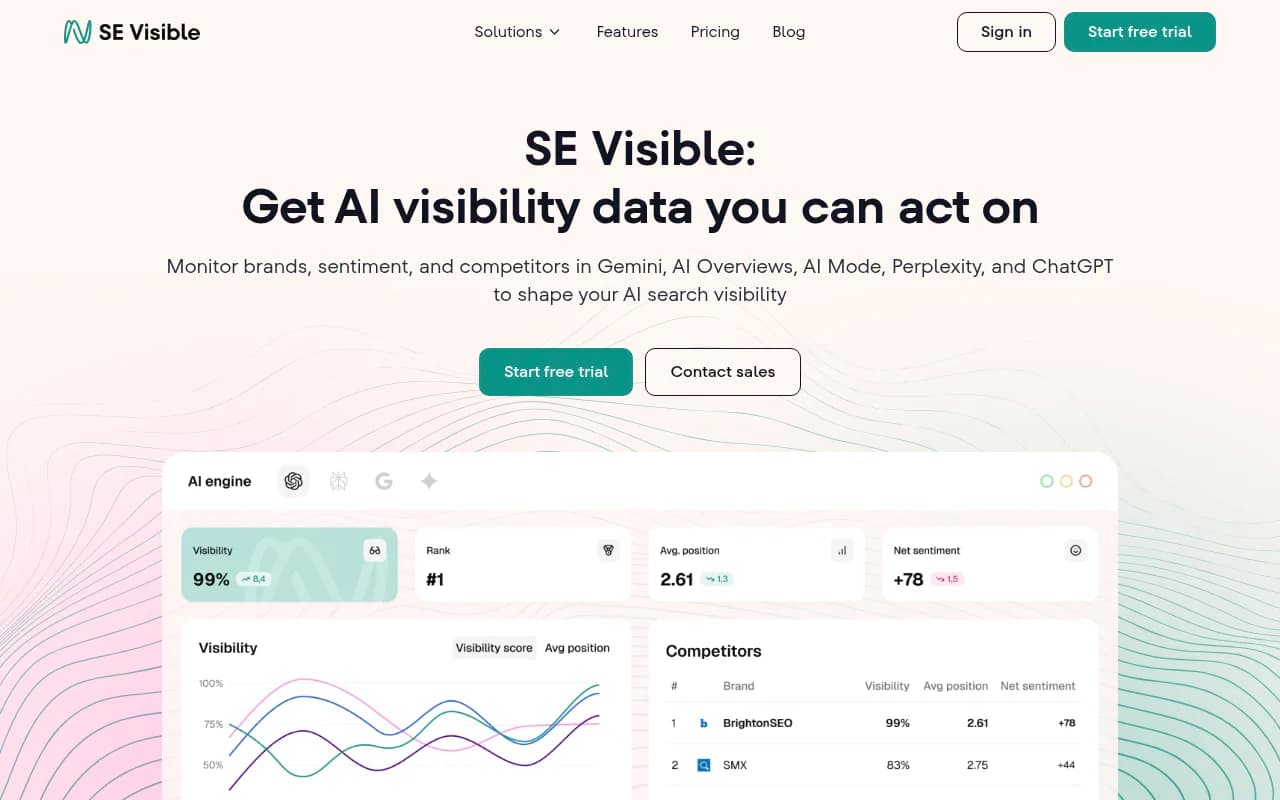
SE Visible is SE Ranking's dedicated AI visibility module, and it benefits from SE Ranking's years of experience building tools that non-technical marketers can actually use.
The setup is fast. You connect your existing SE Ranking project (or create one), add your competitors, and SE Visible starts pulling AI visibility data alongside your traditional rank tracking. For teams already using SE Ranking, the time-to-value is almost immediate -- the data appears in a familiar interface without any new learning curve.
For new users, the onboarding is still solid. SE Visible walks you through prompt setup with suggestions based on your tracked keywords, which removes the blank-page problem. The competitor comparison view is particularly well-designed: you can see, at a glance, which AI models are citing your competitors more than you, broken down by topic cluster.
The main limitation is that SE Visible is primarily a monitoring tool. It shows you the gaps but doesn't help you close them. For teams that have a content workflow already in place, that's fine. For teams that need end-to-end support, you'll need to pair it with something else.
3. Otterly.AI
Otterly.AI has built a reputation for being one of the most accessible entry points into AI visibility tracking. The interface is clean, the setup is minimal, and you can be tracking prompts within about 10 minutes of signing up.
The onboarding experience leans on simplicity. You add your brand name, a few competitors, and a set of prompts -- or let Otterly suggest them. The dashboard shows share-of-voice across AI models in a format that's immediately readable, even for stakeholders who've never thought about AI search before. That's actually a meaningful advantage: if you need to show results to a client or a CMO quickly, Otterly's output is easy to present.
The tradeoff is depth. Otterly doesn't have crawler logs, doesn't track Reddit or YouTube as citation sources, and doesn't generate content. It's a monitoring tool, and a good one, but the ceiling is lower than platforms like Promptwatch or Profound. For teams just getting started with AI visibility -- especially agencies onboarding multiple clients -- Otterly is a genuinely good starting point.

4. Peec AI
Peec AI is worth including here specifically because of its multi-language onboarding. If you're tracking AI visibility in markets outside English, Peec is one of the few tools that makes that setup straightforward rather than painful.
The general onboarding is quick: domain entry, competitor setup, prompt suggestions. Peec's interface is clean and the initial data loads fast. Where it stands out is the regional and language configuration -- you can set up monitoring for French, German, Spanish, and other languages without needing to manually translate prompts or configure separate projects.
For international brands or agencies with clients in multiple markets, this is a real time-saver. The alternative -- manually managing separate prompt sets in different languages across other platforms -- is tedious enough that many teams just don't do it.
Like Otterly, Peec is primarily a monitoring platform. There's no content generation, no crawler logs, and the prompt intelligence is less developed than Promptwatch's. But for getting visibility data in multiple languages quickly, it's hard to beat.

5. Gauge
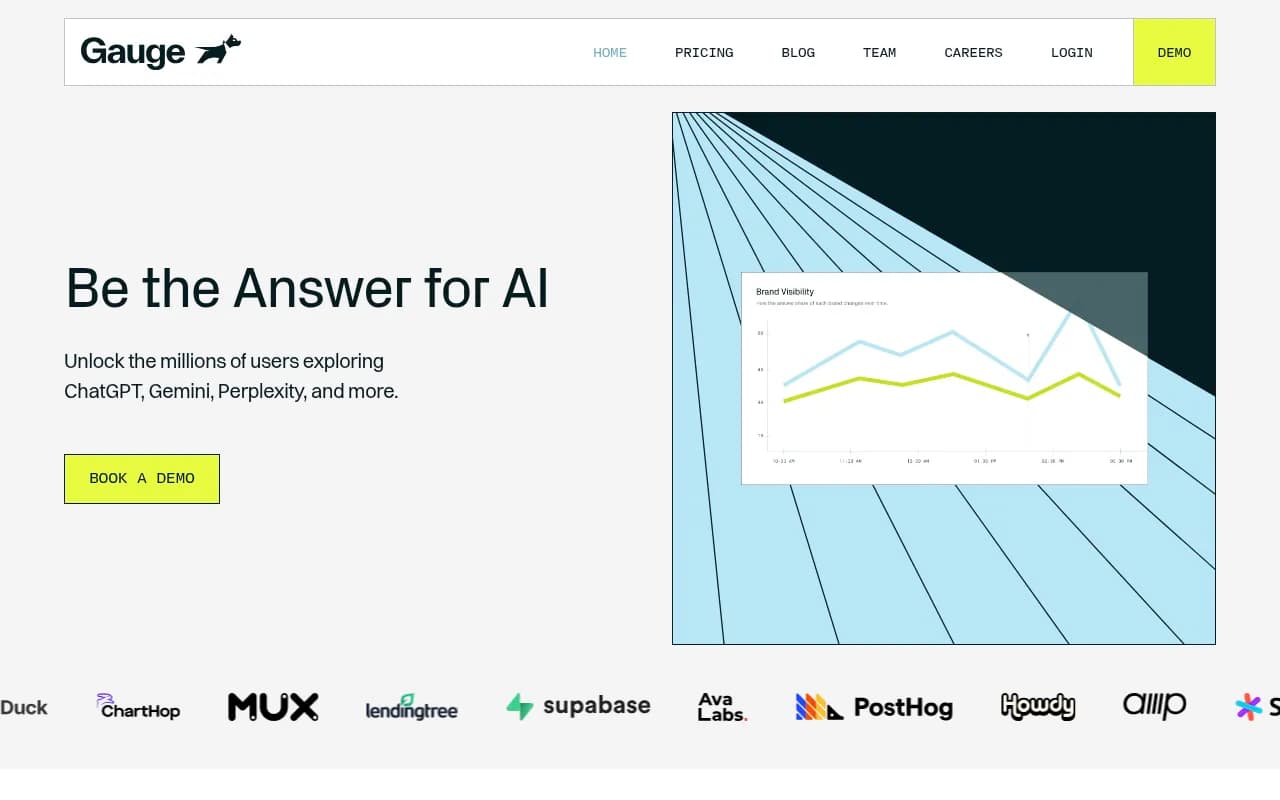
Gauge is specifically designed for teams that are new to AI search visibility and want to start monitoring without getting overwhelmed. The positioning is explicit: it's a simple tool for simple use cases, and it delivers on that promise.
The onboarding is the most guided of any tool on this list. Gauge walks you through a setup wizard that asks about your industry, your main competitors, and your goals -- then configures your initial prompt set automatically. You don't need to know what "share of voice" means or how to structure a GEO prompt. Gauge handles that.
The resulting dashboard is intentionally minimal. You see your visibility score, your competitors' scores, and a list of prompts where you're underperforming. It's not the deepest data in the category, but it's genuinely easy to act on.
The limitation is scalability. Gauge works well for a single brand tracking a focused set of topics. If you're managing multiple sites, need page-level tracking, or want to connect visibility data to traffic and revenue, you'll outgrow it relatively quickly. But as a starting point for teams that have been putting off AI visibility work because it felt too complicated, Gauge removes most of the friction.
Comparison: onboarding and time-to-value at a glance
| Tool | Setup time | Prompt suggestions | Content generation | Multi-language | Best for |
|---|---|---|---|---|---|
| Promptwatch | ~15 min | Yes, AI-powered | Yes (built-in) | Yes | Teams that want to monitor and fix gaps |
| SE Visible | ~10 min (faster with SE Ranking) | Yes, from tracked keywords | No | Limited | SE Ranking users, monitoring-focused teams |
| Otterly.AI | ~10 min | Yes | No | No | Agencies, quick client reporting |
| Peec AI | ~15 min | Yes | No | Yes (strong) | International brands and agencies |
| Gauge | ~5 min (guided wizard) | Yes, auto-configured | No | No | Teams new to AI visibility |
What separates "fast to set up" from "fast to value"
There's a distinction worth making here. A tool can be fast to set up -- you're tracking prompts in 10 minutes -- but still slow to deliver value if the data doesn't tell you what to do next.
The tools that score highest on genuine time-to-value are the ones that answer the question "so what?" quickly. Promptwatch does this with Answer Gap Analysis: the first thing you see after setup isn't a generic visibility score, it's a list of specific prompts where competitors are winning and you're not. That's immediately actionable.
Gauge does it differently -- by removing complexity rather than adding intelligence. You don't get deep insights, but you also don't get lost. The "so what" is simple: here are the prompts where your visibility is low, go work on those topics.
The tools that struggle with time-to-value are the ones that give you a lot of data without a clear prioritization layer. You see that you have 23% share of voice across 150 prompts, but you don't know which 10 prompts to focus on first. That's where prompt difficulty scoring and volume estimates (features Promptwatch offers) make a real difference.
A note on monitoring vs. optimization
Most of the tools in this category -- including Otterly, Peec, and Gauge -- are monitoring platforms. They tell you where you stand. That's genuinely useful, especially when you're just starting to understand your AI visibility.
But monitoring alone has a ceiling. If you track your visibility for three months and it doesn't improve, the tool hasn't failed -- you just haven't had the tools to act on what it showed you.
The platforms that combine monitoring with content optimization (Promptwatch being the clearest example in this list) create a compounding loop: you find a gap, you create content to close it, you track whether the new content gets cited, and you repeat. That loop is what turns AI visibility from a reporting exercise into a growth channel.
For teams evaluating tools right now, the question isn't just "which tool is easiest to start?" It's "which tool will still be useful in six months?" If your goal is to actually improve your AI visibility -- not just measure it -- that distinction matters.
Which tool should you start with?
It depends on where you are.
If you're starting from scratch and want the fastest path to understanding your AI visibility without any complexity, start with Gauge. You'll have a clear picture of your position within a single session.
If you're an agency onboarding multiple clients and need clean, presentable data quickly, Otterly.AI is the most efficient option.
If you operate in multiple languages or markets, Peec AI saves significant setup time compared to any alternative.
If you're already using SE Ranking and want to add AI visibility without learning a new tool, SE Visible is the obvious choice.
If you want to move beyond monitoring and actually improve your rankings in AI search -- and you want a platform that will scale with you -- Promptwatch is the most complete option in this list. The onboarding is fast, the gap analysis is immediately actionable, and the content generation means you can close the gaps you find without switching tools.
The AI search visibility category is still maturing, and the tools are improving quickly. But the gap between platforms that just show you data and platforms that help you act on it is already significant -- and it's only going to widen.