Key takeaways
- The AI visibility tool market exploded in 2025, but most platforms are still monitoring-only dashboards -- they show you data without helping you act on it.
- Promptwatch is the only platform in this review rated as a leader across monitoring, content optimization, and traffic attribution -- making it the strongest all-in-one option for most teams.
- Profound is the best pick for large enterprise teams with dedicated analysts who need deep data and don't mind a higher price tag.
- Otterly.AI and Peec AI are solid entry points for smaller budgets, but expect to hit their ceilings fast.
- If you're already paying for Semrush or SE Ranking, their AI visibility features are worth activating -- but don't expect them to replace a dedicated GEO tool.
The AI search landscape shifted fast in 2025. ChatGPT, Perplexity, Google AI Overviews, and a dozen other models started answering questions that used to send people to Google's blue links -- and suddenly, ranking on page one wasn't the whole story anymore.
A wave of new tools launched to help brands track their visibility in these AI-generated answers. Some were genuinely useful. Others were dashboards dressed up as strategy platforms. Now that we're in 2026 and the dust has settled a bit, it's worth asking: which of these tools actually held up?
This review covers 8 platforms we consider worth knowing about. We're not going to pretend they're all equal -- some are clearly better than others, and we'll say so.
What makes an AI visibility platform actually useful?
Before getting into the tools, it helps to know what you're evaluating. There are a few things a good AI visibility platform needs to do:
Track the right AI models. ChatGPT and Perplexity get the most attention, but Google AI Overviews, Gemini, Claude, Grok, and DeepSeek all matter depending on your audience. A tool that only monitors two or three models is leaving blind spots.
Show you what's missing, not just what's working. Most tools are good at telling you when you appear in an AI response. Far fewer help you understand why you're not appearing -- and what to do about it.
Connect visibility to actual traffic. AI citations don't always translate to clicks. The best platforms close the loop between "AI mentioned us" and "we got a visitor (and a conversion)."
Help you create content that gets cited. Monitoring is table stakes. The platforms worth paying for in 2026 go further -- they help you build the content that earns citations in the first place.
With that in mind, here's how the 8 platforms stack up.
The 8 platforms reviewed
1. Promptwatch -- best overall for teams that want to act, not just watch
Promptwatch is the platform we'd recommend to most marketing and SEO teams in 2026. It's used by 6,700+ brands and agencies including Booking.com and Center Parcs, and it's the only tool in this review that covers the full loop: find gaps, create content, track results.

What separates Promptwatch from the rest of the field is the Answer Gap Analysis. It shows you the specific prompts where competitors are getting cited but you're not -- not as a vague "you're missing coverage here" summary, but as a concrete list of questions and topics your content doesn't currently answer. That's genuinely useful.
From there, the built-in AI writing agent generates articles, listicles, and comparisons grounded in real citation data. This isn't generic content -- it's engineered around what AI models actually cite. The platform has analyzed over 880 million citations, which gives the content recommendations a factual basis most competitors can't match.
On the monitoring side, Promptwatch tracks 10 AI models (ChatGPT, Perplexity, Google AI Overviews, Google AI Mode, Claude, Gemini, Meta/Llama, DeepSeek, Grok, Mistral, Copilot), with page-level tracking that shows exactly which URLs are being cited and how often. The AI Crawler Logs feature -- showing which AI crawlers are hitting your site, which pages they read, and what errors they encounter -- is something most competitors don't offer at all.
An independent review from generatemore.ai rated Promptwatch 4.0/5 overall and named it their top pick out of 15+ solutions evaluated. The main criticisms were occasional UX bugs and the pace of feature releases making it hard to keep up. Fair points, though the feature velocity is also why it's ahead of the competition.
Pricing starts at $99/month for the Essential plan (1 site, 50 prompts, 5 articles). Professional is $249/month (2 sites, 150 prompts, 15 articles, crawler logs). Business is $579/month (5 sites, 350 prompts, 30 articles). A free trial is available.
2. Profound -- best for enterprise teams with dedicated analysts
Profound has a strong feature set and is frequently cited as the go-to option for larger organizations with the budget and headcount to use it properly. It's not a tool you set up in an afternoon -- it's built for teams with someone dedicated to analysis and reporting.

The platform covers AI visibility tracking across major LLMs, with solid competitive benchmarking and reporting capabilities. Where it falls short relative to Promptwatch: no Reddit tracking, no ChatGPT Shopping monitoring, and the price point is higher. For a smaller team or agency, the cost-to-value ratio doesn't work as well. For an enterprise marketing team running structured quarterly reviews, it's a legitimate option.
3. Otterly.AI -- best for getting started on a tight budget
Otterly.AI tracks brand citations across six AI platforms: ChatGPT, Perplexity, Google AI Overviews, AI Mode, Gemini, and Microsoft Copilot. It's one of the more accessible entry points in the category -- the interface is clean, setup is fast, and the pricing is approachable.

The honest limitation is that Otterly.AI is a monitoring tool. It shows you what's happening but doesn't help you change it. There's no content generation, no gap analysis, no crawler logs, no traffic attribution. If you're a small brand just trying to understand whether you're showing up in AI answers, it does that job. If you want to actually improve your visibility, you'll need something else alongside it -- or you'll outgrow it quickly.
4. Peec AI -- best value pick in the community
Peec AI launched in early 2025 out of Berlin and quickly became the Reddit community's consensus "best value" pick in the AI visibility category. Multiple independent users have praised it for delivering solid monitoring at a price point that makes sense for smaller teams and solo operators.

It supports multi-language tracking, which is a genuine differentiator for international brands. Like Otterly.AI, it's primarily a monitoring platform -- you get visibility data, but the optimization work is on you. For teams that have a content strategy already and just need reliable tracking data to inform it, Peec AI is worth a look.
5. SE Ranking (SE Visible) -- best for teams already in the SE Ranking ecosystem
SE Ranking launched SE Visible as its dedicated AI visibility module, and it's one of the more thoughtfully built additions to an existing SEO platform. The tool tracks AI Overview appearances and LLM citations, with a user-friendly interface that doesn't require much onboarding.
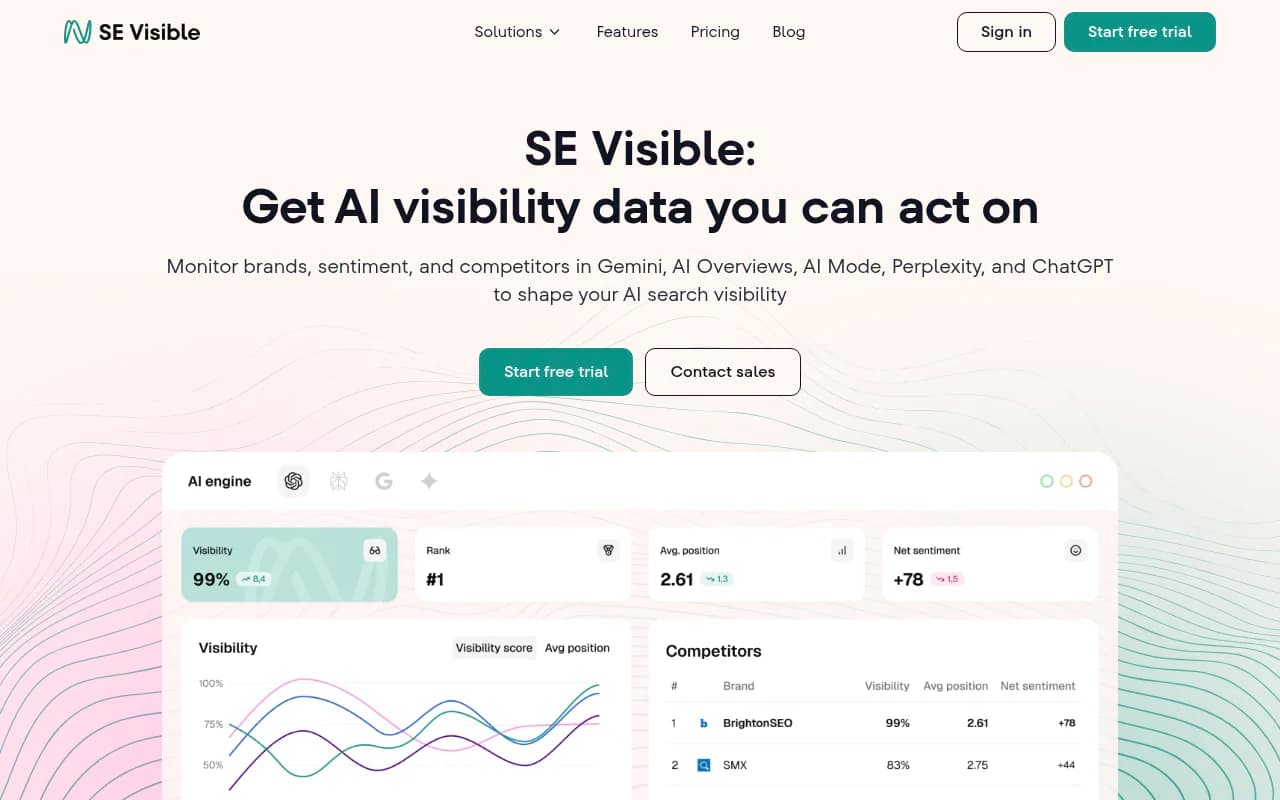
If you're already paying for SE Ranking for traditional SEO, activating SE Visible is a low-friction way to add AI visibility tracking to your workflow. As a standalone product competing against dedicated GEO platforms, it's less compelling -- the depth of data and the action-oriented features aren't there yet.
6. AthenaHQ -- solid monitoring, limited optimization
AthenaHQ tracks brand visibility across 8+ AI search engines and has a clean, professional interface. It's positioned as a monitoring and analytics platform, and it does that well.

The gap is on the optimization side. AthenaHQ doesn't offer content generation, gap analysis, or traffic attribution in the way Promptwatch does. For teams that want a monitoring-focused tool with good data quality and don't need the full optimization stack, it's a reasonable choice. For teams that want to actually move the needle on their AI visibility, the monitoring-only approach will feel limiting.
7. Brand24 -- best for brands that care about AI mentions alongside broader media monitoring
Brand24 is primarily a media monitoring and social listening platform, but it's expanded its coverage to include AI mentions. If you're already using it for brand monitoring across news, social, and web, the AI visibility layer is a useful addition.
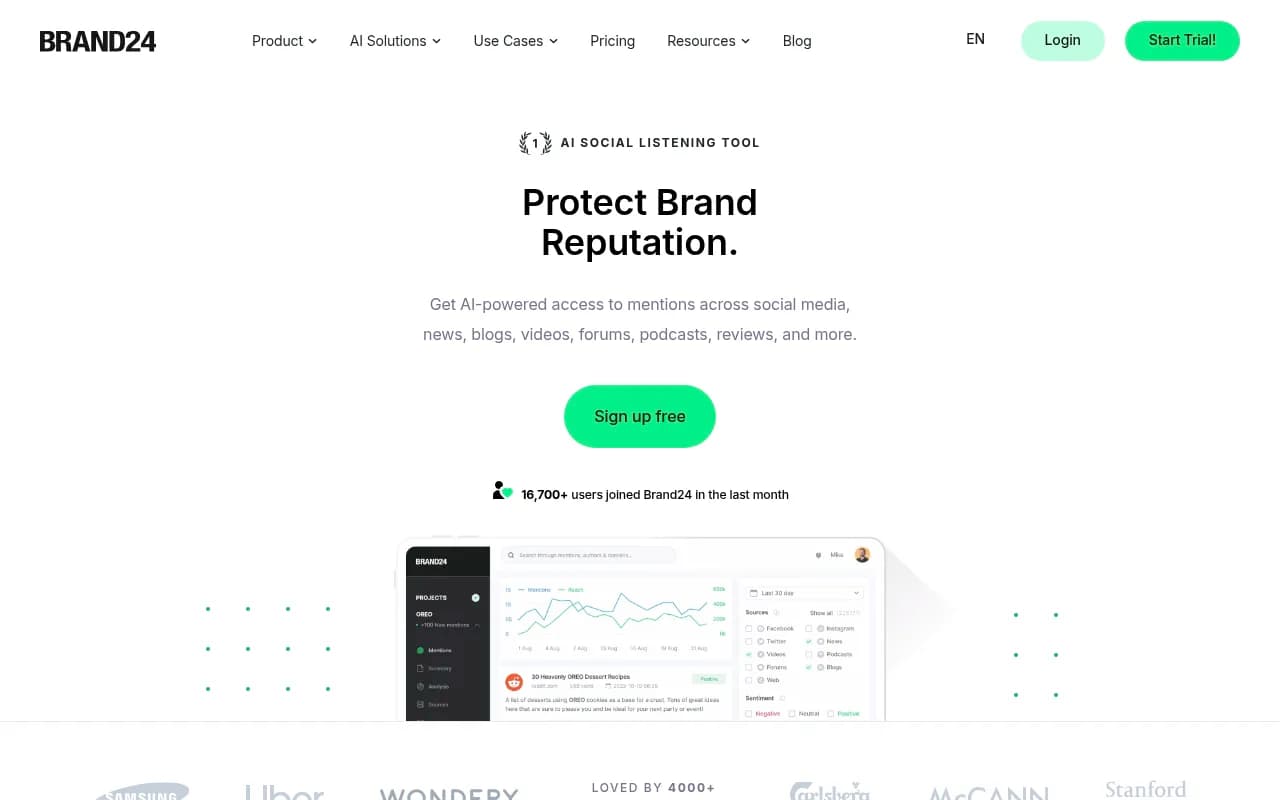
It's not a GEO platform in the same sense as Promptwatch or Profound -- it won't help you optimize for AI citations or generate content. But for brands that want a single tool tracking mentions across 25 million+ sources including AI models, it's a practical choice. The Reddit community frequently recommends it alongside dedicated AI visibility tools rather than as a replacement.
8. Semrush -- best for teams that want AI visibility data inside their existing SEO workflow
Semrush added AI visibility tracking to its platform, and for the millions of teams already using it for keyword research, site audits, and rank tracking, that's convenient.
The limitation is structural: Semrush uses fixed prompts for its AI tracking, which means you're monitoring a predetermined set of queries rather than the specific prompts relevant to your brand and competitors. There's no traffic attribution for AI visits either. It's useful as a supplementary data point, but it's not a replacement for a dedicated AI visibility platform if that's a strategic priority for your team.
How the 8 platforms compare
| Platform | AI models tracked | Content generation | Gap analysis | Crawler logs | Traffic attribution | Reddit/YouTube tracking | Starting price |
|---|---|---|---|---|---|---|---|
| Promptwatch | 10 | Yes | Yes | Yes | Yes | Yes | $99/mo |
| Profound | 6+ | No | Limited | No | No | No | Higher |
| Otterly.AI | 6 | No | No | No | No | No | Low |
| Peec AI | Multiple | No | No | No | No | No | Low |
| SE Visible | Multiple | No | No | No | No | No | Add-on |
| AthenaHQ | 8+ | No | No | No | No | No | Mid |
| Brand24 | Limited | No | No | No | No | No | $99/mo |
| Semrush | Limited | No | No | No | No | No | $139/mo |
The pattern is clear. Most platforms in this space are monitoring tools. They show you data. Promptwatch is the only one in this review that covers the full cycle: find gaps, create content, track results.
Which platform should you choose?
The right answer depends on where you are and what you need.
If you're starting from scratch and want the most complete platform: Promptwatch. The combination of gap analysis, AI content generation, crawler logs, and traffic attribution is genuinely unique. The $99/month Essential plan is a reasonable starting point, and the Professional tier at $249/month is where most serious teams will land.
If you're a large enterprise with a dedicated analytics team and a bigger budget: Profound is worth evaluating. It's built for structured, analyst-driven workflows.
If you're on a tight budget and just need basic monitoring: Peec AI or Otterly.AI. Both are honest about what they are -- tracking tools -- and they do that job at a price that makes sense for smaller operations.
If you're already paying for SE Ranking or Semrush: Activate their AI visibility features. They won't replace a dedicated GEO platform, but they're better than nothing and cost nothing extra.
If you need brand monitoring across AI and broader media: Brand24 is worth considering as a complement to a dedicated AI visibility tool, not a replacement.
One thing worth saying plainly: the monitoring-only tools aren't bad, they're just incomplete. Knowing that ChatGPT mentioned your competitor 47 times last month is interesting. Knowing exactly which content gaps are causing it -- and having a tool that helps you close those gaps -- is what actually changes outcomes.
That's the distinction that matters most when choosing a platform in 2026.
What to look for as the market keeps evolving
A few capabilities that are worth prioritizing as you evaluate any AI visibility tool:
Prompt intelligence. Volume estimates and difficulty scores for specific prompts help you prioritize. Not all prompts are worth chasing -- you want to know which ones have real traffic potential and which ones you can realistically win.
Query fan-outs. One prompt branches into dozens of sub-queries. Tools that show you this branching structure help you understand the full content opportunity, not just the surface-level question.
ChatGPT Shopping tracking. For e-commerce brands, appearing in ChatGPT's product recommendations is increasingly important. Most tools don't track this yet.
Multi-language and multi-region support. AI search behavior varies significantly by language and country. If you operate internationally, a tool that only monitors English-language responses is missing a big part of the picture.
The AI visibility category is still young, and the tools are improving fast. But the core question -- does this platform help me act, or just observe? -- is the right one to ask of any tool you're evaluating.