Key takeaways
- Most GEO tools are monitoring dashboards -- they show you where you're invisible but don't help you fix it
- The tools worth paying for in 2026 combine visibility tracking with content gap analysis and optimization workflows
- Promptwatch is the only platform in this space rated as a "Leader" across all GEO categories, largely because it closes the loop from gap detection to content creation to traffic attribution
- Semrush and Ahrefs have added AI visibility features, but they're bolt-ons to traditional SEO tooling -- not purpose-built for GEO
- Smaller focused tools like Peec AI and Otterly.AI work fine for basic monitoring but hit a wall when you need to act on the data
There are now dozens of tools claiming to do "GEO." Most of them do the same thing: run a set of prompts against ChatGPT or Perplexity, check if your brand name appears, and display the results in a chart. That's useful for about a week. Then you're staring at a dashboard that tells you you're invisible and gives you no path forward.
This shortlist is different. The 7 platforms below were chosen because they either (a) genuinely help you improve your AI visibility, not just measure it, or (b) do one specific thing so well that they earn a place in a serious GEO stack. A few are full optimization platforms. A few are specialized trackers. One is clearly the most complete option available.
Let's get into it.
What separates a GEO tool from a GEO tracker
Before the list, it's worth being clear about the distinction. A tracker shows you data. A GEO tool helps you change that data.
The difference matters because AI search visibility isn't fixed. ChatGPT, Perplexity, Claude, and Gemini pull from web content -- which means if you publish the right content, structured the right way, covering the right topics, your visibility improves. The models start citing you. That's the whole game.
A monitoring-only tool can tell you that a competitor appears in 73% of relevant prompts and you appear in 12%. What it can't do is tell you which specific content you're missing, help you write it, or show you whether publishing it actually moved the needle.
The platforms that do all three are rare. Most stop at step one.
The 7 platforms worth your attention in 2026
1. Promptwatch -- the full optimization loop
Promptwatch is the most complete GEO platform available right now, and it's the one I'd recommend to any marketing team that's serious about AI search visibility rather than just reporting on it.
The core difference is the action loop. Most tools show you a visibility score. Promptwatch shows you the specific prompts where competitors appear and you don't -- then gives you a built-in AI writing agent to create content that addresses those gaps. Then it tracks whether that content gets cited. The loop closes.

A few specifics worth knowing: Promptwatch monitors 10 AI models (ChatGPT, Perplexity, Claude, Gemini, Grok, DeepSeek, Copilot, Meta AI, Mistral, and Google AI Overviews), has processed over 1.1 billion citations, and includes AI crawler logs that show you exactly which pages AI bots are reading on your site and how often. That last feature is something most competitors don't offer at all.
The Answer Gap Analysis is probably the most practically useful feature in the GEO space right now. It shows you which prompts your competitors rank for that you don't -- not as a vague "content gap" suggestion, but as specific questions with prompt volume estimates and difficulty scores. You know what to write, and you know roughly how hard it will be to win.
Pricing starts at $99/month for a single site with 50 prompts. The Professional plan at $249/month adds crawler logs, multi-location tracking, and 15 AI-generated articles per month. There's a free trial.
Used by 6,700+ brands including Booking.com and Center Parcs. Not a startup experiment.
2. Profound -- solid enterprise monitoring
Profound has been around long enough to build a credible enterprise reputation, and it shows in the product. The interface is clean, the prompt coverage is broad, and the reporting is good enough to share with a CMO without embarrassment.

Where Profound falls short is the same place most enterprise-oriented tools do: it's primarily a monitoring and benchmarking platform. You can see how your brand is positioned across AI models, track share of voice against competitors, and get alerts when something changes. What you can't do is generate content to fix what you find, or get granular guidance on which specific pages are being cited (or ignored) by AI crawlers.
For teams that already have a strong content operation and just need reliable visibility data, Profound is a reasonable choice. For teams that need the full loop, it's half a solution.
3. AthenaHQ -- strong tracking, limited action
AthenaHQ covers 8+ AI search engines and has a clean interface for tracking brand mentions, sentiment, and competitor positioning. It's genuinely good at what it does.

The limitation is the same one that comes up repeatedly in this space: AthenaHQ is a monitoring platform. It doesn't have content generation, crawler log analysis, or traffic attribution. If you want to understand your current AI visibility position, it works well. If you want to improve it, you'll need to pair it with other tools.
Worth considering for teams that prioritize clean reporting over optimization workflows.
4. Semrush -- familiar but limited on AI search
Semrush has added AI visibility features to its platform, and if your team is already deep in the Semrush ecosystem, the path of least resistance is to use what you have.
The honest assessment: Semrush's AI search tracking uses fixed prompt sets, which means you're not getting the flexibility to track the actual questions your buyers are asking AI models. The AI visibility features feel like additions to a traditional SEO tool rather than a purpose-built GEO platform. There's no AI traffic attribution, no crawler log analysis for AI bots, and no content generation grounded in citation data.
For traditional SEO -- keyword research, site audits, backlink analysis -- Semrush is still excellent. For GEO specifically, it's a starting point, not a destination.
5. Otterly.AI -- good for getting started
Otterly.AI is one of the more accessible entry points into GEO monitoring. The pricing is approachable, the setup is quick, and it gives you a reasonable read on where your brand appears across ChatGPT, Perplexity, and a few other models.

The ceiling is low, though. No crawler logs, no visitor analytics, no content generation. It's a monitoring tool in the purest sense -- useful for getting a baseline, less useful for doing anything about it. Teams that outgrow it tend to move to Promptwatch or Profound.
If you're just starting to explore GEO and want to see what your brand looks like in AI answers before committing to a bigger platform, Otterly.AI is a reasonable first step.
6. Peec AI -- multi-language monitoring
Peec AI's standout feature is multi-language support, which makes it genuinely useful for brands operating across multiple markets. If you need to track AI visibility in French, German, Spanish, or other languages, the options are thin -- Peec AI is one of the few that handles this reasonably well.

Beyond the language coverage, it's a monitoring tool. No content optimization, no gap analysis, no traffic attribution. But for international teams that need to understand how AI models describe their brand in different languages and regions, it fills a real gap.
7. Writesonic -- content generation with GEO features
Writesonic started as an AI writing tool and has added GEO tracking features. The result is a product that sits in an interesting middle ground: it can help you create content and it has some visibility monitoring built in.
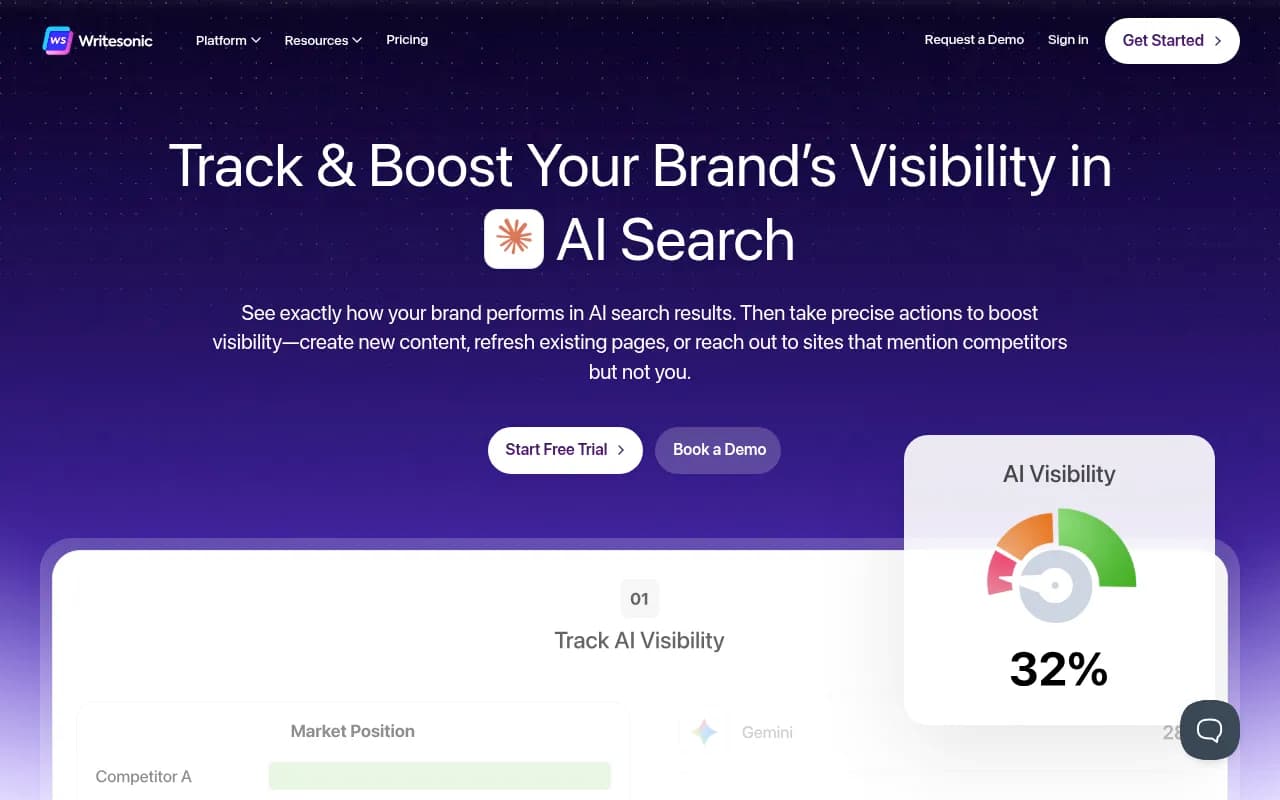
The tracking side is less mature than dedicated GEO platforms -- prompt coverage is narrower, and the analytics aren't as deep. But if your primary need is content creation with some AI visibility awareness baked in, rather than enterprise-grade monitoring, Writesonic is worth a look. It's particularly useful for smaller teams that can't justify separate budgets for a GEO tracker and an AI writing tool.
How these 7 tools compare
| Tool | AI models tracked | Content generation | Crawler logs | Traffic attribution | Best for |
|---|---|---|---|---|---|
| Promptwatch | 10 | Yes (built-in AI agent) | Yes | Yes (GSC, snippet, logs) | Full optimization loop |
| Profound | Multiple | No | No | Limited | Enterprise monitoring |
| AthenaHQ | 8+ | No | No | No | Clean tracking & reporting |
| Semrush | Limited (fixed prompts) | Via ContentShake | No | No | Teams already on Semrush |
| Otterly.AI | Several | No | No | No | Getting started |
| Peec AI | Several | No | No | No | Multi-language monitoring |
| Writesonic | Limited | Yes | No | No | Small teams, content-first |
What to look for when evaluating a GEO platform
A few questions worth asking before you commit to any tool:
Does it cover the models your buyers actually use? ChatGPT and Perplexity get the most attention, but Google AI Overviews drives significant traffic for many categories. Make sure the platform covers the models relevant to your audience.
Can you customize prompts? Fixed prompt sets are a red flag. Your buyers ask specific questions -- the tool should let you track those specific questions, not a generic set of industry queries.
Does it show you what to fix, or just what's broken? This is the core question. A dashboard that shows you low visibility scores is only useful if it also tells you which content gaps are causing the problem.
Can you connect visibility to revenue? AI visibility that doesn't connect to traffic and conversions is a vanity metric. Look for tools that offer traffic attribution -- whether through a code snippet, Google Search Console integration, or server log analysis.
Does it track AI crawlers on your site? This one gets overlooked. Knowing which pages AI bots are reading (and which they're ignoring or hitting errors on) is essential for understanding why your content is or isn't getting cited.
The monitoring trap
One pattern worth naming directly: a lot of teams buy a GEO monitoring tool, spend a few weeks looking at the data, and then... don't know what to do next. The tool has done its job. It's shown them the gap. But the gap is still there.
This is the monitoring trap. It's not the tool's fault, exactly -- monitoring is genuinely useful. But if the tool stops there, the team is left to figure out the "so what" on their own. Which content should we create? How should it be structured? Which prompts should we prioritize? How do we know if what we publish is working?
The platforms that answer those questions -- not just "here's your visibility score" but "here's what to do about it" -- are the ones worth building a GEO strategy around. That's a short list. Promptwatch is at the top of it.
A note on traditional SEO tools adding GEO features
Semrush, Ahrefs, and Moz have all added some form of AI search monitoring to their platforms. This is worth acknowledging because a lot of teams will default to using what they already pay for.
The honest take: these additions are better than nothing, but they're not purpose-built for GEO. Ahrefs Brand Radar, for example, uses fixed prompts and has no AI traffic attribution. Semrush's AI features are similarly constrained. These tools were designed for a world of blue links and keyword rankings -- adding AI monitoring on top doesn't change the underlying architecture.
If you're serious about GEO as a channel, a dedicated platform will give you significantly more depth than a bolt-on feature in a traditional SEO tool.
The bottom line
The GEO tool market in 2026 is crowded with monitoring dashboards. Most of them will show you that you're invisible in AI search and then leave you to figure out what to do about it.
The tools that stand out are the ones that close the loop: find the gaps, help you create content to fill them, and track whether it worked. That's a short list, and Promptwatch is the most complete version of it available right now.
If you're just starting out and want to understand the landscape before committing, Otterly.AI or Peec AI give you a low-cost entry point. If you're operating across multiple languages, Peec AI is worth a serious look. If you're already in the Semrush ecosystem, the built-in AI features are a reasonable starting point.
But if you want to actually move the needle -- not just measure it -- the platform built for that job is Promptwatch.