Key takeaways
- All four platforms track your brand's visibility in AI search engines like ChatGPT, Perplexity, and Gemini -- but they differ dramatically in what they do with that data.
- Peec.ai and Searchable are solid monitoring tools, but they largely stop at showing you the problem.
- Profound has strong analytics depth but comes in at a higher price point with limited content optimization.
- Promptwatch is the only platform here that closes the full loop: find gaps, generate content, track results -- making it the most actionable choice for teams that want to actually improve their AI visibility, not just measure it.
AI search is no longer a side conversation. According to Similarweb's 2025 Generative AI Report, AI platforms generated over 1.1 billion referral visits in June 2025, up 357% year-over-year. Meanwhile, Google AI Overviews now trigger for over 13% of all queries and have been linked to a 34.5% drop in click-through rates for organic position-one results.
If you're ranking #1 and still losing traffic, this is probably why.
That shift has created a new category of tools: AI visibility platforms. They track whether your brand gets cited, mentioned, or recommended when people ask AI engines questions in your space. Four names keep coming up in this conversation: Searchable, Profound, Promptwatch, and Peec.ai.
This guide breaks down what each one actually does, where each one falls short, and which is worth your money in 2026.
What these tools are actually trying to solve
Before comparing features, it's worth being precise about the problem. Traditional SEO tracks rankings -- where your page appears in a list of blue links. AI visibility tracking is different. It asks: when someone types a question into ChatGPT, Perplexity, or Google's AI Mode, does the response mention your brand? Does it cite your content? Does it recommend your product?
You can have a perfectly optimized website and still be completely invisible in AI responses. That's the gap these tools are trying to close.
The question is whether they just show you the gap, or actually help you close it.
The four platforms, side by side
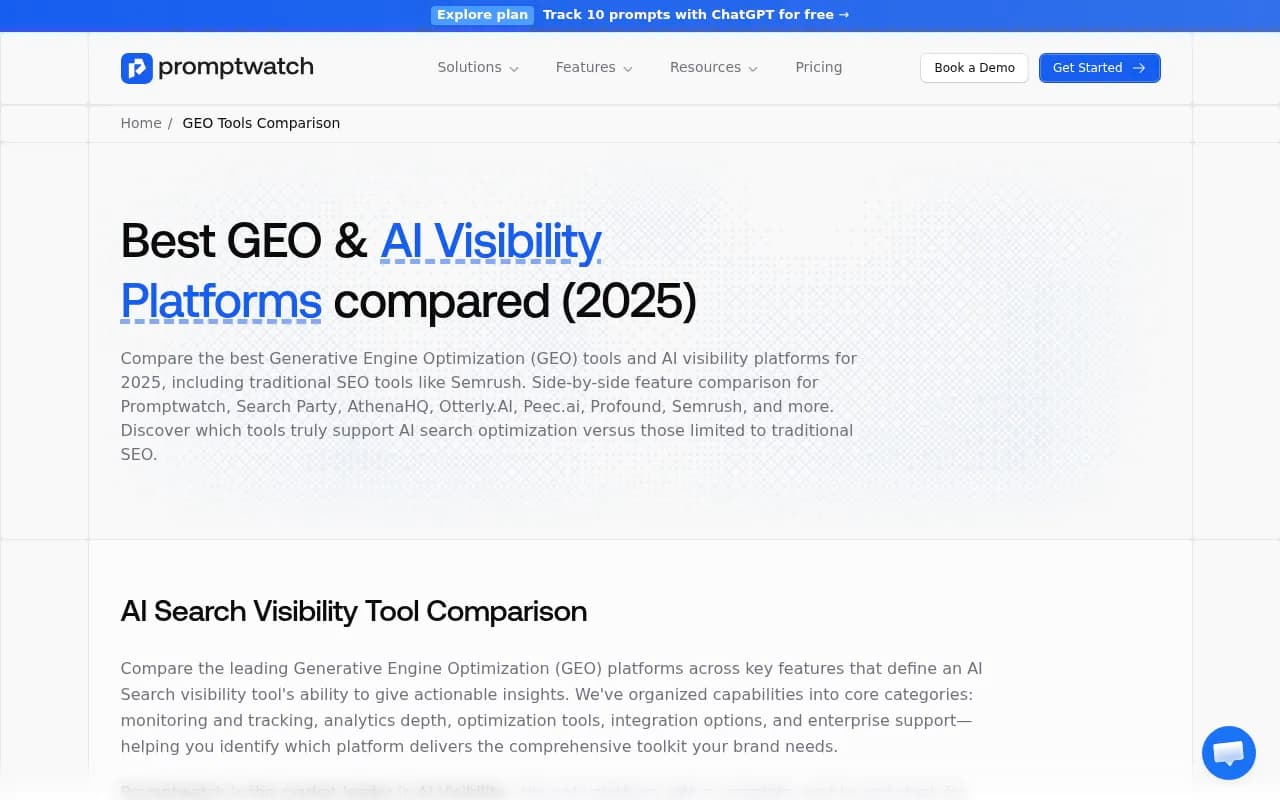
Here's a high-level comparison before we go deeper:
| Feature | Searchable | Profound | Promptwatch | Peec.ai |
|---|---|---|---|---|
| AI model coverage | 5+ | 6+ | 10 | 3 |
| Prompt tracking | Yes | Yes | Yes | Yes |
| Answer gap analysis | Limited | Limited | Yes | No |
| AI content generation | No | No | Yes | No |
| Crawler logs | No | No | Yes | No |
| Reddit/YouTube insights | No | No | Yes | No |
| ChatGPT Shopping tracking | No | No | Yes | No |
| Traffic attribution | No | Partial | Yes | No |
| Multi-language/region | Limited | Yes | Yes | Limited |
| Pricing (entry) | ~$99/mo | ~$149/mo | $99/mo | ~$49/mo |
| Best for | SMBs wanting simple monitoring | Mid-market analytics | Teams that want to act on data | Budget-conscious monitoring |
Peec.ai

Peec.ai is one of the earlier entrants in this space and has built a following among teams that want a straightforward, affordable way to start tracking AI visibility. It monitors a handful of AI engines (ChatGPT, Perplexity, and Google AI Overviews are the core three), tracks brand mentions, and gives you a visibility score over time.
The interface is clean. Setup is fast. For teams that have never tracked AI visibility before, Peec.ai gets you from zero to "I can see what's happening" in under an hour.
Where it runs into trouble is depth. Three AI engines is a narrow window when the market now includes Claude, Gemini, Grok, DeepSeek, Meta AI, and Copilot. The platform also lacks crawler logs, so you can't see why AI engines are or aren't visiting your pages. There's no content gap analysis, no content generation, and no traffic attribution.
Peec.ai is a monitoring tool. It tells you the score. It doesn't coach you on how to improve it.
For teams just getting started with AI visibility on a tight budget, it's a reasonable entry point. For anyone who needs to actually move the needle, it runs out of road quickly.
Searchable
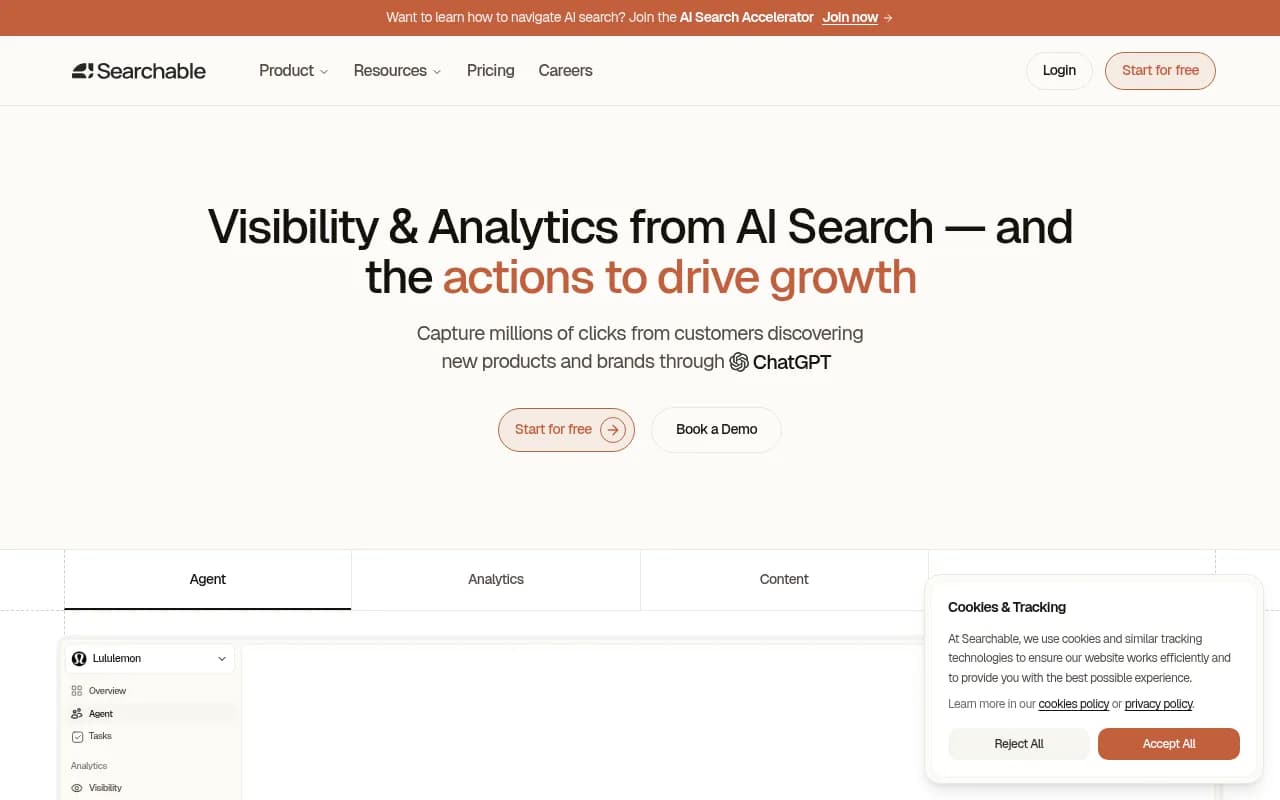
Searchable sits in a similar monitoring-first position but with a slightly broader feature set than Peec.ai. It tracks brand visibility across AI search engines, provides share-of-voice comparisons against competitors, and offers some content-level insights.
The platform has a cleaner reporting layer than Peec.ai, which makes it easier to present data to stakeholders. If your primary use case is "I need to show my CMO a dashboard of how we're performing in AI search," Searchable does that reasonably well.
The limitations are similar to Peec.ai's, though. There's no built-in content generation, no crawler log access, and the optimization guidance is thin. You can see that a competitor is getting cited more than you for a given prompt. You can't easily figure out what to do about it from within the platform.
Searchable is a decent choice for agencies that need clean reporting and don't need deep optimization capabilities. For in-house teams trying to improve their AI visibility, the workflow still requires a lot of manual work outside the tool.
Profound

Profound is the most analytics-heavy of the four. It's built for teams that want to go deep on data: share of voice across AI engines, prompt-level performance, competitive benchmarking, and trend analysis over time.
The data quality is genuinely good. Profound covers more AI engines than Peec.ai and Searchable, and its reporting is detailed enough to support serious strategic decisions. If you're a mid-market brand with a dedicated analytics team, Profound gives you a lot to work with.
The price reflects that ambition. Profound's entry point is higher than the other three tools here, which makes it a harder sell for smaller teams. And despite the analytics depth, Profound is still primarily a monitoring and measurement platform. There's no content generation, no AI crawler logs, and limited optimization tooling.
The pattern here is consistent across the category: you get excellent visibility into what's happening, but the platform stops short of helping you change what's happening. Your team still has to take the data, figure out the content strategy, brief writers, produce content, and hope it works. Profound doesn't close that loop.
For data-driven teams that already have strong content operations and just need better intelligence to inform them, Profound is worth considering. For teams that need the intelligence and the execution, it's only half the solution.
Promptwatch
Promptwatch takes a different approach to the same problem. Rather than building a better monitoring dashboard, it's built around a complete workflow: find the gaps, create content that fills them, track the results.

The "find the gaps" part starts with Answer Gap Analysis. You can see exactly which prompts your competitors are getting cited for that you're not -- not as a vague "you're underperforming here" signal, but as a specific list of questions and topics that AI models want to answer but can't find on your site. That's a content brief, essentially.
The "create content" part is where Promptwatch separates itself from every other tool in this comparison. There's a built-in AI writing agent that generates articles, listicles, and comparisons grounded in real citation data. It's not generic AI content -- it's engineered around what actually gets cited by ChatGPT, Claude, Perplexity, and others, based on analysis of over 880 million citations. The output is content designed to rank in AI search, not just content that sounds good.
The "track results" part closes the loop. Page-level tracking shows which specific pages are being cited, how often, and by which AI models. Traffic attribution connects AI visibility to actual website visits and revenue, through a code snippet, Google Search Console integration, or server log analysis.
Beyond the core loop, Promptwatch covers capabilities the other three tools don't touch at all:
- AI Crawler Logs: Real-time logs of when ChatGPT, Claude, Perplexity, and other AI crawlers visit your site, which pages they read, and what errors they encounter.
- Reddit and YouTube insights: Surface discussions that directly influence AI recommendations -- a channel most competitors ignore.
- ChatGPT Shopping tracking: Monitor when your brand appears in ChatGPT's product recommendations and shopping carousels.
- Prompt Intelligence: Volume estimates and difficulty scores for each prompt, plus query fan-outs that show how one prompt branches into sub-queries.
- Competitor Heatmaps: Compare your AI visibility against competitors across all major LLMs.
It monitors 10 AI models: ChatGPT, Perplexity, Google AI Overviews, Google AI Mode, Claude, Gemini, Meta/Llama, DeepSeek, Grok, Mistral, and Copilot. That's the broadest coverage of any platform in this comparison.
Pricing starts at $99/month for the Essential plan (1 site, 50 prompts, 5 articles), $249/month for Professional (2 sites, 150 prompts, 15 articles, crawler logs), and $579/month for Business (5 sites, 350 prompts, 30 articles). A free trial is available.
In a 2026 comparison of 12 GEO platforms, Promptwatch was the only one rated as a "Leader" across all categories -- the distinction being that it's built around taking action, not just reporting.
How to choose
The honest answer depends on what you actually need.
Choose Peec.ai if you're just getting started, have a small budget, and mainly want to understand whether you have an AI visibility problem before committing to a bigger tool. It's a low-cost way to get your bearings.
Choose Searchable if you're an agency that needs clean, presentable dashboards and your clients aren't yet asking for optimization -- just reporting. It's a reasonable monitoring layer.
Choose Profound if you have a data-heavy team that needs deep analytics and competitive intelligence, you already have strong content operations in place, and you can justify the higher price point for better data quality.
Choose Promptwatch if you need to actually improve your AI visibility, not just measure it. If your team needs to produce content that gets cited, understand why AI crawlers are or aren't engaging with your site, and connect AI visibility to revenue, Promptwatch is the only platform here that covers all of that.
The monitoring-only tools in this list are useful for understanding the problem. Promptwatch is useful for solving it.
A note on the broader market
These four aren't the only options. The AI visibility space has exploded in 2025-2026, and there are now dozens of tools at various price points and capability levels.
A few worth knowing about:

Otterly.AI is a popular entry-level option with a clean interface and affordable pricing. Like Peec.ai, it's monitoring-focused.

AthenaHQ covers 8+ AI engines and has solid tracking capabilities, but sits in the monitoring-first camp without content optimization.
Scrunch AI has built a following for its brand monitoring features, though it's more limited on the optimization side.
The pattern across the category is consistent: most tools were built to answer "how visible are you?" Fewer were built to answer "how do you become more visible?" That's the distinction worth keeping in mind as you evaluate.
Bottom line
AI visibility tracking is no longer optional for brands that care about organic traffic. The question is whether you want a tool that shows you the problem or one that helps you fix it.
Peec.ai and Searchable are fine starting points. Profound is a strong analytics platform for data-heavy teams. But if you're trying to move the needle on your AI search presence -- and connect that work to actual business outcomes -- Promptwatch is the most complete option available in 2026.