Key takeaways
- Searchable is a lightweight AI visibility tracker suited for teams that want simple brand monitoring without a steep learning curve or enterprise price tag.
- Conductor is a mature enterprise AEO platform that combines AI visibility tracking with content workflows, technical SEO, and deep organizational tooling -- but it's priced and scoped for large teams.
- Promptwatch is the only platform of the three built around a full optimization loop: find content gaps, generate AI-optimized content, and track whether it's working -- all in one place.
- If your goal is to actually improve your AI search visibility (not just measure it), the gap between a monitoring tool and an optimization platform matters a lot.
- Pricing ranges from roughly $99/month for Promptwatch's entry tier to enterprise contracts for Conductor -- Searchable sits somewhere in between.
The AI search visibility space has gotten crowded fast. Two years ago, most marketing teams were still debating whether ChatGPT citations were worth tracking. Now, according to Conductor's own research, 32% of CMOs rank AEO/GEO as their number one priority -- and 94% of enterprise leaders are increasing investment in AI search.
That growth has produced a lot of tools. Some are simple dashboards that show you where your brand appears (or doesn't). Others are full platforms with content generation, technical auditing, and multi-model tracking baked in. Searchable, Conductor, and Promptwatch represent three genuinely different points on that spectrum.
This guide breaks down what each platform actually does, where each one falls short, and which teams should use which tool.
What each platform is trying to solve
Before getting into features, it helps to understand the problem each tool was built around.
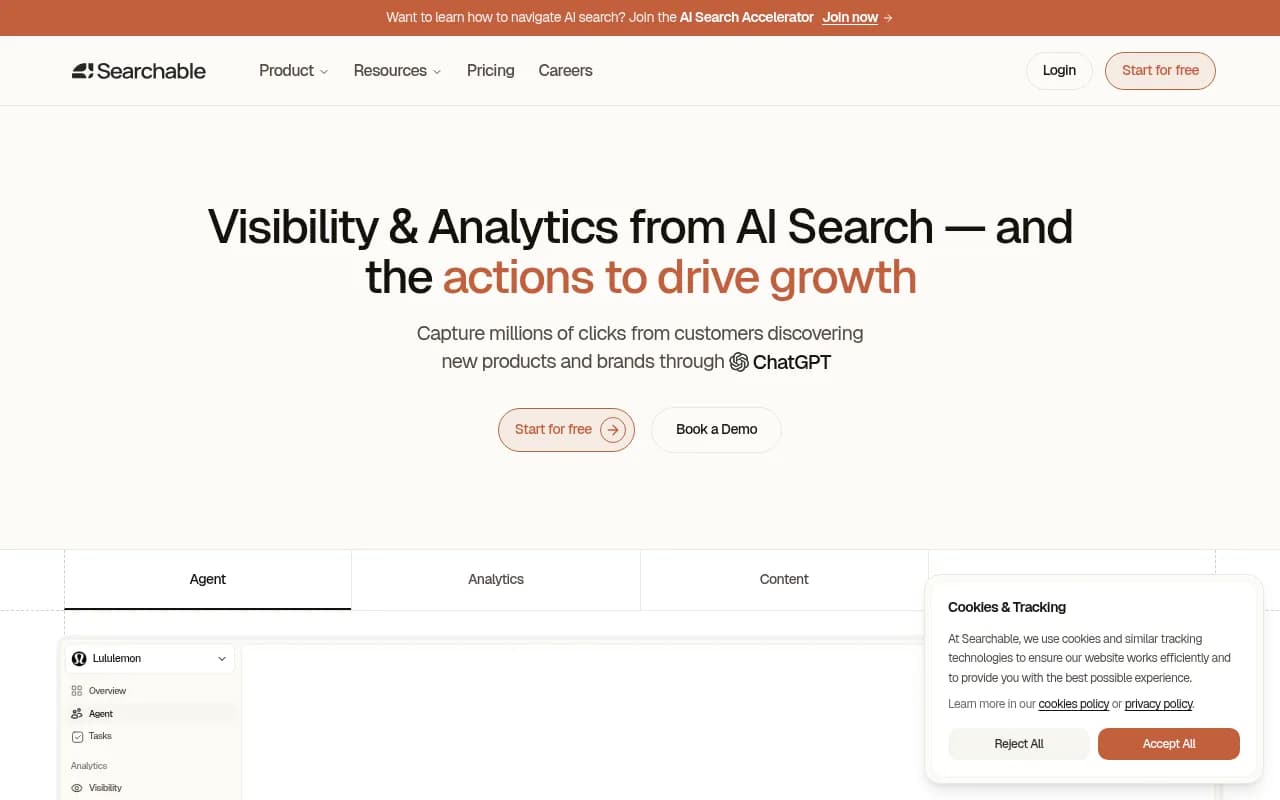
Searchable is positioned as an accessible AI visibility platform -- the kind of tool a solo marketer or small team can spin up quickly to see how their brand appears across ChatGPT, Perplexity, and similar engines. The pitch is simplicity: get visibility data without needing a dedicated analyst or a six-figure contract.
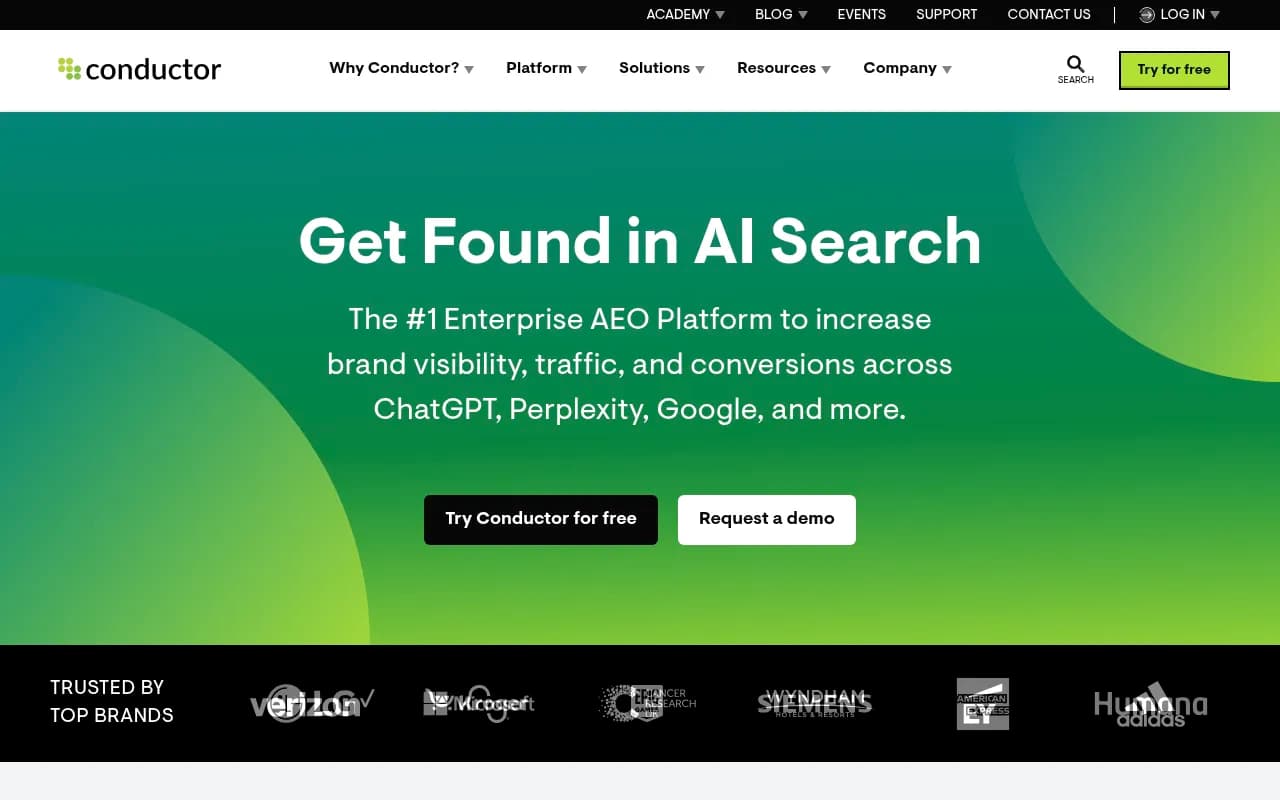
Conductor is a long-established enterprise SEO platform that added AEO capabilities as AI search became impossible to ignore. It already had deep roots in content workflows, technical monitoring, and enterprise reporting. The AEO layer sits on top of that existing infrastructure, which means it's genuinely powerful for large organizations -- but it's also built for teams with the headcount and budget to match.
Promptwatch takes a different angle. Rather than starting from traditional SEO and adding AI tracking, it was built specifically for the AI search era. The core product is an optimization loop: identify which prompts your competitors are winning but you're not, generate content engineered to earn citations, and then track whether that content is actually getting picked up by AI models.

Feature comparison
Here's a side-by-side look at the capabilities that matter most for AI search visibility work:
| Feature | Searchable | Conductor | Promptwatch |
|---|---|---|---|
| AI model monitoring | Yes (core models) | Yes (multi-model) | Yes (10 models incl. ChatGPT, Claude, Gemini, Perplexity, Grok, DeepSeek, Copilot, Mistral, Meta AI, Google AI Overviews) |
| Answer gap / content gap analysis | Limited | Partial | Yes (full Answer Gap Analysis) |
| AI content generation | No | Yes (via content workflows) | Yes (built-in AI writing agent, grounded in citation data) |
| AI crawler logs | No | Partial (server log analysis) | Yes (real-time logs per AI bot) |
| Prompt volume & difficulty scoring | No | No | Yes |
| Query fan-outs | No | No | Yes |
| Reddit & YouTube citation tracking | No | No | Yes |
| ChatGPT Shopping tracking | No | No | Yes |
| Competitor heatmaps | Basic | Yes | Yes |
| Traffic attribution | No | Yes | Yes (code snippet, GSC, server logs) |
| Multi-language / multi-region | Limited | Yes | Yes |
| Agency / white-label support | No | Yes | Yes (custom plans) |
| Pricing entry point | Mid-market | Enterprise contract | $99/month |
| Free trial | Yes | Yes | Yes |
A few things stand out from that table. Conductor and Promptwatch are both serious platforms -- Searchable is clearly in a different weight class. But even between Conductor and Promptwatch, the differences are meaningful. Conductor's strength is its existing enterprise infrastructure: technical SEO, content workflows, organizational reporting. Promptwatch's strength is the depth of its AI-specific data layer and the fact that it closes the loop from gap identification to content creation to traffic attribution.
Going deeper on each platform
Searchable: the lightweight option
Searchable does what it says on the tin. You set up your brand, define some prompts, and it starts tracking how often you appear in AI-generated responses. For teams that are just getting started with AI visibility -- or that need a simple dashboard to share with stakeholders -- it's a reasonable entry point.
The limitations show up quickly if you want to do anything beyond monitoring. There's no content gap analysis, no built-in writing tools, no crawler logs, and no prompt intelligence to help you prioritize which queries to target. You can see that you're invisible for certain prompts, but the platform doesn't help you figure out why or what to do about it.
That's fine if your goal is awareness. It's a problem if your goal is improvement.
Conductor: enterprise AEO with deep roots in traditional SEO
Conductor has been around long enough to have real credibility. Its AEO features are built on top of a mature platform that already handles content performance tracking, technical monitoring, and enterprise reporting. For a large marketing organization that's already using Conductor for SEO, adding AI visibility tracking to the same platform makes operational sense.
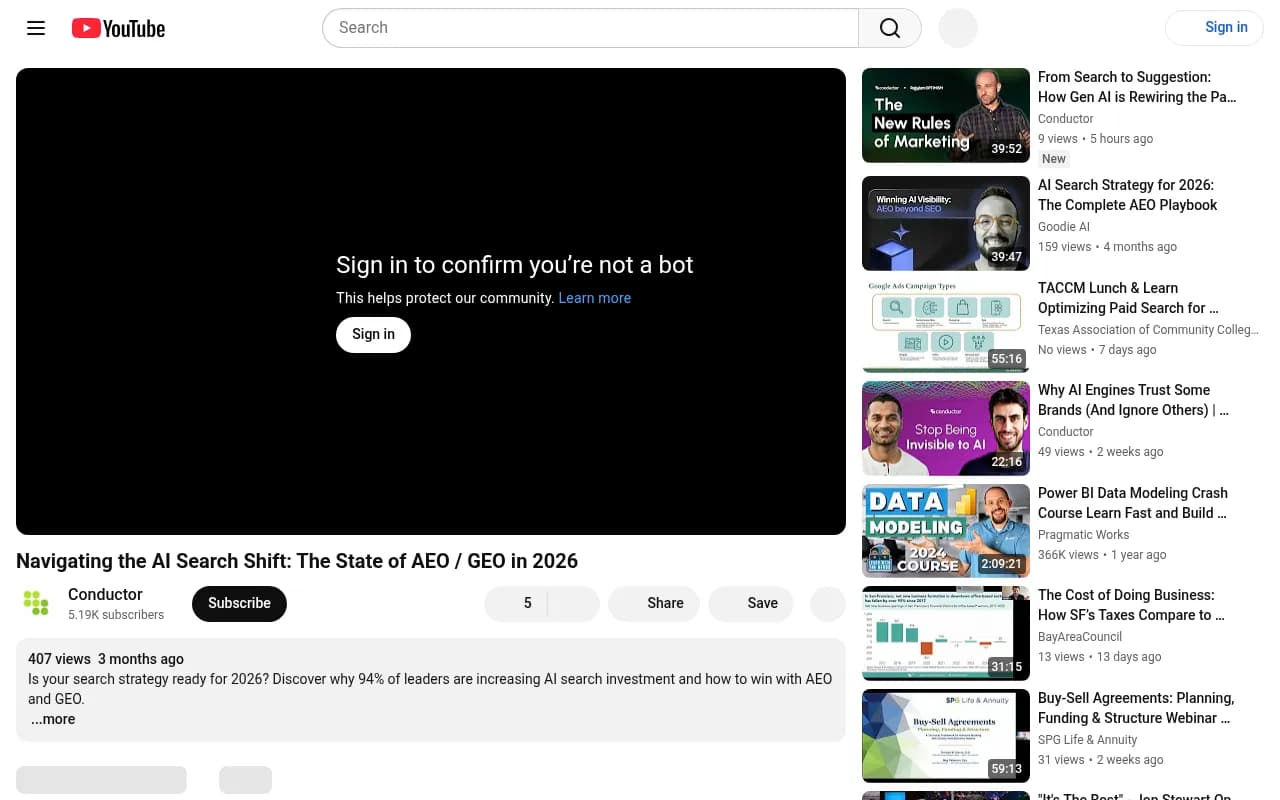
The webinar Conductor published in early 2026 -- "Navigating the AI Search Shift" -- gives a good sense of how they're thinking about the space. They surveyed 250+ enterprise leaders and found that 94% are increasing AI search investment, with server log analysis and bot crawler activity emerging as key new KPIs. Conductor has built tooling around exactly those signals.
Where Conductor falls short for pure GEO work is that it's still fundamentally an enterprise SEO platform with AEO capabilities layered on. The pricing reflects that -- you're not going to get a Conductor contract for $99/month. And some of the more AI-specific features (prompt volume scoring, query fan-outs, Reddit/YouTube citation tracking) aren't part of the offering.
For a Fortune 500 brand with an existing Conductor relationship and a large SEO team, the AEO layer is a natural extension. For a mid-market company that wants to compete in AI search specifically, it may be more platform than you need -- and more expensive than alternatives that do the AI-specific work better.
Promptwatch: built for the optimization loop
Promptwatch is the most AI-native of the three. It monitors 10 AI models, tracks over 1.1 billion citations, and -- this is the part that separates it from most competitors -- actually helps you do something with that data.
The Answer Gap Analysis is the clearest example. It shows you exactly which prompts your competitors are getting cited for that you're not. Not just "you're invisible here" but "here are the specific topics and questions AI models want answered that your site doesn't cover." That's actionable in a way that a visibility score isn't.
From there, the built-in AI writing agent generates content grounded in real citation data -- articles, listicles, comparisons -- designed to earn citations from ChatGPT, Claude, Perplexity, and others. This isn't generic AI content; it's built around what the models are actually citing.
Then you track whether it worked. Page-level tracking shows which pages are being cited, by which models, and how often. Traffic attribution (via code snippet, GSC integration, or server log analysis) connects those citations to actual revenue.
That loop -- find gaps, create content, track results -- is what makes Promptwatch an optimization platform rather than a monitoring dashboard. Most tools in this space, including Searchable and several other well-known platforms, stop at step one.
The AI crawler logs are worth calling out separately. Promptwatch shows you in real time which AI bots (ChatGPT, Claude, Perplexity, etc.) are crawling your site, which pages they're reading, and what errors they're hitting. Most competitors don't offer this at all. It's the kind of data that helps you understand why your content isn't getting cited -- not just that it isn't.
Pricing starts at $99/month for the Essential tier (1 site, 50 prompts, 5 articles), which is genuinely accessible for teams that are serious about AI search but not running enterprise budgets. The Professional tier at $249/month adds crawler logs, city/state tracking, and more prompts. Business at $579/month scales to 5 sites and 350 prompts.
Who should use which tool
This is where the comparison gets practical.
Use Searchable if you're a small team or solo marketer who wants basic AI visibility monitoring without a complex setup or a large budget. It's a reasonable starting point for understanding where you stand -- just know that you'll hit its ceiling quickly if you want to actually move the needle.
Use Conductor if you're at an enterprise with an existing Conductor relationship, a large SEO team, and a need to integrate AI visibility tracking into broader content and technical workflows. The AEO features are solid, and the platform's depth in traditional SEO makes it genuinely useful for organizations where those two disciplines need to live together.
Use Promptwatch if your goal is to improve your AI search visibility, not just measure it. The combination of Answer Gap Analysis, AI content generation, crawler logs, and traffic attribution makes it the most complete tool for teams that want to close the loop between data and results. It's also the most accessible of the three for mid-market teams -- the $99/month entry point is real, not a stripped-down teaser.
The monitoring-only trap
One thing worth naming directly: a lot of teams are investing in AI visibility tools that show them they have a problem but don't help them fix it. That's not a knock on monitoring -- you need data before you can act. But if your platform stops at "here's your visibility score," you're doing half the job.
The research backs this up. Conductor's own 2026 survey found that enterprise teams are allocating roughly 12% of their marketing budget to AEO/GEO. That's real money. Teams spending at that level need to show results, not just dashboards.
The platforms that will prove their value over the next 12-18 months are the ones that connect visibility data to content actions to revenue outcomes. Promptwatch is the clearest example of that in this comparison. Conductor gets there through its broader platform. Searchable, for now, is still primarily a monitoring tool.
A note on the broader landscape
Searchable, Conductor, and Promptwatch aren't the only options. The GEO/AEO space has exploded, and tools like Profound, AthenaHQ, Scrunch, Otterly.AI, and Peec.ai all have their own angles.




In a 2026 comparison of 12 GEO platforms, Promptwatch was the only one rated as a "Leader" across all categories -- the core distinction being that it's built around taking action, not just reporting. Most competitors are monitoring-first platforms that leave optimization work to the user.
That doesn't mean every team needs the most comprehensive platform. If you're just starting to track AI visibility, a simpler tool might be the right first step. But if you're past the "do we need to care about this?" stage and into "how do we actually win in AI search?", the platform you choose matters a lot.
Bottom line
Searchable, Conductor, and Promptwatch are solving related but different problems. Searchable is for teams that want simple monitoring. Conductor is for enterprises that need AI visibility integrated into a broader SEO and content platform. Promptwatch is for teams that want to actually optimize -- find gaps, create content, track results, and connect it all to revenue.
The right choice depends on where your team is in the AI search journey and what you need the tool to do. But if you're serious about improving your visibility in ChatGPT, Perplexity, Claude, and the rest -- not just measuring it -- the platform you choose needs to do more than show you a dashboard.