Key takeaways
- For new product launches, you need more than monitoring -- you need to know which prompts competitors are winning and create content to close those gaps before launch day.
- Promptwatch is the only platform in this comparison that covers the full loop: gap analysis, content generation, crawler logs, and traffic attribution in one place.
- Profound is the enterprise choice with the deepest reporting, but its price point rules it out for most growing teams.
- Peec AI is a solid mid-market analytics tool, though it stops at monitoring and lacks content optimization features.
- Otterly.AI is the most accessible entry point for teams that just want citation tracking without complexity.
- Scrunch takes a different angle -- CDN-edge content serving -- which is interesting but niche, and its monitoring depth is limited.
Launching a new product is already stressful. Now add the fact that a growing share of your potential customers aren't searching Google anymore -- they're asking ChatGPT, Perplexity, or Gemini "what's the best [your category] tool?" and getting a curated answer that may not include you at all.
That's the AI visibility problem. And it's especially acute for new products, because AI models tend to cite established sources. If your brand has no presence in the training data, no citations, no mentions in the right places, you're invisible by default.
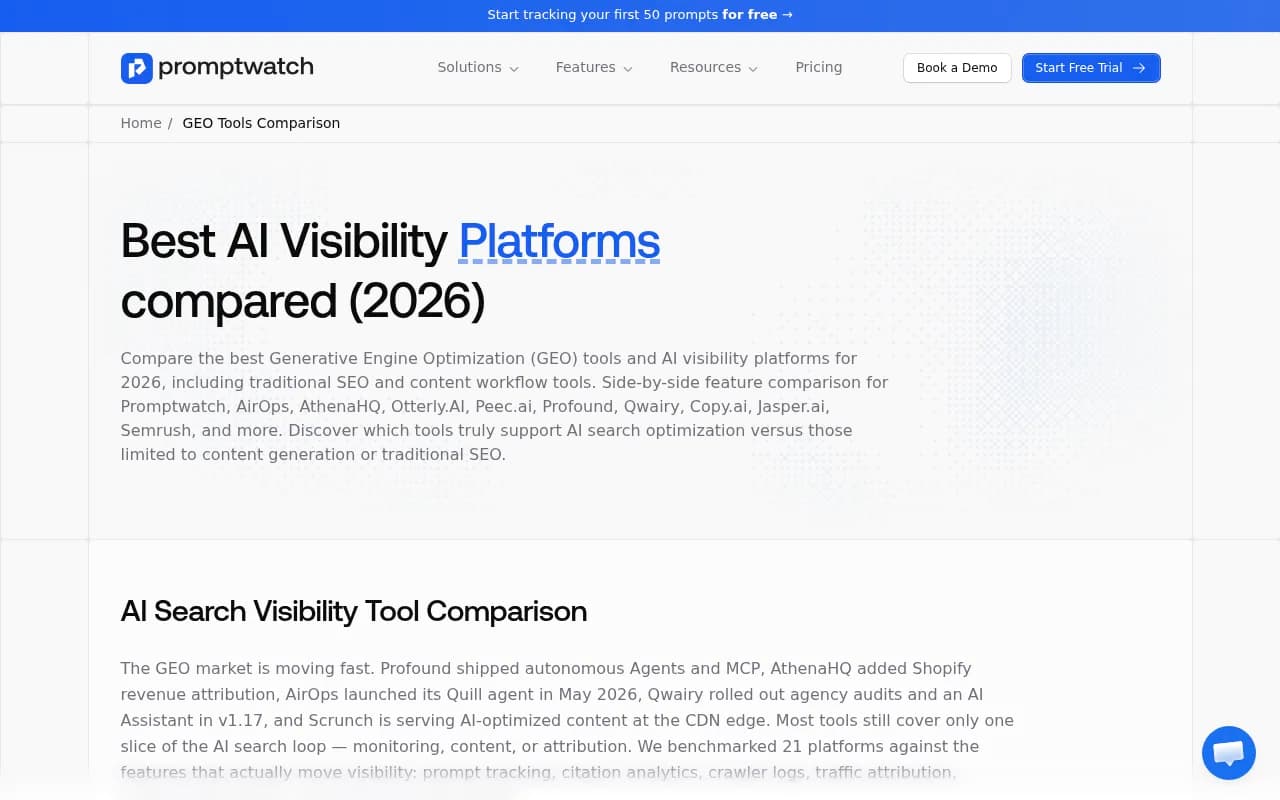
So which platform actually helps you fix that? I looked at five of the most talked-about options in 2026 -- Promptwatch, Peec AI, Profound, Otterly.AI, and Scrunch -- specifically through the lens of a new product launch.
What a new product launch actually needs from an AI visibility tool
Before comparing features, it's worth being specific about what "new product launch" demands that's different from ongoing brand monitoring.
When you're launching, you typically have:
- No existing AI citations (you're starting from zero)
- Competitors who are already visible for the prompts you want to own
- A tight timeline -- you need to build visibility fast, not over six months
- A need to prove ROI to stakeholders quickly
That means the features that matter most are: competitor gap analysis (what are they visible for that you're not?), content creation tools grounded in real prompt data, crawler logs to confirm AI engines are actually finding your new pages, and traffic attribution to show that visibility is converting.
A tool that just shows you a dashboard of your current citations is close to useless at launch -- you have no citations yet. You need to know what to build.
The five platforms, honestly assessed
Promptwatch
Promptwatch is built around what it calls the "action loop": find gaps, create content, track results. For a new product launch, that sequence is exactly what you need.
The Answer Gap Analysis feature shows you which prompts your competitors are appearing in that you're not. You see the specific questions AI models are answering without citing you -- and you can sort by prompt volume and difficulty to prioritize the winnable ones first. That's genuinely useful on day one of a launch, when you have zero existing visibility to analyze.
From there, Content Agents generate articles, listicles, and comparison pieces grounded in that prompt data. These aren't generic blog posts -- they're built around the actual gaps AI models are exposing. The difference matters: a piece written to answer a specific high-volume prompt is more likely to get cited than a piece written to rank on Google.
The crawler log feature (available from the Professional plan at $249/month) is particularly valuable during a launch. It shows you in real time when ChatGPT, Perplexity, Claude, and other AI crawlers hit your new pages, what errors they encounter, and when a page moves from "crawled" to "cited." Most teams have no visibility into this at all -- they publish content and hope for the best.
Promptwatch also tracks 10 AI models (ChatGPT, Perplexity, Google AI Overviews, Google AI Mode, Claude, Gemini, Meta/Llama, DeepSeek, Grok, Copilot), has Reddit and YouTube insights for off-site citation analysis, and includes ChatGPT Shopping tracking for product launches specifically.
Pricing starts at $99/month (Essential: 1 site, 50 prompts, 5 articles), with Professional at $249/month and Business at $579/month.

Peec AI
Peec AI is a well-funded analytics platform ($29M raised, reportedly $4M+ ARR within its first ten months) with solid multi-language tracking and clean reporting. For a new product launch, it covers the monitoring side competently -- you can track prompts across multiple AI models, see citation trends, and export data.
The gap is on the action side. Peec AI doesn't generate content, doesn't have crawler logs, and doesn't help you understand why you're not being cited. It shows you the score; it doesn't help you improve it. For a launch where you're starting from zero, that's a meaningful limitation.
Pricing: Starter at $95/month (50 prompts, 3 AI models), Pro at $245/month (150 prompts, 2 projects), Advanced at $495/month (350 prompts, multi-country). The Advanced tier is roughly comparable in price to Promptwatch's Business plan but with fewer action-oriented features.

Profound
Profound is the category leader by most measures -- $155M raised, $1B valuation, Fortune 500 clients. Its reporting is deep, its dashboards are stakeholder-ready, and it has genuine enterprise credibility.
For a new product launch at a large company, Profound makes sense if you need to present AI visibility data to a CMO or board and want something that looks authoritative. The platform covers competitive analysis and has strong prompt tracking.
The practical issues for most teams: Profound is enterprise-priced (custom pricing, typically well above $1,000/month), and like Peec AI, it's primarily a monitoring and analytics platform. It doesn't have the content generation or crawler log features that help you act on what you find. If you're a mid-market team or a startup launching a new product, the price-to-utility ratio is hard to justify.

Otterly.AI
Otterly.AI is the most accessible option in this comparison -- plans start around $29/month, and the interface is genuinely simple to use. For a small team or solo marketer who wants to start tracking AI citations without a steep learning curve, it's a reasonable starting point.
For a new product launch, though, Otterly.AI's limitations show up quickly. It's monitoring-only: no content generation, no crawler logs, no gap analysis against competitors. You can see whether you're being cited, but you can't do much about it from within the platform. It also covers fewer AI models than Promptwatch or Peec AI.
If your launch budget is tight and you just want basic citation tracking to report upward, Otterly.AI works. If you need to actively build visibility from scratch, you'll outgrow it fast.

Scrunch
Scrunch takes a different technical approach than the other four. Rather than just monitoring AI responses, it serves AI-optimized content at the CDN edge -- essentially intercepting AI crawler requests and delivering structured content designed to be cited. It's an interesting architectural choice.
In practice, this means Scrunch is more of a content delivery and optimization layer than a full visibility platform. It doesn't have the prompt tracking depth, competitor analysis, or traffic attribution that you'd want for a launch. It's worth watching as the technology matures, but right now it's a niche tool that solves one specific problem rather than the full launch workflow.
Side-by-side comparison
| Feature | Promptwatch | Peec AI | Profound | Otterly.AI | Scrunch |
|---|---|---|---|---|---|
| AI models tracked | 10 | 3-all (plan-dependent) | Multiple | Limited | Limited |
| Competitor gap analysis | Yes | Partial | Yes | No | No |
| Content generation | Yes (Content Agents) | No | No | No | No |
| AI crawler logs | Yes | No | No | No | No |
| Traffic attribution | Yes | No | Partial | No | No |
| Reddit/YouTube insights | Yes | No | No | No | No |
| ChatGPT Shopping tracking | Yes | No | No | No | No |
| Multi-language/region | Yes | Yes (Advanced+) | Yes | Limited | No |
| Starting price | $99/mo | $95/mo | Custom (enterprise) | ~$29/mo | Custom |
| Free trial | Yes | Yes | Demo only | Yes | Demo only |
| Best for | Full launch workflow | Mid-market analytics | Enterprise reporting | Entry-level monitoring | CDN-edge optimization |
Which platform fits which launch scenario
You're a startup or scale-up launching your first product
Start with Promptwatch. The gap analysis tells you exactly what content to create before you have any citations. The Content Agents help you build that content fast. The crawler logs confirm AI engines are finding it. At $99-$249/month, the price is reasonable for what you get.
You're a mid-market team with existing SEO resources
Peec AI or Promptwatch, depending on whether you need content generation. If your team already has strong writers and just needs the data layer, Peec AI's analytics are clean and exportable. If you want the platform to help generate content too, Promptwatch is the better fit.
You're an enterprise team at a Fortune 500 company
Profound is the safe choice for stakeholder reporting and enterprise credibility. Pair it with Promptwatch if you need content optimization capabilities that Profound doesn't cover.
You're a solo marketer or small agency on a tight budget
Otterly.AI gets you started cheaply. Upgrade to Promptwatch when you're ready to act on the data rather than just observe it.
You have a technical team and want to experiment with AI content delivery
Scrunch is worth a look, but it's not a replacement for a full visibility platform.
The content gap problem is the real issue for new launches
It's worth dwelling on this for a moment, because it's the thing most teams underestimate.
When you launch a new product, AI models don't know you exist. They've been trained on data that predates your launch. Even after you publish content, there's a lag before crawlers find it, process it, and start citing it. That lag can be weeks or months if you're not actively managing it.
The platforms that help you close this gap fastest are the ones that show you what content is missing (gap analysis), help you create it (content generation), and confirm it's being found (crawler logs). Of the five platforms in this comparison, only Promptwatch does all three.
That's not a knock on Peec AI or Profound -- they're good at what they do. But "what they do" is analytics and reporting, not optimization. For a launch, you need optimization.
A few things worth knowing before you commit
Prompt selection matters more than platform selection. Any of these tools will give you better results if you spend time thinking about which prompts actually matter for your product. "Best [category] tool" prompts are competitive. "Best [category] tool for [specific use case]" prompts are often more winnable and more relevant to your actual buyers.
AI visibility takes time to build, even with the best tools. Promptwatch's crawler analytics show the timeline from publish to crawl to citation -- and it's rarely instant. Set realistic expectations with stakeholders: weeks, not days.
Off-site citations matter as much as on-site content. AI models cite Reddit threads, YouTube videos, review sites, and third-party listicles heavily. Promptwatch tracks these; most competitors don't. For a new product launch, getting mentioned in the right external sources is often faster than waiting for your own content to get cited.
Multi-model coverage isn't uniform. Peec AI's Starter plan only covers 3 AI models. If your target audience uses Perplexity heavily (common in tech-adjacent markets), make sure the platform you choose actually tracks it.
Bottom line
For tracking AI visibility during a new product launch in 2026, the honest answer is that most of these platforms are built for monitoring established brands, not for building visibility from scratch.
Promptwatch is the exception. The combination of gap analysis, content generation, and crawler logs gives you an actual workflow for building AI visibility during a launch window, not just a dashboard to stare at after the fact. For teams that need enterprise reporting and have the budget, Profound covers that need well. For teams on a tight budget who want basic citation tracking, Otterly.AI is a reasonable starting point.
But if you're serious about owning your category in AI search from day one of your launch, the action loop matters more than the monitoring dashboard.