Key takeaways
- Gauge and Rankability are solid monitoring tools for tracking competitor visibility in AI search, but neither offers content generation or optimization capabilities -- they show you the gap, not how to close it.
- Promptwatch is the only platform of the three that completes the full loop: find gaps, generate content, track results, and attribute traffic to revenue.
- For raw competitive benchmarking dashboards, Gauge has a clean interface and strong cross-model coverage. Rankability leans toward agency workflows.
- If your goal is to actually improve your AI visibility -- not just measure it -- Promptwatch is the clearest choice among the three.
- Pricing varies significantly: Gauge and Rankability both target mid-market and agency buyers; Promptwatch starts at $99/mo with a free trial.
Why competitive intelligence in AI search is harder than it looks
A year ago, most marketing teams were still asking "should we care about AI search?" That question is settled. ChatGPT, Perplexity, Claude, and Google AI Overviews now influence how millions of people discover products, services, and brands every day. The new question is: "Which of my competitors is winning this channel, and what do I need to do about it?"
That's a harder problem than it sounds. Traditional SEO competitive intelligence is relatively straightforward -- you can see who ranks for a keyword, pull their backlink profile, and reverse-engineer their content strategy. AI search doesn't work that way. There's no public index. Responses are generated dynamically. The same prompt can return different results depending on the model, the user's location, their phrasing, and dozens of other factors.
So when you're evaluating an AI visibility platform for competitive intelligence specifically, you need to ask: does this tool actually show me why a competitor is winning, and does it help me do something about it?
That's the lens I'm using to compare Promptwatch, Gauge, and Rankability here.
What each platform is built to do
Before diving into the comparison, it's worth being honest about what these three tools are optimizing for. They're not identical products competing on the same axis.
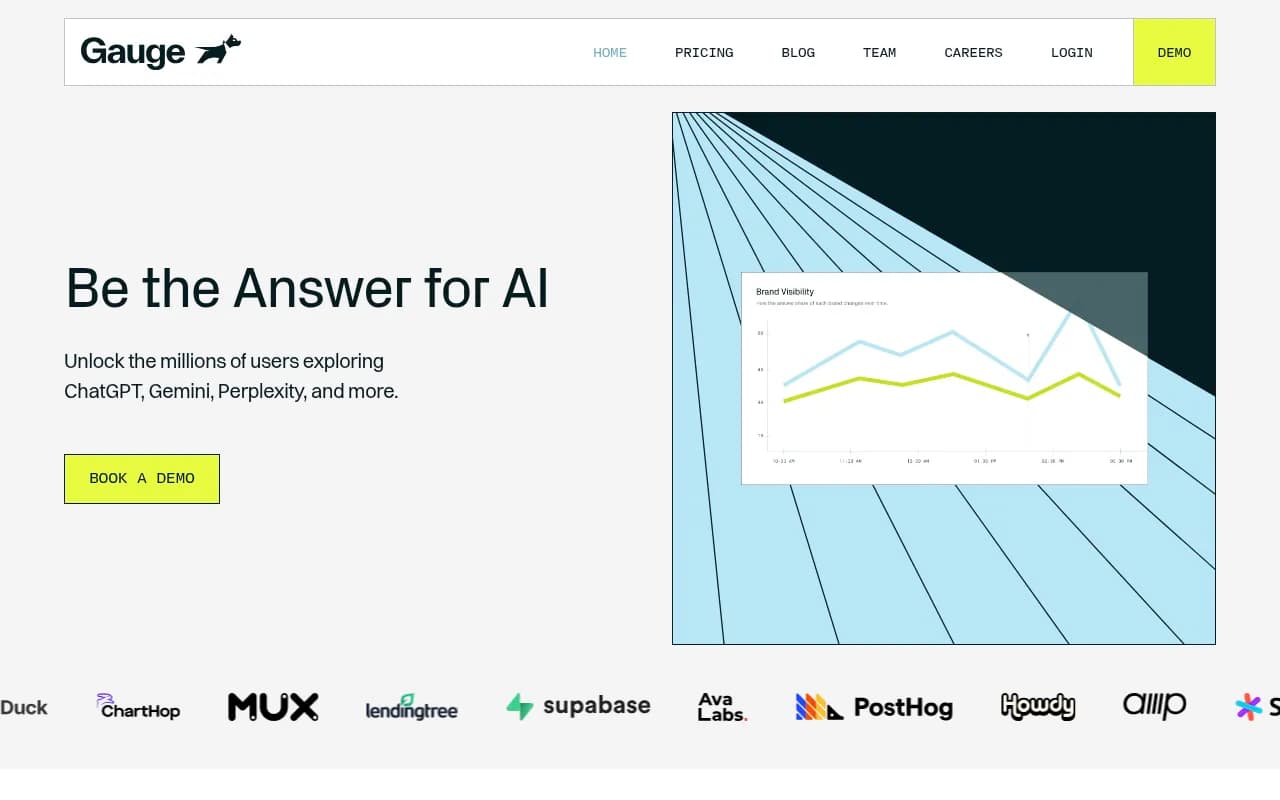
Gauge is built around strategic competitive intelligence for AI visibility. Its core pitch is helping teams understand share of voice across AI models, track how competitors are mentioned, and surface trends over time. It's a monitoring and benchmarking tool at heart.
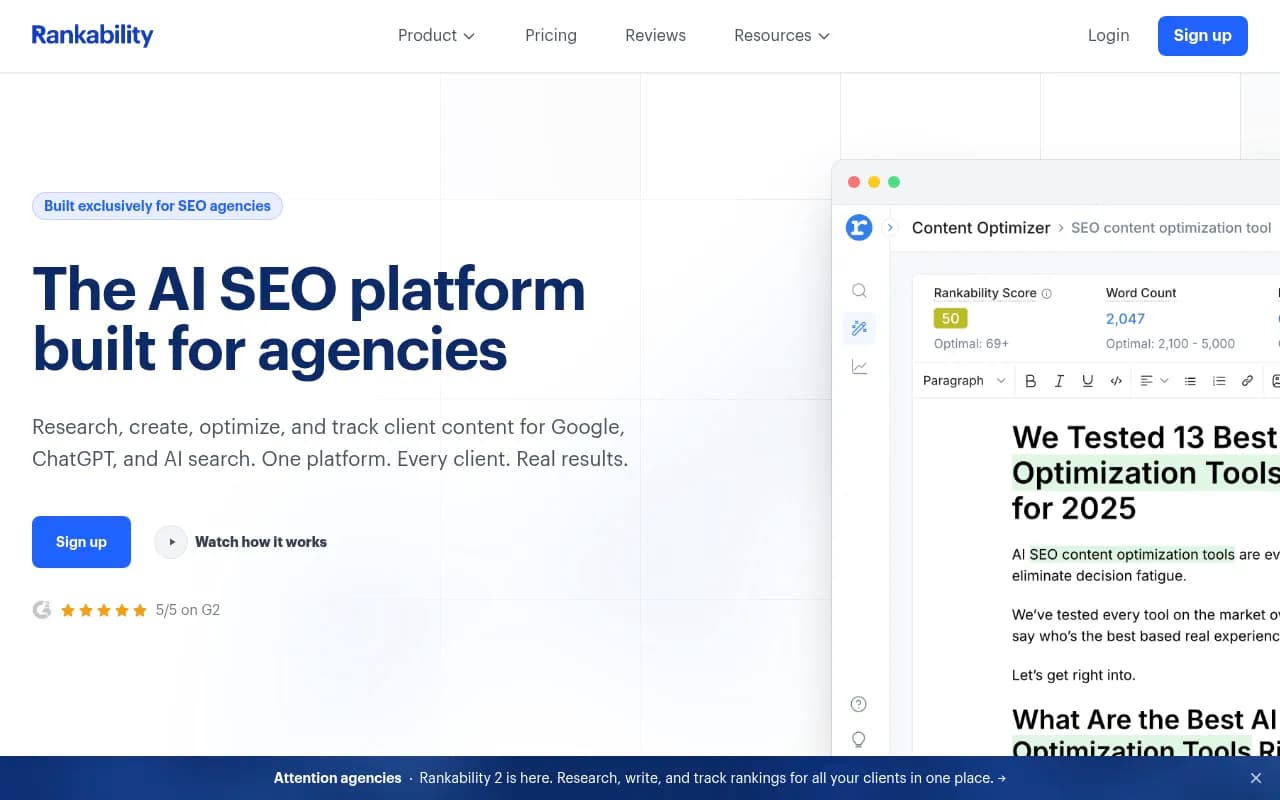
Rankability is an agency-focused analytics platform. It's designed for teams managing multiple clients who need clean reporting on AI visibility performance. The emphasis is on dashboards, client-facing reports, and tracking visibility scores over time.
Promptwatch takes a different approach. It starts with monitoring and competitive intelligence, but the platform is built around what happens after you see the data. The answer gap analysis, built-in AI writing agent, crawler logs, and traffic attribution tools are all designed to help you act on what you find -- not just observe it.
Promptwatch has processed over 1.1 billion citations, clicks, and prompts, which gives its content recommendations and competitive benchmarks a level of empirical grounding that newer platforms can't match yet.

Head-to-head comparison
Competitive intelligence features
This is where Gauge genuinely shines. Its competitor heatmaps and share-of-voice tracking are well-designed, and the interface makes it easy to see at a glance which brands are winning for specific prompts across different AI models. If your primary need is a clean, visual dashboard showing competitive positioning, Gauge delivers that well.
Rankability's competitive intelligence is more report-oriented. You can track competitor visibility scores and pull comparisons for client presentations, but the depth of prompt-level analysis is thinner than Gauge.
Promptwatch's competitive intelligence goes deeper in a specific way: it doesn't just show you that a competitor is more visible than you -- it shows you which prompts they're winning, what content is driving those citations, and what's missing from your own site. The Answer Gap Analysis is the feature that makes this actionable. You see the exact topics and questions AI models want to answer but can't find on your website. That's a different kind of competitive intelligence than a share-of-voice chart.
Prompt tracking and coverage
| Feature | Promptwatch | Gauge | Rankability |
|---|---|---|---|
| AI models tracked | 10+ (ChatGPT, Claude, Perplexity, Gemini, Grok, DeepSeek, Copilot, Meta AI, Mistral, Google AI Overviews) | Multiple (ChatGPT, Perplexity, Gemini, Claude) | Multiple (ChatGPT, Perplexity, Gemini) |
| Prompt volume estimates | Yes | Limited | No |
| Prompt difficulty scoring | Yes | No | No |
| Query fan-outs | Yes | No | No |
| Custom personas | Yes | Limited | No |
| Multi-language/region | Yes | Limited | No |
Promptwatch's prompt intelligence layer is notably more developed. Volume estimates and difficulty scores let you prioritize which prompts are actually worth targeting. Query fan-outs show how a single prompt branches into sub-queries -- useful for understanding the full surface area of a competitive topic. Neither Gauge nor Rankability offers this.
Content optimization and generation
This is the biggest structural difference between the three platforms.
Gauge and Rankability are monitoring tools. They don't help you create content. You can identify that a competitor is more visible for a set of prompts, but the platform stops there. What you do with that information is up to you.
Promptwatch has a built-in AI writing agent that generates articles, listicles, and comparisons grounded in real citation data. The content it produces isn't generic -- it's informed by which sources AI models actually cite, what angles are getting traction, and which competitor gaps you're trying to close. For teams that want to move from "we found a gap" to "we published something to fill it" without switching tools, this matters.
Crawler logs and technical visibility
Promptwatch's AI Crawler Logs feature is something neither Gauge nor Rankability offers. It shows you in real time which AI crawlers (ChatGPT, Claude, Perplexity, etc.) are hitting your website, which pages they're reading, how often they return, and what errors they encounter. This is genuinely useful for diagnosing why certain pages aren't getting cited -- it's the AI equivalent of checking your server logs for Googlebot.
If you're running a technical SEO team alongside your GEO efforts, this is a meaningful differentiator.
Traffic attribution
| Feature | Promptwatch | Gauge | Rankability |
|---|---|---|---|
| AI traffic attribution | Yes (code snippet, GSC, server logs) | No | No |
| Page-level citation tracking | Yes | Limited | No |
| Revenue connection | Yes | No | No |
| ChatGPT Shopping tracking | Yes | No | No |
Connecting AI visibility to actual traffic and revenue is still a hard problem, and most platforms don't try. Promptwatch does, through a code snippet, Google Search Console integration, or server log analysis. This lets you close the loop between "our visibility score improved" and "we got more organic traffic from AI search." Gauge and Rankability don't offer this.
Pricing
| Plan | Promptwatch | Gauge | Rankability |
|---|---|---|---|
| Entry-level | $99/mo (1 site, 50 prompts) | Custom/contact | Contact for pricing |
| Mid-tier | $249/mo (2 sites, 150 prompts) | -- | -- |
| Business | $579/mo (5 sites, 350 prompts) | -- | -- |
| Free trial | Yes | Limited | Limited |
| Agency/Enterprise | Custom | Yes | Yes |
Promptwatch is the most transparent on pricing. The $99/mo Essential plan is a reasonable entry point for a single brand, and the Professional tier at $249/mo unlocks crawler logs, city/state tracking, and more articles. Gauge and Rankability both lean toward custom pricing, which typically means higher floor costs aimed at mid-market and agency buyers.
Where each tool fits
Use Gauge if...
You need clean, visual competitive benchmarking and your primary deliverable is a share-of-voice dashboard. Gauge's interface is well-designed for presenting competitive positioning to stakeholders. If monitoring is the job and you have a separate content team to act on the findings, it's a reasonable choice.
Use Rankability if...
You're an agency managing multiple clients who need structured reporting on AI visibility. Rankability is built for that workflow -- client dashboards, visibility scores, and comparative reporting. It's not a tool for in-house teams trying to optimize their own AI presence.
Use Promptwatch if...
You want to actually improve your AI visibility, not just track it. The combination of Answer Gap Analysis, AI content generation, crawler logs, prompt volume data, and traffic attribution makes it the most complete platform of the three. It's the right fit for in-house marketing and SEO teams at brands that take AI search seriously, and for agencies that want to deliver optimization work (not just reports) to clients.
The 6,700+ brands using it -- including Booking.com and Center Parcs -- suggest it scales across both enterprise and mid-market use cases.
The monitoring-only trap
One pattern worth naming directly: a lot of teams buy an AI visibility tool, get excited about the dashboards, and then... don't do much with the data. This isn't a criticism of the teams -- it's a product design problem. When a tool only shows you what's happening, the next step (figuring out what to do) requires a separate workflow, a separate tool, and often a separate meeting.
Promptwatch's design philosophy is explicitly built around breaking that pattern. The action loop -- find gaps, generate content, track results -- is the core product, not a feature added on top of monitoring. That's a meaningful difference if you're trying to justify the ROI of an AI visibility platform to leadership.
As one independent review from February 2026 noted after testing 25+ tools: strong dashboards and cross-platform monitoring are table stakes now. The platforms that stand out are the ones that tell you what to do next.
Additional tools worth knowing
If you're still evaluating options beyond these three, a few others in the space are worth a look depending on your specific needs:
Profound is a strong enterprise-tier option with solid tracking depth, though it's priced accordingly and lacks Reddit/YouTube tracking.

AthenaHQ covers 8+ AI engines and is monitoring-focused -- good for teams that need breadth of coverage without the optimization layer.

Otterly.AI is one of the more affordable monitoring options, though it doesn't offer crawler logs, content generation, or traffic attribution.

Peec AI is worth considering if multi-language tracking is your primary need.

Bottom line
Gauge and Rankability are both legitimate tools for specific jobs. Gauge is the better competitive intelligence dashboard of the two. Rankability is the better fit for agency reporting workflows. Neither is built to help you close the gap they identify.
Promptwatch is the platform that treats competitive intelligence as the starting point, not the end goal. If you're tracking competitors in AI search because you want to outrank them -- not just observe them -- that distinction matters more than any individual feature comparison.
The free trial is available at promptwatch.com if you want to test the Answer Gap Analysis and see what your competitors are winning that you're not.