Key takeaways
- Most AI visibility platforms are monitoring-only dashboards -- they show you data but don't help you act on it.
- In a 2026 comparison of 12 GEO platforms, Promptwatch is the only tool rated "Leader" across all categories, including content generation, crawler logs, and traffic attribution.
- The core difference is an action loop: find gaps, generate content that gets cited, track the results.
- Competitors like Otterly.AI, Peec.ai, and AthenaHQ stop at step one (monitoring). Profound and Scrunch have stronger feature sets but higher prices and missing capabilities like Reddit tracking and ChatGPT Shopping.
- Pricing starts at $99/month, with a free trial available.
Why this comparison matters right now
AI search isn't a trend you can afford to watch from the sidelines anymore. Google AI Overviews now reach over 1.5 billion people monthly. Adobe reported that AI-driven traffic to U.S. retail sites grew 1,100% year over year, and those visitors showed 12% higher engagement. ChatGPT, Perplexity, Claude, and Gemini are actively recommending brands, products, and services -- and if your brand isn't being cited, someone else's is.
That shift has created a new category of software: AI visibility platforms. Tools that help you understand, track, and improve how AI engines talk about you.
The problem? Most of them are just dashboards.
You get a score. You see which prompts your competitors rank for. You feel vaguely informed. Then you close the tab and wonder what to actually do about it.
This guide breaks down how the major platforms compare in 2026, and why one of them has pulled ahead by doing something the others haven't: building the full loop from diagnosis to action.
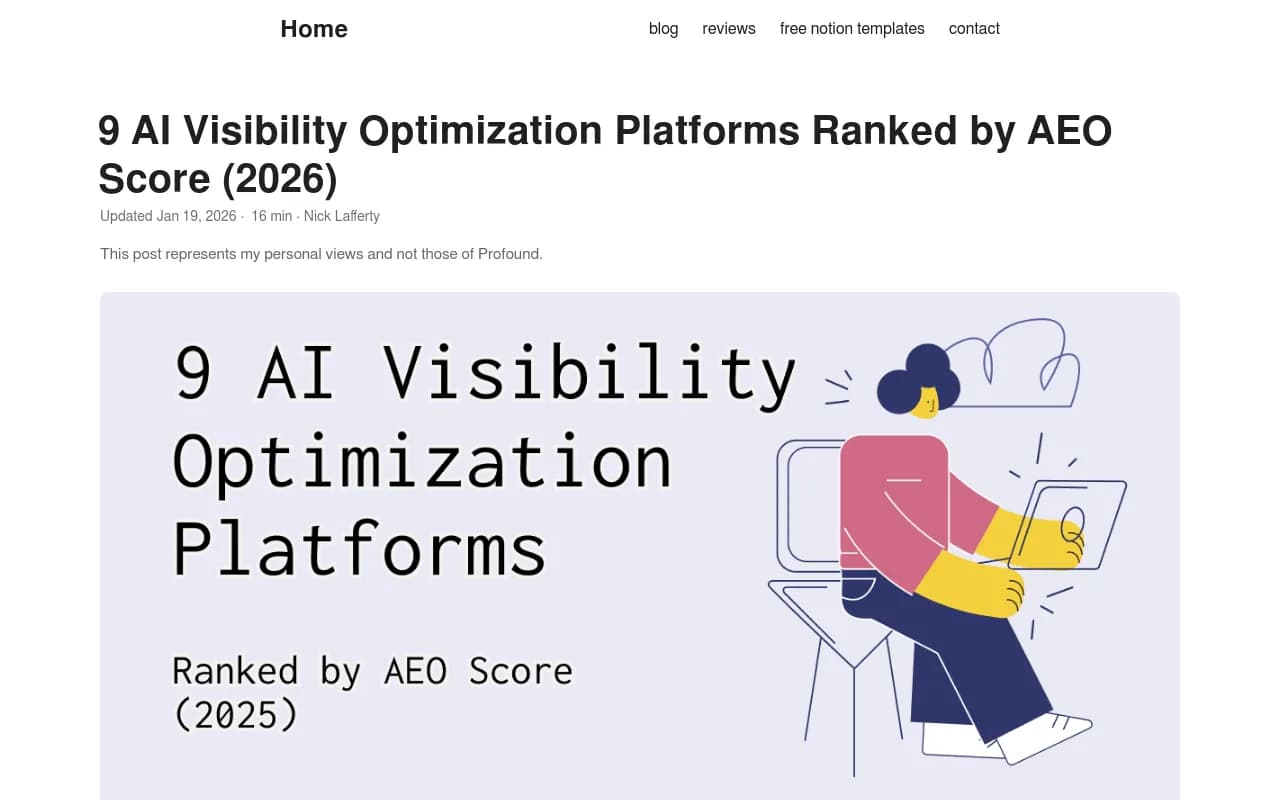
The monitoring-only problem
Before getting into specific tools, it's worth naming the pattern that defines most of this category.
A typical AI visibility tool works like this: you enter your brand name and some competitor names, pick a set of prompts, and the tool runs those prompts across ChatGPT, Perplexity, Gemini, and a few others. It shows you how often you appear, where your competitors appear instead, and maybe a sentiment breakdown.
That's useful. It's not nothing. But it answers the question "how visible am I?" without answering "what do I do about it?"
The gap between those two questions is where most tools fall short. Knowing that a competitor ranks for "best project management software for remote teams" doesn't tell you what content to create, how to structure it, or whether that prompt is even worth targeting. You're left doing that work manually -- or not doing it at all.
The platforms that have started to close this gap are the ones worth paying attention to.
How the major platforms stack up
Here's a direct comparison of the most-discussed AI visibility platforms in 2026 across the capabilities that actually matter:
| Platform | AI models tracked | Content generation | Crawler logs | Reddit/YouTube tracking | ChatGPT Shopping | Traffic attribution | Prompt volume/difficulty |
|---|---|---|---|---|---|---|---|
| Promptwatch | 10+ | Yes (built-in AI writer) | Yes | Yes | Yes | Yes (GSC, snippet, logs) | Yes |
| Profound | 10+ | No | No | No | No | Yes (GA4) | Limited |
| AthenaHQ | 8+ | No | No | No | No | No | Limited |
| Otterly.AI | 5 | No | No | No | No | No | No |
| Peec.ai | 6+ | No | No | No | No | No | No |
| Search Party | 6+ | No | No | No | No | No | No |
| Scrunch | 8+ | No | No | No | No | Limited | No |
| Semrush (AI toolkit) | 4 | No | No | No | No | No | No |
| Ahrefs Brand Radar | 4 | No | No | No | No | No | No |
The pattern is obvious. Most tools cover the monitoring column and stop there.
Platform-by-platform breakdown
Promptwatch
Promptwatch is the platform this site is built on, so it's worth being direct about what sets it apart rather than just listing features.
The core idea is an action loop with three steps. First, Answer Gap Analysis shows you exactly which prompts your competitors appear for that you don't -- not just that a gap exists, but what content your site is missing to fill it. Second, a built-in AI writing agent generates articles, listicles, and comparisons grounded in citation data from 880M+ analyzed citations, prompt volumes, and competitor analysis. This isn't generic content -- it's built around what AI models actually cite. Third, page-level tracking shows which of your pages are being cited, by which models, and how often -- and traffic attribution (via GSC integration, a code snippet, or server log analysis) connects that visibility to actual revenue.
On top of that loop, Promptwatch adds capabilities most competitors don't have at all: real-time AI crawler logs showing which pages ChatGPT, Claude, and Perplexity are reading on your site; Reddit and YouTube insights that surface discussions influencing AI recommendations; ChatGPT Shopping tracking; competitor heatmaps; and multi-language, multi-region monitoring with customizable personas.
It monitors 10 AI models: ChatGPT, Perplexity, Google AI Overviews, Google AI Mode, Claude, Gemini, Meta/Llama, DeepSeek, Grok, Mistral, and Copilot.
Pricing: Essential at $99/month (1 site, 50 prompts, 5 articles), Professional at $249/month (2 sites, 150 prompts, 15 articles, crawler logs), Business at $579/month (5 sites, 350 prompts, 30 articles). Free trial available.

Profound
Profound is the most credible competitor in the enterprise segment. It tracks 10+ AI engines, has SOC 2 Type II certification, and integrates with GA4 for attribution -- which puts it ahead of most monitoring-only tools. One independent ranking gave it an AEO score of 92/100, the highest in that particular comparison.
Where it falls short: no content generation, no crawler logs, no Reddit or YouTube tracking, and no ChatGPT Shopping visibility. It's a strong analytics platform, but it's still fundamentally a tracker. If you want to know what to do with the data, you're on your own.

AthenaHQ
AthenaHQ tracks 8+ AI search engines and has solid segmentation capabilities -- geography, product category, competitor breakdowns. For teams that need granular monitoring data, it's a reasonable option.
But it's monitoring-focused. No content optimization, no generation capabilities, no crawler logs. It answers "where am I visible?" well. It doesn't help with "how do I become more visible?"

Otterly.AI
Otterly.AI is one of the more affordable options in the category, which makes it popular for teams just getting started with AI visibility. It covers the basics: track your brand across a handful of AI models, see where competitors appear, get alerts.
The ceiling is low, though. No crawler logs, no visitor analytics, no content generation, no prompt volume data. It's a good starting point if budget is the primary constraint, but teams that want to actually improve their AI visibility will outgrow it quickly.

Peec.ai
Peec.ai has multi-language tracking and covers several AI models, which makes it a reasonable option for international brands. Prompt discovery is one of its stronger features.
Like Otterly.AI, it's a monitoring tool. The data is there; the "what to do with it" layer isn't.

Search Party
Search Party is positioned more toward agencies and has some automation features. But it has limited prompt metrics, no content gap analysis, and no content generation. For agencies that want to show clients AI visibility data, it works. For teams that want to improve that visibility, it's incomplete.
Semrush and Ahrefs
Both Semrush and Ahrefs have added AI visibility features to their existing SEO platforms, which makes them attractive for teams already using those tools. The integration is convenient.
The depth isn't there, though. Semrush's AI toolkit uses fixed prompts, which limits how well it maps to your actual customer queries. Ahrefs Brand Radar also uses fixed prompts and has no AI traffic attribution. Neither was built for AI search optimization -- they're SEO tools with AI monitoring bolted on.
The features that actually separate the leaders
A few specific capabilities are worth calling out because they're either rare or completely absent from most platforms:
AI crawler logs
This is one of the most underrated features in the category. Knowing that Perplexity cited your page is useful. Knowing that Perplexity's crawler visited your page 47 times last month, read three specific URLs, and encountered a 404 error on a fourth -- that's actionable. Crawler logs let you fix indexing issues, understand crawl frequency, and see which content AI engines are actually consuming. Most competitors don't have this at all.
Prompt volume and difficulty scoring
Not all prompts are worth targeting. A prompt that gets asked 50 times a month by high-intent buyers is worth more than one asked 5,000 times by people who'll never convert. Prompt volume estimates and difficulty scores let you prioritize instead of guessing. Query fan-outs -- showing how one prompt branches into sub-queries -- add another layer of strategic depth.
Reddit and YouTube insights
AI models don't just cite brand websites. They cite Reddit threads, YouTube videos, and forum discussions. If a Reddit thread about your product category is being cited in ChatGPT responses, you want to know about it -- either to engage with it or to create content that competes with it. Most platforms ignore this channel entirely.
Traffic attribution
The hardest question in AI visibility is "is this actually driving revenue?" Attribution closes that loop. Connecting AI citations to actual site visits and conversions -- via GSC integration, a tracking snippet, or server log analysis -- turns visibility data from a vanity metric into a business metric.
Who should use what
The honest answer is that the right tool depends on where you are and what you need.
If you're just starting out and want to understand your AI visibility before committing to a full platform, something like Otterly.AI or Peec.ai gives you a low-cost entry point. You'll hit the ceiling fast, but it's a reasonable way to get oriented.
If you're an enterprise team with strict security requirements and primarily need analytics, Profound is worth evaluating. The GA4 integration and SOC 2 certification matter in regulated industries.
If you want to actually improve your AI visibility -- not just measure it -- Promptwatch is the only platform in 2026 that covers the full loop. The combination of gap analysis, content generation grounded in real citation data, crawler logs, and traffic attribution is unique. No other tool in this comparison does all of that.
For agencies managing multiple clients, Promptwatch's agency and enterprise tiers with custom pricing are worth a conversation. The Looker Studio integration and API also make it easier to build client-facing reporting.
A note on the "best AI visibility tool" lists
There are a lot of "top 10 AI visibility tools" articles circulating right now, and most of them rank tools by feature count or marketing claims rather than actual performance. A few things to watch for when reading those lists:
- Tools that list 10+ AI models tracked but only show data for 4-5 in practice
- "Content optimization" features that are really just keyword suggestions, not AI-grounded content generation
- Attribution claims that rely entirely on UTM parameters rather than actual traffic analysis
- Rankings that don't disclose how they were compiled or what criteria were used
The category is moving fast, and the gap between what tools claim and what they deliver is still wide. The safest approach is to trial a platform against your actual use case -- your brand, your competitors, your prompts -- rather than trusting a generic ranking.
Bottom line
The AI visibility category in 2026 has a clear split: tools that monitor and tools that optimize. Most platforms are in the first group. They show you data, give you a score, and leave the hard work to you.
Promptwatch is the only platform that covers the full cycle -- from finding the specific content gaps that are costing you citations, to generating the content that fills them, to tracking whether it worked. That's why it's the only platform rated "Leader" across all categories in a 2026 comparison of 12 GEO platforms.
If your goal is to understand your AI visibility, several tools will get you there. If your goal is to improve it, the options narrow considerably.