Key takeaways
- Most AI visibility platforms are monitoring dashboards — they show you citation data but don't help you act on it.
- Profound is the strongest pure-monitoring option at the enterprise level, but its $499/month price tag and lack of content tools leave a gap.
- Otterly.AI is the most accessible entry point for small teams, though it stays firmly in the "track, don't fix" camp.
- Searchable offers some content tooling but lacks the depth of citation data and crawler-level insights that more mature platforms provide.
- Promptwatch is the only platform in this comparison that closes the full loop: find gaps, generate content engineered for AI citation, and track whether it worked.
Why "monitoring-only" is a real problem in 2026
Here's the situation most marketing teams are in right now: they've signed up for an AI visibility tool, they can see their brand barely appears when buyers ask ChatGPT or Perplexity for recommendations, and they have no idea what to do next. The dashboard is full of data. The team is full of questions. Nothing changes.
That's the monitoring-only trap. And it's not a minor inconvenience — it's a structural problem with how most of these platforms were built. They were designed to measure, not to fix.
The stakes are real. According to research cited by Otterly.AI, 15% of all website traffic now comes from AI agents and bots, with ChatGPT alone accounting for 56% of AI search referral traffic. Gartner has predicted search engine volume will drop 25% by 2026 as users shift to AI chatbots. If your brand isn't being cited, you're not just missing rankings — you're missing the channel where buying decisions increasingly get made.
So the question isn't just "which tool shows me the most data?" It's "which tool actually helps me do something about it?"
Let's go through each platform honestly.
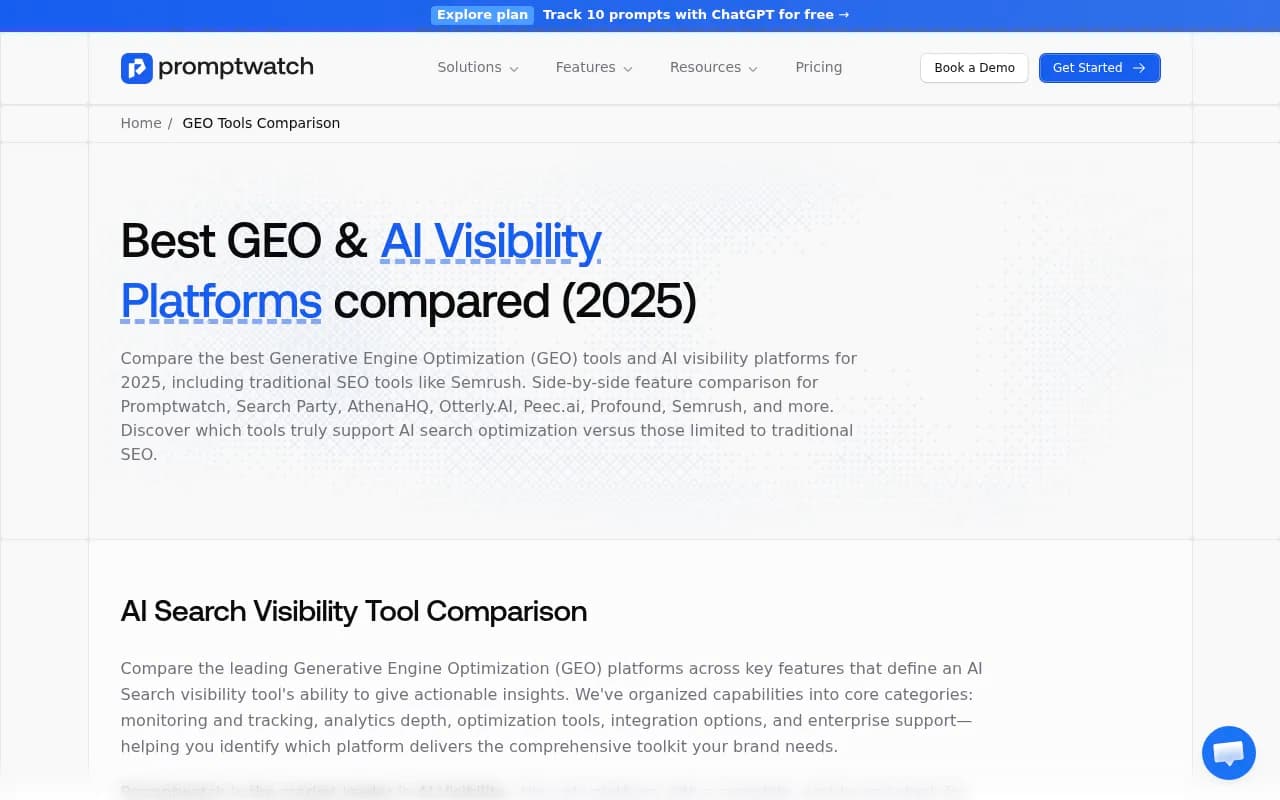
Profound: enterprise depth, but the work still falls on you

Profound is the most feature-rich pure-monitoring platform in this comparison. It tracks your brand across ChatGPT, Perplexity, Google AI Overviews, Claude, and Gemini, with solid competitive benchmarking and share-of-voice metrics. For enterprise teams that need to report AI visibility to leadership, it's genuinely impressive.
Pricing starts at $499/month, which positions it firmly in the enterprise tier. For a large brand with a dedicated SEO team, that's defensible. For a mid-market company or agency managing multiple clients, it's a harder sell.
The core limitation is what happens after you see the data. Profound will tell you which prompts your competitors are winning and where you're invisible. It won't tell you what content to create, and it certainly won't create it for you. There's no built-in content generation, no answer gap analysis that surfaces specific topics you're missing, and no Reddit or YouTube tracking to understand which third-party sources are influencing AI recommendations.
If your team has the bandwidth and expertise to take citation data and independently build a content strategy around it, Profound gives you solid raw material. Most teams don't have that bandwidth, which is why the monitoring-only model keeps failing in practice.
Otterly.AI: the accessible entry point with a ceiling

Otterly.AI has done a good job making AI visibility monitoring approachable. Plans start around $29/month, the interface is clean, and it covers the major AI platforms including Google AI Overviews, ChatGPT, Gemini, and Copilot. For a small business or solo marketer who just wants to know whether their brand shows up in AI results, it's a reasonable starting point.
The research from Otterly.AI's own 2026 data is actually quite useful — their finding that ChatGPT drives 56% of AI search referral traffic, followed by Gemini at 18% and Perplexity at 8%, is the kind of context that helps teams prioritize which platforms to care about.
But Otterly.AI hits a ceiling quickly. It's a monitoring tool. There's no content generation, no crawler log analysis showing which pages AI bots are actually reading on your site, no prompt volume or difficulty scoring to help you prioritize, and no traffic attribution to connect visibility improvements to actual revenue. You'll know you're invisible. You won't know why, and you won't have tools to fix it.
For teams that outgrow basic monitoring — which happens faster than most expect — Otterly.AI becomes a data source without a workflow attached to it.
Searchable: content tools, but limited depth
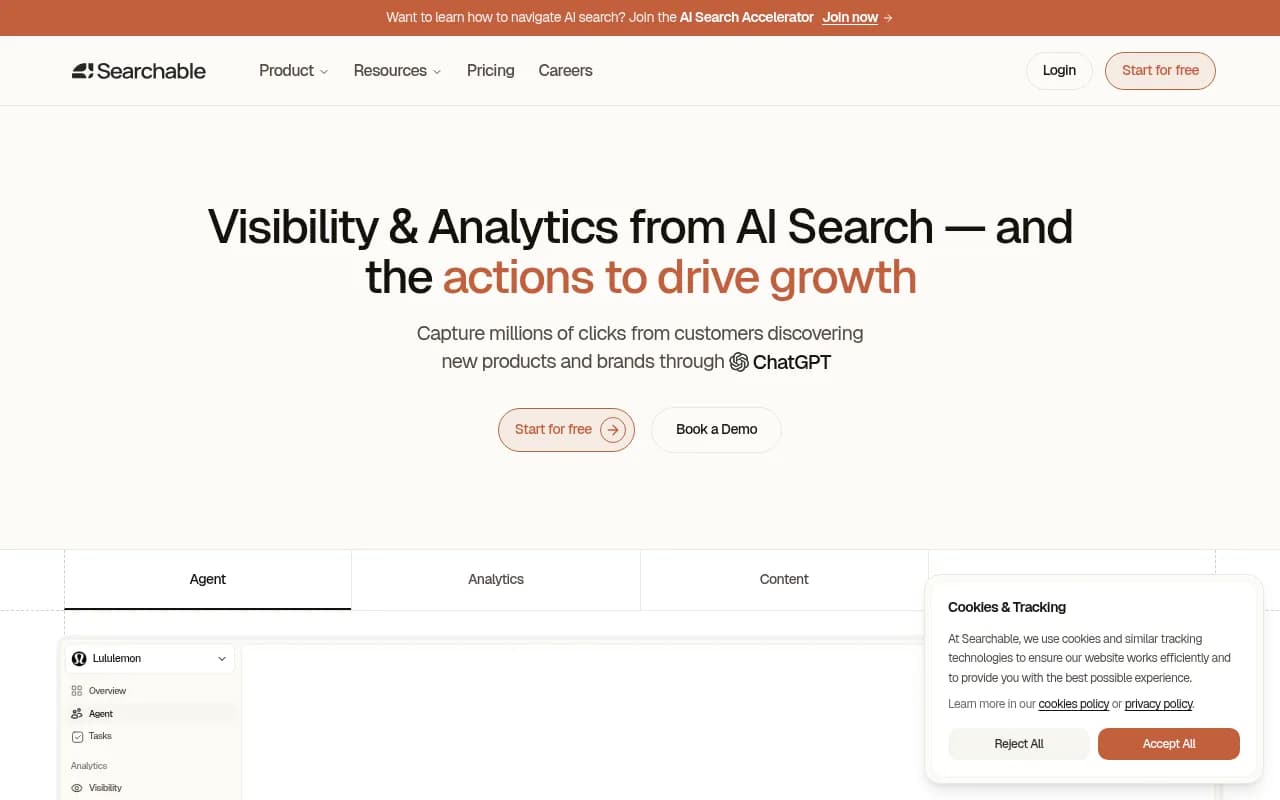
Searchable sits in an interesting middle position. It offers both monitoring and some content optimization tools, which puts it closer to the action-oriented end of the spectrum than Profound or Otterly.AI. That's genuinely worth acknowledging.
The gaps show up in the details. Searchable lacks the citation database depth that comes from analyzing hundreds of millions of real AI responses. Its crawler log capabilities — showing which pages AI bots are actually visiting and what errors they're encountering — are limited compared to more mature platforms. Reddit and YouTube tracking, which matter because AI models frequently cite community discussions and video content, aren't part of the picture.
For teams that want more than pure monitoring but aren't ready to commit to a full-stack platform, Searchable is a reasonable middle ground. Just go in knowing that the content tools are more basic than they might appear at first glance, and that the underlying data powering recommendations is thinner than what you'd get from a platform built around a larger citation corpus.
Promptwatch: the only platform that closes the loop
Promptwatch is built around a different premise than the other three. The core idea is that monitoring is only useful if it leads somewhere — so the platform is designed as a cycle: find the gaps, create content that fills them, track whether it worked.

The "find the gaps" part starts with Answer Gap Analysis, which shows you the specific prompts your competitors are being cited for that you're not. Not just "you have low visibility" — but the exact topics, questions, and angles that AI models want answers to but can't find on your site. That's a different level of specificity than what Profound or Otterly.AI provide.
The "create content" part is where Promptwatch genuinely separates itself. There's a built-in AI writing agent that generates articles, listicles, and comparisons grounded in real citation data — over 880 million citations analyzed. The content isn't generic SEO filler. It's engineered around the specific prompts and topics where AI models are actively looking for sources to cite. Prompt volume estimates and difficulty scores help you prioritize which content to create first.
The "track results" part closes the loop with page-level tracking showing exactly which pages are being cited, by which AI models, and how often. Traffic attribution via a code snippet, Google Search Console integration, or server log analysis connects visibility improvements to actual site traffic and revenue.
A few capabilities worth calling out specifically because competitors consistently lack them:
- AI Crawler Logs: real-time logs of ChatGPT, Claude, Perplexity, and other AI crawlers hitting your site. You can see which pages they're reading, what errors they're encountering, and how often they return. This is how you diagnose why you're not being cited, not just that you're not.
- Reddit and YouTube tracking: AI models frequently cite Reddit threads and YouTube videos. Promptwatch surfaces which discussions are influencing recommendations — a channel most platforms ignore entirely.
- ChatGPT Shopping tracking: monitors when your brand appears in ChatGPT's product recommendation and shopping carousels, which matters a lot for e-commerce and consumer brands.
- Query fan-outs: shows how a single prompt branches into sub-queries, so you understand the full scope of what you need to cover for a given topic.
Pricing runs from $99/month (Essential: 1 site, 50 prompts, 5 articles) to $249/month (Professional: 2 sites, 150 prompts, 15 articles, crawler logs, state/city tracking) to $579/month (Business: 5 sites, 350 prompts, 30 articles). There's a free trial available, and agency/enterprise pricing is available on request.
Feature comparison
| Feature | Profound | Otterly.AI | Searchable | Promptwatch |
|---|---|---|---|---|
| AI platform coverage | ChatGPT, Perplexity, Gemini, Claude, AI Overviews | ChatGPT, Gemini, Perplexity, Copilot, AI Overviews | ChatGPT, Perplexity, Gemini | 10 models incl. Grok, DeepSeek, Mistral, Meta AI |
| Prompt volume & difficulty scoring | No | No | No | Yes |
| Answer gap analysis | Limited | No | Limited | Yes (full) |
| AI content generation | No | No | Basic | Yes (citation-grounded) |
| AI crawler logs | No | No | No | Yes |
| Reddit & YouTube tracking | No | No | No | Yes |
| ChatGPT Shopping tracking | No | No | No | Yes |
| Traffic attribution | No | No | No | Yes (GSC, snippet, server logs) |
| Page-level citation tracking | Yes | Limited | Limited | Yes |
| Competitor heatmaps | Yes | Basic | No | Yes |
| Multi-language / multi-region | Yes | Limited | No | Yes |
| Starting price | $499/mo | $29/mo | Varies | $99/mo |
| Free trial | No | Yes | Yes | Yes |
Which platform should you actually use?
The honest answer depends on what you need to do with the data.
If you're at a large enterprise with a dedicated content team that can take citation data and independently build a strategy around it, Profound gives you the most analytical depth for pure monitoring. You'll pay for it, and you'll need to do the execution work yourself, but the data quality is solid.
If you're a small team or solo marketer who just wants a basic read on whether your brand shows up in AI results, Otterly.AI is the cheapest way to get that answer. Don't expect it to tell you what to do next.
If you want monitoring plus some content tooling but aren't ready to go all-in on a full platform, Searchable is a reasonable middle ground — just calibrate your expectations on the depth of the underlying data.
If you want to actually improve your AI visibility — not just measure it — Promptwatch is the only platform in this comparison built for that. The combination of gap analysis, citation-grounded content generation, crawler logs, and traffic attribution creates a workflow that the other three platforms simply don't have. For marketing teams, SEO teams, and agencies that need to show results (not just reports), that distinction matters a lot.
The monitoring-only trap is real, and it's expensive. Every month you spend looking at a dashboard showing low AI visibility without a clear path to fixing it is a month your competitors are getting cited instead of you.
A note on the broader market
These four platforms don't exist in isolation. The AI visibility tool market has expanded quickly, and there are other options worth knowing about depending on your specific situation.

Peec AI sits between Otterly.AI and Profound on price and features — a reasonable mid-market option if Profound feels too expensive and Otterly.AI feels too basic, though it shares the monitoring-only limitation.

AthenaHQ covers 8+ AI search engines with solid monitoring depth, but like Profound, it stops at the tracking layer without content optimization or generation capabilities.
Scrunch AI is worth a look for brands focused on AI search visibility monitoring, though it lacks the content generation and crawler log features that distinguish Promptwatch.
The pattern across the market is consistent: most tools were built to measure the problem. Very few were built to solve it. That gap is where the real differentiation lives in 2026.