Key takeaways
- The 2025-to-2026 shift separated monitoring tools from optimization platforms — brands that only tracked their AI visibility fell behind those that could also fix it.
- Promptwatch is the only platform in this comparison rated as a "Leader" across all evaluation categories, largely because it closes the loop from gap analysis to content creation to traffic attribution.
- Profound has strong enterprise-grade monitoring but sits at a higher price point and lacks Reddit tracking and ChatGPT Shopping visibility.
- Searchable covers the basics well for smaller teams but is missing several capabilities that matter at scale.
- Scrunch offers solid brand monitoring fundamentals but doesn't extend into content generation or crawler-level diagnostics.
What actually changed between 2025 and 2026
A year ago, most marketing teams were still treating AI visibility as a curiosity. They'd check whether their brand showed up in a ChatGPT response, screenshot it, and move on. That was fine when AI search was a sideshow.
It isn't a sideshow anymore. ChatGPT crossed 800 million weekly active users in early 2026. Perplexity is now a default search option on some Android devices. Google's AI Mode is eating into traditional organic click-through rates in ways that are showing up in GSC data. Brands that aren't visible in AI-generated answers are losing consideration at the very top of the funnel — before a user ever visits a website.
This shift forced AI visibility platforms to evolve quickly. The tools that launched in 2024 and early 2025 were mostly dashboards: they'd run prompts, record whether your brand appeared, and show you a score. Useful, but incomplete. The question that kept coming up was: "OK, I can see I'm invisible for these prompts. Now what?"
The platforms that answered that question well are the ones worth using in 2026. The ones that didn't are still dashboards.
The four platforms: a quick orientation
Before going deep, here's a fast overview of where each platform sits.
| Platform | Primary strength | Content generation | Crawler logs | Reddit/YouTube tracking | ChatGPT Shopping | Starting price |
|---|---|---|---|---|---|---|
| Promptwatch | End-to-end optimization | Yes (AI writing agent) | Yes | Yes | Yes | $99/mo |
| Profound | Enterprise monitoring | No | No | No | No | Higher tier |
| Searchable | Mid-market monitoring | Limited | No | No | No | Mid-range |
| Scrunch | Brand monitoring basics | No | No | No | No | Entry-level |
The table tells most of the story, but the details matter. Let's go through each one.
Promptwatch: the platform that built around action
Promptwatch made a deliberate bet in 2025: that monitoring alone wouldn't be enough. The product is built around what they call an action loop — find gaps, create content, track results. That framing sounds simple, but it's genuinely different from how most competitors are structured.

The gap analysis piece is where it starts. Promptwatch's Answer Gap Analysis shows you the specific prompts where competitors are getting cited but you aren't. Not a vague "you're underperforming in this category" message — the actual prompts, with volume estimates and difficulty scores attached. You can see which questions ChatGPT or Perplexity are answering with a competitor's content instead of yours, and understand why.
From there, the built-in AI writing agent generates content designed to fill those gaps. This isn't a generic content tool bolted on as an afterthought. The articles it produces are grounded in citation data from over 880 million citations analyzed, which means the output is shaped by what AI models actually cite, not just what ranks well in traditional search. The difference matters: a page optimized for Google's algorithm and a page optimized to be cited by Claude or Perplexity are not the same page.
The third part of the loop is tracking. Page-level visibility scores show which of your pages are being cited, by which models, and how often. Traffic attribution closes the loop further — through a code snippet, GSC integration, or server log analysis, you can connect AI visibility to actual sessions and revenue. That's rare. Most platforms stop at "here's your visibility score."
A few other things worth noting about Promptwatch that became more relevant as 2026 progressed:
The AI crawler logs are genuinely useful. You can see in real time when ChatGPT's crawler, Perplexity's bot, or Claude's indexer hits your site, which pages they read, and whether they encounter errors. If an AI model can't crawl a key page, your visibility score for related prompts will suffer — and you'd never know why without this data.
The Reddit and YouTube tracking is something most competitors don't touch. AI models cite Reddit threads and YouTube videos more than most brands realize. Knowing which discussions are influencing recommendations in your category gives you a channel to work with.
Promptwatch monitors 10 AI models: ChatGPT, Perplexity, Google AI Overviews, Google AI Mode, Claude, Gemini, Meta/Llama, DeepSeek, Grok, Mistral, and Copilot. That's comprehensive. Some competitors monitor four or five.
Pricing starts at $99/month for the Essential plan (1 site, 50 prompts, 5 articles), $249/month for Professional (2 sites, 150 prompts, 15 articles, crawler logs), and $579/month for Business (5 sites, 350 prompts, 30 articles). There's a free trial, and annual billing brings the cost down.
The honest caveat: Promptwatch is a more complex tool than a simple monitoring dashboard. If you want to just check a visibility score once a week, it's more than you need. But if you're trying to actually move the number, the depth is the point.
Profound: enterprise-grade monitoring with a price to match
Profound has built a solid reputation in the enterprise segment. The monitoring capabilities are thorough, the interface is clean, and the data quality is generally good. For a large brand that needs to report AI visibility metrics to a CMO, Profound gets the job done.

Where it runs into friction is the same place most monitoring-only platforms do: it shows you what's happening but doesn't help you change it. There's no content generation, no crawler diagnostics, no Reddit or YouTube tracking. If you're a 10-person marketing team trying to improve your AI visibility score, Profound tells you where you stand and then leaves you to figure out the rest.
The pricing is also positioned at the higher end of the market. For teams that are primarily looking for a reporting and monitoring layer, that's a meaningful consideration — especially when platforms like Promptwatch offer more functionality at lower price points.
Profound is a reasonable choice for enterprises that already have strong content and SEO teams and just need reliable AI visibility data to feed into their existing workflows. It's less suited for teams that need the platform to help them act on what they find.
Searchable: solid basics, limited ceiling
Searchable sits in the mid-market. It covers the core monitoring use cases — prompt tracking, brand mention detection, some competitor benchmarking — and does so without a steep learning curve.
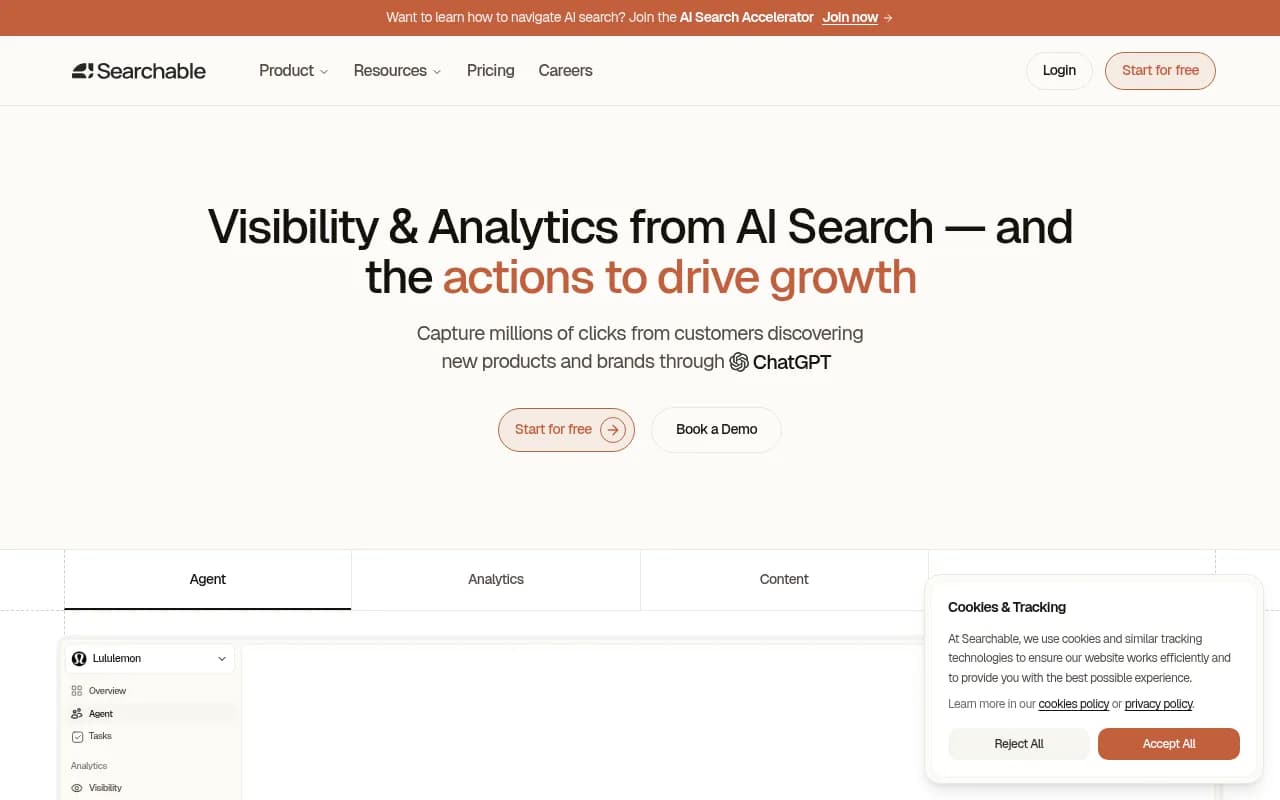
The limitations become visible when you try to scale. There's no content generation, no crawler log access, and the prompt volume and difficulty scoring that Promptwatch offers isn't present. For a small business or a solo marketer who wants to check whether they're appearing in AI answers for their main keywords, Searchable is functional.
For a brand that's trying to systematically improve AI visibility across dozens of prompts and multiple AI models, the ceiling is low. You'll hit the edges of what the platform can tell you fairly quickly, and then you're back to doing the optimization work manually.
Scrunch: brand monitoring without the optimization layer
Scrunch has been around long enough to have a recognizable name in the AI visibility space. The brand monitoring fundamentals are there — it tracks how generative platforms represent your brand, surfaces mentions, and gives you a basic picture of your AI presence.
What Scrunch doesn't do is help you improve that picture. There's no content gap analysis, no writing tools, no crawler diagnostics. It's a monitoring product, and it's honest about being one. The question is whether monitoring alone is enough in 2026, and for most brands, the answer is increasingly no.
Scrunch makes more sense as a supplementary tool — something you use alongside a more capable platform — than as a primary AI visibility solution.
How the market split in 2026
The clearest way to understand what happened to this category between 2025 and 2026 is to look at the question every user eventually asks: "I can see my visibility score. How do I improve it?"
Monitoring-only platforms (Scrunch, basic tiers of Searchable, early versions of many tools) have no answer to that question built into the product. You get the data, you leave the platform, you figure it out yourself.
Optimization platforms (Promptwatch, and to a lesser extent a few others) treat that question as the whole point. The data exists to drive action. The action is built into the product.
This split became more pronounced as AI search grew. When AI visibility was a minor concern, a dashboard was enough. When it started affecting real traffic and revenue, teams needed tools that could help them move the needle, not just measure it.
The other thing that separated platforms in this period was model coverage. ChatGPT, Claude, Perplexity, and Google AI Overviews are the obvious four. But DeepSeek's rise in early 2025, Grok's expansion, and Google AI Mode's rollout meant that brands tracking only four models were missing significant chunks of their actual AI visibility picture. Platforms that added model coverage quickly (Promptwatch now tracks 10) gave their users a more complete view.
Feature comparison: what each platform actually covers
Here's a more detailed breakdown of specific capabilities:
| Feature | Promptwatch | Profound | Searchable | Scrunch |
|---|---|---|---|---|
| Prompt tracking | Yes (with volume + difficulty scores) | Yes | Yes | Yes |
| Competitor benchmarking | Yes (heatmaps) | Yes | Limited | Basic |
| Content gap analysis | Yes | No | No | No |
| AI content generation | Yes | No | No | No |
| AI crawler logs | Yes | No | No | No |
| Reddit/YouTube tracking | Yes | No | No | No |
| ChatGPT Shopping tracking | Yes | No | No | No |
| Traffic attribution | Yes (snippet, GSC, server logs) | No | No | No |
| Multi-language/region | Yes | Yes | Limited | No |
| Number of AI models monitored | 10 | Several | Limited | Limited |
| Query fan-outs | Yes | No | No | No |
| API access | Yes | Yes | Limited | No |
The gap between Promptwatch and the other three isn't subtle. It's not that Profound, Searchable, and Scrunch are bad tools — they're not. It's that they were built to answer a different question. Promptwatch was built to answer "how do I improve my AI visibility?" The others were built to answer "what is my AI visibility?"
Both questions matter. But in 2026, the second question without the first is increasingly hard to justify paying for.
Who should use which platform
A few honest recommendations:
If you're a marketing or SEO team that wants to actually improve AI visibility — not just report on it — Promptwatch is the clearest choice. The action loop (gap analysis, content generation, tracking) is the most complete implementation of that workflow available at any price point. The $249/month Professional plan is where most teams will land; it includes crawler logs and the content generation tools that make the platform genuinely useful.
If you're a large enterprise that needs AI visibility data to feed into existing workflows and already has strong content and SEO teams, Profound is worth evaluating. The monitoring quality is high, and the enterprise-grade reporting is polished. Just go in knowing you'll need to handle the optimization work elsewhere.
If you're a small business or solo operator who wants basic AI visibility monitoring without complexity, Searchable covers the essentials at a lower commitment level. It won't scale with you, but it's a reasonable starting point.
If you're evaluating Scrunch, think carefully about whether monitoring alone is enough for your goals. It works as a supplementary tool, but as a primary AI visibility platform in 2026, the lack of optimization capabilities is a real limitation.
The bottom line
The AI visibility platform market matured faster than most people expected. What started as a niche category of "ChatGPT rank trackers" in 2024 is now a serious part of the marketing technology stack for brands that care about being found in AI-generated answers.
The platforms that kept up with that maturation are the ones that moved beyond monitoring. Promptwatch is the most complete example of that evolution — it's the only platform in this comparison that covers the full cycle from identifying gaps to creating content to measuring results. Profound is a strong monitoring product for enterprises that need reliability over breadth. Searchable and Scrunch serve specific, narrower use cases.
If your AI visibility score matters to your business, the tool you use to track it should also help you improve it. That's the bar worth holding platforms to in 2026.