Key takeaways
- Profound's pricing (Growth plan at $399/month, enterprise in the mid-four figures) makes it a tough sell for agencies managing multiple clients on tight margins.
- Most alternatives fall into two camps: monitoring-only dashboards and full optimization platforms. For agencies, the distinction matters a lot.
- The tools that scale best for agencies offer white-label reporting, multi-site management, and content workflows -- not just visibility scores.
- Promptwatch is the only platform in this comparison rated as a "Leader" across all categories in a 2026 evaluation of 12 GEO platforms, largely because it closes the loop from gap analysis to content creation to traffic attribution.
- Coverage breadth varies significantly: some tools track only ChatGPT, others cover 10+ AI engines. Know which models your clients' customers actually use before committing.
Profound built a real category. When AI search visibility was still a niche experiment, they were one of the first platforms to take it seriously -- server log analysis, AI crawler detection, brand tracking across LLMs. For Fortune 500 brands with dedicated analytics teams and enterprise budgets, it still makes sense.
But agencies have a different problem. You're managing five, ten, maybe twenty clients. Each one wants to know why ChatGPT isn't recommending them. You need something that scales without charging you enterprise rates per client, generates deliverables you can actually show in a deck, and ideally helps you fix the visibility problems you find -- not just document them.
That's where Profound starts to strain. Its Starter plan tracks only ChatGPT for $99/month. The Growth plan jumps to $399. Enterprise pricing lands in the mid-four figures. And across the board, the platform is built around analytics and reporting, not content optimization or gap-filling.
This guide covers the best alternatives in 2026 for agencies specifically -- tools that handle multi-client workflows, cover the AI engines your clients' customers use, and give you something actionable to do with the data.
What agencies actually need from an AI visibility tool
Before getting into specific tools, it's worth being clear about what makes something "agency-friendly" versus just "good for brands."
A solo brand team can live with a single-site dashboard and manual reporting. Agencies can't. The criteria that matter most:
- Multi-site or multi-client management without paying per-client enterprise rates
- White-label or exportable reporting (Looker Studio, PDF, CSV)
- Coverage across the AI engines your clients' audiences actually use -- not just ChatGPT
- Content gap analysis and optimization workflows, so you can show clients a path forward
- Prompt volume data and difficulty scoring to prioritize where to focus
- Traffic attribution to connect AI visibility to actual revenue (this is what clients care about)
With that in mind, here's how the main alternatives stack up.
The best Profound alternatives for agencies in 2026
Promptwatch
Promptwatch is the most complete option for agencies that want to go beyond monitoring. Where most tools show you a visibility score and leave you to figure out what to do next, Promptwatch is built around a specific workflow: find the gaps, create content that fills them, then track whether it worked.

The Answer Gap Analysis feature shows exactly which prompts your clients' competitors are appearing for that your clients aren't. You see the specific topics and questions AI models want answers to but can't find on the site. From there, the built-in AI writing agent generates articles, listicles, and comparisons grounded in real citation data -- not generic SEO filler, but content engineered to get cited by ChatGPT, Claude, Perplexity, and others.
For agencies, a few things stand out. It monitors 10 AI models (ChatGPT, Perplexity, Google AI Overviews, Google AI Mode, Claude, Gemini, Meta/Llama, DeepSeek, Grok, Mistral, Copilot). It has real AI crawler logs showing which pages each AI engine is reading, how often, and what errors it's hitting -- something most competitors don't offer at all. And it has traffic attribution via GSC integration, a code snippet, or server log analysis, so you can connect AI visibility to actual sessions and revenue.
Pricing runs $99/month (Essential, 1 site), $249/month (Professional, 2 sites, crawler logs), and $579/month (Business, 5 sites). Agency and enterprise plans are custom. There's a free trial.
The Looker Studio integration and API make it straightforward to build client-facing dashboards without exporting manually every week.
Profound
Worth including for context. Profound is genuinely strong for enterprise analytics -- server log analysis, AI crawler detection, deep brand tracking. If a client is a Fortune 500 with a dedicated analytics team and a real budget, it's a legitimate option.

The friction for agencies: the pricing structure doesn't fit multi-client work well, the platform skews toward reporting over optimization, and there's no built-in content generation. You can see where a client is invisible; you have to go elsewhere to fix it.
Peec AI
Peec AI is a solid monitoring tool for smaller clients or agencies that need something affordable to get started. Entry pricing around €89/month, multi-language support, and a clean interface make it easy to onboard clients quickly.
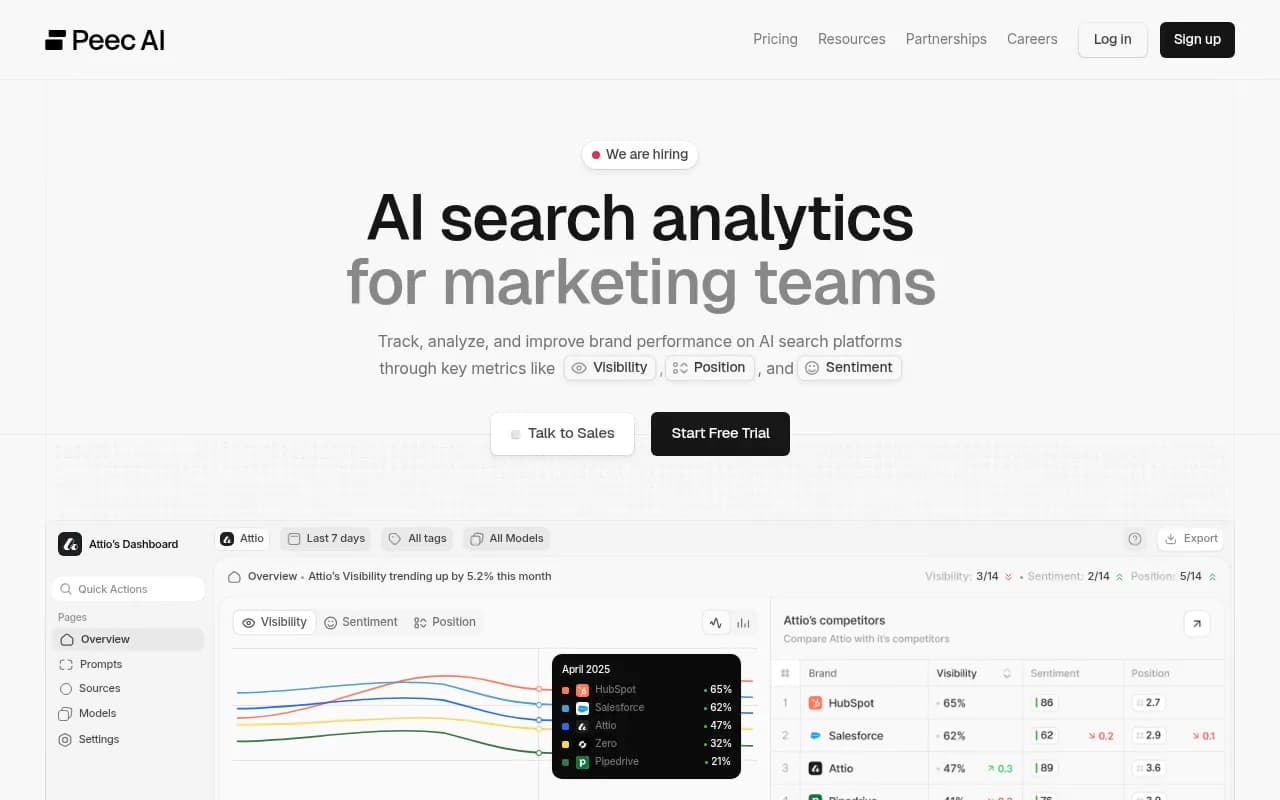
The limitation is the same one that affects most monitoring-only tools: it shows you data but doesn't help you act on it. No content generation, no crawler logs, no traffic attribution. For agencies that handle the strategy and content work separately, that's fine. For agencies that want an end-to-end workflow in one platform, it's not enough.
Otterly.AI
Otterly is probably the most popular budget option in this space. It's affordable, covers the major AI engines, and has a clean enough interface for client reporting.
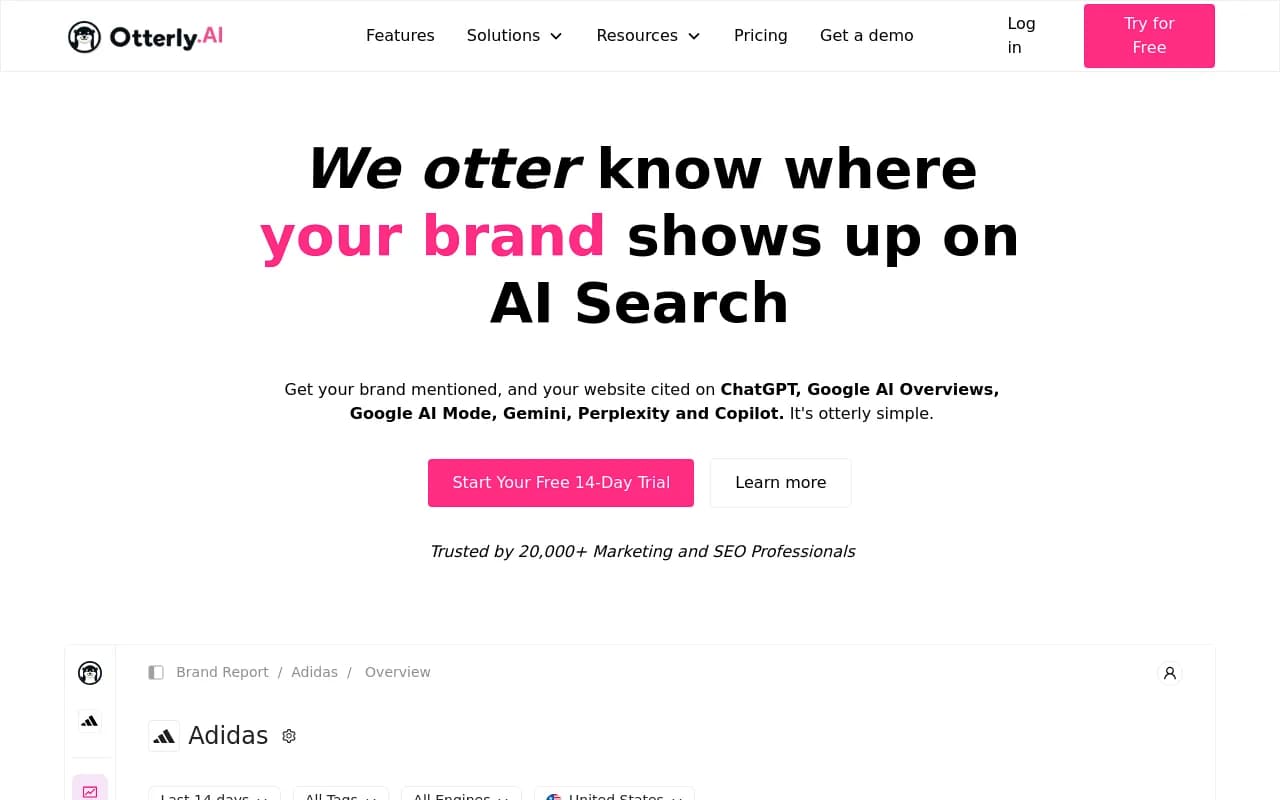
It works well for brand monitoring and sentiment tracking -- useful for PR-adjacent agency work. But like Peec, it's monitoring-first. There's no content gap analysis, no AI writing workflow, and no crawler log data. Good for agencies that just need to show clients a visibility score and track it over time.
Scrunch AI
Scrunch takes a different angle. Its AXP "Shadow Site" technology focuses on influencing how AI crawlers discover and index your clients' content -- more of a technical infrastructure play than a monitoring dashboard.
For agencies with technical SEO capabilities, this is interesting. For agencies that primarily do content and strategy work, it's probably not the right fit as a primary tool. Worth knowing about if you have clients with serious crawler access issues.
SE Visible
SE Visible (from SE Ranking) is built for SEO agencies transitioning into AI visibility work. It fuses traditional SEO data with AI Overview tracking, which is useful if your clients are still primarily worried about Google.
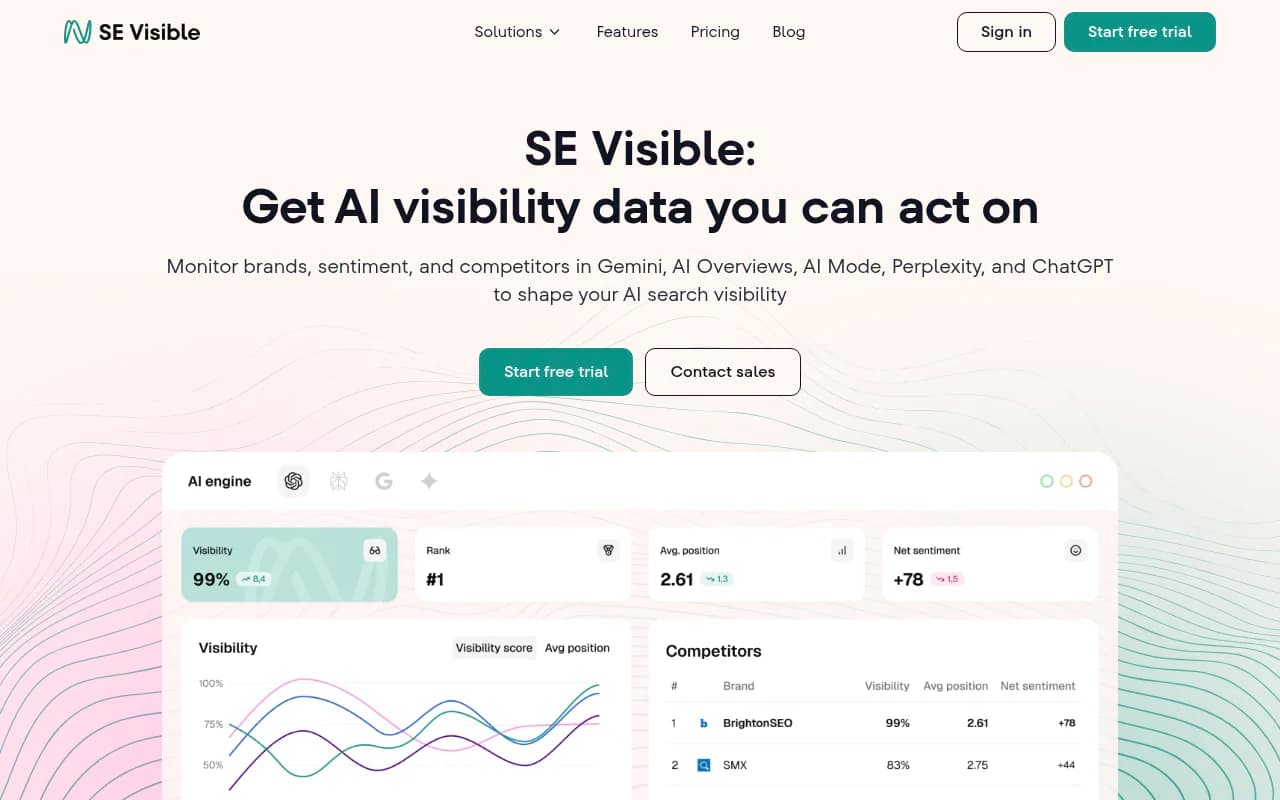
The source detection features are strong, and the white-label reporting options make it practical for agency use. The trade-off is that it's more Google-centric than some alternatives -- coverage of non-Google AI engines is narrower than platforms built specifically for GEO.
Ahrefs Brand Radar
If your agency already uses Ahrefs, Brand Radar is the path of least resistance for adding AI visibility tracking. It lives inside the same ecosystem as your keyword research and backlink data, which simplifies reporting.
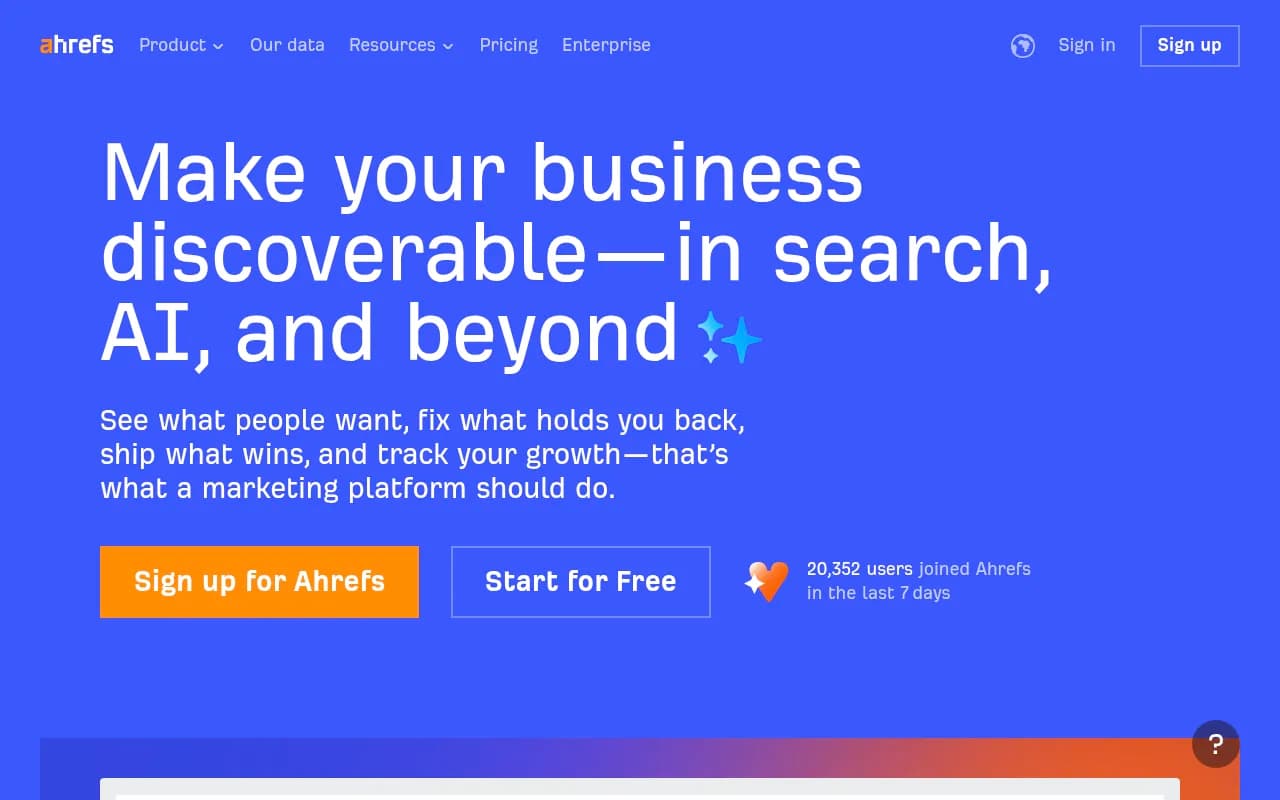
The honest limitations: Brand Radar uses fixed prompts (you can't customize them to match your clients' actual customer queries), and there's no AI traffic attribution. For agencies that need to show clients a clear line from AI visibility to revenue, that's a real gap.
Semrush
Semrush's AI visibility toolkit is similar to Ahrefs in the sense that it's most valuable if you're already in the ecosystem. The integration with keyword research, site audits, and content tools means you can build a fairly complete picture of a client's search presence in one place.
Same caveat as Ahrefs: fixed prompts, no deep traffic attribution for AI search specifically. It's a good supplementary tool for agencies that already pay for Semrush, but probably not the right primary GEO platform if AI visibility is a core service you're selling.
AthenaHQ
AthenaHQ positions itself as an enterprise GEO platform with automation and revenue attribution. It covers more ground than basic monitoring tools and has some content optimization capabilities.
It's monitoring-focused in practice, though. The content optimization features are less developed than platforms like Promptwatch, and the pricing skews toward larger enterprise budgets rather than agency multi-client pricing.
Ranketta
Ranketta is worth mentioning specifically for agencies with e-commerce clients. Its product-level tracking inside AI Shopping results is genuinely differentiated -- if ChatGPT Shopping is recommending a competitor's product instead of your client's, Ranketta shows you why.
For agencies without e-commerce clients, it's less relevant. But if you work with D2C or retail brands, the product-level granularity is something most other platforms don't offer.
How the tools compare
Here's a side-by-side view of the features that matter most for agency work:
| Tool | Multi-site pricing | AI engines covered | Content generation | Crawler logs | Traffic attribution | Best for |
|---|---|---|---|---|---|---|
| Promptwatch | Yes (Business: 5 sites, $579/mo) | 10 | Yes (built-in AI writer) | Yes | Yes (GSC, snippet, logs) | Full-service agencies |
| Profound | Enterprise custom | 6+ | No | Yes (Agent Analytics) | Partial | Enterprise brands |
| Peec AI | Limited | 4-5 | No | No | No | SMB monitoring |
| Otterly.AI | Yes | 5-6 | No | No | No | Budget monitoring |
| Scrunch AI | Yes | 4-5 | No | Partial (AXP) | No | Technical SEO agencies |
| SE Visible | Yes (white-label) | Google-focused | No | No | No | Google-first SEO agencies |
| Ahrefs Brand Radar | Per seat | 4-5 | No | No | No | Existing Ahrefs users |
| Semrush | Per seat | 4-5 | Partial (ContentShake) | No | No | Existing Semrush users |
| AthenaHQ | Enterprise custom | 8+ | Limited | No | Partial | Enterprise monitoring |
| Ranketta | Agency custom | 7 (Enterprise) | Yes | No | Yes | E-commerce agencies |
The monitoring-only problem
This is worth naming directly because it affects most of the tools in this space.
A monitoring dashboard that shows you a visibility score is useful for about one meeting. The client sees the number, asks "how do we improve it?", and then you need an answer. If your tool only monitors, you're back to doing the strategy work manually -- figuring out which content to create, what topics to cover, how to structure it so AI models will actually cite it.
The platforms that solve this problem are the ones built around what you do after you see the data. Promptwatch's Answer Gap Analysis + AI writing workflow is the most developed version of this in the market right now. Ranketta has content generation for e-commerce contexts. A few others are building in this direction.
For agencies specifically, this matters more than for in-house teams. You're selling a service, not just a report. The tools that help you deliver results -- not just document the current state -- are the ones worth paying for.
Choosing the right tool for your agency
A few questions to work through before committing:
What AI engines do your clients' customers actually use? If most of your clients are B2B SaaS, Perplexity and ChatGPT probably matter more than Google AI Overviews. If they're consumer brands, Google AI Mode and Gemini might be just as important. Check that your tool covers the engines that matter, not just the ones that are easiest to track.
Do you need to show revenue impact? If clients are asking "is this driving traffic and sales?", you need traffic attribution. That narrows the field considerably -- Promptwatch and Ranketta are the clearest options here.
How many clients are you managing? If it's under five, most tools work fine. Above that, you want something with proper multi-site management and ideally API access for custom reporting. Promptwatch's Business plan (5 sites) and agency pricing, plus the Looker Studio integration, are built for this.
Are you doing the content work or just the reporting? If you're delivering content as part of your service, a tool with built-in AI writing grounded in citation data saves significant time. If you're just reporting on visibility and handing off recommendations, a monitoring-only tool might be sufficient.
The bottom line
Profound is a serious platform that built a real category. But it's priced and structured for enterprise brands, not agencies managing multiple clients at different budget levels.
For most agencies in 2026, the better path is a platform that covers the full workflow: identify where clients are invisible, understand why, create content that fixes it, and track whether AI models start citing it. That's a different product than a monitoring dashboard, and it's what clients are actually paying for when they hire an agency.
Promptwatch is the strongest option for agencies that want that end-to-end workflow. Peec AI and Otterly.AI work if you need something affordable for smaller clients and handle the strategy work separately. Ranketta is the right call if you have e-commerce clients who care about AI Shopping. SE Visible makes sense if you're a Google-first SEO agency adding AI visibility as a service line.
The tools are good enough now that "we don't have visibility into AI search" isn't a defensible position for any agency. The question is which platform fits how you actually work.