Key takeaways
- AI visibility tools track where your brand appears (or doesn't) in responses from ChatGPT, Perplexity, Claude, Gemini, and other AI engines
- Answer gap analysis -- seeing which prompts competitors rank for but you don't -- is the most actionable feature to look for
- Most platforms stop at monitoring; only a handful help you actually fix the gaps they find
- Pricing ranges from free tiers to $500+/month for enterprise platforms; your choice should depend on whether you need monitoring, optimization, or both
- Promptwatch is the only platform in this comparison rated as a "Leader" across all categories, largely because it closes the loop from gap discovery to content creation to traffic attribution
If you've been paying attention to search traffic lately, you've probably noticed something strange. Pages that used to pull consistent organic traffic are flattening out. Not because your rankings dropped -- but because a growing share of users are getting their answers directly from ChatGPT, Perplexity, or Google's AI Overviews without ever clicking through to a website.
This is the core problem AI visibility tools are built to solve. They answer a deceptively simple question: when someone asks an AI model about your category, does your brand get mentioned?
The harder question is what you do when the answer is "no." That's where most tools fall short.
This guide covers seven platforms worth considering in 2026, what each one actually does well, and where the gaps are.
What to look for in an AI visibility tool
Before getting into specific platforms, it's worth being clear about what separates a useful tool from a dashboard that just looks impressive.
The features that matter most:
- Answer gap analysis: Can the tool show you which prompts competitors appear in but you don't? This is the single most actionable insight in GEO.
- Prompt coverage: How many AI models does it monitor? ChatGPT and Perplexity are table stakes. Claude, Gemini, DeepSeek, Grok, and Google AI Mode matter too.
- Content recommendations: Does the tool tell you what to create, or just what's missing?
- Traffic attribution: Can you connect AI citations to actual website visits and revenue?
- Crawler visibility: Do you know when AI bots are crawling your site, which pages they read, and which they skip?
Most platforms in 2026 cover the first item reasonably well. Very few cover all five.
The top 7 AI visibility tools in 2026
1. Promptwatch
Promptwatch is the most complete platform in this category right now, and the distinction that matters most is this: it's built around fixing problems, not just finding them.

The core workflow is a three-step loop. First, Answer Gap Analysis shows you the specific prompts where competitors are visible but you're not -- not vague topic areas, but the actual questions AI models are answering that your content doesn't address. Second, a built-in AI writing agent generates articles, listicles, and comparisons grounded in real citation data (880M+ citations analyzed) and prompt volume estimates. Third, page-level tracking shows whether your new content is actually getting cited, by which models, and how often -- with traffic attribution via a code snippet, Google Search Console integration, or server log analysis.
That loop -- find gaps, create content, measure results -- is what most competitors don't have. Otterly.AI, Peec AI, and AthenaHQ all stop at step one.
A few other things worth knowing: Promptwatch monitors 10 AI models (ChatGPT, Perplexity, Claude, Gemini, Grok, DeepSeek, Copilot, Meta AI, Mistral, and Google AI Overviews), logs real-time AI crawler activity on your site, tracks Reddit and YouTube discussions that influence AI recommendations, and monitors ChatGPT Shopping carousels. It's used by 6,700+ brands and agencies including Booking.com and Center Parcs.
Pricing starts at $99/month (Essential: 1 site, 50 prompts, 5 articles), $249/month for Professional (2 sites, 150 prompts, 15 articles, crawler logs), and $579/month for Business (5 sites, 350 prompts, 30 articles). A free trial is available.
2. Profound
Profound is a strong choice for enterprise teams with dedicated analysts. It tracks brand visibility across major LLMs, supports near real-time monitoring, and offers raw data access via API -- which is genuinely useful if you want to build custom dashboards or feed data into existing reporting workflows.

Where it's less useful: Profound is primarily a monitoring and analytics platform. It doesn't generate content or give you a clear path from "here's the gap" to "here's what to publish." If you have analysts who can turn data into action, that's fine. If you need the tool to do more of the heavy lifting, it'll feel incomplete.
Pricing is on the higher end for the category. Worth evaluating if you're enterprise-scale and already have a content team that can act on the data.
3. Otterly.AI
Otterly.AI is one of the more affordable options in the market and genuinely easy to set up. You can track brand mentions across ChatGPT, Perplexity, and a handful of other models, set up alerts, and get a basic read on how visible you are relative to competitors.

The honest limitation: Otterly.AI is a monitoring tool. It shows you data. It doesn't have crawler logs, doesn't generate content, and doesn't attribute AI traffic to revenue. For teams that just want to know "are we showing up?" without needing to act on it immediately, it's a reasonable starting point. For teams that need to improve their visibility, it's a first step that will quickly feel insufficient.
4. Peec AI
Peec AI covers multi-language AI visibility tracking, which is a real differentiator for brands operating across multiple markets. It monitors mentions across the main AI platforms and surfaces some competitive comparison data.

Like Otterly.AI, it's primarily a monitoring dashboard. The multi-language support is genuinely useful if you're tracking visibility in non-English markets -- that's a feature most platforms handle poorly or not at all. But if your main goal is closing content gaps, you'll need to pair it with something else.
5. AthenaHQ
AthenaHQ tracks brand visibility across 8+ AI search engines and has a reasonably clean interface for competitive comparison. It's positioned as a monitoring and optimization platform, though in practice the "optimization" side is lighter than the monitoring side.

It's a solid choice for teams that want structured competitive tracking without the complexity of an enterprise platform. The gap between what AthenaHQ shows you and what you can do about it is still something you'll need to bridge yourself.
6. SE Ranking (AI Visibility Toolkit)
SE Ranking has been a well-regarded traditional SEO platform for years, and its AI visibility toolkit adds LLM monitoring on top of existing keyword and rank tracking features. If you're already using SE Ranking for SEO, adding AI visibility tracking to your existing workflow is relatively low friction.
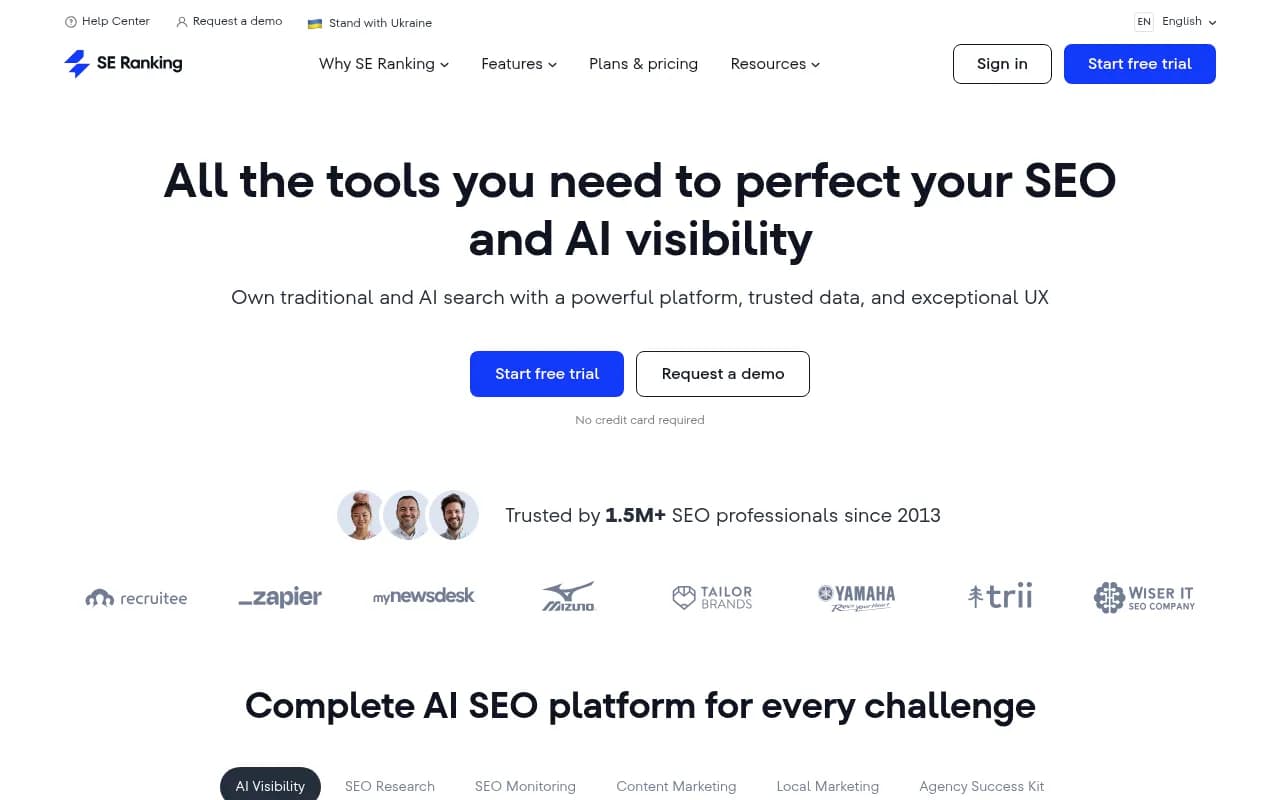
The AI-specific features are less deep than dedicated GEO platforms -- prompt coverage is narrower, and there's no content generation or crawler log analysis. But the integration with traditional SEO data (keyword rankings, site audits, backlink tracking) can be genuinely useful for teams that want one tool covering both traditional and AI search.
7. Semrush
Semrush has added AI visibility tracking to its existing platform, and for teams already paying for Semrush, it's worth exploring. The AI Overviews tracking and some LLM monitoring features are included in higher-tier plans.
The honest caveat: Semrush's AI visibility features use fixed prompts rather than letting you define your own prompt universe, and there's no AI traffic attribution. It's a reasonable addition to an existing Semrush workflow, but it's not a replacement for a dedicated GEO platform if AI search visibility is a priority.
How these tools compare
| Tool | AI models monitored | Answer gap analysis | Content generation | Crawler logs | Traffic attribution | Starting price |
|---|---|---|---|---|---|---|
| Promptwatch | 10 | Yes (full) | Yes (built-in AI writer) | Yes | Yes (3 methods) | $99/mo |
| Profound | 6+ | Partial | No | No | No | Custom/high |
| Otterly.AI | 4-5 | Basic | No | No | No | ~$49/mo |
| Peec AI | 4-5 | Basic | No | No | No | ~$49/mo |
| AthenaHQ | 8 | Partial | No | No | No | Custom |
| SE Ranking | 3-4 | No | No | No | No | $65/mo |
| Semrush | 3-4 | No (fixed prompts) | No | No | No | $140/mo |
Which tool is right for you?
The answer depends on what you actually need to do.
If you're trying to understand the full picture -- where you're invisible, why, what to create, and whether it's working -- Promptwatch is the only platform that covers all of it without requiring you to stitch together multiple tools. The answer gap analysis alone is worth the price for most marketing teams; the built-in content generation and traffic attribution make it a complete workflow rather than just a dashboard.
If you're enterprise-scale with dedicated analysts and want raw data access, Profound is worth evaluating alongside Promptwatch. It has strong data depth, though you'll need to bring your own content execution process.
If you're just starting out and want a simple read on whether your brand shows up in AI answers, Otterly.AI or Peec AI will get you there cheaply. Just know you'll outgrow them quickly once you start trying to actually improve your visibility.
If you're already deep in the SE Ranking or Semrush ecosystem, their AI features are worth turning on -- but treat them as a supplement, not a primary GEO strategy.
The gap most tools leave open
Here's the thing that doesn't get said enough in these comparisons: monitoring your AI visibility is easy. Dozens of tools do it. The hard part is knowing what to do next.
When you find out that a competitor appears in 40% of prompts in your category and you appear in 8%, the question isn't "interesting, I wonder why." The question is "what specific content do I need to create, and how do I know if it worked?"
Most tools leave you to figure that out yourself. A few, like Promptwatch, are built around answering it. That's the real differentiator in 2026 -- not which tool has the prettiest dashboard, but which one actually helps you close the gap.