Key takeaways
- AI search engines like ChatGPT, Perplexity, and Google AI Overviews are now major discovery channels -- if your brand isn't mentioned in their responses, you're invisible to a growing segment of buyers
- Product launches need pre-launch baseline tracking, real-time monitoring during launch week, and post-launch gap analysis to close the loop
- Most AI visibility tools only monitor -- the best ones also help you create content that gets cited, which matters enormously during a launch
- Promptwatch is the only platform rated as a "Leader" across all categories in a 2026 comparison of 12 GEO platforms, combining monitoring, content gap analysis, and AI-powered content generation
- For budget-conscious teams, tools like Otterly.AI and Peec AI offer solid entry-level monitoring; for full optimization capability, Promptwatch or Profound are the stronger choices
Why AI search visibility matters more during a product launch
Product launches are high-stakes, time-compressed events. You've got PR going out, ads running, influencers posting -- and meanwhile, a growing percentage of your potential customers are asking ChatGPT "what's the best [product category] to buy right now?" or prompting Perplexity for a comparison of options in your space.
If your new product isn't in those AI-generated answers, none of your other launch activity can compensate for that gap.
According to research from SE Ranking's AI Mode study, brands appear in 90% of Google AI Mode responses -- but only 43% of traditional AI Overviews. That gap tells you something important: the format of the question and the AI engine doing the answering both affect whether you show up. During a launch, you're fighting for visibility across all of them simultaneously.
The problem is that most marketing teams still measure launch success by press coverage, social mentions, and ad performance. Those metrics matter, but they miss the AI search layer entirely. A competitor who's been quietly building AI visibility for six months will get recommended by ChatGPT while your brand goes unmentioned -- even if your product is objectively better.
This guide covers the platforms that can help you fix that, specifically in the context of a product launch.
What to look for in a launch-focused AI visibility platform
Not all AI visibility tools are built for the same job. Some are designed for ongoing brand monitoring. Others are better suited to the sprint-and-measure cycle of a product launch. Here's what actually matters when you're launching:
Pre-launch baseline. Before you launch, you need to know where you stand. Which prompts is your brand already visible for? Which ones are competitors dominating? This baseline is your starting point for measuring impact.
Real-time or near-real-time tracking. Launch week moves fast. You need to see changes in AI citations within days, not weeks.
Competitor comparison. Launches are competitive events. You need to know not just whether you're visible, but whether you're more visible than the alternatives buyers are being shown.
Content gap analysis. If AI models aren't citing your brand for key launch-related prompts, you need to know what content is missing -- and ideally, get help creating it fast.
Multi-model coverage. ChatGPT, Perplexity, Google AI Overviews, Gemini, Claude -- your buyers use all of them. A tool that only tracks one or two models gives you an incomplete picture.
Traffic attribution. Ultimately, you want to connect AI visibility to actual traffic and revenue. Tools that can tie AI citations to site visits or conversions are significantly more useful than pure monitoring dashboards.
The top platforms for launch-time AI visibility tracking
Promptwatch -- best for end-to-end launch optimization
Promptwatch is the platform I'd recommend first for any team serious about AI visibility during a launch. The reason isn't just the monitoring -- it's what comes after.
Most tools will show you that you're not appearing in AI responses for your target prompts. Promptwatch goes further: it shows you exactly which prompts competitors are winning that you're not (Answer Gap Analysis), then helps you generate the content needed to close those gaps. That content generation is grounded in 880M+ citations analyzed, so it's not generic filler -- it's built around what AI models actually cite.
For a product launch, that workflow is genuinely useful. You can identify the questions buyers are asking AI engines about your product category, see which competitors are getting recommended, and create targeted content before or during launch to improve your chances of being cited.
It also covers 10 AI models (ChatGPT, Perplexity, Google AI Overviews, Gemini, Claude, Grok, DeepSeek, Copilot, Meta AI, Mistral), includes AI crawler logs so you can see which pages AI bots are actually reading on your site, and offers traffic attribution to connect visibility to revenue.
Pricing starts at $99/month for the Essential plan (1 site, 50 prompts, 5 articles). The Professional plan at $249/month adds crawler logs, more prompts, and city-level tracking.

Profound -- best for enterprise launches
Profound is one of the earliest dedicated AI visibility platforms and has built a strong feature set for large organizations. It covers major AI engines, offers content operations tooling, and has a read/write AI model that can automate some optimization tasks.
Where it falls short for most teams is price -- it starts at $99/month but enterprise tiers get expensive quickly -- and it lacks some of the newer capabilities like Reddit tracking and ChatGPT Shopping monitoring that matter for consumer-facing launches.

Otterly.AI -- best budget option for launch monitoring
If your team is smaller or your budget is tight, Otterly.AI is a reasonable starting point. It starts at $29/month, handles automated prompt testing, and gives you a basic view of brand visibility across AI engines.
The honest limitation: it's a monitoring tool. It won't help you understand why you're not visible or what to do about it. For a launch where you need to move fast, that gap matters. But if you just need a dashboard to track whether your brand is being mentioned, it works.

Peec AI -- good for B2B and SaaS launches
Peec AI is worth considering for B2B or SaaS product launches. It has a clean dashboard, solid competitor benchmarking, and multi-language support -- useful if you're launching in multiple markets. Starts at €89/month.
Like Otterly, it's primarily a monitoring platform. You'll see the data but you'll need to figure out the content strategy yourself.

SE Visible -- solid for agencies managing multiple launches
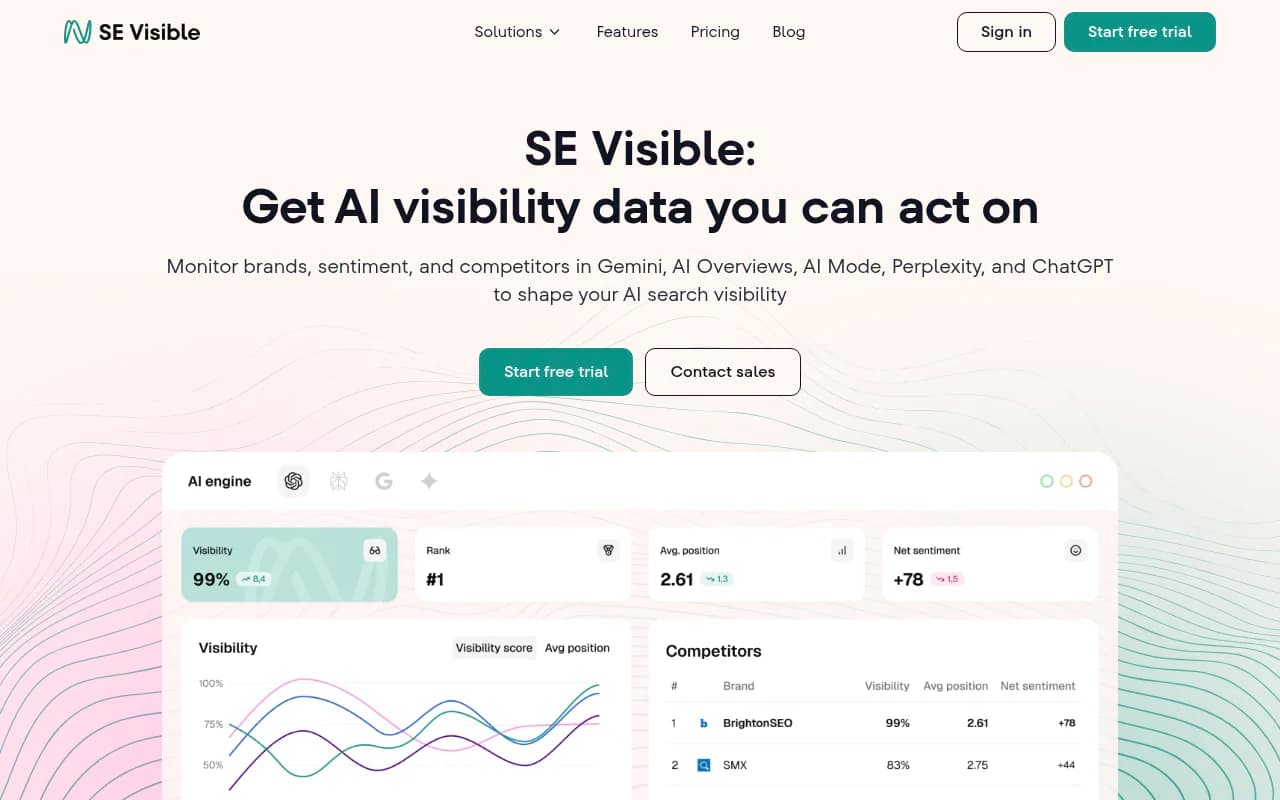
SE Visible is built by SE Ranking and is a good fit for agencies running multiple client launches simultaneously. It covers AI Mode, AI Overviews, Gemini, ChatGPT, and Perplexity, and the interface is clean enough that you can pull client reports without a lot of manual work. Starts at $189/month.
Scrunch AI -- useful for prompt discovery
Scrunch automatically tracks 1,000 industry-specific prompts and analyzes your brand's visibility across them. For a launch, that breadth is useful -- you might discover prompt angles you hadn't thought to track. It also suggests prompts for improving visibility, which gives you some direction beyond raw monitoring.
AthenaHQ -- clean monitoring across 8+ engines
AthenaHQ covers 8+ AI search engines and has a reasonably clean interface for tracking brand visibility. It's monitoring-focused, so similar caveats apply -- you'll see where you stand but won't get much help optimizing. Worth considering if you want broad engine coverage at a mid-range price.

Platform comparison table
| Platform | AI engines covered | Content gap analysis | Content generation | Crawler logs | Traffic attribution | Starting price |
|---|---|---|---|---|---|---|
| Promptwatch | 10 | Yes | Yes (AI writing agent) | Yes | Yes | $99/mo |
| Profound | 6+ | Limited | Partial | No | No | $99/mo |
| Otterly.AI | 5+ | No | No | No | No | $29/mo |
| Peec AI | 5+ | No | No | No | No | €89/mo |
| SE Visible | 5 | No | No | No | No | $189/mo |
| Scrunch AI | 5+ | Partial | No | No | No | Custom |
| AthenaHQ | 8+ | No | No | No | No | Custom |
How to structure your launch tracking strategy
Phase 1: Pre-launch baseline (4-6 weeks out)
Start tracking before you launch. This sounds obvious but most teams don't do it -- they set up monitoring on launch day and have no baseline to compare against.
In this phase, you want to:
- Identify the 30-50 prompts most relevant to your product category and buyer journey
- Establish your current visibility score across those prompts
- Map which competitors are being recommended and for which specific questions
- Identify content gaps -- topics where AI models are giving answers but not citing your brand
Tools like Promptwatch's Answer Gap Analysis are built for exactly this. You can see the specific prompts where competitors are visible but you're not, which tells you where to focus your pre-launch content efforts.
Phase 2: Launch week monitoring
During the launch itself, you want near-real-time visibility into what's changing. Are AI models starting to pick up your new product pages? Are press mentions and review coverage translating into citations? Is your brand appearing in comparison prompts?
This is also when crawler logs become valuable. Promptwatch's AI crawler logs show you which pages ChatGPT, Perplexity, and other AI bots are actually visiting -- so you can see if your new product pages are being indexed and read, or if there's a technical issue blocking discovery.
Phase 3: Post-launch gap closure
Two to four weeks after launch, you should have enough data to see what's working and what isn't. Which prompts are you now visible for that you weren't before? Which ones are still dominated by competitors?
This is when you run another round of content gap analysis and create targeted content to fill the remaining gaps. The goal is a compounding effect: each piece of content you create based on real citation data improves your visibility for a specific set of prompts, and that visibility persists long after the launch buzz fades.
The monitoring-only trap
One thing worth naming directly: most AI visibility tools will show you a dashboard full of data and leave you wondering what to do with it. You can see that you're not appearing in responses for "best [product category] under $100" -- but the tool doesn't tell you why, what content would fix it, or how to create that content efficiently.
That's the monitoring-only trap. It's a real problem because the gap between "I can see I'm invisible" and "I know how to become visible" is where most teams get stuck.
The platforms that go beyond monitoring -- specifically Promptwatch and, to a lesser extent, Profound and Scrunch -- are more useful for launch scenarios because they give you a path to action, not just a picture of the problem.
Reddit and YouTube: the hidden AI citation sources
Something most teams overlook during a launch: AI models don't just cite brand websites. They cite Reddit threads, YouTube videos, review sites, and forum discussions. If your product launch generates discussion on Reddit or gets reviewed on YouTube, those sources can directly influence what AI engines say about you.
Promptwatch tracks Reddit and YouTube sources as part of its citation analysis -- showing you which discussions are influencing AI recommendations in your category. That's a channel most competitors ignore entirely, and it's one where a well-timed launch can create real AI visibility momentum.
Connecting AI visibility to revenue
The final piece of the puzzle is attribution. Knowing that ChatGPT is mentioning your brand is useful. Knowing that those mentions are driving traffic and converting to sales is what justifies the investment.
A few platforms are starting to close this loop. Promptwatch offers three attribution methods: a code snippet for direct traffic tracking, Google Search Console integration, and server log analysis. That last option is particularly useful because it catches AI-referred traffic that doesn't show up cleanly in standard analytics.
For most teams, even a rough connection between AI visibility improvements and traffic changes is enough to make the case for continued investment. The key is setting up attribution before launch so you have clean data from day one.
Practical recommendations by team type
If you're a marketing team at a mid-size brand launching a new product, Promptwatch is the most complete option. The combination of monitoring, gap analysis, and content generation means you can run the full optimization cycle without stitching together multiple tools.
If you're a digital agency managing a client launch, SE Visible or Promptwatch both work well -- SE Visible if you want a lighter-weight monitoring dashboard, Promptwatch if the client wants to see optimization activity and results.
If you're a bootstrapped startup with a tight budget, start with Otterly.AI for basic monitoring, then upgrade to a platform with content gap analysis once you've validated that AI visibility is moving the needle for your category.
If you're an enterprise brand with a complex launch (multiple markets, multiple product lines), Promptwatch's Business plan or Profound are the right tier -- both support multi-site tracking and can handle the volume of prompts you'll need to monitor.
Final thought
A product launch in 2026 without an AI visibility strategy is like launching without a PR strategy -- you're leaving a major discovery channel unaddressed. The good news is that the tools to fix this are mature enough now to be genuinely useful, not just experimental.
The teams that will win are the ones who start tracking before launch, use that data to create content that AI models actually cite, and close the loop with attribution that connects visibility to revenue. That cycle -- track, create, measure -- is what separates brands that show up in AI answers from brands that don't.