Key takeaways
- Profound works well for enterprise-grade AI visibility depth, but its pricing and single-workspace model make it a poor fit for most agencies managing multiple clients.
- The best Profound alternatives in 2026 support multi-client management, white-label reporting, and -- critically -- help you act on the data, not just stare at it.
- Promptwatch is the strongest all-around alternative for agencies that need optimization capabilities alongside monitoring. Most competitors stop at tracking.
- Rankability is the most agency-native option for teams that want AEO and SEO workflows in one place.
- Peec AI is worth considering if you manage clients across multiple markets and languages.
Profound is a solid tool. If you're running AI visibility for a Fortune 500 brand with a dedicated analytics team and a five-figure monthly budget, it probably does what you need. But if you're an agency managing 10 or 20 clients, the math doesn't work. One workspace per account, enterprise pricing that starts climbing fast past the Growth tier, and dashboards that tell you what's happening without much guidance on what to fix -- that's a rough combination when you're billing clients on results.
The good news: the GEO and AEO tool market has matured a lot in 2026. There are now real alternatives built with agencies in mind. This guide covers the five best, with honest takes on where each one shines and where it falls short.
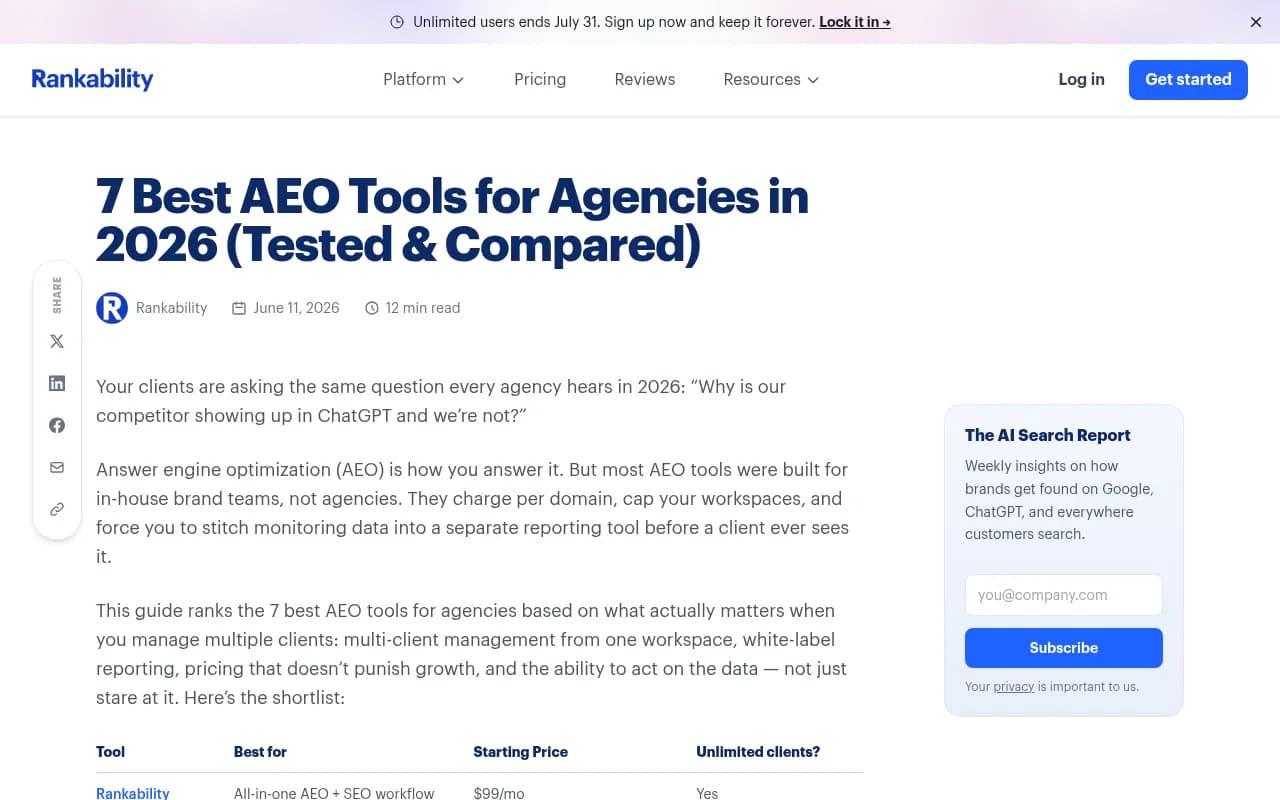
What agencies actually need from a Profound alternative
Before getting into the tools, it's worth being specific about what "agency-friendly" actually means in this context. A lot of tools claim it without delivering it.
The real requirements:
- Multi-client management from a single login, not separate accounts you have to juggle
- White-label reporting so you can send clients something that looks like your agency built it
- Pricing that doesn't scale linearly with the number of clients (per-domain pricing kills margins)
- Content optimization features, not just monitoring -- because clients want results, not dashboards
- Coverage across the AI models that matter: ChatGPT, Perplexity, Google AI Overviews, Gemini, Claude, and ideally a few more
With that frame in mind, here's how the top alternatives stack up.
The 5 best Profound alternatives for agencies in 2026
1. Promptwatch -- best for agencies that need to optimize, not just monitor
Promptwatch is the most complete option on this list if your agency's job is to actually improve AI visibility, not just report on it. Most tools in this space -- including Profound -- are fundamentally monitoring dashboards. They show you where you're visible and where you're not. Promptwatch goes further by showing you what to do about it.

The core workflow is built around three steps: find the gaps, create content to fill them, and track the results. The Answer Gap Analysis shows you exactly which prompts competitors are appearing for that your clients aren't -- not vague categories, but specific questions AI models are already answering without citing your client's site. From there, Content Agents generate articles, comparisons, and briefs grounded in that prompt data. Then page-level tracking shows when the new content gets crawled and cited.
For agencies, a few specific features stand out. The AI Crawler Logs show which pages AI bots are hitting, how often, and what errors they're running into -- this is genuinely useful for diagnosing why a client's content isn't getting cited even when it should be. Competitor heatmaps let you show clients a clear visual of who's winning for which prompts. And the platform covers 10 AI models, including ChatGPT, Perplexity, Google AI Overviews, Claude, Gemini, Grok, and DeepSeek.
Pricing starts at $99/month for the Essential plan (1 site, 50 prompts), $249/month for Professional (2 sites, 150 prompts, crawler logs), and $579/month for Business (5 sites, 350 prompts). Agency and enterprise plans are available with custom pricing for larger client rosters. It's not the cheapest option, but it's the only one on this list where the platform actively helps you generate the content that improves visibility -- which is what clients are paying for.
2. Rankability -- best for multi-client AEO tracking with built-in SEO
Rankability was built with agencies in mind from the start, which shows in the workflow. You get multi-client management from a single workspace, white-label reporting, and tracking across Google AI Mode, ChatGPT, Perplexity, and local search -- all without stitching together separate tools.
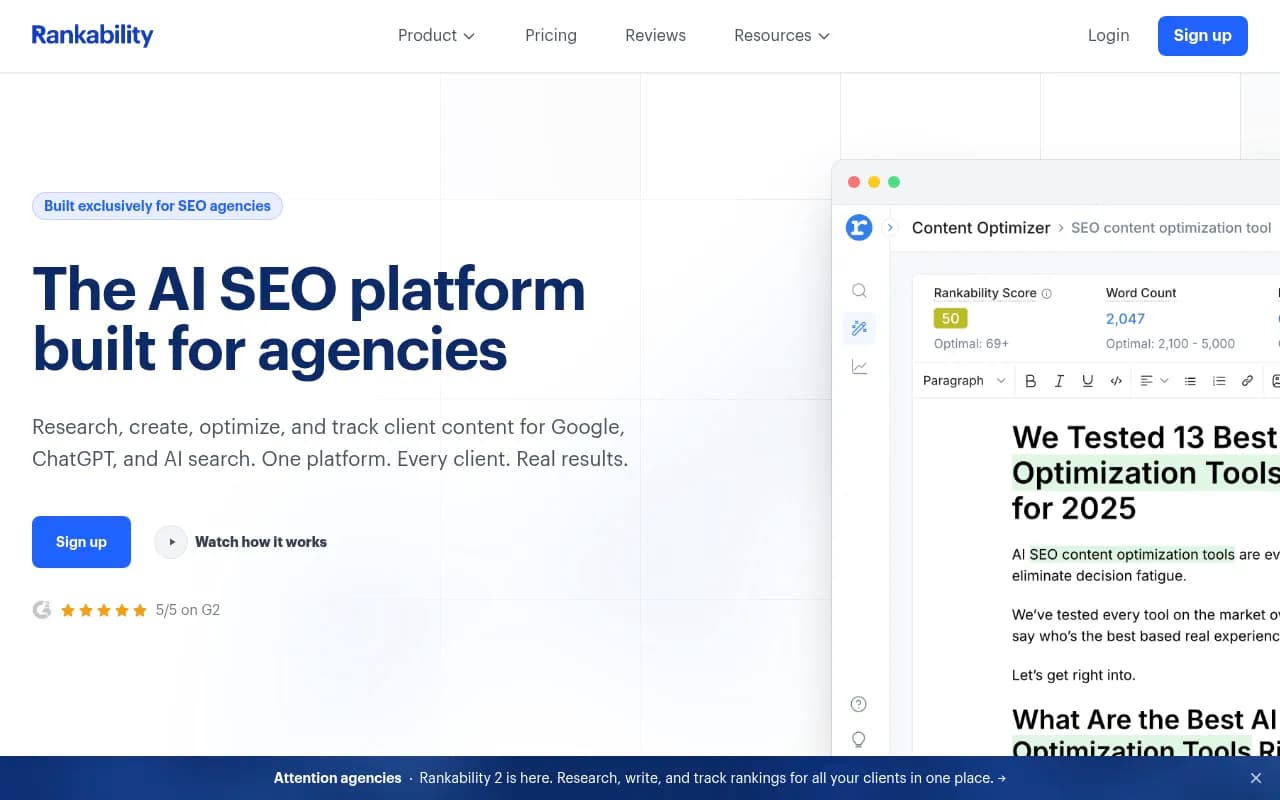
What makes it particularly useful for agencies is the consolidation. AEO performance still depends heavily on SEO fundamentals -- authority, content quality, technical health -- and Rankability handles both sides. You're not running a separate SEO platform alongside your AI visibility tracker. That's a real operational advantage when you're managing 15 clients and don't want to maintain two separate reporting stacks.
The platform also lets unlimited users work within an account, which matters for agencies where multiple team members need access to client data. Pricing starts at $99/month, which is competitive for what you get.
The main limitation compared to Promptwatch is on the optimization side. Rankability is strong at tracking and reporting, but it doesn't have the same depth of content generation or gap analysis tools. If your agency's value proposition is "we'll improve your AI visibility," you'll need to supplement it with content workflows elsewhere.
3. Peec AI -- best for multi-market and multilingual tracking
If you manage clients with international audiences, Peec AI is worth a close look. Most AI visibility tools are built around English-language prompts in US markets. Peec AI handles multi-language and multi-region tracking in a way that few competitors match.

Agency plans start around $245/month and are structured around client seats rather than a flat unlimited model, so the economics depend on your client count. For agencies with 5-10 international clients, it works well. For agencies with 30+ clients, the per-seat model gets expensive quickly.
The monitoring coverage is solid, and the interface is clean enough that you can pull client-facing reports without too much manual cleanup. Where it falls short is in the same place as most tools in this category: it's primarily a monitoring platform. You'll see where clients are visible and where they're not, but the "what to do about it" is left to you.
4. Scrunch AI -- best for brands where content and AI visibility overlap
Scrunch AI takes a slightly different angle. It's built around understanding how AI models perceive and cite content, with a focus on the relationship between content quality and citation frequency. For agencies that already have strong content production capabilities and want to understand which content is actually driving AI visibility, it's a useful lens.
The platform is stronger on the analysis side than the action side -- you get detailed breakdowns of citation patterns, source authority, and content gaps, but the workflow for actually fixing those gaps is less developed than Promptwatch's. It's a better fit for agencies that want to inform their existing content team's work rather than generate content directly from the platform.
Pricing is in the mid-range for this category. Worth evaluating if content strategy is central to your agency's offering.
5. Otterly.AI -- best for agencies that want affordable baseline monitoring
Otterly.AI is the most accessible entry point in this category. If you have clients who are just starting to ask about AI visibility and you need a way to show them where they stand without a major budget commitment, Otterly.AI gets the job done.

It tracks brand mentions and citations across the main AI models, produces clean reports, and doesn't require a lot of setup time. For smaller agencies or for clients who aren't yet ready to invest in optimization, it's a reasonable starting point.
The honest limitation: it's monitoring-only. There's no content gap analysis, no crawler logs, no content generation. It tells you the score but doesn't help you improve it. For agencies whose clients will eventually want results rather than just data, you'll hit the ceiling of what Otterly.AI can do fairly quickly.
How these tools compare
| Tool | Multi-client management | White-label reporting | Content optimization | AI models covered | Starting price |
|---|---|---|---|---|---|
| Promptwatch | Yes (agency plans) | Yes | Yes (Content Agents, gap analysis) | 10 | $99/mo |
| Rankability | Yes (unlimited users) | Yes | Partial (SEO + AEO tracking) | 4+ | $99/mo |
| Peec AI | Client-seat based | Yes | No | Multiple | ~$245/mo (agency) |
| Scrunch AI | Yes | Yes | Partial (analysis only) | Multiple | Mid-range |
| Otterly.AI | Yes | Basic | No | 5+ | Low |
| Profound | No (one workspace) | Limited | No | 6+ | $99/mo (Growth $399/mo) |
The monitoring-only problem
It's worth naming this directly because it affects most of the tools in this space, including Profound. Monitoring tells you where you stand. It does not tell you how to move.
For agencies, this is a real business problem. Clients don't pay retainers to see a dashboard. They pay for visibility improvements. If your tool shows that a client's competitor is appearing in ChatGPT for 40 prompts the client isn't appearing for, the next question is: what do we publish, how do we structure it, and when will it start working?
Most tools leave that question unanswered. Promptwatch is the clearest exception -- the Answer Gap Analysis feeds directly into content generation, and the crawler logs show you when AI bots are actually reading the new content. That closed loop is what separates an optimization platform from a monitoring dashboard.
Which tool should your agency use?
There's no single right answer, but here's a practical framework:
If your agency sells AI visibility as a managed service and clients expect measurable improvement, Promptwatch is the strongest fit. The content generation and gap analysis tools mean you're not just reporting -- you're shipping work that moves the needle.
If your agency wants a single platform that handles both AEO and traditional SEO reporting for clients, Rankability is the most operationally efficient choice. The unlimited-user model and white-label reporting make it easy to scale.
If you manage clients across multiple countries and languages, Peec AI is worth the premium for the multilingual coverage.
If clients are early-stage and just need baseline visibility data without a big budget, Otterly.AI is a reasonable starting point with the understanding that you'll likely need to upgrade as expectations grow.
Profound itself isn't a bad tool -- it's just not built for agencies. The single-workspace model and enterprise pricing structure make more sense for an in-house team at a large brand than for an agency managing a portfolio of clients. If you're evaluating it for that use case, the alternatives above will serve you better.
A note on what to watch in the second half of 2026
The AI search landscape is still moving fast. Google AI Mode is expanding, ChatGPT's shopping and recommendation features are getting more sophisticated, and the gap between brands that are visible in AI answers and those that aren't is widening. Agencies that build GEO capabilities now -- real optimization, not just monitoring -- will have a meaningful advantage in client retention and new business.
The tools that will matter most are the ones that help you close that gap, not just measure it.