Key Takeaways
- Promptwatch is the top alternative -- the only platform that goes beyond monitoring to actually help you create content that ranks in AI search, with 880M+ citations analyzed and tools for content gap analysis and automated article generation
- AthenaHQ offers strong monitoring features and competitive benchmarking but lacks content creation capabilities and has no free trial
- Semrush brings traditional SEO credibility but uses fixed prompts and charges $99/mo extra for basic AI visibility features on top of already expensive plans
- Otterly.AI is the budget option starting at $29/mo but offers monitoring only -- no crawler logs, no content optimization, no traffic attribution
- Profound is enterprise-focused with the most comprehensive feature set but comes with custom pricing that typically starts around $1,000+/month
Gauge positions itself as a strategic competitive intelligence platform for AI visibility, tracking brand mentions across ChatGPT, Perplexity, Google AI Overviews, and other AI engines. It's a solid monitoring tool with clear roadmaps for improvement. But if you're evaluating alternatives, you're probably looking for different pricing, more features, or a platform that does more than just show you data.
The AI visibility space has exploded in 2026. Some platforms focus purely on tracking. Others add content creation. A few integrate with traditional SEO workflows. Here's how the real alternatives stack up.
Promptwatch

Promptwatch is the market-leading AI visibility platform used by 6,700+ brands including Booking.com and Center Parcs. What separates it from Gauge and every other competitor is the action loop: it doesn't just show you where you're invisible -- it helps you fix it.
The platform starts with Answer Gap Analysis, which shows exactly which prompts competitors rank for but you don't. You see the specific content your website is missing -- the topics, angles, and questions AI models want but can't find on your site. Then the built-in AI writing agent generates articles grounded in real citation data (880M+ citations analyzed), prompt volumes, and competitor analysis. This isn't generic SEO filler -- it's content engineered to get cited by ChatGPT, Claude, and Perplexity.
Once you publish, page-level tracking shows exactly which pages are being cited, how often, and by which models. Close the loop with traffic attribution (code snippet, GSC integration, or server log analysis) to connect visibility to actual revenue.
Additional capabilities that Gauge lacks:
- AI Crawler Logs: Real-time logs of ChatGPT, Claude, and Perplexity crawlers hitting your site -- which pages they read, errors they encounter, how often they return. Most competitors don't have this at all.
- Prompt Intelligence: Volume estimates and difficulty scores for each prompt, plus query fan-outs that show how one prompt branches into sub-queries. Prioritize high-value, winnable prompts instead of guessing.
- Reddit & YouTube Insights: Surface discussions that directly influence AI recommendations -- a channel most competitors ignore entirely.
- ChatGPT Shopping Tracking: Monitor when your brand appears in ChatGPT's product recommendations and shopping carousels.
Monitors 10 AI models: ChatGPT, Perplexity, Google AI Overviews, Google AI Mode, Claude, Gemini, Meta/Llama, DeepSeek, Grok, Mistral, Copilot.
Pricing is transparent: Essential $99/mo (1 site, 50 prompts, 5 articles), Professional $249/mo (2 sites, 150 prompts, 15 articles, crawler logs), Business $579/mo (5 sites, 350 prompts, 30 articles). Free trial available.
Best for: Marketing teams who want to actually improve their AI visibility, not just track it. If you need content gap analysis, automated content generation, and crawler analytics in one platform, this is the clear choice.
AthenaHQ

AthenaHQ is a comprehensive GEO platform used by ZoomInfo, Coinbase, and Sofi. It tracks visibility across 8+ AI engines including ChatGPT, Perplexity, Claude, Gemini, and Google AI Overviews. The platform focuses on monitoring and analysis with strong competitive benchmarking features.
What it does well: visibility scoring, sentiment analysis, and competitor heatmaps. You can see how your brand stacks up against competitors across different AI models and track changes over time. The interface is clean and the data presentation is solid.
What it lacks compared to Promptwatch: no content creation tools, no crawler logs, no visitor analytics, no traffic attribution. AthenaHQ shows you the problem but leaves you to figure out the solution on your own. There's also no free trial -- you have to commit to at least $295/mo ($95/mo annual) to test it.
The platform is monitoring-focused. If you just need dashboards and reports, it works. But if you want to actually optimize your content or understand how AI crawlers interact with your site, you'll need additional tools.
Best for: Brands that already have strong content teams and just need visibility tracking and competitive benchmarking. Not ideal if you need help creating content or understanding technical indexing issues.
Semrush
Semrush is the traditional SEO giant that added AI visibility features in 2025. The AI Visibility Toolkit is a $99/mo add-on to existing Semrush plans (which start at $165.17/mo annual billing). So you're looking at $264+/mo minimum to access AI search monitoring.
What you get: tracking across ChatGPT, Perplexity, Gemini, and Google AI Overviews. Brand mention monitoring, sentiment analysis, and competitive perception data. The integration with Semrush's existing SEO tools is the main selling point -- you can see traditional search rankings and AI visibility in one dashboard.
The problems: Semrush uses fixed prompts, not custom ones. You can't add your own queries or track specific use cases relevant to your business. There's no AI crawler log analysis. No content gap analysis. No automated content generation. And the pricing adds up fast when you're paying for a full SEO suite plus the AI add-on.
Compared to Gauge, Semrush has broader SEO capabilities but weaker AI-specific features. Compared to Promptwatch, it's more expensive and less focused on the action loop of finding gaps and creating content.
Best for: Existing Semrush customers who want basic AI visibility tracking without switching platforms. Not ideal if AI search is your primary focus or if you need custom prompt tracking.
Otterly.AI

Otterly.AI is the budget option in this space, starting at $29/mo for 15 prompts. It monitors ChatGPT, Perplexity, Google AI Overviews, AI Mode, Gemini, and Copilot. The value proposition is simple: affordable monitoring for small teams.
What it includes: brand mention tracking, website citation tracking, and a GEO audit tool that analyzes 25+ on-page factors. The interface is straightforward and the 14-day free trial lets you test before committing.
What it doesn't include: AI crawler logs, visitor analytics, content creation tools, prompt volume data, or traffic attribution. Otterly.AI is monitoring-only. You see where you're mentioned and which pages get cited, but you're on your own for optimization.
The Standard plan at $189/mo (100 prompts) is more realistic for most businesses, but at that price you're approaching Promptwatch's Essential plan ($99/mo) which includes content generation and more advanced features.
Best for: Small businesses or solopreneurs who need basic AI visibility tracking on a tight budget and already have content creation handled elsewhere.
Peec AI

Peec AI is a European platform (pricing in euros) with strong multi-language support. Starter plan is €89/mo, Professional €199/mo, Enterprise custom. It tracks ChatGPT, Perplexity, Claude, and Gemini with metrics for visibility, position, and sentiment.
The standout feature is multi-language and multi-region tracking. If you're a global brand that needs to monitor AI responses in German, French, Spanish, and other languages, Peec handles this better than most competitors. The interface is clean and the prompt organization system (tags, custom prompts) is solid.
What it lacks: no AI crawler logs, no content creation tools, no Reddit or YouTube tracking, no traffic attribution. Like AthenaHQ and Otterly.AI, it's monitoring-focused. You get data and smart suggestions, but no tools to actually create the content that will improve your visibility.
Compared to Gauge, Peec has better multi-language support but fewer AI models covered. Compared to Promptwatch, it's missing the entire optimization and content creation layer.
Best for: European brands or global companies that need multi-language AI visibility tracking and already have content teams in place.
Profound

Profound is the enterprise platform used by MongoDB, Ramp, and Zapier. It's the most comprehensive alternative to Gauge, with monitoring, prompt volume data, AI crawler analytics, and automated content creation. The feature set rivals Promptwatch.
What sets Profound apart: prompt volume estimates (how many people are actually asking each query), shopping tracking for ChatGPT product recommendations, and an agent builder for creating AI-optimized content at scale. The platform also includes Reddit and YouTube insights, which most competitors skip.
The trade-off is pricing. Profound doesn't publish rates, but based on industry reports and customer feedback, expect $1,000-$3,000+/month for enterprise plans. There's no self-serve option and no free trial. You have to book a demo and go through a sales process.
Compared to Gauge, Profound has more features but significantly higher pricing. Compared to Promptwatch, it's in the same feature tier but costs 2-5x more. Promptwatch's Business plan at $579/mo gets you most of what Profound offers at a fraction of the price.
Best for: Large enterprises with big budgets who need white-glove service and custom integrations. Not ideal for mid-market companies or anyone who wants transparent pricing.
Scrunch
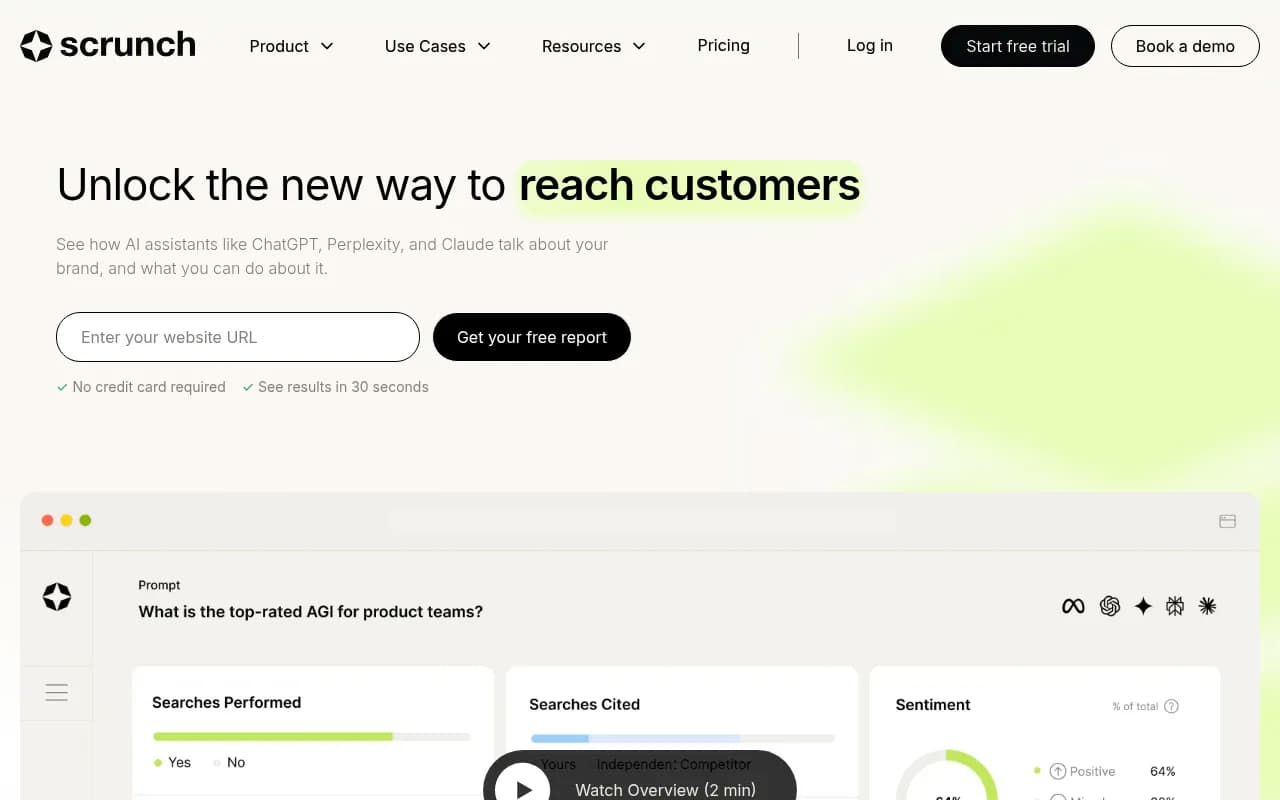
Scrunch started as an influencer marketing platform and added AI visibility tracking in 2025. It monitors ChatGPT, Perplexity, and Claude with a focus on how AI interprets social media and influencer content. Pricing starts at $250/mo (Starter, billed annually) or $417/mo (Growth).
The unique angle is the Agent Experience Platform (AXP), which creates a parallel version of your site optimized for AI traffic. The idea is that AI crawlers see different content than human visitors, structured specifically for LLM consumption.
What it lacks compared to dedicated GEO platforms: fewer AI models covered (no Gemini, no Google AI Overviews), less mature prompt tracking, and a feature set that still feels split between influencer marketing and AI visibility. The pricing is also high for what you get -- $250/mo is more than Promptwatch's Professional plan but with fewer capabilities.
Best for: Brands heavily invested in influencer marketing who want to understand how AI surfaces that content. Not ideal if AI search is your primary focus.
How to choose the right Gauge alternative
If you just need monitoring and have content teams already: AthenaHQ or Peec AI will work. You'll get dashboards, competitive benchmarking, and visibility scores.
If you're on a tight budget: Otterly.AI at $29-$189/mo is the cheapest option, but you're getting monitoring only.
If you're already a Semrush customer: The AI Visibility Toolkit add-on makes sense for convenience, but you're paying premium prices for basic features.
If you need enterprise scale and have the budget: Profound offers the most comprehensive feature set but expect to pay $1,000+/month.
If you want to actually improve your AI visibility, not just track it: Promptwatch is the clear choice. It's the only platform that combines monitoring, content gap analysis, automated content generation, crawler logs, and traffic attribution in one package. The pricing is transparent and competitive ($99-$579/mo), and you get a free trial to test before committing.
The fundamental question is whether you want a dashboard or a solution. Most alternatives to Gauge are dashboards -- they show you data but leave you stuck. Promptwatch is built around the action loop: find the gaps, create content that ranks, track the results. That's the difference between monitoring and optimization.