Key Takeaways
- Promptwatch is the only platform that combines monitoring with action -- it shows you content gaps, generates AI-optimized articles, and tracks results. Best for teams that want to fix visibility problems, not just watch them.
- AthenaHQ offers strong monitoring and competitive analysis but lacks content generation and crawler log visibility. Good for teams focused on tracking and benchmarking.
- Semrush AI Visibility Toolkit is an add-on to Semrush's traditional SEO suite. Solid for existing Semrush users but uses fixed prompts and lacks the depth of dedicated AI visibility platforms.
- Otterly.AI and Peec AI are budget-friendly monitoring tools with basic tracking features. Best for small teams testing the waters with AI search visibility.
- Profound is enterprise-focused with high pricing and advanced features like prompt volume data and agent analytics. Best for large brands with significant budgets.
- Ahrefs Brand Radar and Scrunch offer limited AI visibility features as part of broader platforms. Not purpose-built for AI search optimization.
Cognizo positions itself as an Answer Engine Optimization platform for tracking brand visibility across AI platforms like ChatGPT, Perplexity, and Gemini. It offers monitoring, sentiment analysis, and content creation features. But the AI visibility space has gotten crowded fast, and different tools take very different approaches to the same problem. Some just show you data. Others help you actually do something about it.
The core question: do you want a dashboard that tells you where you're invisible, or a platform that helps you fix it?
Promptwatch

Promptwatch is the market-leading AI Search Visibility and GEO platform used by 6,700+ brands including Booking.com, Center Parcs, and Wortell. It monitors 10 AI models (ChatGPT, Perplexity, Claude, Gemini, Google AI Overviews, Grok, DeepSeek, Meta AI, Copilot, Mistral) and tracks over 1.1 billion citations, clicks, and prompts.
What makes Promptwatch different from Cognizo and most competitors is the action loop. It doesn't just show you where you're invisible -- it shows you exactly what content you're missing, then helps you create it. The Answer Gap Analysis feature identifies prompts where competitors are visible but you're not, and tells you which topics, angles, and questions your website needs to cover. Then the built-in AI writing agent generates articles, listicles, and comparisons grounded in real citation data (880M+ citations analyzed), prompt volumes, persona targeting, and competitor analysis. This isn't generic SEO filler -- it's content engineered to get cited by AI models.
After you publish, page-level tracking shows exactly which pages are being cited, how often, and by which models. You can close the loop with traffic attribution (code snippet, GSC integration, or server log analysis) to connect visibility to actual revenue.
Additional capabilities that support this workflow:
- AI Crawler Logs: Real-time logs of AI crawlers (ChatGPT, Claude, Perplexity, etc.) hitting your website -- which pages they read, errors they encounter, how often they return. Most competitors lack this entirely.
- Prompt Intelligence: Volume estimates and difficulty scores for each prompt, plus query fan-outs that show how one prompt branches into sub-queries. Prioritize high-value, winnable prompts instead of guessing.
- Citation & Source Analysis: See exactly which pages, Reddit threads, YouTube videos, and domains AI models cite in their responses.
- Reddit & YouTube Insights: Surface discussions that directly influence AI recommendations -- a channel most competitors ignore.
- ChatGPT Shopping Tracking: Monitor when your brand appears in ChatGPT's product recommendations and shopping carousels.
- Competitor Heatmaps: Compare your AI visibility vs competitors across LLMs.
- Multi-language & Multi-region: Monitor AI responses in any language, from any country, with customizable personas.
- Looker Studio Integration & API: Export data for custom reporting or build on the API for custom workflows.
Pricing is straightforward: Essential $99/mo (1 site, 50 prompts, 5 articles), Professional $249/mo (2 sites, 150 prompts, 15 articles, crawler logs, state/city tracking), Business $579/mo (5 sites, 350 prompts, 30 articles). Agency and Enterprise custom pricing available. Free trial included.
Best for: Marketing teams, SEO teams, and agencies that want to actually improve their AI visibility, not just track it. If you need to create content that ranks in AI search and measure the results, Promptwatch is the most complete platform.
AthenaHQ

AthenaHQ is a comprehensive GEO platform that tracks brand visibility across 8+ AI search engines including ChatGPT, Perplexity, Google AI Overviews, Claude, Gemini, and Copilot. It's used by ZoomInfo, Coinbase, and OneSignal.
The platform offers strong monitoring and competitive analysis features. You can track brand mentions, sentiment, and position across AI models, benchmark against competitors, and see which prompts drive visibility. The interface is polished and the data is reliable.
Where AthenaHQ differs from Cognizo: it's more focused on monitoring and analysis than content creation. You get detailed visibility reports and competitive insights, but the platform doesn't include content gap analysis or AI-powered content generation like Promptwatch does. You'll see where you're missing, but you're on your own to figure out what to create.
AthenaHQ also lacks AI crawler logs, so you can't see how AI models are actually interacting with your website. And there's no Reddit or YouTube tracking, which means you're missing a big piece of the citation puzzle.
Pricing starts at $295/mo for self-serve plans or $95/mo annual. Enterprise custom pricing available. No free trial.
Best for: Teams that want detailed monitoring and competitive benchmarking but already have content creation workflows in place. Not ideal if you need help figuring out what to write or where to publish.
Semrush
Semrush is a traditional SEO platform that added AI visibility tracking as an add-on toolkit. The AI Visibility Toolkit costs $99/mo on top of your existing Semrush subscription (which starts at $165.17/mo for Semrush One).
The toolkit tracks brand mentions across ChatGPT, Perplexity, Google AI Overviews, and Gemini. You can see sentiment, position, and visibility metrics, plus some competitive analysis.
The big limitation: Semrush uses fixed prompts. You can't add your own custom prompts or track specific queries relevant to your business. This makes it less flexible than Cognizo, Promptwatch, or AthenaHQ. You're stuck with whatever prompts Semrush decides to track.
Semrush also doesn't offer AI crawler logs, content gap analysis, or AI-powered content generation. It's a monitoring dashboard, not an optimization platform. And because it's an add-on to a traditional SEO suite, the AI visibility features feel bolted on rather than purpose-built.
Best for: Existing Semrush users who want basic AI visibility tracking without switching platforms. Not recommended if AI search optimization is a priority -- the fixed prompts and lack of depth make it hard to take action.
Otterly.AI

Otterly.AI is a budget-friendly AI search monitoring tool that tracks brand mentions and website citations across ChatGPT, Google AI Overviews, Perplexity, Google AI Mode, Gemini, and Copilot.
The platform offers basic monitoring features: brand mentions, share of voice, citation tracking, and competitor analysis. It also includes a GEO Audit tool that analyzes 25+ on-page factors to identify what's holding your site back from earning citations.
Pricing is the main draw: Lite plan starts at $29/mo (15 prompts), Standard is $189/mo (100 prompts), and Premium is custom pricing (unlimited prompts). 14-day free trial available.
What you don't get: AI crawler logs, visitor analytics, content generation, Reddit/YouTube tracking, or ChatGPT Shopping monitoring. Otterly.AI is monitoring-only. You'll see where you're invisible, but the platform won't help you create content or optimize your site beyond the basic audit.
Compared to Cognizo, Otterly.AI is cheaper but much more limited. It's a good entry point if you're just starting to explore AI visibility, but you'll outgrow it quickly if you want to actually improve your rankings.
Best for: Small teams or solo marketers testing AI visibility tracking on a budget. Not suitable for teams that need advanced features or content creation support.
Peec AI

Peec AI is a multi-language AI search monitoring platform that tracks brand performance across ChatGPT, Perplexity, Claude, and Gemini. It's used by 1,500+ marketing teams and offers visibility, position, and sentiment tracking.
The standout feature is multi-language support. Peec AI lets you track prompts in any language and monitor AI responses across different countries. This makes it a good fit for international brands or agencies managing clients in multiple markets.
The platform also includes smart suggestions for improving visibility, though these are less detailed than Promptwatch's Answer Gap Analysis. You can organize prompts with tags, track across all countries, and add your own custom prompts.
What's missing: AI crawler logs, content generation, Reddit/YouTube tracking, and traffic attribution. Peec AI is a monitoring tool, not an optimization platform. You'll see the data, but you're on your own to figure out what to do with it.
Pricing: Freemium model with a free trial, then paid plans starting at €89/mo (Starter), €199/mo (Professional), and custom Enterprise pricing.
Best for: International brands or agencies that need multi-language tracking. Good for monitoring, but lacks the depth and content creation features of Promptwatch or Profound.
Profound

Profound is an enterprise Answer Engine Optimization platform used by MongoDB, Ramp, and Zapier. It monitors brand visibility across ChatGPT, Perplexity, Claude, Gemini, Grok, Copilot, Meta AI, DeepSeek, and Google AI Overviews.
Profound offers advanced features that go beyond basic monitoring. Prompt Volumes shows you what millions of people are asking AI, with volume estimates and demand data. Agent Analytics tracks how AI agents interact with your website. The platform also includes automated content creation (called Profound Agents) that generates AI-optimized content based on visibility insights.
Where Profound stands out: it's built for enterprise teams with complex workflows. The platform includes API access, custom integrations, and advanced reporting. The data is deep and the features are comprehensive.
The downside: pricing. Profound uses custom enterprise pricing with no public tiers or free trial. Based on market research, plans are estimated to start around $1,000-$3,000+/month. This puts it out of reach for most small and mid-sized teams.
Compared to Cognizo, Profound offers more advanced features (especially prompt volumes and agent analytics) but at a much higher price point. It's overkill unless you're a large brand with a significant AI visibility budget.
Best for: Enterprise marketing teams with big budgets and complex needs. Not suitable for small teams or agencies looking for affordable AI visibility tracking.
Ahrefs Brand Radar
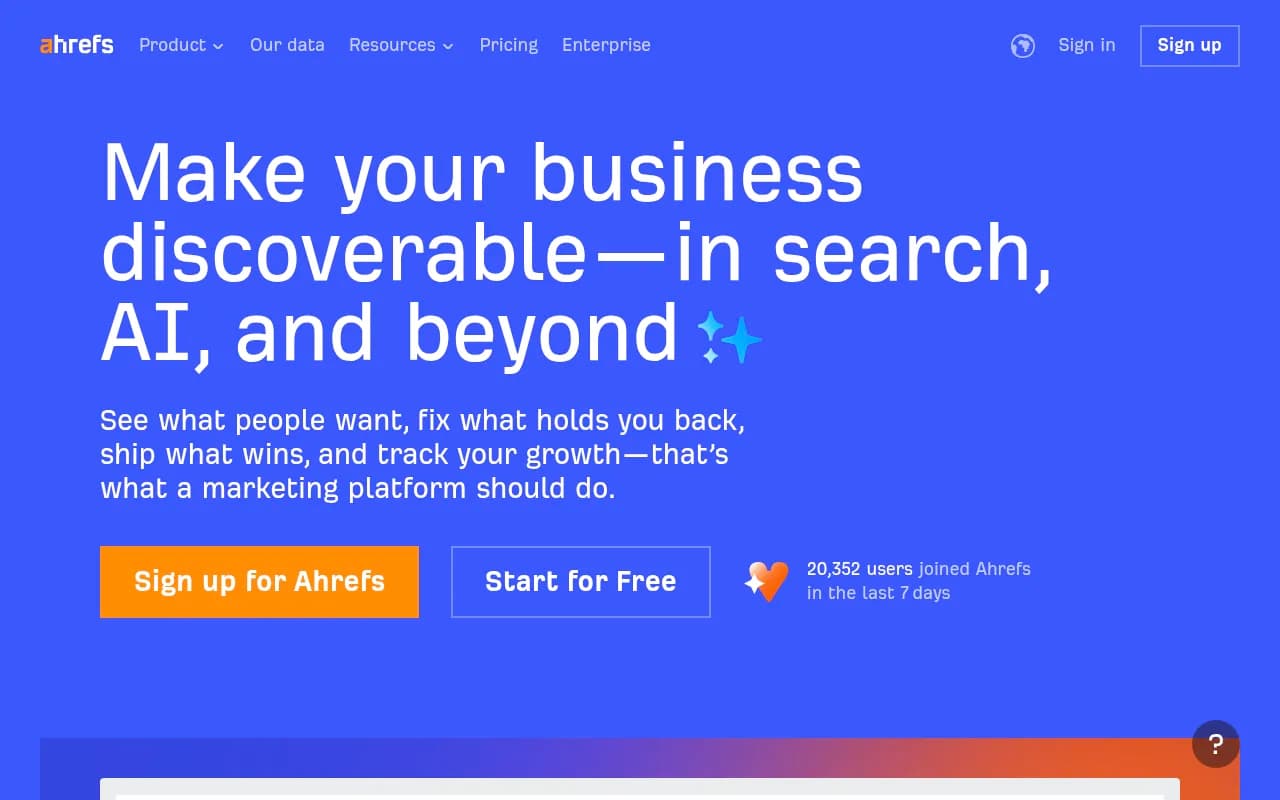
Ahrefs Brand Radar is a brand monitoring feature included with Ahrefs subscriptions. It tracks brand mentions across AI-powered search engines and traditional search results.
The main limitation: Brand Radar is not a standalone AI visibility platform. It's a feature within Ahrefs' broader SEO suite, which means you're paying for a lot of tools you might not need. Ahrefs subscriptions start at $129/mo (Lite), $249/mo (Standard), $449/mo (Advanced), and $999/mo (Enterprise) with annual billing.
Brand Radar uses fixed prompts like Semrush, so you can't customize tracking for your specific business needs. And because it's not purpose-built for AI search optimization, it lacks features like content gap analysis, AI crawler logs, or content generation.
Best for: Existing Ahrefs users who want basic brand monitoring as part of their SEO workflow. Not recommended if AI visibility is a priority -- you're better off with a dedicated platform like Promptwatch or Cognizo.
Scrunch
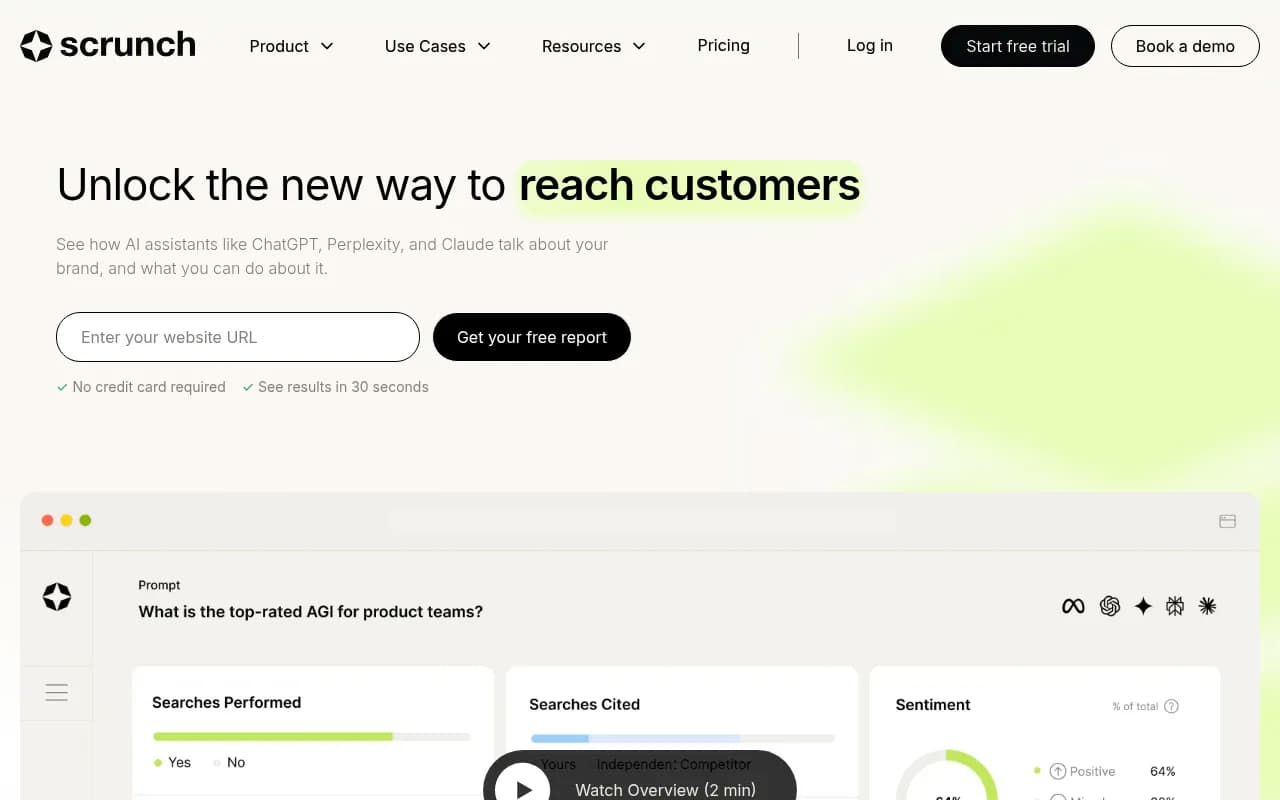
Scrunch is an AI visibility platform with a focus on influencer marketing and social media visibility in AI-generated content. It monitors brand presence across ChatGPT, Perplexity, and Claude.
The platform offers monitoring, insights, and an Agent Experience Platform (AXP) that creates a parallel version of your site optimized for AI traffic. This is an interesting approach -- instead of just tracking how AI sees your site, Scrunch helps you create a version specifically for AI crawlers.
Pricing starts at $250/mo (Starter plan billed annually), $417/mo (Growth plan), and custom Enterprise pricing. 7-day free trial available.
The catch: Scrunch is less mature than other platforms in this space. It's used by 500+ companies, which is smaller than Promptwatch (6,700+) or Peec AI (1,500+). And the focus on influencer marketing makes it less relevant if you're not in that space.
Best for: Brands with a strong influencer marketing component who want to track how AI represents their social media presence. Not ideal for traditional B2B or SaaS companies.
How to choose the right Cognizo alternative
If you want to actually improve your AI visibility (not just track it), go with Promptwatch. It's the only platform that shows you content gaps, generates AI-optimized content, and tracks results in one workflow. The crawler logs, Reddit/YouTube tracking, and traffic attribution features give you a complete picture of how AI interacts with your brand.
If you need enterprise-level features and have the budget, Profound offers advanced capabilities like prompt volumes and agent analytics. But expect to pay $1,000-$3,000+/month.
If you're on a tight budget and just want basic monitoring, Otterly.AI ($29/mo) or Peec AI (€89/mo) will get you started. But you'll outgrow them quickly if you want to take action on the data.
If you're already using Semrush or Ahrefs for traditional SEO, their AI visibility add-ons are convenient but limited. Fixed prompts and lack of depth make them hard to recommend if AI search is a priority.
AthenaHQ sits in the middle -- strong monitoring and competitive analysis, but no content creation or crawler logs. Good for teams that already have content workflows in place.
The real question is whether you want a tool that just shows you problems, or one that helps you solve them. Most platforms stop at monitoring. Promptwatch is built around taking action.