Key takeaways
- Most "AI visibility" tools in 2025 only tracked two or three LLMs -- true multi-model coverage was rarer than vendors admitted
- The gap between monitoring-only tools and optimization platforms widened significantly; knowing you're invisible isn't the same as being able to fix it
- LLM coverage breadth matters, but prompt intelligence, citation tracking, and content gap analysis are what separate useful tools from expensive dashboards
- Pricing ranged from free tiers to $1,000+/month enterprise contracts -- the right tier depends heavily on how many prompts and models you actually need to track
- Tools built around an action loop (find gaps, create content, measure results) consistently delivered more value than pure monitoring dashboards
The question used to be "where do I rank on Google?" Now it's "does ChatGPT even mention me?"
That shift happened fast. In 2024, AI search went from a curiosity to a real traffic channel. By 2025, brands were losing leads to competitors who appeared in Perplexity answers and ChatGPT recommendations -- without anyone on their team knowing it was happening.
A new category of tools emerged to solve this. But the market got crowded quickly, and a lot of what launched was monitoring theater: dashboards that show you data, make you feel informed, and leave you with no clear path to actually improving your visibility.
This guide covers the eight platforms that stood out in 2025 for their LLM coverage breadth, and explains what actually separated the useful ones from the noise.
Why LLM coverage breadth matters more than you think
Before getting into the tools, it's worth being clear about why "which LLMs does this track?" is such an important question.
Different AI models pull from different sources, weight content differently, and serve different user bases. ChatGPT has the largest consumer install base. Perplexity skews toward research-oriented queries and cites sources explicitly. Google AI Overviews and AI Mode sit at the top of the world's most-used search engine. Claude tends to be more cautious with brand recommendations. Gemini is baked into Google's ecosystem.
If your tool only tracks one or two of these, you're getting a partial picture. A brand could be dominating ChatGPT recommendations while being completely absent from Perplexity -- or vice versa. Without cross-model data, you don't know.
The platforms that actually covered all the major LLMs in 2025 tracked at minimum: ChatGPT, Claude, Perplexity, Gemini, and Google AI Overviews. The better ones added Grok, DeepSeek, Copilot, Meta AI, and Mistral.
The 8 platforms worth knowing
1. Promptwatch
Promptwatch is the most complete platform in this space, and the only one in a 2026 comparison of 12 GEO tools rated as a "Leader" across every evaluation category. It tracks 10 AI models: ChatGPT, Perplexity, Google AI Overviews, Google AI Mode, Claude, Gemini, Meta/Llama, DeepSeek, Grok, Mistral, and Copilot.
What separates it from most competitors isn't just coverage -- it's what happens after you see the data. The Answer Gap Analysis shows exactly which prompts competitors rank for that you don't, and the built-in AI writing agent generates content specifically engineered to get cited by AI models (grounded in 880M+ citations analyzed). You can track whether that content actually improves your visibility scores, then connect visibility to real traffic through GSC integration, a code snippet, or server log analysis.
It also has features most competitors simply don't offer: real-time AI crawler logs (so you can see when ChatGPT or Claude is crawling your site and what errors they hit), Reddit and YouTube citation tracking, ChatGPT Shopping monitoring, and prompt volume/difficulty scoring with query fan-outs.
Pricing starts at $99/month for the Essential plan (1 site, 50 prompts, 5 articles), $249/month for Professional (2 sites, 150 prompts, crawler logs), and $579/month for Business (5 sites, 350 prompts). A free trial is available.

2. Profound
Profound (TryProfound) built a strong reputation in 2025 for enterprise-grade breadth. It covers the major LLMs and goes deep on competitive benchmarking -- showing share-of-voice across models and tracking how brand perception shifts over time. The interface is polished and the data is reliable.
The main limitation is that Profound is primarily a monitoring and analytics platform. It shows you where you stand with considerable precision, but content optimization and generation aren't core to the product. For enterprise teams with separate content resources, that's fine. For teams that need an end-to-end workflow, it's a gap.
Pricing is on the higher end and typically requires a sales conversation.

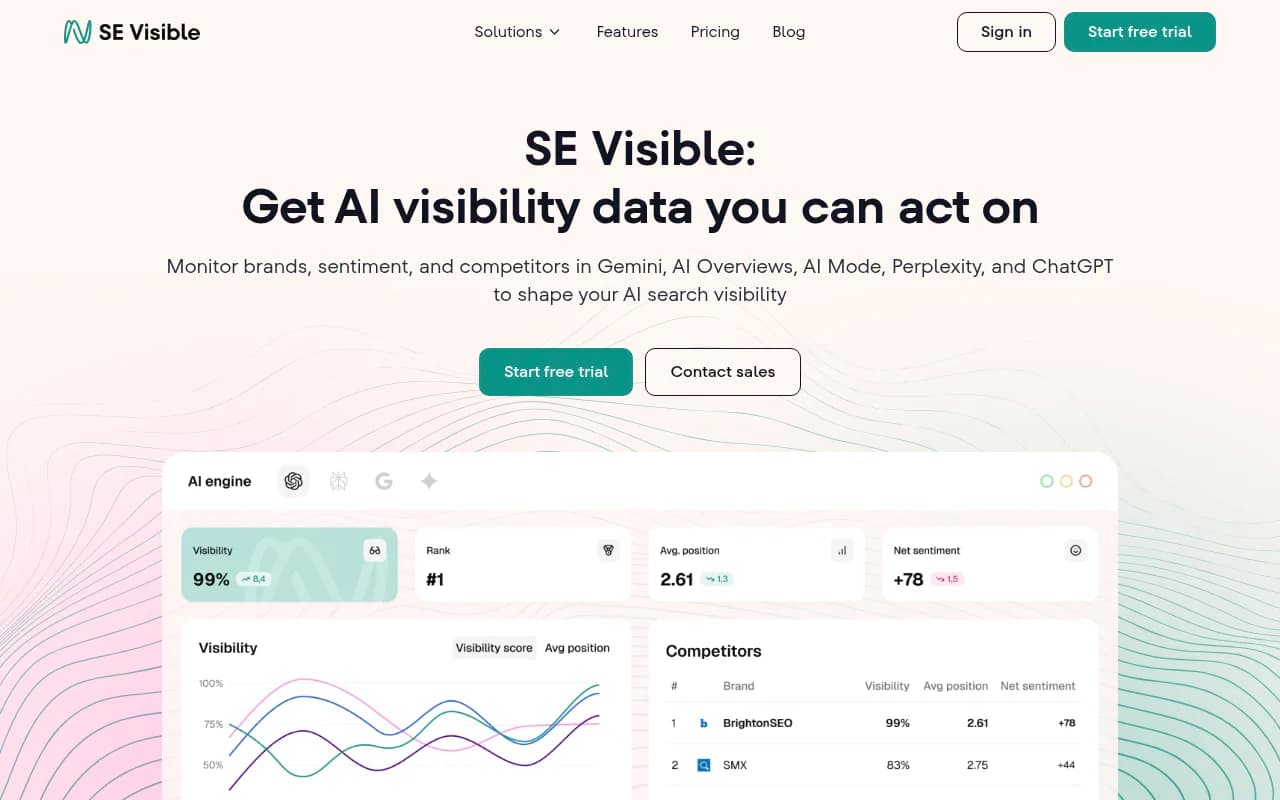
3. SE Ranking (SE Visible)
SE Ranking launched its AI visibility module (branded as SE Visible) in 2025 and it quickly became one of the more accessible options for teams already using SE Ranking for traditional SEO. Coverage includes ChatGPT, Claude, Perplexity, Gemini, and Google AI Overviews -- solid breadth for most use cases.
The integration with SE Ranking's existing keyword and ranking data is genuinely useful. You can cross-reference your traditional SEO performance with AI visibility in the same dashboard, which helps prioritize where to focus. The AI visibility features are more monitoring-focused than optimization-focused, but the price point makes it reasonable for teams that don't need the full action loop.
4. AthenaHQ
AthenaHQ tracks 8+ AI search engines and does a good job of presenting competitive visibility data in a clean interface. It's particularly strong on share-of-voice metrics and prompt-level breakdowns -- you can see exactly which queries competitors are winning and where you're being mentioned.
The honest limitation: AthenaHQ is a monitoring platform. There's no content generation, no gap analysis that tells you what to create, and no built-in path from "I see the problem" to "here's how I fix it." For teams that want data to inform their existing content workflow, it works well. For teams that want the tool to help them act on the data, it falls short.

5. Otterly.AI
Otterly.AI positioned itself as the affordable entry point to AI visibility tracking in 2025. It covers the main LLMs (ChatGPT, Perplexity, Claude, Gemini) and delivers clean, readable reports on brand mention frequency and sentiment.
It's genuinely good for what it is: a lightweight monitoring tool that doesn't require a large budget or a long onboarding process. The trade-off is that it stops at monitoring. No crawler logs, no visitor analytics, no content optimization features. If you're a small team that just wants to know whether you're showing up in AI answers, Otterly.AI is a reasonable starting point. If you want to improve your visibility, you'll need additional tools.

6. Semrush (AI toolkit)
Semrush added AI visibility tracking to its platform in 2025, which made sense given its existing user base. The integration means you can monitor AI mentions alongside your traditional SEO metrics without switching tools -- a real convenience for teams already paying for Semrush.
The AI tracking module uses a fixed prompt set, which limits how precisely you can target the specific queries your customers are actually using. There's also no AI traffic attribution, so connecting AI visibility to actual revenue requires external tools. For Semrush users who want a basic read on AI visibility without adding another subscription, it's a reasonable add-on. As a standalone AI visibility solution, it's not the strongest option.
7. Ahrefs Brand Radar
Ahrefs launched Brand Radar as its answer to the AI visibility tracking trend, and it benefits from Ahrefs' strong reputation for data accuracy. Coverage spans the main LLMs, and the brand mention tracking is reliable.
The limitations are similar to Semrush: fixed prompts (you can't customize the queries being tracked), no AI traffic attribution, and no content optimization features. Brand Radar is a useful signal for Ahrefs users who want to add AI visibility to their existing workflow, but it's not built for teams who want to actively optimize for AI search.
8. Peec.AI
Peec.AI focused on multi-language and multi-region AI visibility tracking in 2025, which made it genuinely useful for international brands that needed to monitor AI responses across different markets and languages. Coverage includes the major LLMs, and the localization capabilities are more developed than most competitors.
Like several others on this list, Peec.AI is primarily a monitoring tool. It tells you what's happening across languages and regions with reasonable accuracy, but doesn't offer content generation or optimization features. For global brands with in-house content teams, it fills a specific gap well.

How these platforms compare
Here's a direct comparison across the dimensions that matter most:
| Platform | LLMs tracked | Content generation | Crawler logs | Prompt customization | AI traffic attribution | Starting price |
|---|---|---|---|---|---|---|
| Promptwatch | 10+ | Yes (AI writing agent) | Yes | Yes | Yes | $99/mo |
| Profound | 6-8 | No | No | Yes | No | Custom |
| SE Visible | 5 | No | No | Yes | No | Bundled with SE Ranking |
| AthenaHQ | 8+ | No | No | Yes | No | Custom |
| Otterly.AI | 4-5 | No | No | Limited | No | ~$49/mo |
| Semrush AI | 4-5 | No | No | Fixed prompts | No | Bundled |
| Ahrefs Brand Radar | 4-5 | No | No | Fixed prompts | No | Bundled |
| Peec.AI | 5-6 | No | No | Yes | No | Custom |
The pattern is hard to miss. Most platforms in this space are monitoring dashboards. They show you data. They don't help you act on it.
What to actually look for when evaluating these tools
The LLM coverage list is the starting point, not the finish line. Here's what actually determines whether a tool is useful:
Prompt customization
Fixed prompt sets are a significant limitation. Your customers don't ask generic questions -- they ask specific ones. A tool that only tracks "best [category] software" can't tell you whether you're showing up for "best [category] software for [specific use case] teams" or "what does [your brand] do." Customizable prompts let you track the queries your actual buyers are using.
Citation and source tracking
Knowing you were mentioned is useful. Knowing which page on your site was cited, how often, and by which model is much more useful. Page-level citation tracking lets you understand what's working and replicate it.
Content gap analysis
The most actionable feature in this category is showing you what you're missing -- specifically, which prompts competitors appear in that you don't, and what content would close that gap. Most tools don't do this. The ones that do are fundamentally more useful.
Traffic attribution
AI visibility that doesn't connect to traffic and revenue is hard to justify. Tools that can show you how many visitors came from AI search (via GSC integration, a tracking snippet, or server logs) let you close the loop between visibility scores and business outcomes.
Crawler log access
This one is underrated. Knowing when AI crawlers are visiting your site, which pages they're reading, and what errors they're hitting tells you how AI models are discovering your content -- and where the indexing problems are. Most platforms don't offer this at all.
The monitoring-only problem
It's worth being direct about something: a lot of the tools that launched in 2024-2025 are dashboards dressed up as optimization platforms. They show you a visibility score, a list of mentions, and a competitor comparison chart. That's useful context. It's not a strategy.
The analogy is a rank tracker that shows you you're on page 3 for a keyword but gives you no information about why, no content recommendations, and no way to track whether your optimization efforts are working. You'd find that frustrating pretty quickly.
The same dynamic applies here. Knowing your AI visibility score is 23 out of 100 is only useful if you know what to do about it. The platforms that answer "what should I create?" and "did it work?" are the ones worth paying for.
Which tool is right for your situation
There's no universal answer, but here's a rough framework:
If you're a small team or solo marketer who just wants to know whether you're showing up in AI answers, Otterly.AI or SE Visible (if you already use SE Ranking) are reasonable starting points. Low cost, low complexity.
If you're a mid-size marketing or SEO team that wants to actively improve AI visibility -- not just monitor it -- Promptwatch is the most complete option. The combination of multi-model tracking, content gap analysis, AI writing, crawler logs, and traffic attribution covers the full workflow in one platform.
If you're an enterprise team with a dedicated content operation and you mainly need reliable data to inform your existing workflow, Profound or AthenaHQ give you solid monitoring with good competitive benchmarking.
If you're an international brand that needs multi-language tracking, Peec.AI's localization capabilities are worth a closer look.
For teams already paying for Semrush or Ahrefs, the bundled AI tracking features are worth turning on -- just don't expect them to replace a dedicated AI visibility platform if optimization is the goal.
The bottom line
The AI visibility tracking market matured quickly in 2025. The tools that covered all the major LLMs were genuinely useful. The ones that stopped at monitoring were less so.
What the best platforms figured out is that visibility data is only valuable if it tells you what to do next. The gap between "you're not showing up for this prompt" and "here's the content that would change that" is where most tools still fall short -- and where the real differentiation lives going into 2026.