Key takeaways
- Promptwatch is the only platform in this comparison that covers the full loop: monitoring, content gap analysis, AI-powered content generation, and traffic attribution.
- Otterly.AI and Peec AI are solid monitoring tools but stop short of helping you act on what they find.
- Searchable sits somewhere in the middle, with content tools, but its feature depth and data scale lag behind Promptwatch.
- If your team needs to show results, not just dashboards, the platform you choose matters a lot.
AI visibility has gone from a nice-to-have to something marketing teams are actively being asked to report on. ChatGPT alone now accounts for over half of AI search referral traffic, and brands that don't appear in AI-generated answers are effectively invisible to a growing slice of their audience.
The problem is that the tool market has exploded. There are now dozens of platforms claiming to "track your AI visibility," and most of them look similar at first glance. This guide focuses on four that come up repeatedly in team evaluations: Searchable, Promptwatch, Peec AI, and Otterly.AI.
These aren't the only options, but they represent a useful cross-section of the market. One is built for action, two are monitoring-first, and one is trying to do both. Here's how they actually compare.
What to look for in an AI visibility platform
Before getting into the tools, it's worth being clear about what "reliability" means in this context. Teams that have been burned by early-generation tools tend to care about a few specific things:
- Does the platform monitor the AI engines that actually matter to your audience (ChatGPT, Perplexity, Google AI Overviews, Gemini, Claude)?
- Does it give you prompt-level data, not just brand mention counts?
- Can it tell you why you're not being cited, not just that you aren't?
- Does it help you fix the problem, or just document it?
- Is the data fresh enough to act on?
With that in mind, let's look at each tool.
The four tools at a glance
Promptwatch
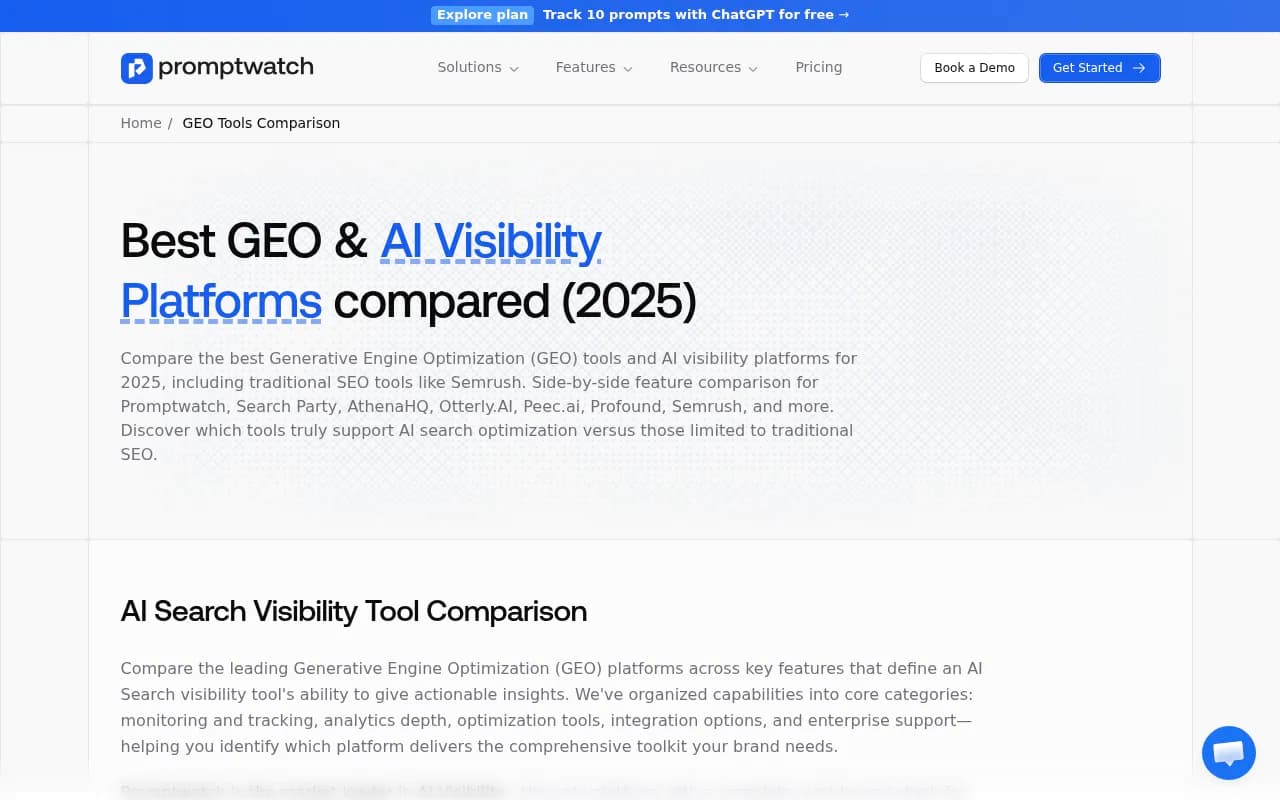
Promptwatch is the most complete platform in this comparison. It monitors 10 AI models (ChatGPT, Perplexity, Google AI Overviews, Google AI Mode, Claude, Gemini, Meta/Llama, DeepSeek, Grok, Mistral, Copilot), but the monitoring is really just the starting point.
What separates Promptwatch from the others is what happens after you see the data. The Answer Gap Analysis shows you exactly which prompts competitors rank for that you don't. The built-in AI writing agent then generates content specifically engineered to close those gaps, drawing on 880M+ citations analyzed to understand what AI models actually want to cite. And the traffic attribution layer (via code snippet, Google Search Console integration, or server log analysis) connects your visibility improvements to actual revenue.
There's also a crawler logs feature that shows you which AI bots are hitting your site, which pages they're reading, and what errors they're encountering. Most competitors don't have this at all.

Pricing runs from $99/month (Essential, 1 site, 50 prompts) to $579/month (Business, 5 sites, 350 prompts, 30 articles). Agency and enterprise pricing is custom. A free trial is available.
Otterly.AI
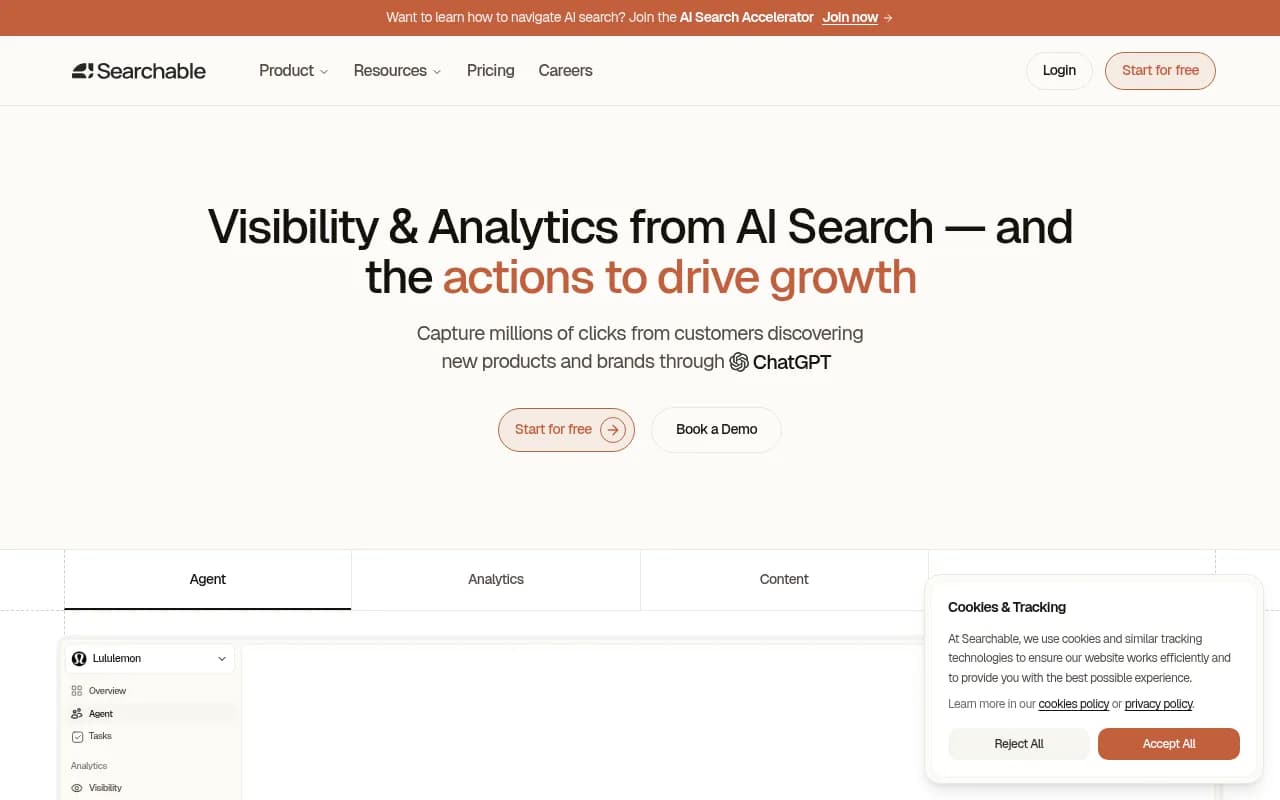
Otterly.AI was one of the first purpose-built AI monitoring tools and still has a loyal following, particularly among smaller teams. It covers the major AI engines, tracks brand mentions and citations, and has a reasonably clean interface that's easy to get started with.
The limitation is that it's primarily a monitoring dashboard. You can see where you appear and where you don't, but the platform doesn't help you understand why, and it doesn't generate content or suggest fixes. For teams that just need to report on visibility metrics, that might be fine. For teams that need to improve those metrics, it creates a gap.

Otterly.AI is generally positioned as an affordable entry point into AI monitoring. It works well as a first tool for teams just starting to track AI visibility, but tends to get outgrown once teams want to move from tracking to optimizing.
Peec AI
Peec AI is a multi-language AI visibility tracker with decent coverage across major LLMs. Its standout feature is language and regional support, which makes it a reasonable choice for international teams or agencies managing brands across multiple markets.
Like Otterly.AI, though, Peec AI is fundamentally a monitoring tool. It shows you visibility data, tracks competitors, and reports on brand mentions. What it doesn't do is help you create content to improve those numbers, analyze which specific content gaps are hurting you, or connect visibility to traffic and revenue.

It's a competent tracker. If multi-language monitoring is your primary requirement and you're comfortable doing the optimization work separately, Peec AI is worth evaluating. If you need an end-to-end workflow, it'll leave you with a lot of manual steps.
Searchable
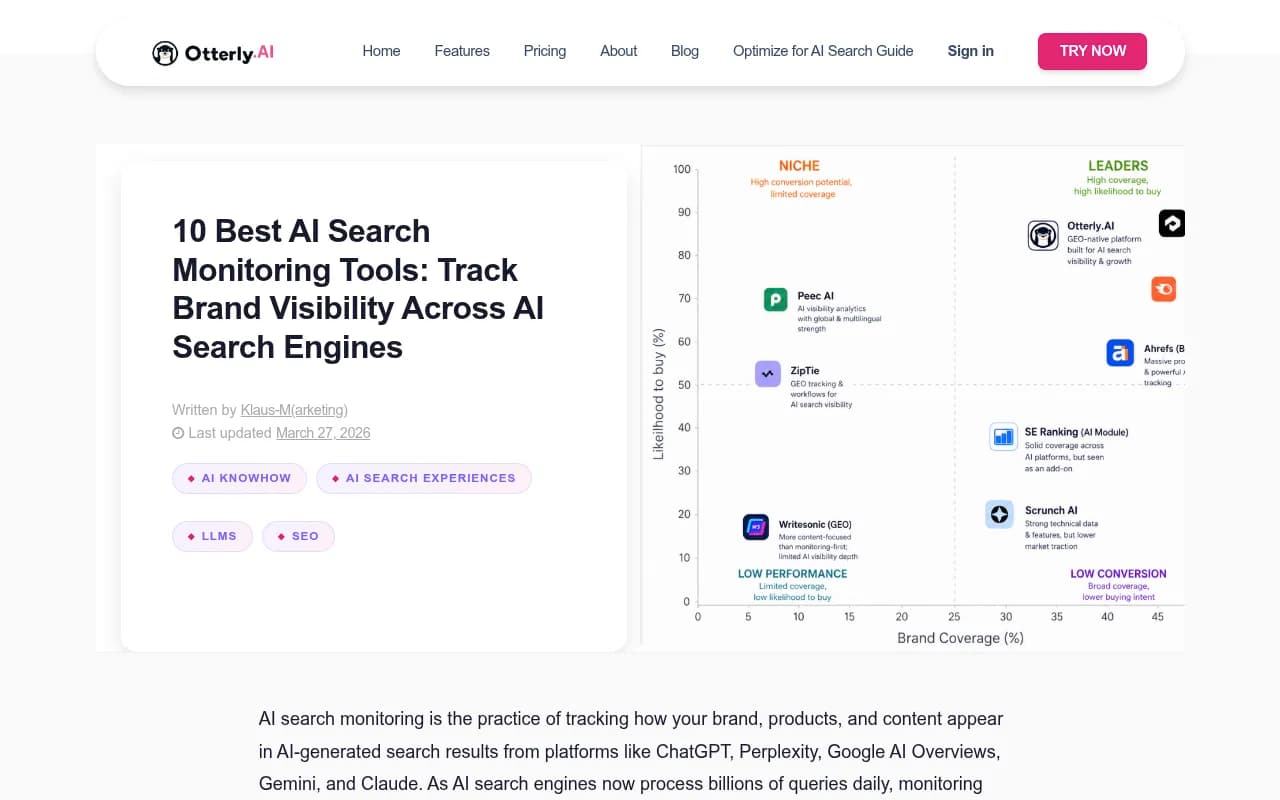
Searchable is a newer entrant that tries to bridge monitoring and content optimization. It tracks AI visibility and includes some content tooling, which puts it a step ahead of pure-monitoring tools like Otterly.AI and Peec AI.
The honest assessment is that it's a work in progress. The feature set is less mature than Promptwatch's, the citation database is smaller, and some of the more advanced capabilities (crawler logs, query fan-outs, ChatGPT Shopping tracking, Reddit and YouTube insights) aren't present. For teams with modest needs and a tight budget, it might be a reasonable starting point. For teams that need depth and reliability, the gaps become apparent quickly.
Feature comparison table
| Feature | Promptwatch | Otterly.AI | Peec AI | Searchable |
|---|---|---|---|---|
| AI models monitored | 10 (ChatGPT, Perplexity, Gemini, Claude, Grok, DeepSeek, Copilot, Meta AI, Google AI Overviews, Google AI Mode) | 5+ | 5+ | 4+ |
| Answer gap analysis | Yes | No | No | Partial |
| AI content generation | Yes (built-in writing agent) | No | No | Basic |
| Crawler logs | Yes | No | No | No |
| Prompt volume & difficulty scores | Yes | No | No | No |
| Query fan-outs | Yes | No | No | No |
| Reddit & YouTube insights | Yes | No | No | No |
| ChatGPT Shopping tracking | Yes | No | No | No |
| Traffic attribution | Yes (snippet, GSC, server logs) | No | No | No |
| Multi-language / multi-region | Yes | Limited | Yes | Limited |
| Competitor heatmaps | Yes | Basic | Basic | Basic |
| Page-level citation tracking | Yes | No | No | No |
| Looker Studio / API | Yes | No | No | No |
| Free trial | Yes | Yes | Yes | Yes |
| Starting price | $99/mo | Lower tier | Lower tier | Lower tier |
How they handle the core use cases
Tracking where you appear in AI answers
All four tools do this to some degree. Promptwatch and Otterly.AI have the most polished interfaces for it. Peec AI's multi-language support gives it an edge for international use cases. Searchable is functional but less refined.
The key difference at this layer is prompt depth. Promptwatch gives you volume estimates and difficulty scores for each prompt, which means you can prioritize. The others show you presence or absence without helping you understand which prompts are worth winning.
Understanding why you're not being cited
This is where the gap between Promptwatch and the rest becomes significant. Promptwatch's Answer Gap Analysis shows you the specific prompts where competitors appear and you don't, then surfaces the content gaps on your site that explain it. The crawler logs add another layer: you can see exactly which pages AI bots are reading and whether they're encountering errors.
Otterly.AI, Peec AI, and Searchable don't offer this kind of diagnostic depth. You can see that you're not appearing, but not why.
Creating content to fix the problem
Only Promptwatch has a built-in content generation workflow. The AI writing agent generates articles, listicles, and comparisons grounded in real citation data, targeting the specific prompts and personas where you need visibility. This isn't generic content generation -- it's specifically calibrated to get cited by AI models.
The other three tools require you to take the data elsewhere and figure out the content strategy yourself.
Connecting visibility to revenue
Traffic attribution is a feature most monitoring tools skip entirely, probably because it's technically harder to build. Promptwatch offers three methods: a JavaScript snippet, Google Search Console integration, or server log analysis. This lets you close the loop between "we appeared in more AI answers" and "here's the traffic and revenue that came from it."
None of the other three tools in this comparison offer this.
Who each tool is actually for
Picking the right tool depends a lot on where your team is in the AI visibility journey and what you need to do with the data.
Otterly.AI makes sense if you're just getting started and need a simple, affordable way to see whether your brand is appearing in AI answers. It's easy to set up, covers the major platforms, and won't overwhelm a small team. The ceiling is low, but the floor is accessible.
Peec AI is the right call if multi-language monitoring is a hard requirement. If you're managing an international brand or working across multiple markets, its regional and language support is genuinely useful. Just go in knowing you'll need separate tools for optimization.
Searchable is worth a look if you want something that tries to do more than pure monitoring but you're not ready to commit to a full platform. It's less proven than Promptwatch, but it's also less expensive and has some content tooling built in.
Promptwatch is the right choice if your team needs to show results, not just metrics. The full loop -- find gaps, generate content, track results -- is what makes it different. It's also the only platform here with crawler logs, ChatGPT Shopping tracking, Reddit and YouTube insights, and proper traffic attribution. The price reflects that, but so does the output.
A note on the "monitoring-only" trap
One thing worth naming directly: a lot of teams buy a monitoring tool, get a dashboard full of visibility scores, and then... don't know what to do next. The data is interesting, but it doesn't translate into action without significant manual work.
This is the core problem with monitoring-only platforms. They're good at showing you the problem. They're not built to help you solve it.
Promptwatch was designed specifically to avoid this. The Answer Gap Analysis, the AI writing agent, the page-level tracking, and the traffic attribution are all there to make the data actionable. You can see the gap, generate the content to close it, publish it, and then watch the visibility scores move. That feedback loop is what most teams actually need.
Pricing reality check
Pricing in this category varies a lot, and the sticker price doesn't always reflect the value. A $30/month monitoring tool that can't help you improve your rankings might cost more in staff time than a $249/month platform that does the heavy lifting.
Promptwatch's Professional plan at $249/month includes 2 sites, 150 prompts, 15 articles per month, crawler logs, and state/city tracking. For a marketing team that's actively trying to improve AI visibility, that's a reasonable cost-per-outcome.
Otterly.AI and Peec AI are cheaper at entry level, which makes them easier to justify for teams that just need to report on visibility without needing to improve it. Searchable sits in a similar range.
The honest framing: if your goal is to track AI visibility, any of these tools will work. If your goal is to improve it, Promptwatch is the only one in this comparison that gives you the tools to do that.
Bottom line
The AI visibility tool market in 2026 is full of dashboards that show you where you stand. What's rarer is a platform that helps you change where you stand.
Otterly.AI and Peec AI are reliable monitoring tools. They do what they say. If you need to track AI visibility without a big budget or a complex workflow, either one is a reasonable choice.
Searchable is trying to be more than a monitor, and it's worth watching, but it's not there yet in terms of depth or data scale.
Promptwatch is the only platform here that covers the full cycle: monitoring, gap analysis, content generation, and revenue attribution. For teams that are accountable for AI visibility as a performance metric, that difference matters.