Key takeaways
- Peec.ai is a solid monitoring tool with good accuracy and clean reporting, but it stops at data — there's no content generation, no crawler logs, and no traffic attribution.
- Searchable offers some content features but remains limited in scope, missing key capabilities like Reddit/YouTube tracking, prompt volume data, and AI crawler logs.
- Promptwatch is the only platform of the three that covers the full optimization loop: find gaps, create content, track results — plus crawler logs, ChatGPT Shopping tracking, and multi-model coverage across 10+ AI engines.
- If you're serious about improving AI visibility (not just measuring it), the difference between a monitoring tool and an optimization platform matters a lot.
- All three tools have free trials or entry-level pricing, so you can test before committing.
The AI search visibility category exploded in 2025. Dozens of platforms launched, all promising to show you where your brand appears in ChatGPT, Perplexity, Claude, and Google AI Overviews. Most of them do roughly the same thing: run prompts, check if your brand shows up, show you a dashboard.
The harder question is what happens after you see the data. You're invisible for a set of prompts your competitors dominate. Now what?
That's where the three platforms in this comparison diverge sharply. Peec.ai, Searchable, and Promptwatch all sit in the AI visibility space, but they're solving different problems. This guide breaks down exactly what each one does, where each one stops, and which one actually helps you move the needle.
What the "full optimization loop" actually means
Before diving into the tools, it's worth being precise about what "full optimization loop" means, because it's easy to conflate monitoring with optimization.
Monitoring tells you where you stand. Optimization changes where you stand.
A complete loop looks like this:
- Discover which prompts your competitors appear for that you don't (gap analysis)
- Understand why — what content they have that you're missing
- Create content specifically designed to get cited by AI models
- Track whether that content actually improves your visibility
- Connect visibility to real traffic and revenue
Most tools in this space handle step 4 reasonably well. Very few handle steps 1-3. Almost none handle step 5. That's the gap this comparison is really about.
Peec.ai: clean monitoring, limited action

Peec.ai has built a reputation for accuracy. The platform tracks your brand across ChatGPT, Perplexity, and Google AI Overviews at its base tier, with additional models available as paid add-ons ($30-$140/month depending on tier). It's used by agencies and small teams who want reliable visibility data without a lot of noise.
What Peec.ai does well
The reporting is genuinely clean. You get share of voice metrics, brand mention tracking, and competitor comparisons across the AI models it covers. The UI is straightforward enough that you don't need a dedicated analyst to interpret the data. For teams that just want to know "are we showing up?" on a weekly basis, it works.
Peec.ai also has decent multi-language support, which matters if you're tracking visibility across markets. And the $85/month starting price is accessible for smaller teams.
Where Peec.ai stops short
The core limitation is that Peec.ai is a reporting tool. It shows you data. It doesn't help you do anything with it.
There's no content gap analysis that tells you which specific topics or questions you're missing. There's no built-in content generation. There's no AI crawler log showing which pages the AI bots are actually reading on your site. There's no Reddit or YouTube tracking (both of which directly influence what AI models cite). And there's no traffic attribution connecting AI visibility to actual website visits or conversions.
A case study on Peec.ai's blog reported that one customer (Momentum) achieved roughly a 10x improvement in AI search visibility using the platform. But the mechanism for that improvement isn't the platform itself — it's the work the team did with the data. Peec.ai showed them the problem; they had to solve it elsewhere.
That's fine if you have the resources to act on raw data. It's a real limitation if you don't.
Searchable: a step further, but gaps remain
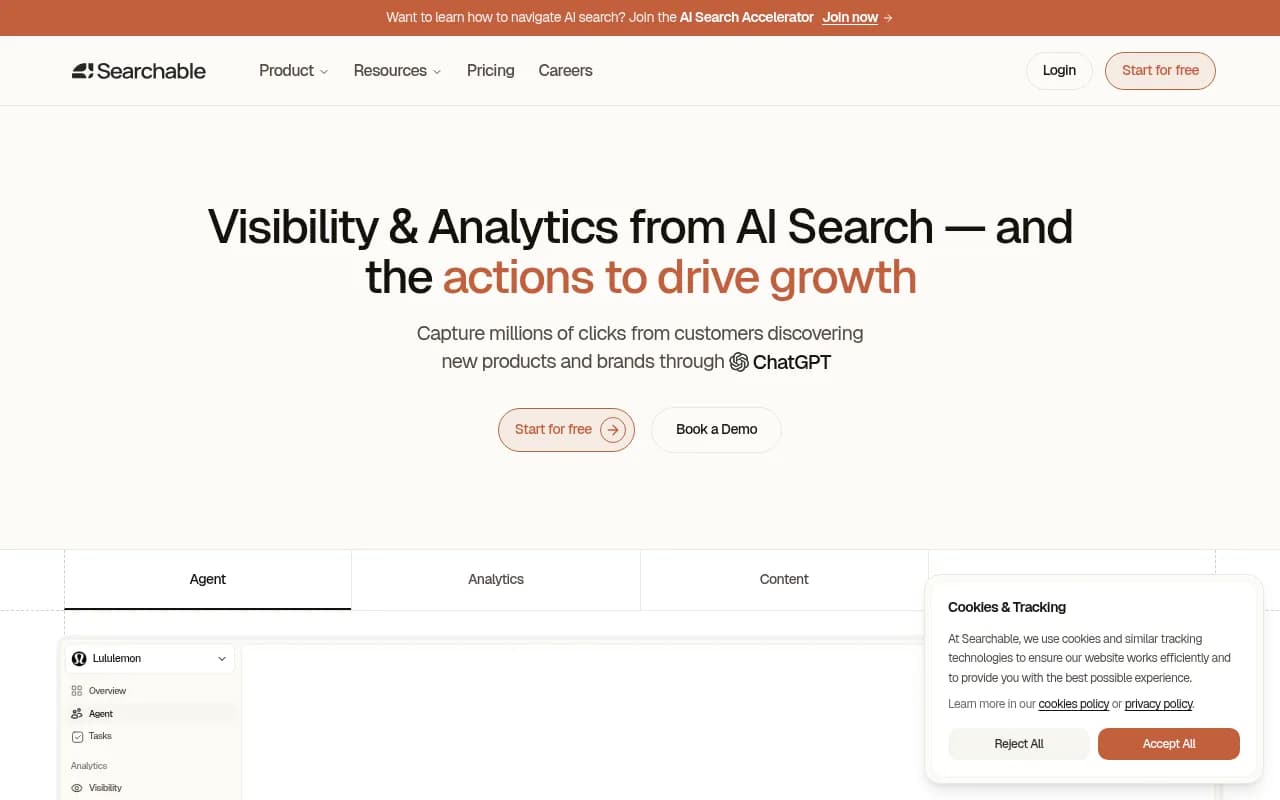
Searchable sits slightly further along the spectrum than Peec.ai. It has monitoring capabilities plus some content-oriented features, positioning itself as more than a pure tracker.
What Searchable does well
Searchable covers AI visibility monitoring with a cleaner onboarding experience than some competitors, and it includes some content optimization guidance. For teams that want a starting point for understanding what content changes might improve their AI presence, it offers more direction than a pure monitoring dashboard.
Where Searchable falls short
The content features in Searchable are limited compared to what a full optimization loop requires. There's no AI-native content generation grounded in citation data. Prompt volume and difficulty scoring — which tell you which prompts are actually worth targeting — aren't available. Reddit and YouTube tracking, which surface the discussions that directly shape AI recommendations, are absent.
Crawler log analysis (showing which AI bots visit your site, which pages they read, and what errors they hit) isn't part of the platform. Neither is ChatGPT Shopping tracking, which matters increasingly for e-commerce and product-focused brands. And traffic attribution — connecting AI visibility to real business outcomes — isn't there either.
Searchable is a better starting point than Peec.ai for teams that want some content direction, but it still leaves most of the optimization work to you.
Promptwatch: the full loop
Promptwatch is built around a fundamentally different premise: monitoring is only useful if it leads to action. The platform is structured around three phases that form a closed loop.

Phase 1: find the gaps
Promptwatch's Answer Gap Analysis shows you exactly which prompts your competitors appear for that you don't. Not just "you're invisible for X topic" — but the specific questions and angles that AI models are answering using competitor content instead of yours. You see what's missing from your site, not just that something is missing.
Prompt Intelligence adds volume estimates and difficulty scores to each prompt, so you can prioritize the gaps worth closing first. Query fan-outs show how a single prompt branches into related sub-queries, which helps you understand the full content territory around a topic.
Phase 2: create content that gets cited
This is where Promptwatch separates itself most clearly from monitoring-only tools. The built-in AI writing agent generates articles, listicles, and comparisons grounded in real citation data — over 880 million citations analyzed. It's not generic SEO content. It's content engineered to match the patterns AI models actually cite, informed by prompt volumes, competitor analysis, and persona targeting.
The Citation & Source Analysis feature shows which pages, Reddit threads, YouTube videos, and domains AI models are currently citing. That tells you where to publish and what format tends to work.
Phase 3: track the results
Page-level tracking shows exactly which of your pages are being cited, how often, and by which AI models. As you publish new content, you can watch your visibility scores change. The traffic attribution layer — available via a code snippet, Google Search Console integration, or server log analysis — connects AI visibility to actual website traffic and revenue.
Additional capabilities that matter
A few features Promptwatch has that neither Peec.ai nor Searchable offer:
- AI Crawler Logs: real-time logs of ChatGPT, Claude, Perplexity, and other AI crawlers hitting your site, including which pages they read and what errors they encounter
- Reddit & YouTube Insights: surface discussions that directly influence AI recommendations
- ChatGPT Shopping Tracking: monitor when your brand appears in ChatGPT's product recommendations
- Competitor Heatmaps: compare your AI visibility vs competitors across individual LLMs
- Multi-language & multi-region monitoring with customizable personas
Promptwatch tracks 10+ AI models: ChatGPT, Perplexity, Google AI Overviews, Google AI Mode, Claude, Gemini, Meta/Llama, DeepSeek, Grok, Mistral, and Copilot.
Head-to-head comparison
| Feature | Peec.ai | Searchable | Promptwatch |
|---|---|---|---|
| AI brand monitoring | Yes | Yes | Yes |
| Models covered | 3 base + add-ons | Limited | 10+ |
| Competitor visibility tracking | Yes | Yes | Yes |
| Answer gap analysis | No | Partial | Yes |
| Prompt volume & difficulty | No | No | Yes |
| Query fan-outs | No | No | Yes |
| AI content generation | No | Limited | Yes (built-in agent) |
| Citation-grounded content | No | No | Yes (880M+ citations) |
| AI crawler logs | No | No | Yes |
| Reddit & YouTube tracking | No | No | Yes |
| ChatGPT Shopping tracking | No | No | Yes |
| Traffic attribution | No | No | Yes |
| Page-level citation tracking | No | No | Yes |
| Multi-language support | Yes | Limited | Yes |
| Starting price | $85/mo | Custom | $99/mo |
Who should use which tool
The honest answer is that the right choice depends on what problem you're actually trying to solve.
If you want clean, reliable monitoring data and you have a separate content team that can act on it independently, Peec.ai is a reasonable choice at its price point. It does what it says. The limitation is that "what it says" is a fairly narrow thing.
If you want something slightly more action-oriented but aren't ready to invest in a full optimization platform, Searchable is worth evaluating. It won't close the full loop, but it moves in that direction.
If you want to actually improve your AI visibility — not just measure it — Promptwatch is the only platform of the three that gives you the tools to do that. The gap analysis tells you what to fix. The content generation helps you fix it. The tracking shows you whether it worked. That's a complete workflow, not a dashboard.
For marketing teams, SEO teams, and agencies that are serious about AI search as a channel, the difference between a monitoring tool and an optimization platform is the difference between knowing you have a problem and solving it.
Pricing overview
| Platform | Entry plan | What you get |
|---|---|---|
| Peec.ai | ~$85/mo | 3 AI models, brand monitoring, reporting |
| Searchable | Custom | Monitoring + limited content guidance |
| Promptwatch Essential | $99/mo | 1 site, 50 prompts, 5 articles/mo |
| Promptwatch Professional | $249/mo | 2 sites, 150 prompts, 15 articles, crawler logs, local tracking |
| Promptwatch Business | $579/mo | 5 sites, 350 prompts, 30 articles |
Promptwatch offers a free trial. Annual billing discounts are available across tiers.
The broader landscape
It's worth noting that Peec.ai and Searchable aren't uniquely limited — most tools in this category have the same monitoring-only problem. Otterly.AI, AthenaHQ, and Search Party all sit in similar positions: solid dashboards, limited action.
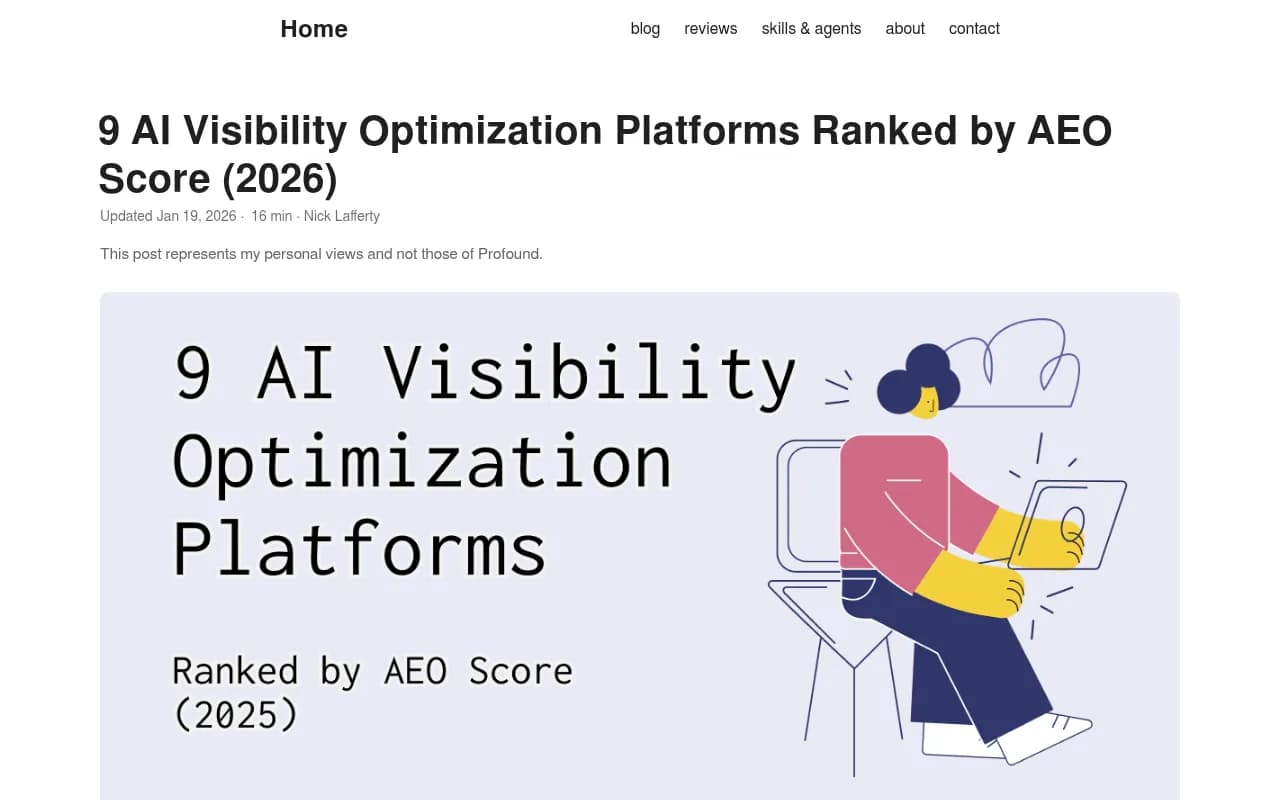
The platforms that go further — Profound at the enterprise end, Promptwatch across mid-market and agency use cases — are the ones that have built around the idea that data without action is just overhead.
For most teams evaluating this category in 2026, the right question isn't "which tool has the best dashboard?" It's "which tool helps me actually show up more in AI answers?" Those are different questions, and they lead to different tools.
Bottom line
Peec.ai is a good monitoring tool. Searchable is a step further. But if the goal is to improve your brand's visibility in AI search — not just observe it — neither platform covers the full optimization loop that the category now requires.
Promptwatch is the only platform of the three that takes you from gap identification through content creation to result tracking, with crawler logs and traffic attribution closing the loop on real business impact. For teams that want to treat AI search as a channel worth optimizing, that's a meaningful difference.