Key takeaways
- National AI visibility is about whether a brand gets cited or recommended at all when someone asks an unbranded or comparison question. Local AI visibility is about whether a specific address gets recommended when someone wants to walk in the door today.
- SOCi's 2026 Local Visibility Index found ChatGPT recommended just 1.2% of analyzed brand locations, Gemini 11%, and Perplexity 7.4%, compared to an average 35.9% appearance rate in Google's local 3-pack. AI local visibility is measured as 3 to 30 times harder to win than traditional local search.
- A strong national brand doesn't carry weaker locations. SOCi found only 45% overlap between the top 20 retail brands by traditional local search visibility and the top 20 brands AI assistants actually recommend.
- AI treats review ratings as a hard filter rather than a ranking factor. Average star ratings of AI-recommended locations run higher than what shows up in a typical local pack, so a mediocre location can get excluded entirely rather than just ranked lower.
- The two problems need different fixes: national visibility runs on earned media, entity clarity, and being cited across a wide set of credible domains; local visibility runs on structured, accurate, consistent data at the individual location level.
Two different questions, two different scoreboards
Here's the thing that trips up most multi-location brands when they start worrying about AI search: they assume "brand visibility" is one metric. It isn't. When someone asks ChatGPT "is [Brand] a good company" or "best running shoe brands 2026," that's a national brand visibility question. When someone asks Gemini "best coffee shop near me open now," that's a local store visibility question, and it has almost nothing to do with the brand's national reputation.
These are evaluated by different mechanisms inside the AI model, pull from different data sources, and get solved with different tactics. Treat them as one problem and you'll end up optimizing the wrong thing, usually the national brand story, while individual stores stay invisible.
What national brand visibility actually measures
National visibility in AI search is about whether your brand shows up, and how it's framed, when someone asks a category question without naming you, or asks to compare you against competitors. This is the realm of "best X for Y," "X vs Y," and "is X worth it."
Promptwatch's analysis of ChatGPT responses found that unbranded (organic) prompts produce the most crowded answers: 52.5% cite ten or more different domains, and 71.8% cite at least eight. Promptwatch's data on unique domains per response also shows competitor-comparison prompts behave almost the same way, with 49.1% citing ten-plus domains. If you're trying to win a national category question, you're competing against a wide field of sources, not just your direct competitors' homepages.
Brand-named prompts work differently. Only 21.3% of them cite ten or more domains, and five domains is the single most common count. That matters: once someone names your brand directly, the AI narrows its source set, and each source that appears carries disproportionate weight. A single negative review roundup or outdated Wikipedia line can dominate the answer when there are only five sources to begin with.
National visibility also depends on domain authority, but maybe not in the way people assume. Promptwatch's domain-rank data for August 2026 found mid-authority sites in the DR 46-75 range captured roughly 46% of ChatGPT's citations, while the very top tier (DR 91-100) fell from about 7% in week one of the month to roughly 3% by mid-August and stayed there. Earned placements in the DR 61-90 range are a more realistic target for brand PR than chasing the handful of DR 90+ sites everyone else is also fighting for.
The tactics that move the needle on national brand visibility look a lot like classic PR and content strategy with an AI lens: get cited on a wide spread of credible, mid-authority domains, keep an entity-clear homepage and About page, build expert bios and author credentials, and earn third-party mentions that aren't under your direct control. None of this is about any one store location. It's about the brand as a single entity.
What local store visibility actually measures
Local visibility is a completely different animal, and the numbers make that obvious. SOCi's 2026 Local Visibility Index analyzed thousands of multi-location brands and hundreds of thousands of individual locations and found that AI assistants recommend a tiny fraction of the locations that show up in traditional local search. ChatGPT recommended just 1.2% of brand locations analyzed. Gemini recommended 11%. Perplexity recommended 7.4%. Compare that to the 35.9% average appearance rate those same brands got in Google's local 3-pack, and you get SOCi's framing that AI local visibility is 3 to 30 times harder to achieve than traditional local search visibility.
That gap alone tells you something important: a brand showing up reliably in Google Maps results is not a predictor of showing up in an AI assistant's local recommendation. SOCi's retail analysis backs this up directly, finding only 45% overlap between the top 20 brands by traditional local search visibility and the top 20 brands AI actually recommended. Some brands, like Sam's Club and Aldi, outperformed their Google local ranking in AI recommendations. Others, including Target and Batteries Plus Bulbs, underperformed relative to where their Google rankings would predict.
Why the disconnect? A few mechanics explain most of it.
AI scores each location independently, not the brand
Traditional local search ranks individual locations on relevance, distance, and prominence, roughly 35%, 35%, and 30% respectively by Google's own weighting. AI assistants rely on the same underlying signals, structured data, review sentiment, consistency across directories, but they evaluate each address on its own. A strong brand name does nothing to rescue a location with a stale Google Business Profile, wrong hours, or no local landing page. If a store doesn't have its own page with its own address, hours, and services, AI models have nothing specific to point to, and they often fall back to a generic brand homepage that proves nothing about that particular address.
Review ratings act as a gate, not a tiebreaker
This is one of the more striking findings in SOCi's research. In a traditional local pack, a 3.5-star business can still rank if it's close and relevant. In AI recommendations, that same business often gets excluded outright. The average star rating of AI-recommended locations was 4.3 on ChatGPT, 4.1 on Perplexity, and 3.9 on Gemini. AI models appear to treat reviews as a pass/fail filter rather than a ranking input, which means a handful of weak-performing locations in an otherwise strong chain can simply disappear from AI answers while still showing up fine in Google Maps.
Data accuracy varies wildly by platform
SOCi also found business profile information was only about 68% accurate when surfaced by ChatGPT and Perplexity, compared to 100% accuracy on Gemini, which pulls directly from Google Maps data. That's a meaningful split: if your brand relies on ChatGPT or Perplexity for a chunk of discovery traffic, you're exposed to whatever stale or scraped data those models picked up somewhere, with no guarantee it matches your actual Google Business Profile.
A single bad location can drag down trust in the whole brand
Because AI answers often skip the click-through entirely, giving a direct answer instead of a list of links, inaccurate or inconsistent location data becomes the customer's actual experience. There's no website visit where the customer could catch the error themselves. One outdated listing can introduce doubt about the whole chain, not just that one store.
The entity distinction that explains most of this
A useful mental model: your homepage defines the brand entity. Each location page defines its own place-based entity. These need separate, specific schema markup, using narrower LocalBusiness subtypes like Restaurant, Dentist, or Attorney rather than the generic LocalBusiness type, so AI systems can disambiguate when they're reconciling your website against real-world facts like Google Business Profile and Apple Business Connect listings.
The core fields worth auditing at the location level are name, address, phone, hours, geo coordinates, areaServed for service-area businesses, and sameAs links back to your Google Business Profile and other verified profiles. These need to match exactly across every platform. A phone number that's one digit off between your website and your Google listing creates what local SEO practitioners call entity confusion, and AI models don't resolve that confusion in your favor. They just drop the ambiguous location from the answer.
National vs. local AI visibility, side by side
| Dimension | National brand visibility | Local store visibility |
|---|---|---|
| What's being evaluated | The brand as a single entity | Each individual location, separately |
| Typical prompt | "Best running shoe brands," "X vs Y" | "Coffee shop near me open now" |
| Primary signals | Earned media, entity clarity, citation breadth across mid-authority domains | GBP/NAP accuracy, review sentiment and volume, local schema, structured data consistency |
| AI recommendation rate (SOCi 2026) | Not directly comparable; measured via citation share | ChatGPT 1.2%, Gemini 11%, Perplexity 7.4%, vs. 35.9% in Google's local 3-pack |
| How reviews function | One input among many | A hard filter; AI-recommended locations average 3.9-4.3 stars |
| Who owns the fix | Brand/PR/content team | Local SEO/ops team, per location |
| Risk of one weak unit | Diluted brand narrative | A single location can undercut trust in the whole chain |
Why brand growth doesn't lift every location
It's worth saying plainly: local search does not rank brands, it ranks locations. Growing national brand awareness, landing press coverage, improving your Wikipedia entry, none of that automatically improves how an individual franchise location performs in a "near me" AI query. The two systems run on different inputs. This is the opposite of what most marketing teams assume, and it's why national PR wins often get celebrated internally while foot traffic at specific underperforming locations stays flat.
The flip side is also true and more encouraging: local SEO teams already have a head start on AI visibility, because the structured data they've been maintaining for years, categories, attributes, hours, coordinates, reviews, is exactly the format AI systems need to make a confident local recommendation. If your local data hygiene has been solid, you may be closer to AI-ready than your national content team.
What this looks like in practice
Culver's, cited in SOCi's industry breakdowns, hit a 30.0% AI recommendation rate on ChatGPT and 45.8% on Gemini for its restaurant locations, driven by consistently strong ratings and complete profiles. Liberty Tax reached 68.3% visibility in Google's local 3-pack and was recommended 19.2% of the time on Gemini and 26.9% on Perplexity after cleaning up profile coverage and accuracy. Compare that to underperforming financial services brands averaging around 3.4 stars with under 5% review response rates, described in the same research as effectively invisible in AI local recommendations. The pattern holds across industries: review quality and data completeness at the location level predict AI visibility far better than brand size or national marketing spend.
Tools for each side of the problem
For national brand visibility, monitoring how your brand gets cited and framed across ChatGPT, Gemini, Perplexity, and Google AI Overviews is the starting point. Promptwatch tracks prompt-level citation data, query fan-outs, and content gaps across these engines, and its Content Agents can help close the gap once you've found it by drafting and publishing GEO-optimized content.

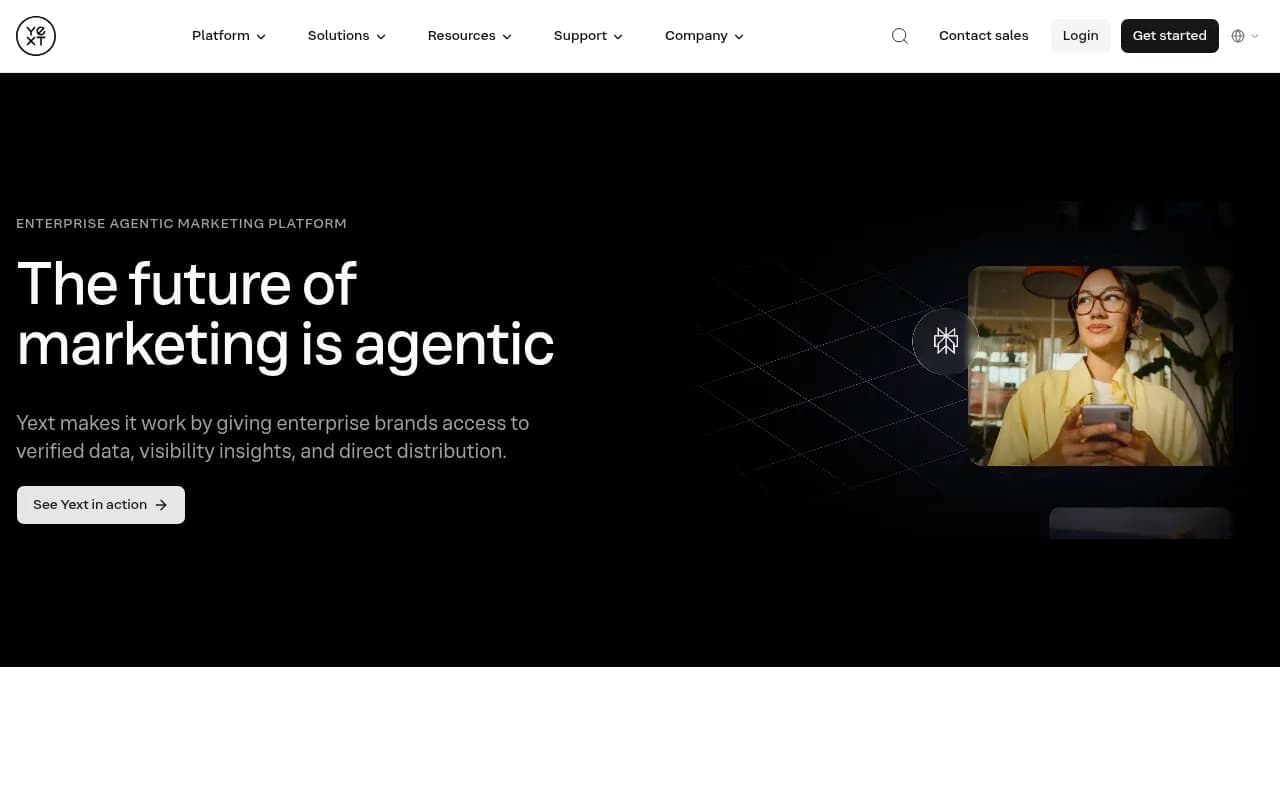
For multi-location local visibility specifically, the tooling looks different because the unit of measurement is the individual address, not the brand. Yext Scout is built around benchmarking each location's AI citation performance against local competitors, drawing on what it describes as 20 million monthly AI citations across 12 million locations.
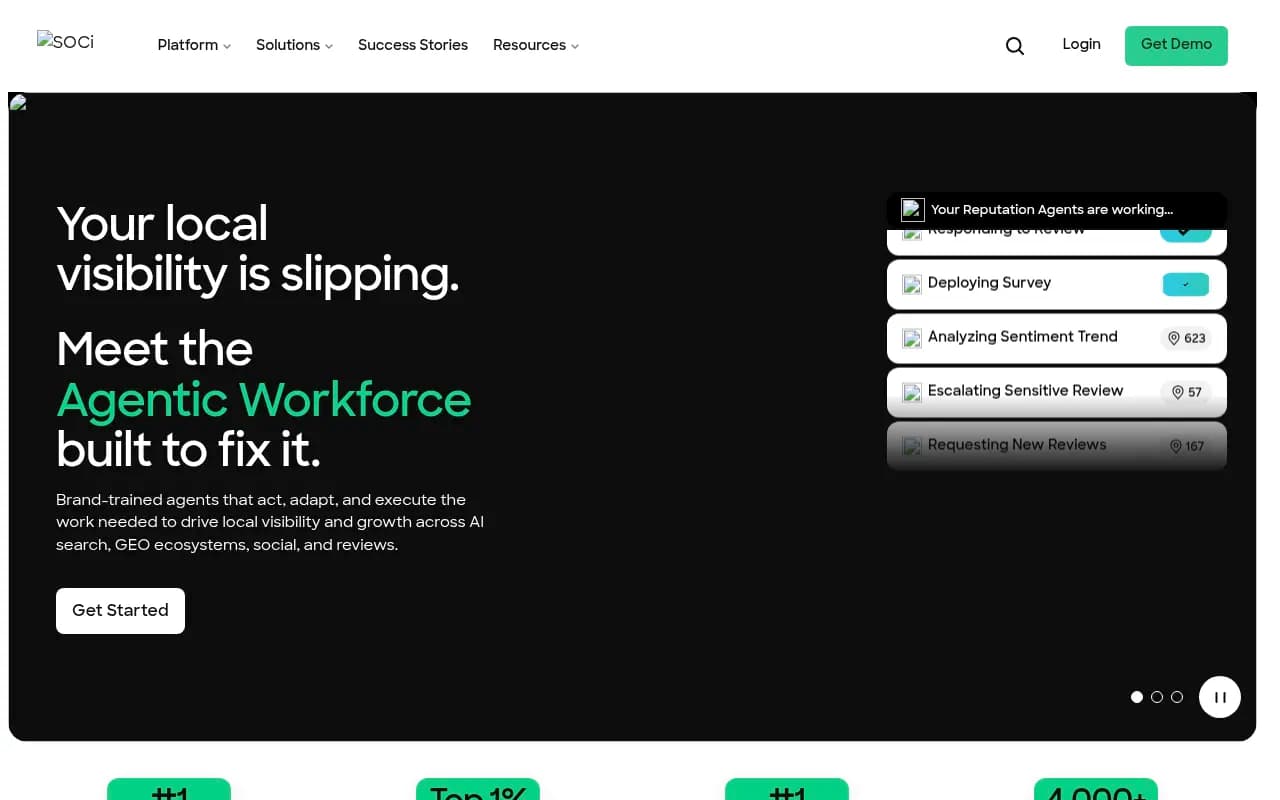
SOCi positions itself less as an audit tool and more as an execution layer for multi-location brands, running local search, social, and review management across hundreds or thousands of locations at once through its Genius Local Search Agent.
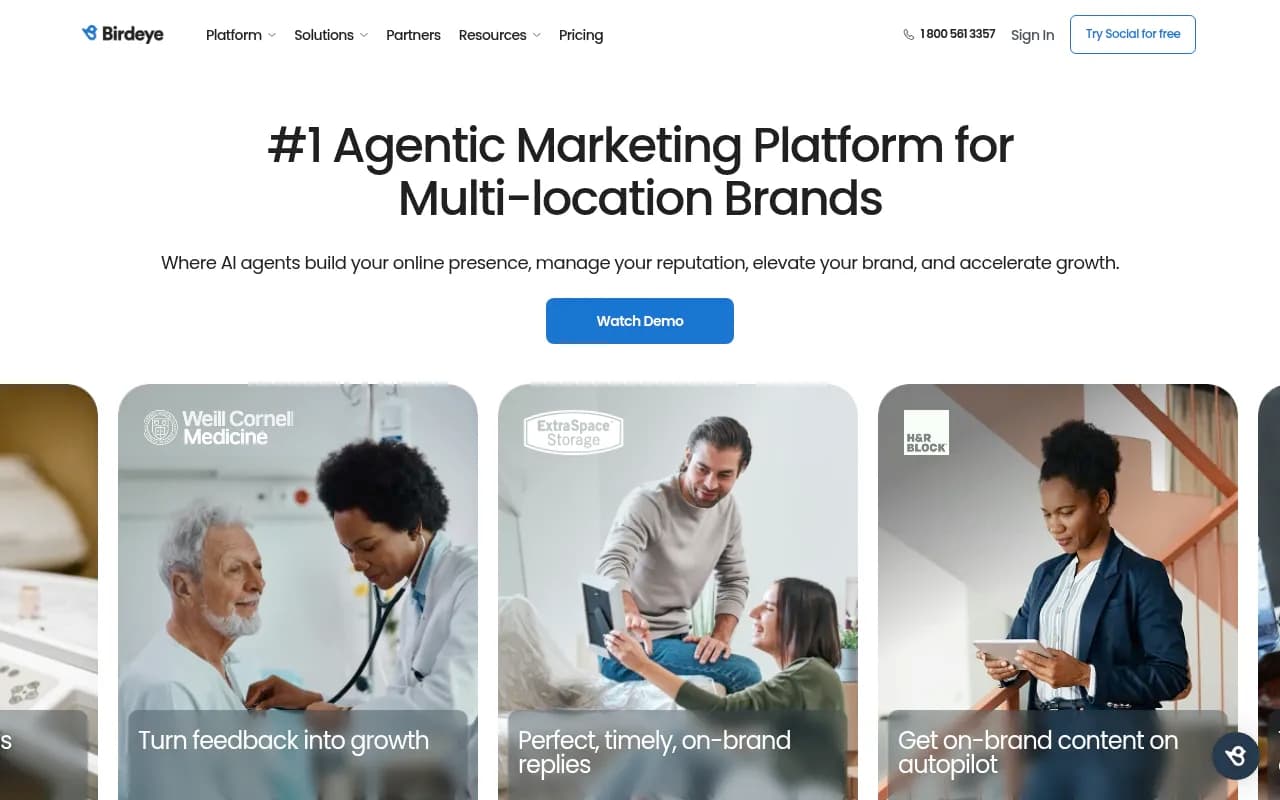
Birdeye's Search AI feature monitors how specific locations appear in ChatGPT, Gemini, and Perplexity, and flags citation gaps or data inconsistencies per site.
If you want to compare more AI visibility platforms before picking one, the directory at bestgeosoftware.com is a reasonable place to see how the broader field stacks up.
Practical checklist for multi-location brands
If you're running a brand with more than a handful of locations, these are the things worth checking in order:
- Audit NAP (name, address, phone) consistency across your website, Google Business Profile, Bing Places, Apple Business Connect, and major directories. Any mismatch creates entity confusion.
- Give every location its own page with LocalBusiness schema using the most specific subtype available, not a generic brand page.
- Treat review response rate as an operational KPI per location, not just a reputation metric. AI models appear to filter out low-rated or unresponsive locations entirely.
- Don't assume national press wins translate to local recommendation rates. Measure the two separately.
- If a location consistently underperforms, fix or close it rather than letting it drag on brand-wide trust in AI answers.
The bottom line
National AI visibility and local store visibility are measured by different mechanisms, solved by different teams, and improved with different tactics. A great national brand reputation buys you nothing at the individual store level if that store's Google Business Profile is stale or its reviews are weak. Conversely, a chain with excellent per-location data hygiene can outperform bigger, more famous competitors in AI local recommendations, the way Sam's Club and Aldi did against brands with stronger Google local pack presence. Treat them as one job and you'll likely win neither.