Key takeaways
- Birdeye and Promptwatch solve different problems: Birdeye manages reviews, listings, and local pages across hundreds of locations; Promptwatch tracks and improves how your brand shows up in AI answers across every major model.
- Birdeye now has an AI Search module bolted onto its core reputation suite, but it's priced per location (quote-only, benchmarked around $299-$449+/location/month) and built for multi-location enterprises, not for cross-engine prompt-level analytics.
- Promptwatch covers ChatGPT, Gemini, Claude, Perplexity, Grok, AI Overviews, and AI Mode with transparent pricing from $95/month, plus crawler logs, content agents, and a content-gap-to-publish workflow that Birdeye doesn't offer.
- Promptwatch's own data shows reviews jump from 1.7% to 5.6% of ChatGPT citation share on branded prompts, meaning Birdeye's review-management engine feeds exactly the signal AI models weight once someone names your brand.
- If you're a single-location business or SaaS company worried about AI citations, Promptwatch alone probably covers it. If you're a multi-location brand juggling thousands of Google Business Profiles and need both reputation ops and AI visibility, you likely need both, or at least need to budget for both.
Why this comparison even exists
I get why people keep putting these two in the same sentence. Both companies talk about "AI search visibility," both publish reports with the phrase "get cited," and both now have an AI-facing feature that sounds, from a distance, like the same thing. It isn't.
Birdeye started as a reputation and customer experience platform. Its bread and butter is review generation, review response, listings management, and local page content across potentially thousands of locations. Somewhere in 2025 it noticed, correctly, that AI answer engines use review signals and business-profile consistency to decide who gets recommended, so it built Birdeye Search AI (also called Birdeye AI Search) on top of its existing reputation stack.
Promptwatch started from the opposite direction. It was built from day one to track what ChatGPT, Gemini, Claude, Perplexity, and the rest actually say about a brand, then to close the loop with content that fixes the gaps. It has no review-collection workflow and doesn't manage your Google Business Profile.
So really the question isn't "which is better." It's "which job are you trying to get done, and does your business even have the kind of job Birdeye is built for."
What Birdeye actually does
Birdeye's core product is reputation management at scale. The feature set includes:
- Review Generation Agent that triggers SMS/email review requests off CRM or POS events
- Review Response Agent that drafts sentiment-aware, on-brand replies (with multi-language support)
- Review Reporting Agent that surfaces trends and recurring issues across locations
- Listings management across 200+ sites from a single dashboard
- Birdeye Search AI, an "accuracy audit" layer that checks whether AI engines are surfacing correct business details (hours, address, pricing, services), traces where that information came from, and flags gaps or outright hallucinations
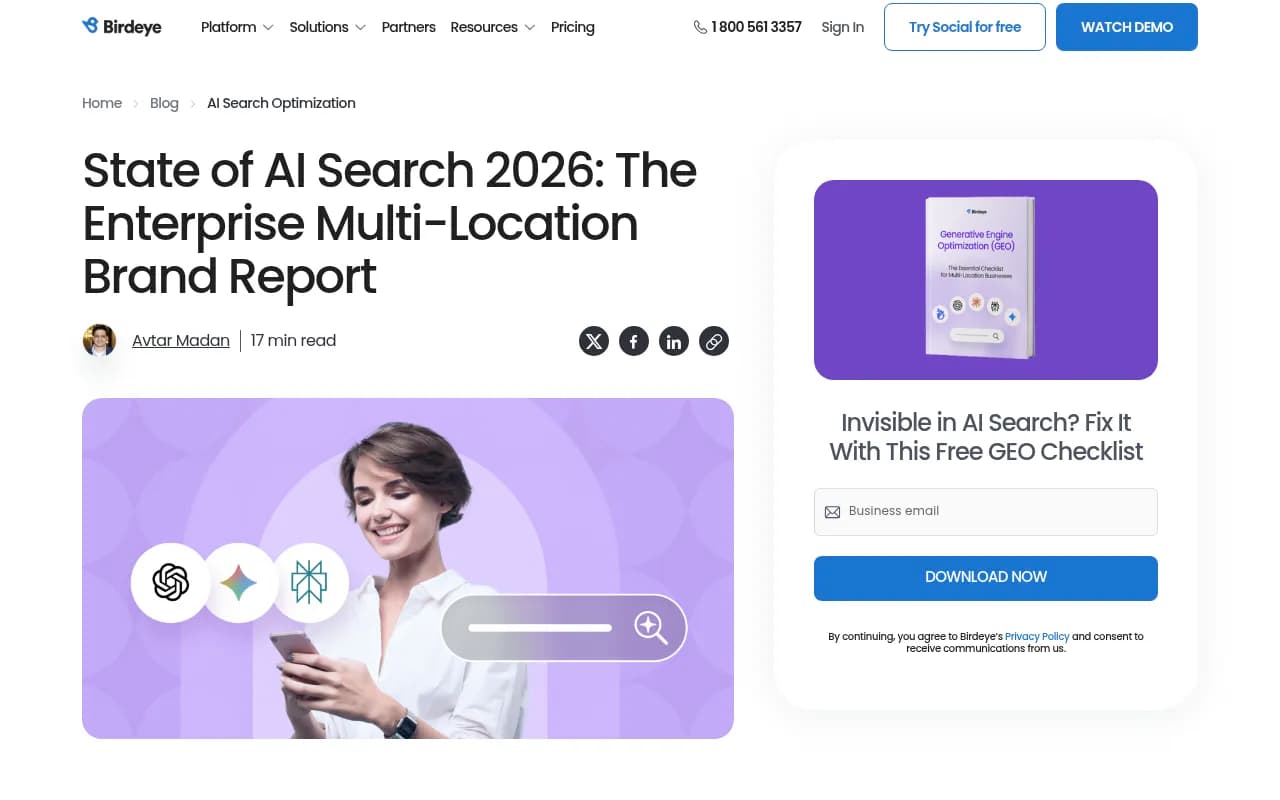
Birdeye's own State of AI Search 2026 report makes its pitch pretty directly: 80% of brands get cited at least once in AI answers, but only 15% hold the top citation spot with their own domain. For multi-location brands, every location gets evaluated independently by AI engines, so inconsistency multiplies fast across a few hundred stores.
That's a real problem, and Birdeye is set up to fix it for exactly the kind of business that has it: Sutter Health, Aspen Dental, Six Flags, Cracker Barrel, Jiffy Lube. These are brands with hundreds or thousands of locations where review volume, NAP consistency, and local-page accuracy genuinely move the needle.
On G2, Birdeye holds a 4.7/5 across 4,000+ reviews and ranks #1 in several reputation-management categories. A case study cited on its own blog claims Moss & Company, a 300+ location operator, saw a 62% increase in new reviews and 141% more reviews responded to after rolling out Birdeye Reviews. That's a legitimate, measurable win, just not an AI-visibility win in the way Promptwatch measures it.
The tradeoffs show up in the complaints too. Pricing is quote-only and benchmarked by third parties at roughly $299-$449+ per location per month, which adds up fast for anything beyond a handful of sites. Reviewers on G2 have flagged that AI response personalization has a ceiling (it doesn't always map specific business facts into recurring review themes well), and one reviewer called Birdeye's Listings AI suggestions "about 85% ineffective" when their business type didn't match Birdeye's templates. It's also a lot of platform, webchat, social scheduling, and surveys bundled in, for a business that might only want reviews fixed.
What Promptwatch actually does
Promptwatch tracks how a brand appears across ChatGPT, Gemini, Claude, Perplexity, Grok, Meta Llama, DeepSeek, Microsoft Copilot, Google AI Overviews, and AI Mode, using real prompts run against the actual user interfaces, not just API samples. Then it goes further than most monitoring tools by turning that data into action.

The stack includes prompt tracking with volume and difficulty scoring, citation analytics broken down by content type and domain, AI crawler logs (Agent Analytics) that show exactly when ChatGPTBot, ClaudeBot, PerplexityBot, and 400+ other bots hit your pages, visitor analytics that tie AI traffic to actual conversions, and Content Agents that write and publish GEO-optimized articles straight to your CMS. There's also Agent Chat for querying your own visibility data conversationally, and Unified Actions, a prioritized to-do list generated from your citation and crawler data.
It's used by 1,840+ brands and agencies, growing by 150+ a month, and sits at 4.7/5 on G2. Customers span Duolingo, Yelp, Typeform, Fireflies, Rabobank, ABN AMRO, and agencies like Monks (whose clients include Netflix and BMW). Pricing is public and transparent: a free Explore tier, Essential at $95/month, Professional at $245/month (the plan most teams land on), Business at $579/month, and custom enterprise and agency tiers.
Where Birdeye audits business facts against AI answers, Promptwatch audits content, citations, and crawler behavior against AI answers, then writes the content that fixes the gaps. One independent reviewer who tested it put it simply: "If you want crawler log analysis, built-in visitor analytics, and a solid content optimization workflow all in one platform, Promptwatch delivers."
The data point that actually connects the two
Here's the part that makes this comparison worth more than a feature checklist. Promptwatch's own citation-type data shows that reviews, as a content type, account for just 1.7% of all ChatGPT citations overall. But narrow that down to branded prompts, someone literally naming your company, and reviews jump to 5.6% of citations, more than three times their baseline share. Product and landing pages still dominate branded citations at roughly 46% combined, but FAQ pages and social posts also punch above their overall weight once a brand is named by name.
That's a concrete reason Birdeye's core function, generating and managing reviews, actually does feed into AI visibility, at least for the subset of queries where someone is asking about you specifically rather than comparing categories broadly. It also explains why Birdeye's pivot into "Search AI" makes strategic sense: the review infrastructure it already owns is one of the inputs the AI engines weight more heavily on brand-name queries.
It's worth noting Promptwatch's data also shows ChatGPT has all but stopped citing Reddit and other social platforms (combined social citations fell to 0.46% of all citations in the first week of October 2026, down from 5.8% previously, per Promptwatch's social media citation data). Google AI Overviews still leans on social heavily, about 12.2% of citations, led by YouTube. So review platforms and listicles matter more for ChatGPT visibility than raw social chatter, while Google's AI surfaces are a different story.
Side-by-side comparison
| Birdeye | Promptwatch | |
|---|---|---|
| Core job | Review generation, response, and listings management | AI search visibility tracking and content optimization |
| AI monitoring scope | Accuracy audit of business facts in AI answers, tied to its own trust-signal data | Full prompt, citation, and crawler tracking across ChatGPT, Gemini, Claude, Perplexity, Grok, AI Overviews, AI Mode, and more |
| Pricing model | Quote-only, per location, benchmarked $299-$449+/location/month | Published tiers from free to $579/month, based on prompts and responses tracked |
| Content execution | Local page updates, listing fixes, review responses | Content Agents that write and publish full articles to your CMS, Unified Actions to-do list |
| Crawler-level data | Not published at this granularity | AI Agent Analytics logs 400+ bots including ChatGPTBot and ClaudeBot |
| Reddit/YouTube tracking | Not a focus | Dedicated citation reports for Reddit and YouTube |
| Best fit | Multi-location enterprises managing hundreds+ of locations | Any brand, single location or not, that needs to understand and improve AI citations across models |
| G2 rating | 4.7/5 (4,000+ reviews) | 4.7/5 |
So, do you need both?
Honestly, it depends on how many locations you're running and what's actually broken.
If you're a single-location business, a SaaS company, or an e-commerce brand with one website and no Google Business Profile sprawl, you probably don't need Birdeye at all. Your problem isn't review volume across 300 storefronts, it's whether ChatGPT and AI Overviews know you exist and cite you accurately. That's squarely Promptwatch's job, and it's a fraction of the cost.
If you're running hundreds or thousands of locations, Jiffy Lube, Orkin, a dental chain, a multi-state retailer, the math changes. You genuinely have a review-generation and listings-consistency problem that Birdeye is purpose-built to solve, and solving it will measurably improve your brand-prompt citation rate per the 5.6% stat above. But Birdeye's own AI Search module still won't tell you how you stack up against competitors on ChatGPT Search, won't show you crawler logs, won't track Reddit or YouTube citations, and won't write content for your blog based on a content-gap analysis against what AI engines are actually citing.
In practice, a lot of multi-location brands end up running both: Birdeye for the operational grind of reviews and listings, and Promptwatch (or something like it) for the cross-engine visibility picture and the content work that closes the gap. They're not redundant, they're upstream and downstream of each other. Reviews feed the signal; Promptwatch tells you if the signal is landing and helps you build the content that lands it better.
If you want to explore other options
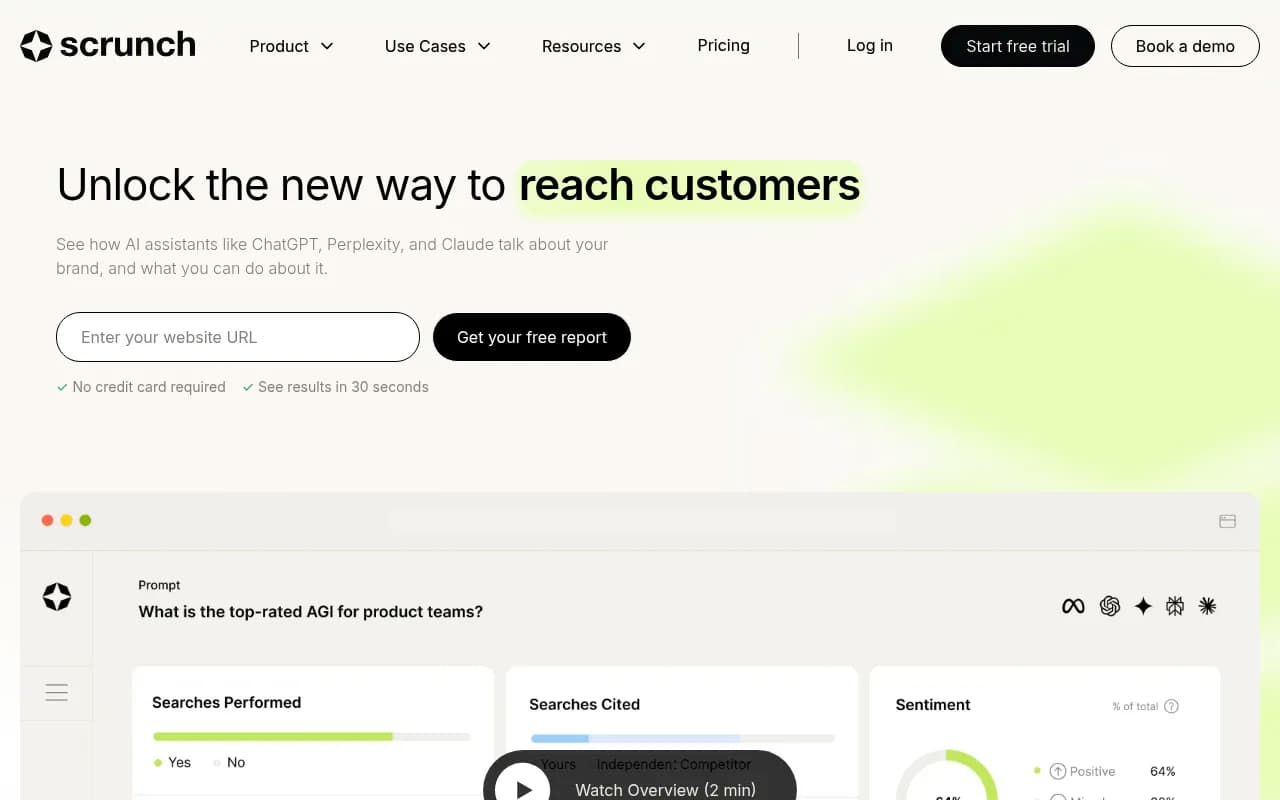
Birdeye and Promptwatch aren't the only players here. If you're comparing AI visibility tools specifically, Profound and Scrunch offer strong monitoring but lack Promptwatch's crawler logs, Reddit tracking, and content-generation layer. Otterly.AI and Peec AI are lighter, budget-friendly prompt trackers without the execution layer. For a broader side-by-side of 21 platforms, including Birdeye's own AI Search module, the GEO software directory at bestgeosoftware.com is a useful starting point, and Promptwatch's own comparison of 21 GEO and AI visibility platforms breaks down feature parity in more detail.



If your actual bottleneck is review volume and local-listing consistency rather than AI-answer tracking, it's worth looking at the category Birdeye competes in directly rather than assuming you need a GEO platform at all. But if AI citations, crawler behavior, or content gaps are the question keeping you up at night, start with a platform built for that from the ground up.