Key takeaways
- Most AI visibility tools track your brand as one entity. Multi-location brands need location-level tracking, because AI engines evaluate each address, each set of reviews, and each local listing independently.
- Birdeye Search AI and Yext Scout are the two platforms purpose-built for this problem, both pricing custom by location count and both connecting visibility data to execution (listings, reviews, content fixes).
- Yext's own research found 80% of AI citations with location context point to a website or listing, not a review site or forum, which tells you where to focus effort first.
- Mid-market brands with 10 to 100 locations often get more value from a focused GEO tracker paired with a local SEO tool than from an enterprise suite built for thousands of locations.
- Whichever platform you pick, the goal isn't just a visibility score. It's connecting that score to specific location pages, listings, or reviews you can actually go fix.
Why single-brand AI tracking breaks down for multi-location businesses
If you run one website for one business, a standard AI visibility tool works fine. Ask it "how does my brand show up in ChatGPT" and you get an answer that reflects reality.
But if you run 40 dental clinics, 200 bank branches, or a franchise with 2,000 locations, that question stops making sense. AI engines don't evaluate "Acme Dental" as a single entity. They evaluate the Acme Dental on Main Street in Austin separately from the one in a strip mall in Tulsa, because the prompts people actually type are local: "is the dentist near me open Saturdays," "best urgent care downtown," "is the Wells Fargo on 5th open right now."
Yext's research on this is worth citing directly. Across 155.5 million AI citations and 1,623 brands analyzed in Q1 2026, when location context was present in the query, 80% of citations pointed to a website or listing, the two things a brand fully controls, outpacing Wikipedia by nearly 6 to 1. That's a meaningfully different picture than brand-level AI visibility research, where third-party sources like Reddit and news sites play a bigger role. For location queries, your own data is what AI engines lean on, which also means your own data is what breaks visibility when it's wrong.
The practical consequence: a tool that gives you one national "AI visibility score" is nearly useless if location #47 has a wrong phone number on three directories and location #12 has stale hours listed on its Google profile. You need the score broken out location by location, and ideally a way to act on what's broken without manually checking a few thousand listings.
What to look for in a multi-location AI visibility tool
Before comparing specific platforms, here's what actually matters at scale:
- Location-level scoring, not just a brand-wide number. You want to see which of your 500 locations are invisible in AI answers and why, not an average that hides the worst performers.
- Coverage of the engines people actually use for local queries: ChatGPT, Gemini, Perplexity, Google AI Overviews, Google AI Mode, and increasingly Claude and Grok.
- A connection between the visibility score and the underlying cause, whether that's a listing inconsistency, a thin review profile, or a missing local landing page.
- Some way to act on findings at scale. Checking and fixing a thousand locations by hand isn't realistic, so execution workflows (even semi-automated ones) matter more here than in single-brand tools.
- Review and reputation signals included, since Yext's research found reviews and social make up a disproportionate share of citations for Anthropic's Claude (7.5x OpenAI's share) and matter heavily in healthcare and food service verticals specifically.
Birdeye Search AI
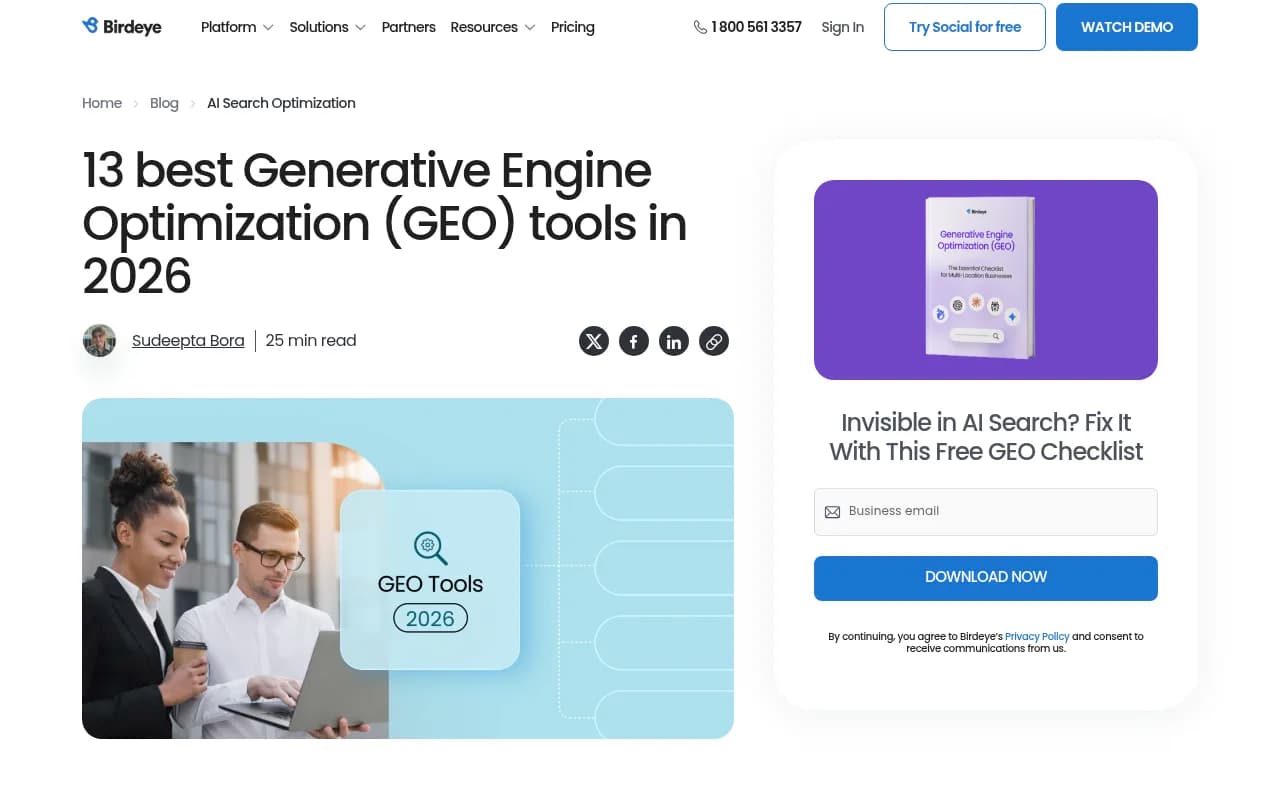
Birdeye built Search AI specifically for brands running 100 to 10,000+ locations. It tracks visibility across ChatGPT, Gemini, Perplexity, Google AI Overviews, Google AI Mode, Claude, and Grok, and it gives every individual location its own AI Visibility Score from 0 to 100, not just the parent brand.
What makes this different from a generic tracker is the diagnostic layer. Birdeye's citation intelligence shows which AI crawlers actually visited a given location's pages, so you can see why location A is getting cited and location B isn't, instead of guessing. It then routes that insight to what Birdeye calls AI coworkers, Jay for marketing, Robin for operations, Myna for customer experience, which act on the findings across listings, reviews, and content with human approval built in.
The healthcare case study is the clearest proof point here. Sutter Health, with 4,000+ practices and providers, reached an 81% Birdeye AI Visibility Score while generating 35.4K new Google reviews and a 120% increase in monthly review volume over four months, using Birdeye's listings management and review workflows alongside the AI visibility monitoring. That's a useful data point if you're trying to estimate what's achievable at genuine enterprise scale.
Pricing is entirely custom, based on the number of locations, which LLMs you want tracked, and how many queries you're monitoring. There's no published price list, which is standard for this tier of enterprise tool but makes it hard to compare on a spreadsheet before a sales call. Birdeye does offer a free AI Visibility Checker as a lower-commitment starting point. On G2, Birdeye holds a 4.7/5 rating from over 4,100 reviews as of mid-2026, with the bulk of reviewers managing 10 to 450+ locations.
Yext Scout
Yext's answer to the same problem is Scout, part of its broader digital presence platform. The standout feature, according to Zapier's hands-on review, is a map view showing visibility as colored hexagons across your locations, so you can spot at a glance which branches are underperforming in high-intent AI searches.
Scout tracks four distinct query types that matter for multi-location brands: branded-objective ("is the downtown branch open Sundays"), branded-subjective ("is the downtown branch any good"), unbranded-objective ("what banks near me are open Saturdays"), and unbranded-subjective ("best bank downtown"). Yext argues, reasonably, that most brands lose visibility on the unbranded queries because they're not optimizing for them at all, just assuming their brand name alone will surface.
Scout benchmarks you against your 20 closest competitors per scan and includes sentiment analysis and citation tracking, showing which sources AI answers pull from. The catch is that Scout's recommended actions route through the rest of the Yext platform, meaning you need to be using Yext's broader listings and publisher distribution tools to get full value. If you just want a standalone tracker, that's a limitation worth weighing.
Third-party pricing estimates put Yext Scout at roughly $199/month as an entry point, though actual enterprise deals for listings and multi-product bundles commonly run $500-$2,500 per location annually depending on scale and modules, according to Vendr's marketplace data. Yext doesn't publish a price list, so get a real quote before assuming either number applies to your situation.
Yext's own citation research is genuinely useful regardless of which tool you pick. An earlier study of 6.8 million citations found 86% came from brand-controlled sources: 44% websites, 42% listings, 8% reviews and social, with Reddit and forums making up just 2% once location and intent were factored in. That's a strong argument for prioritizing your own website and listing accuracy over chasing third-party mentions.
How Birdeye and Yext compare against general GEO platforms
The broader GEO and AI visibility market (Profound, Rankscale, Peec.ai, ZipTie, and dozens of others) is mostly built for single-brand tracking. A few, like ZipTie, have added multi-region support across a handful of markets, but "region" and "individual location" are different problems. None of the general-purpose platforms break visibility down to the individual-store level the way Birdeye and Yext do.
| Platform | Location-level scoring | Engines tracked | Execution workflows | Pricing model |
|---|---|---|---|---|
| Birdeye Search AI | Yes, 0-100 score per location | ChatGPT, Gemini, Perplexity, AI Overviews, AI Mode, Claude, Grok | AI coworkers act on listings, reviews, content | Custom, by locations/queries/LLMs |
| Yext Scout | Yes, map-based hexagon view | ChatGPT, Gemini, Claude, Perplexity | Routes to Yext's publisher/listings network | Custom, ~$199/mo+ reported entry point |
| Rankscale | No, brand/team level | 17+ engines, no tier gating | Technical readiness checkpoints, not execution | Enterprise custom |
| ZipTie | Partial, multi-region (6 markets) | AI Overviews, ChatGPT, Perplexity (3 engines) | AI content briefs | Tiered, published plans |
| [tool:promptwatch] Promptwatch | Multi-site tracking, state/city-level in paid tiers | ChatGPT, Gemini, Claude, Perplexity, Grok, AI Overviews, AI Mode, and more | Content Agents, CMS publishing, Unified Actions | $95-$579/mo published tiers |
Promptwatch isn't purpose-built for thousands of physical storefronts the way Birdeye and Yext are, but it's worth a look if your "multiple locations" problem is really a handful of regional sites, country-specific domains, or a business with 2-5 sites that each need their own content and citation strategy. It tracks visibility down to state and city level on its Professional tier, and unlike most of the pure monitoring tools, it includes Content Agents that generate and publish AEO-optimized pages directly to Webflow, Framer, or WordPress, plus a Unified Actions list that tells you what to fix first based on crawler logs and citation data. If your core issue is "we don't know why AI engines ignore half our regional pages," that diagnostic-to-execution loop is the part that matters, not just another dashboard.
What the data says about where to focus effort
A few numbers from Promptwatch's and Yext's own research are worth building your strategy around rather than guessing.
First, citation counts are tighter than people expect. ChatGPT cites roughly 5 sources per web-search-enabled answer, about half of what a traditional Google results page shows, according to Promptwatch's data on average sources per response. Google AI Overviews and Perplexity are more generous, citing around 10 sources each. For brand-specific queries, the kind your location pages are trying to win, ChatGPT cites 10+ domains only 21.3% of the time, with 5 domains being the most common count. That means for branded local searches, each citation slot is worth more, not less.
Second, you don't need to out-rank the biggest domains in your industry to get cited. Promptwatch's domain-rank data for August 2026 shows ChatGPT citations concentrate in the DR 46-75 range, nearly half of all citations, while DR 91-100 domains earned only 3-4.4% by month's end (see ChatGPT Citation Share by Domain Rank, August 2026). A well-maintained location page on a mid-authority site competes just fine.
Third, social and review platforms matter more in some verticals than others. Yext's industry breakdown found food service relies on reviews and social for 13.3% of citations, the highest of any vertical, while healthcare is overwhelmingly listings-driven at 52.6%. If you're a restaurant chain, review management probably deserves more budget than it's currently getting. If you're a healthcare network, get your NPI, directory, and insurance-plan listings airtight first.
A practical decision framework
Here's how I'd actually choose between these, based on scale and what you already use:
If you're running hundreds to thousands of locations and already use Birdeye (or are open to it) for reviews, listings, and messaging, Search AI is the lower-friction path because it's built into a tool you're already paying for and the AI coworkers can act on findings without a separate implementation.
If listings accuracy and publisher distribution across 200+ sites is your biggest gap, and you can commit to the broader Yext platform rather than just Scout as a point solution, Yext makes sense, especially if unbranded local queries ('best X near me') are where you suspect you're losing.
If you're a mid-market brand with a handful of regional sites or country domains rather than thousands of physical locations, a GEO platform built around content execution, like Promptwatch, will likely serve you better than an enterprise location-management suite you don't need. You get citation tracking, crawler logs showing which AI bots actually visit each regional page, and automated content publishing without paying for listings infrastructure you won't use.
If you just want a fast, low-cost sanity check before committing to any platform, both Birdeye and several lighter tools, including Promptwatch's free Explore tier, offer no-cost AI visibility checks that'll at least tell you whether this is a real problem worth solving before you sign a contract.
Final thought
The location-level AI visibility problem is real and it's getting worse, not better, as more local search volume shifts into AI answer engines. But the fix isn't exotic: get your website and listings accurate first, since that's where 80-86% of citations originate according to Yext's own research, then layer in review management for the verticals where it matters, then pick a tracking tool whose scope actually matches how many locations you're managing. A thousand-location enterprise and a five-city regional brand have different problems, and the right tool looks different for each. For a broader look at GEO software outside the multi-location niche, the directory at bestgeosoftware.com is a reasonable next stop.