Key takeaways
- Brand-level AI visibility scores are close to useless for franchises. If your Austin location is invisible in ChatGPT and your Dallas location isn't, a blended number hides that completely.
- Tools built for local/franchise use (Yext Scout, Birdeye, LocalFalcon) report per-location win rates and grid scans. Generic AI visibility trackers (Otterly, Peec AI, Profound) are built around a fixed number of "prompts," so tracking 50 cities means spending 50 prompts, which gets expensive fast.
- Promptwatch Data shows brand-specific prompts (the kind franchises live on, like "best [brand] near me in [city]") cite far fewer unique domains per ChatGPT answer than generic prompts, 21.3% hit 10+ domains versus roughly half for organic queries. That narrower source set is actually good news: it's more winnable per location.
- Templated location pages (same copy, different city name swapped in) are the single biggest reason franchise locations cannibalize each other in both Google and AI answers, according to Bing's own webmaster blog.
- Most "true" multi-location AI visibility pricing (Yext, Birdeye) isn't self-serve. You'll need a sales call. Credit-based tools like LocalFalcon are the one category where cost scales cleanly with city count.
Why "brand visibility" isn't the metric franchises need
If you run marketing for a 120-unit QSR chain or a regional home services franchise, you've probably already been burned by a dashboard that told you everything was fine. One visibility score, trending up, confetti emoji in the quarterly deck. Meanwhile three of your franchisees in mid-size markets can't get ChatGPT to mention them at all when someone asks "best [category] in [their city]."
That's the core problem with applying standard AI visibility tools to a multi-location business. These platforms were built to answer "does ChatGPT know about Acme Corp," a single-entity question. Franchises aren't a single entity in any answer engine's eyes. Every city is its own competitive set, with its own local competitors, its own Google Business Profile signals, and its own slice of citations.
Consumer behavior backs up why this matters now rather than later. Use of AI assistants to find local businesses reportedly jumped from 6% in January 2025 to 45% by January 2026, according to a figure circulating in local-search industry coverage. Even if you treat that number with some skepticism (it's a steep curve), the direction is not in question. And AI Overviews trigger rates vary wildly by category, with restaurant queries hitting AI Overviews roughly 78% of the time versus under 8% for local queries broadly in late 2025. Franchise categories like food, fitness, home services, and healthcare sit right in the high-trigger zone.
What "per-city tracking" actually requires
Before comparing tools, it helps to be precise about what location-level AI visibility tracking means in practice, because vendors use the phrase loosely.
- A separate prompt or scan per location. "Best pizza delivery in Austin" and "best pizza delivery in Dallas" are different queries with different answers. A tool that only tracks "best pizza delivery near me" once, nationally, isn't doing location tracking, it's doing brand tracking with a local-sounding prompt.
- Reporting that doesn't average locations together. A chain with 40 strong locations and 10 invisible ones should see 10 red flags, not one green average.
- A cost model that doesn't explode at scale. Tracking 200 locations across 3-5 AI engines means potentially thousands of distinct query/engine combinations. If a tool prices per prompt, this gets expensive. If it prices per credit or per location, it's more predictable.
- Franchisee-level access. Someone running one location needs to see their own data without wading through the entire network's dashboard.
The tools that actually do this
Yext Scout: the most purpose-built option
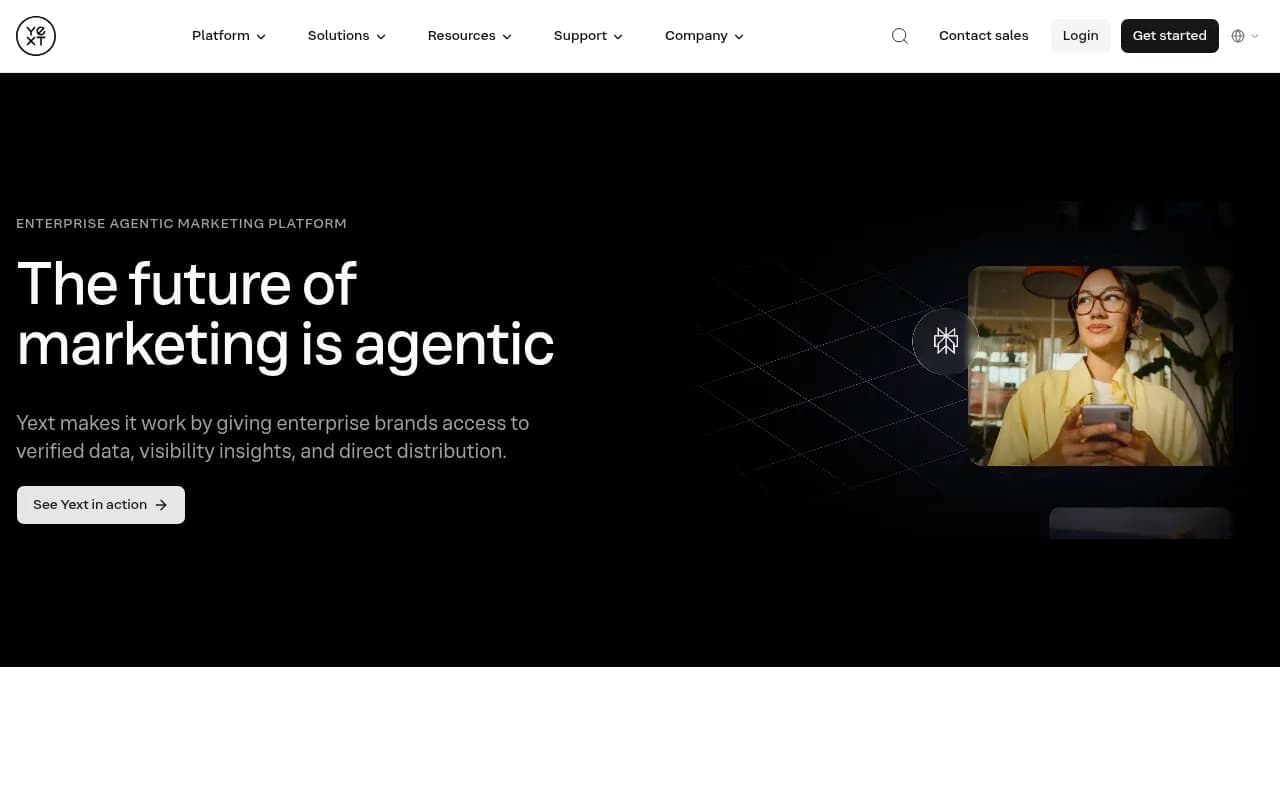
Yext markets Scout explicitly for multi-location brands, with a Local Benchmarking feature that measures performance "location by location" rather than just at the brand level, while still rolling up to an executive view. It tracks Google Search, Google Maps, and Google AI Overviews alongside ChatGPT, Gemini, Claude, and Perplexity, and its competitive benchmarking tracks head-to-head win rates against up to 20 competitors per market. There's also a mobile app so individual location managers can spot and fix visibility issues without logging into a full BI dashboard.
The catch is pricing. Yext doesn't publish self-serve rates for Scout at scale, you're looking at a sales conversation, and third-party estimates floating around put entry pricing somewhere near $109/month with higher tiers around $449/month, though that's unverified and worth confirming directly with Yext before you budget against it.
Birdeye: listings management plus AI visibility in one place
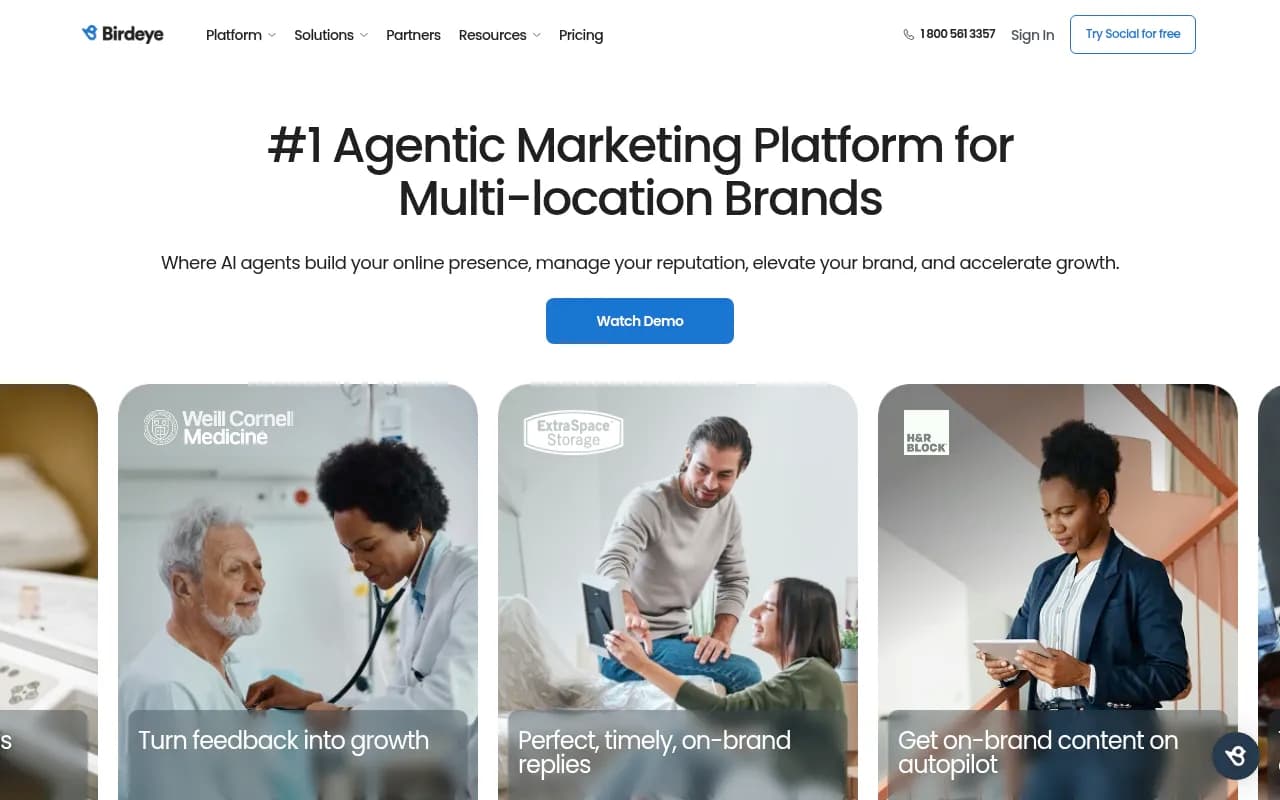
Birdeye leans hard into the franchise use case, with messaging aimed squarely at brands managing "100, 500, or 1,000+ locations." It tracks ChatGPT, Gemini, Perplexity, AI Overviews, AI Mode, Claude, and Grok, and ties that visibility data directly to listings management across 200+ directory sites, which matters because inconsistent name/address/phone data across listings is one of the quieter ways franchises undermine their own AI visibility. Birdeye has also started generating location-specific content recommendations rather than one brand-wide suggestion applied everywhere.
Like Yext, pricing is fully custom based on location count and which product modules you activate. No rate card, no self-serve signup for the franchise tier.
LocalFalcon: the most literal "track every city" tool
LocalFalcon isn't primarily an AI visibility platform, it started as a geo-grid rank tracker, plotting rankings across a map grid instead of one aggregate number. A 5x5 grid scan costs 25 credits, a 9x9 grid costs 81 credits, and it now includes AI visibility tracking and an AI-powered analysis layer (Falcon AI) alongside the classic Google Business Profile grid scans.
What makes it worth including here: pricing is credit-based, not per-location or per-seat, and keywords and locations tracked are unlimited on every tier, from a $24.99/month Starter plan with 7,500 credits up to Enterprise packages running $499 to $4,999/month. Cost scales with how often and how granularly you scan, not with how many cities you have on the books. For a franchise that wants genuinely city-by-city resolution without negotiating enterprise contracts, this is the most transparent pricing model of the group.
Otterly.AI, Peec AI, and Profound: useful, but built around prompts, not locations



These three are solid general-purpose AI visibility trackers, and all three cover the major engines (ChatGPT, AI Overviews, Perplexity, and either Gemini or Copilot depending on plan). The problem for franchises is structural: each location/city/query combination you want to track consumes one of a fixed prompt allotment.
Otterly's Standard plan gives you 100 prompts. If you're tracking 30 locations across just two query variants ("best X near me" and "X [city]") on two engines each, that's 120 prompt-slots gone before you've covered half your footprint. Peec AI's tiers run from 50 prompts on Starter up to 350 on Advanced, with countries capped per plan (1 on Starter, 3 on Pro/Advanced), which is a geography constraint more than a city constraint. Profound has no published self-serve pricing at all for anything beyond a 7-day trial, pushing multi-location deployments straight to an Enterprise quote.
None of this makes them bad tools. It makes them the wrong shape for a 50+ location footprint unless you're willing to pay agency-tier pricing or narrow your tracked queries down hard.
Comparison table
| Tool | Location-level reporting | Pricing model | Self-serve for 50+ locations? | Best for |
|---|---|---|---|---|
| Yext Scout | Yes, built for it | Custom/quote | No | Franchises wanting local + national rollup in one view |
| Birdeye | Yes, built for it | Custom/quote | No | Franchises already using Birdeye for listings/reviews |
| LocalFalcon | Yes, geo-grid per city | Credit-based | Yes | Franchises wanting transparent, scalable per-city pricing |
| Otterly.AI | Partial, via manual prompt setup | Per-prompt tier | Difficult past ~20-30 locations | Smaller multi-location brands (5-20 units) |
| Peec AI | Partial, via manual prompt setup | Per-prompt tier, geo-priced | Difficult, country-capped | Multi-country brands with fewer, larger markets |
| Profound | Enterprise-only | Custom/quote | No | Enterprise franchises ready for a managed deployment |
| Semrush AI Visibility Toolkit | Partial, pairs with Local Toolkit | Per-location Local Toolkit + flat AI add-on | Yes, but stacks two bills | Franchises already on Semrush for local SEO |
Why brand-specific local prompts are more winnable than you'd think
Here's a detail from Promptwatch's data that's genuinely useful if you're deciding where to focus: ChatGPT cites far fewer unique domains for brand-specific prompts than for generic ones. Organic, non-branded prompts see 10+ cited domains in 52.5% of responses. Brand-specific prompts, the kind closer to "is [brand] near me good" or "[brand] [city] reviews", hit that 10+ domain mark in only 21.3% of cases, with 5 domains being the single most common count.

Translate that to franchise terms: a query like "best [your brand] location in Tampa" is structurally closer to a brand-specific prompt than a generic "best coffee shop Tampa" search. Fewer domains competing for the answer means your own location page, your Google Business Profile, and a handful of local directories have a real shot at being among the small set of sources ChatGPT actually cites, rather than getting drowned out among 10+ competitors. That's a meaningfully easier fight than most franchise marketers assume when they first start tracking this.
It's also worth knowing that mid-authority domains (DR 46-75) took close to half of all ChatGPT citations in August 2026, while the very top authority tier shrank to around 3%. Individual franchise location pages, which rarely carry the domain authority of the brand's homepage, aren't shut out just because they're not DR 90.
The trap that undoes most franchise AI visibility strategies
None of the tools above fix a franchise's biggest structural problem, which is templated location pages. If your Tampa page and your Orlando page are the same template with a city name and phone number swapped, you're not creating 50 pages of unique content, you're creating one page copied 50 times. Bing's own webmaster blog has been explicit about this: LLMs grounded in search indexes cluster near-duplicate URLs and effectively pick one to represent the group, which means your own locations end up competing against each other for which page gets to represent the brand in an AI answer, and updates to any single location page can take longer to surface.
The pitfalls worth fixing before you even start tracking:
- Location pages that differ only in city name and contact info, rather than local reviews, local staff, local service specifics, or local landmarks
- Inconsistent name/address/phone data across the website, Google Business Profile, and directory listings, which erodes the trust signals AI systems lean on
- Treating "localization" as a find-and-replace exercise instead of genuinely different content per market
No visibility tool will outrun these problems. A tool can tell you your Tampa location is invisible in ChatGPT; it can't make that location's page worth citing if it's identical to forty others.
How to actually set this up
A workable process looks like this regardless of which tool you pick:
- Tier your locations. You don't need daily city-level tracking for all 200 units. Rank by revenue, by competitive intensity, or by how AI-Overview-heavy the category is locally, and track your top 20-30% closely.
- Pick 2-3 query patterns per city that mirror how real customers phrase things, not what your brand team wishes they'd say. "[Brand] [city]" and "best [category] near [neighborhood/city]" cover most of it.
- Separate franchisee-facing reporting from executive reporting from day one. A franchisee needs their city's win rate, not a 50-page PDF.
- Fix the templated-page problem before you scale tracking further. Tracking invisibility doesn't create visibility.
- Re-check your tool's pricing model against your actual city count every time you add locations. Prompt-based pricing that looked fine at 10 locations can double or triple by the time you're at 40.
If you want to browse beyond this list, the GEO software directory at bestgeosoftware.com covers a wider set of platforms worth comparing on features and pricing side by side.