Key takeaways
- SOCi and Birdeye manage the local presence itself (Google Business Profile, reviews, social) with AI-visibility reporting layered on top; Promptwatch tracks and optimizes AI citations and content but has no listings or review-management module at all.
- SOCi's own 2026 Local Visibility Index found ChatGPT recommends just 1.2% of the 350,000+ locations it analyzed, versus a 35.9% average appearance rate in Google's local 3-Pack, roughly 30x more selective.
- Birdeye's "Location Blind Spot" report found 1 in 5 locations invisible in AI search entirely, with up to a 50-point visibility gap between a brand's best and worst location.
- Neither SOCi nor Birdeye publishes self-serve pricing; both require a custom quote scaled by location count. Promptwatch is the only one of the three with transparent published pricing, starting at $95/month.
- All three vendors' headline stats come from their own commissioned reports, not an independent audit, so treat the "we win" claims from each one with the same skepticism.
Why this question keeps coming up
If you run marketing for a brand with more than a handful of locations, you've probably had some version of this conversation in the last few months: "Are we even showing up when people ask ChatGPT where to go?" And then someone forwards you a vendor report with a scary stat, and now three different sales teams are in your inbox.
I went through the actual data each platform has published in 2026, not the sales decks, to figure out what SOCi, Birdeye, and Promptwatch actually do, where they overlap, and where the real gap is. Spoiler: there's a reason this is a three-way comparison and not a head-to-head. Two of these products execute local presence. One of them doesn't touch your Google Business Profile at all.
What the data says about how selective AI local search really is
Start with the scale of the problem, because it explains why this category exists.
SOCi's 2026 Local Visibility Index analyzed more than 350,000 locations across 2,751 multi-location brands and found that ChatGPT recommends just 1.2% of the locations it looked at, compared with an average 35.9% appearance rate in Google's local 3-Pack. That's not a small gap, it's close to 30x more selective. Gemini recommended 11.0% of locations and Perplexity 7.4%, still far tighter than traditional local search.
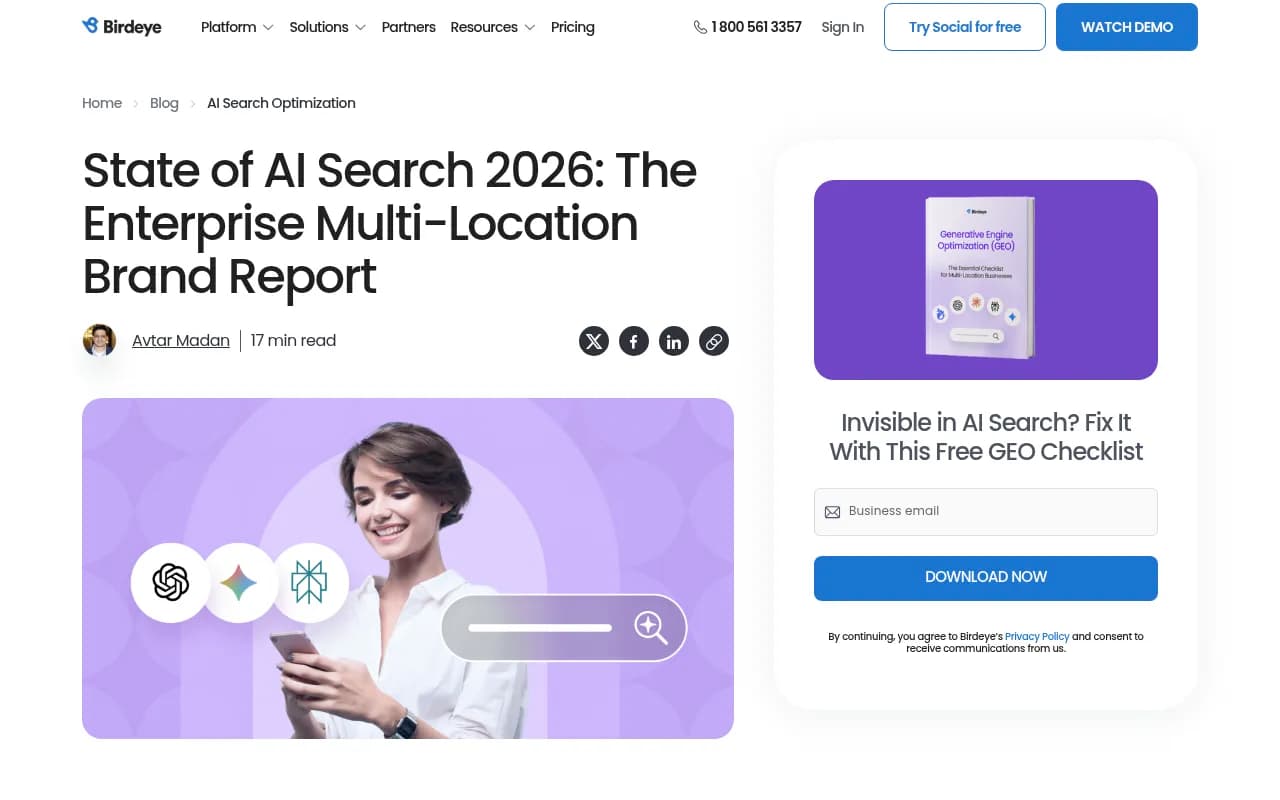
Birdeye's "Location Blind Spot" report, which scanned 1,762 multi-location brands across 16,240 location-level checks, lands on a similar conclusion from a different angle: 1 in 5 locations is completely invisible in AI search, not low-ranked, just absent. And the gap between a brand's best and worst performing location can swing by up to 50 points. Birdeye's separate State of AI Search 2026 report adds that 80% of brands get cited at least once, but only 15% hold the top citation spot with their own domain.
One detail from SOCi's report is worth sitting with: only 45% overlap between the brands that lead traditional local search and the brands AI platforms recommend most. In retail, only 9 of the top 20 traditional-search leaders also rank in the top 20 for AI recommendations. Ranking well in Google doesn't transfer automatically. AI models appear to weight things like review sentiment more heavily; locations ChatGPT recommends average a 4.3-star rating.
All three of these numbers come from the vendors themselves, so I'll say this plainly: there's no independent, neutral benchmark comparing SOCi, Birdeye, and Promptwatch on actual AI-citation accuracy. Each report is commissioned by the company selling the fix. That doesn't make the data wrong, but it means you should read "30x more selective" and "1 in 5 invisible" as directionally real, not as precise, audited figures.
What each platform actually does
SOCi: agents that run your local presence
SOCi calls itself an agentic workforce, and the product is built around three "Genius Agents": a Local Search Agent that manages listings and dynamic local pages, a Social Agent that handles content, engagement, and ads, and a Reputation Agent that manages reviews, solicitation, and 24/7 chat. There's also SOCi Shield, a compliance layer that scans franchisee or location-level edits before they publish, which matters a lot once you have hundreds of local managers touching the same brand.
SOCi says it had surpassed 400,000 deployed Genius Agents by September 2026. Customer numbers it publishes are specific: Liberty Tax grew 3-Pack ranking from 60% to 90% and review volume by 120%; Sport Clips Haircuts runs 3,400+ SOCi agents across 1,800 locations; Priderock Capital improved "apartments near me" 3-Pack placement by 127%. A Forrester-commissioned study on a composite 1,000-location brand found 192% ROI over three years with payback under six months, for what it's worth given it's vendor-commissioned.
Pricing is custom only, no self-serve numbers, no free trial, scaled by location count and which agents you turn on. Third-party estimates (not SOCi's own figures) put it somewhere around $800 to $2,500 per location per year for smaller footprints, less per location at scale.
Birdeye: visibility tracking plus execution agents
Birdeye's pitch is similar in structure but framed around a named AI agent, "Jay," that tracks visibility across ChatGPT, Gemini, Claude, and Perplexity, diagnoses why a location is losing visibility (wrong listing field, missing content theme, whatever it is), and then kicks off fix agents, a Listings Optimization Agent, a Blog Page Agent, and others, automatically.
Birdeye publishes customer-reported results on its own site: a 30% increase in AI visibility, 53% more leads, and 74% of AI recommendations accepted. It also claims over 3,000 integrations and positions itself as the top-rated agentic marketing platform for multi-location brands on G2 for Fall 2026.
On its own comparison page, Birdeye argues that SOCi "focuses on execution" while Birdeye "combines execution with deeper visibility, insights, and performance tracking," including competitive benchmarking like share of voice and review velocity against local competitors. Worth noting that page carries Birdeye's own disclaimer that it doesn't warrant the completeness of the information, so take the framing as one side's marketing, not a neutral read.
Like SOCi, Birdeye has no published self-serve pricing. Third-party pricing benchmarks (again, not official) suggest tiers around $299 per location/month for a starter package, up to roughly $449 per location/month for the top tier with chatbot features included.
Promptwatch: tracks and fixes AI citations, doesn't touch your listings
This is where the comparison gets interesting, because Promptwatch is solving a different problem than the other two. It's built to monitor how your brand shows up across ChatGPT, Gemini, Claude, Perplexity, Grok, and the rest, down to crawler-log level, meaning it can show you when an AI crawler actually visited a page and whether that visit turned into a citation. It pairs that with content gap analysis and Content Agents that draft and publish fixes directly to Webflow, Framer, or WordPress.
I'll be direct about the gap for this specific use case: nothing in Promptwatch's pricing page or product docs mentions managing a Google Business Profile, responding to reviews, or tracking local-pack rankings. Its "city and state targeting" feature, only available on the $579/month Business tier, is about geo-targeting prompts to see how AI answers differ by location, not about managing listings location by location. If what you need is someone to keep 800 GBP listings clean and respond to reviews at scale, Promptwatch isn't that tool.
What it does give you that the other two don't: transparent published pricing, a 7-day free trial, and every AI model tracked on every paid tier with no per-engine upsell. Essential starts at $95/month (50 prompts, 6,000 responses, API and MCP access, no crawler logs). Professional at $245/month adds Agent Analytics crawler logs and automated content generation. Business at $579/month adds the state/city prompt targeting, ChatGPT Shopping insights, and Ads Radar.
Promptwatch also publishes citation-share data that's useful even if you end up buying SOCi or Birdeye. Its automotive-vertical citation analysis for August 2026, for example, found that marketplaces and research sites (Autotrader, Cars.com) dominate automotive citations in ChatGPT, taking 27.27% combined, while manufacturer sites take only 7.92%. A single local dealership site made the top 31 at just 0.28% share, showing individual local-business pages can appear in these citations, but it's rare without deliberate work. Notably, Promptwatch's own research explicitly recommends maintaining complete profiles on review platforms including Birdeye as a "search asset," which tells you something about how these categories overlap rather than compete.

How crowded are these AI answers, really
One more data point worth knowing before you pick a strategy: Promptwatch's citation-crowding research (Sept 28-Oct 4, 2026) found that 47.6% of all ChatGPT responses with citations cite 10 or more domains, and for non-branded, "best [service] near me" style prompts, that climbs to 52.5%. That's a crowded field for generic local queries. But for brand-specific prompts, like "is [Brand] good", the field narrows sharply: only 21.3% cite 10+ domains, and 40.7% cite five or fewer sources. That means once someone is already asking about your brand by name, what's on your own site and a short list of review sources carries outsized weight, which is exactly the lever both SOCi's Reputation Agent and Birdeye's review tools are built to pull.
Side-by-side comparison
| Platform | Primary job | AI models/engines tracked | Listings & review management | Pricing model | Notable data point |
|---|---|---|---|---|---|
| SOCi | Runs local presence via Genius Agents (listings, social, reviews) | ChatGPT, Gemini, Perplexity (reporting layer) | Yes, native, plus compliance (SOCi Shield) | Custom quote, no self-serve, no free trial | ChatGPT recommends 1.2% of locations vs 35.9% in Google's 3-Pack |
| Birdeye | Visibility tracking + execution agents for listings and content | ChatGPT, Gemini, Claude, Perplexity | Yes, native, plus competitive benchmarking | Custom quote, no self-serve, no free trial | 1 in 5 locations invisible in AI search |
| Promptwatch | Tracks and fixes AI citations and content, with crawler-log depth | All major models on every paid tier, incl. AI Overviews/AI Mode | No, not a listings or review tool | Published, from $95/mo, 7-day free trial | 52.5% of non-branded ChatGPT answers cite 10+ domains |
So which one should you actually buy
Honestly, the framing of "which platform wins" is a bit off for this particular trio, because two of them are trying to do the same job (run your local presence, with AI visibility as a reporting layer) and one is doing a completely different job (track and optimize what AI says about your content, with no listings component).
If you manage dozens or hundreds of physical locations and the actual pain point is inconsistent listings, slow review responses, or franchisee-level content governance, SOCi or Birdeye is the right category. Between those two, the honest answer is that nobody outside the vendors has published a neutral test of which one gets you cited more often. SOCi leans slightly more agentic-execution-first with Genius Agents and Shield; Birdeye leans a bit more into cross-engine visibility tracking and competitive benchmarking on top of execution. Both require a sales call for pricing, which is annoying if you just want a number to compare.
If what you actually need is to understand why your brand's own site and content aren't being cited, down to the crawler-log level, and you want a tool that can turn that gap into a published page without touching your GBP listings, Promptwatch is built for that and is the only one of the three with pricing you can see before you talk to anyone. For a multi-location brand, the realistic setup for a lot of teams is Promptwatch or a similar AI-visibility layer paired with SOCi or Birdeye for the operational side, since they're not actually substitutes for each other.
If you want to see how Promptwatch stacks up against other AI-visibility specialists rather than location-management platforms, the GEO software directory at bestgeosoftware.com is a reasonable place to keep browsing, and Promptwatch's own 2026 comparison of 21 GEO platforms goes deeper on the feature-by-feature breakdown than I have room for here.