Key takeaways
- Promptwatch's own tracking shows ChatGPT ads appeared in 32.4% of search-powered responses over the past 7 days (as of mid-August 2026), up from essentially zero before May 27, 2026. Full ad-frequency data.
- A 50,006-prompt study by SE Ranking found advertisers get cited as an organic source only 3.63% of the time, and the exact advertised URL shows up in citations just 0.09% of the time. Paying for the ad slot does not buy you a seat in the organic answer.
- The real "organic lift" most marketers are seeing is very likely a tracking artifact: ChatGPT ad clicks without proper UTM tagging land in GA4 as ordinary chatgpt.com referral traffic, indistinguishable from a free citation.
- 14.35% of ChatGPT ads in that same study were semantically unrelated to the prompt they appeared next to, which should make anyone nervous about brand adjacency, not just attribution.
- Fixing this is mostly a measurement problem, not a conspiracy. Tag every campaign, audit historical sessions for the
opprefclick ID, and run a holdout test before you draw conclusions.
The question everyone's asking in the wrong order
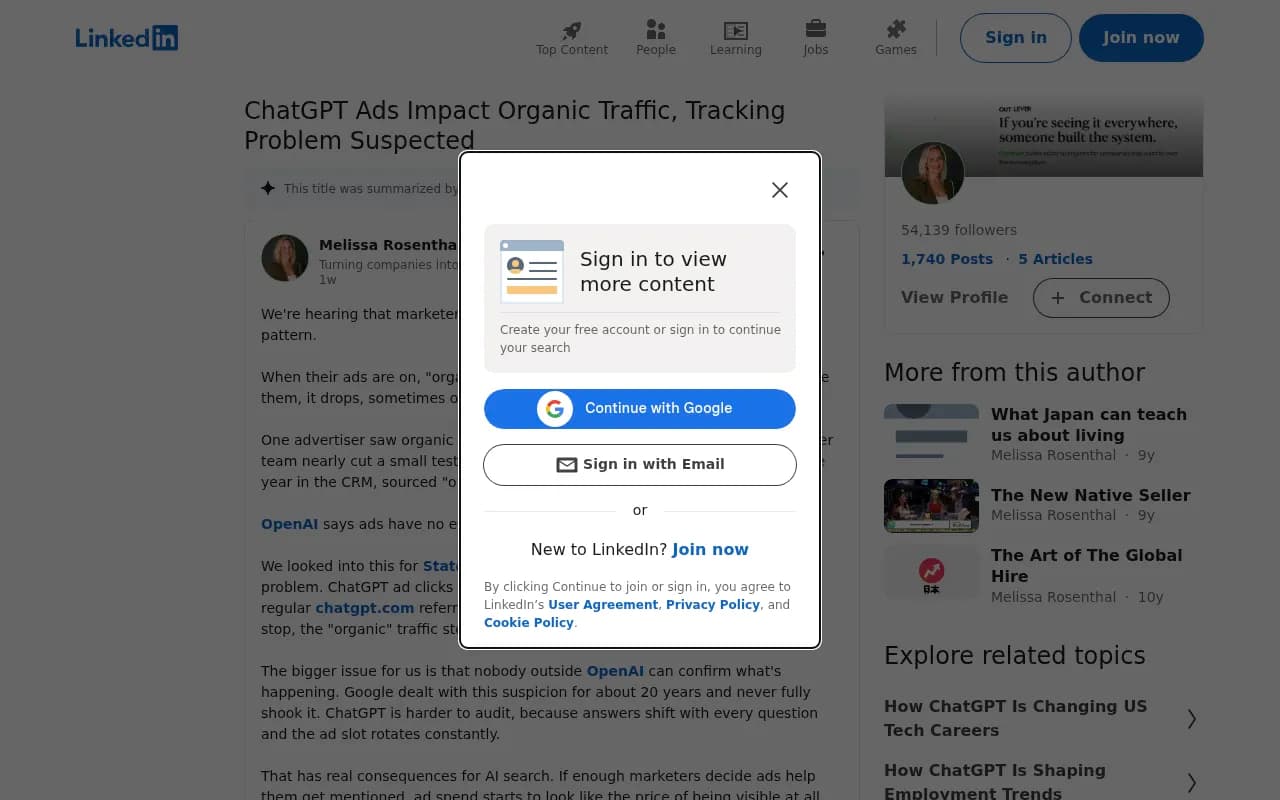
A LinkedIn thread this fall got a lot of attention for a simple reason: marketers running ChatGPT ad campaigns kept seeing their "organic" ChatGPT traffic rise right alongside the ad spend, and fall the day the ads got paused. One advertiser reported a fivefold jump in organic traffic while ads were live. Another found the biggest deal of their year sourced "organically" through ChatGPT, despite nearly nothing showing in the ad dashboard.
The instinct is to ask: is ChatGPT letting advertisers buy their way into the organic answer? I get why people are asking that. We've all watched this movie before with Google Ads and organic rankings, and the suspicion never fully died even after two decades of Google's denials.
But before chasing a conspiracy, there's a much more boring explanation sitting in the data: a tracking gap. And the boring explanation fits the evidence better.
What's actually happening, mechanically
When ChatGPT links to a site inside an organic answer, it appends utm_source=chatgpt.com to the URL. Google Analytics 4 records that as a chatgpt.com referral, and most teams now bucket that under "organic AI traffic."
ChatGPT ad clicks are different. OpenAI attaches a click identifier called oppref, which GA4 doesn't recognize as its own channel. Unless the advertiser adds their own UTM parameters to the landing page, that paid click lands in GA4 in the exact same bucket as a free citation. Pause the ads, and the inflated "organic" number drops with them. It looks like the ads were boosting organic. What actually happened is the organic number was never organic.
There's good news here: this is fixable. Since May 2026, GA4 has shipped a dedicated "AI Assistant" channel in its Default Channel Group reports, and OpenAI added dynamic URL macros ({campaign_id}, {ad_group_id}, {ad_id}) to ChatGPT Ads Manager in early August 2026. Graphite.io's own testing found that 92 to 96% of properly UTM-tagged ChatGPT ad clicks now show up correctly in GA4 as paid sessions, sitting on a separate row from organic chatgpt.com referrals. The gap mostly exists for campaigns that launched before anyone thought to tag them, or that are still running without UTMs today.
So do ads actually influence the organic answer?
OpenAI's position, stated plainly in its help center, is that ads run on separate systems from the chat model and "do not influence ChatGPT's answers." Advertisers have no ability to shape, rank, or alter responses. Ads appear below the answer with a visible "Sponsored" label, and are never shown to Plus, Pro, Business, Enterprise, or Edu users, only to Free and Go plan accounts.
The independent data backs this up more than it contradicts it. SE Ranking analyzed 50,006 commercial prompts across 20 niches in July 2026 and found that 96.37% of the time, the advertiser running an ad was never cited as an organic source in the answer sitting above it. Only 3.63% of advertisers also showed up as a cited source, and the exact advertised URL appeared in citations in a mere 0.09% of cases. Whitebox's separate analysis of more than 150,000 sponsored placements found that only 16.4% of brands ChatGPT names in its answers had ever advertised on the platform at all. If ad spend bought citations, you'd expect the opposite pattern.
Where things get genuinely interesting is the credibility-signal question raised by Seer Interactive's Wil Reynolds. In one client account, organic CTR jumped 156% when a paid ad ranked alongside the organic result, and didn't recover when the ad was paused. That's not citation manipulation. It's a behavioral effect, a paid placement next to an organic answer may make the brand feel more validated to the person reading it, the same dynamic search marketers have debated for years on Google SERPs. It's a real pattern worth watching, but it's a UX effect on the user, not OpenAI quietly reranking citations for advertisers.
The adjacency risk nobody's talking about enough
Here's the part of the SE Ranking study that should worry advertisers more than the citation question: 14.35% of ChatGPT ads were semantically unrelated to the prompt they appeared on. A dating-app query paired with a clothing retailer ad. A newspaper-subscription question paired with an electricity-provider ad. In the News & Politics category, 54.2% of ads had little connection to the prompt at all.
And ad frequency on sensitive topics is higher than you'd expect: ads showed on 28.69% of healthcare prompts in the SE Ranking dataset, versus only 2.64% for the equivalent query type in Google AI Mode. If you're running ads in a regulated or reputation-sensitive category, that's a targeting-quality problem worth raising with your rep, not just an attribution problem.
The Seer framing is the one I'd actually act on: before approving any ChatGPT ad budget, go check what ChatGPT says about your brand organically, right now, with no ad running. If the sentiment is positive 80% of the time across a set of prompts, an ad has something to amplify. If it's a coin flip, you're gambling. If it leans negative, you're paying to put a spotlight on the wrong answer.
How to actually audit this, step by step
1. Tag everything, retroactively if you have to
If any ChatGPT campaign has run without advertiser-specific UTM parameters, treat every organic AI trend line from that period as contaminated. Add UTMs at the ad level (they override campaign-level tags), and start using OpenAI's dynamic macros so each click carries a readable campaign and ad ID into GA4.
2. Go back through historical sessions
Filter past "organic" ChatGPT sessions in GA4 for landing URLs containing the oppref parameter. Every one of those was an ad click wearing an organic costume. Pull those sessions out of your organic trend before you report on it.
3. Separate ad data from citation data in your monitoring
This is the part most teams skip. OpenAI's own Ads Manager only reports on your campaigns, it can't tell you whether a competitor's ad is sitting next to your citation, or whether your ad is appearing on prompts where you're organically invisible. A monitoring layer that tracks both ad placements and organic citations, and keeps them as separate data types, is the only way to see the full picture.
Promptwatch tracks exactly this split through its Ads Radar, capturing advertiser, landing page, and ad copy for every sponsored placement it finds, tagged by prompt type (organic, brand-specific, competitor comparison) so you can filter ad exposure the same way you'd filter citation data, without it polluting your Visibility Score.

4. Run a real holdout test
Pause ads in one market or product line for three to four weeks while keeping them live elsewhere. Track organic mention rates on a fixed set of prompts in both groups, alongside traffic. If mention rates hold steady while traffic drops in the paused group, the traffic was coming from the ads, not from an organic lift. If mentions move with the ads too, that's a finding worth publishing.
5. Watch the prompt type, not just the prompt
Promptwatch's tracking shows that 73.3% of ChatGPT ads concentrate on generic, non-branded "organic" commercial prompts (think "best running shoes for flat feet"), not brand-vs-brand comparisons. That matters for your audit because those same organic prompts are also the most citation-crowded: 52.5% of organic-prompt answers cite 10 or more domains. An ad on a branded query carries more relative weight, since branded answers typically settle on far fewer sources, often just five.
Benchmarks worth knowing before you panic
A few numbers to sanity-check your own results against, compiled from roughly two dozen published advertiser tests:
| Metric | Typical range | Google Search comparison |
|---|---|---|
| CTR | 0.35% to 7.9% (median ~1.25%) | Consistently lower than Google Search CTR in every head-to-head test found |
| CPC | $0.76 to $22.89, many US accounts $3-$10 | Google CPCs often higher but convert at a higher rate |
| Ad frequency on commercial prompts | ~26% (SE Ranking, July 2026) | Comparable to Google AI Mode's ~29% on the same query type |
| Ads appear on YMYL/healthcare prompts | ~28.7% | Google AI Mode: ~2.6% |
Workshop Digital's B2B test is a useful data point: $2,319 in ChatGPT ad spend across 69,630 impressions produced 739 clicks (1.1% CTR, $3.14 CPC) and zero marketing-qualified leads, versus Google Search's $6.76 CPC and 2 MQLs on comparable spend in the same window. If your numbers look like that, you're not doing anything wrong, that's roughly where the channel sits right now.
Tooling: what to use for what
None of this requires exotic software, but the right tool saves a lot of manual prompt-checking. Here's how the main options split by job:
| Tool | Sees your own ad campaigns | Sees competitor ads | Tracks organic citations separately | Best for |
|---|---|---|---|---|
| OpenAI Ads Manager | Yes | No | No | Basic ad spend, clicks, CTR reporting |
| Google Analytics 4 + UTMs | Yes (if tagged) | No | Yes | Fixing the attribution gap |
| Promptwatch | Yes (Ads Radar) | Yes | Yes | Full audit: ads vs. citations side by side, prompt-type filtering |
| SE Ranking | No | Yes (via research) | Yes | One-off competitive ad research studies |
| Profound | No | Partial | Yes | Enterprise citation monitoring at scale |

If you want a wider view of the category before picking a stack, the GEO software directory at bestgeosoftware.com breaks down more than two dozen platforms by what they actually monitor versus what they claim to.
What to actually do with this
The honest takeaway is that most of what's being reported as "ChatGPT ads boosting organic visibility" is very likely a measurement problem, not a pay-to-play scheme. OpenAI's own data and two independent studies point the same direction: advertisers almost never get cited as an organic source just because they're running an ad. The 96.37% non-citation rate from SE Ranking's study is about as clean a refutation as you'll get without OpenAI opening up its ranking logs.
What's real, and worth acting on, is the adjacency risk. Your ad might be running right next to an organic answer that recommends your competitor, or next to nothing related to your prompt at all. That's a brand safety issue dressed up as a performance metric. Check your organic sentiment before you spend a dollar on ads, tag every campaign so you're not lying to yourself about where the traffic came from, and run an actual holdout before you tell your CFO the ads are working.
If you want a broader read on how AI platforms are reshaping citation behavior generally, not just the ads layer, Promptwatch's research on which domains ChatGPT cites most by rank bucket is worth a look, since it shows how crowded the organic side of these same commercial prompts already is, with or without an ad sitting below them.