Key takeaways
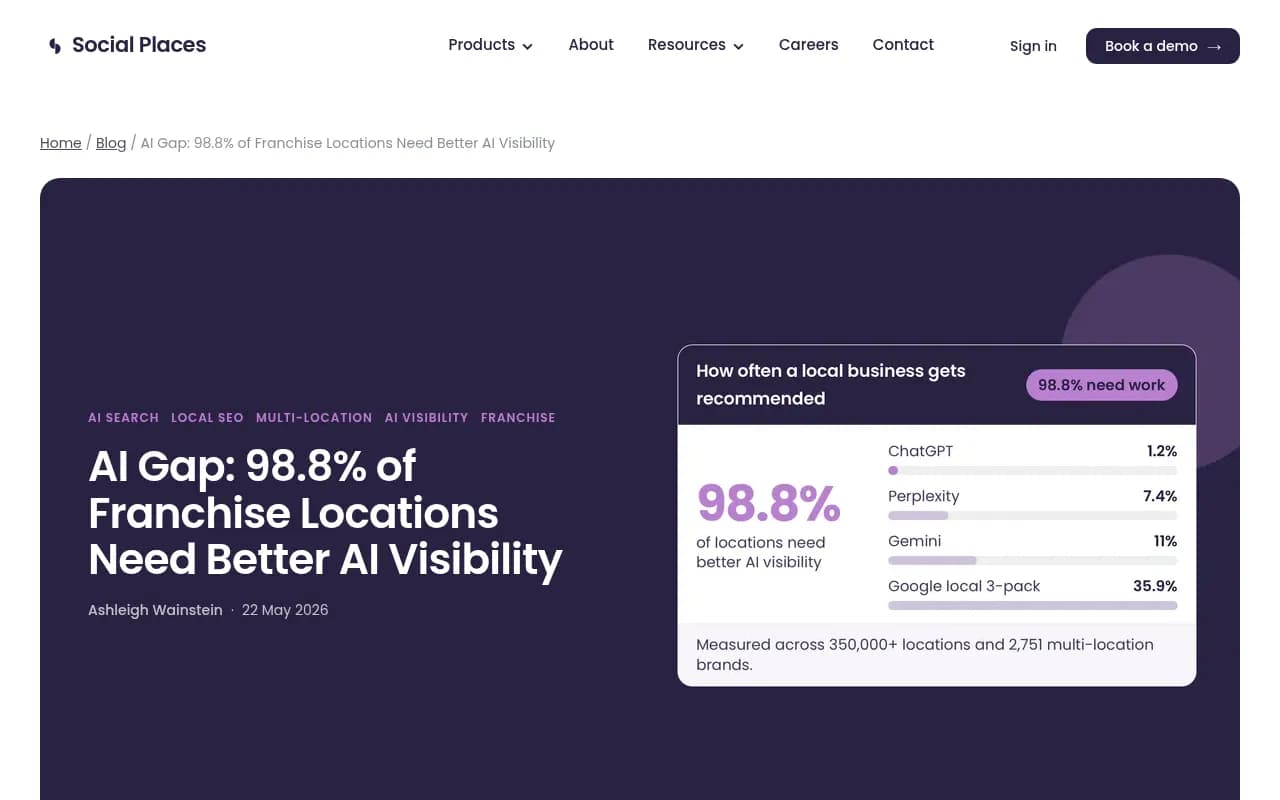
- Only 1.2% of franchise locations get recommended by ChatGPT, compared to 35.9% that show up in Google's local 3-pack, according to SOCi's 2026 Local Visibility Index (350,000+ locations, 2,751 brands).
- Aggregate, brand-level visibility scores hide the problem. ChatGPT treats every location as its own entity with its own citation record, so tracking has to happen at the city or neighborhood level, not the brand level.
- ChatGPT cites roughly 5 sources per answer, half of what AI Overviews or Perplexity cite, so generic templated location pages rarely make the cut. Product/landing pages and reviews punch above their weight for brand-name queries.
- A single test prompt tells you almost nothing. Build a rotating set of 20-40 prompts per market, run them for at least 30 days, and log position, citations, and sentiment before drawing conclusions.
- Dedicated geo-grid and multi-location AI visibility tools (Local Falcon, Profound, Promptwatch) separate per-branch data automatically; generic brand monitoring tools usually roll everything into one number unless you pay for a higher tier.
Why this is harder than normal AI visibility tracking
Most AI visibility advice is written for a single-domain brand. A franchise with 40, 400, or 4,000 locations is a different animal entirely. Each location has its own Google Business Profile, its own reviews, its own local citations, and, crucially, its own relationship with ChatGPT.
That last part trips up a lot of franchisors. Cintra's research on AI visibility for franchise brands puts it bluntly: AI search treats each location independently. Your corporate "About Us" page describing the brand's mission doesn't translate into a citation for the Austin franchisee. ChatGPT needs something that specifically ties a service to a geography, written in a way that reads like it was actually about that location, not a city name swapped into a template.
The numbers back up how big this gap is. SOCi's 2026 Local Visibility Index found that the average brand appears in Google's local 3-pack 35.9% of the time, but gets recommended by ChatGPT in only 1.2% of comparable queries. Gemini sits at 11%, Perplexity at 7.4%. Social Places, analyzing the same dataset, called this a cliff rather than a gap: AI assistants are up to 30 times more selective than Google's local results.
The gap also varies a lot by category. Retail franchises get recommended by ChatGPT 10.2% of the time. Restaurants sit at 5.3%. Financial services locations drop to 3.1%. If you're benchmarking your franchise against "the average brand," you're probably benchmarking against the wrong vertical. Pull the numbers for your actual category before deciding whether your visibility is good or bad.
Why ChatGPT is so much more selective than Google
Google's local results work on something like broad match. Show up consistently, keep your profile reasonably complete, and you'll land somewhere in the results most of the time. ChatGPT works on a confidence model. If it isn't fairly certain about a business, it leaves it out entirely rather than ranking it lower. That's a meaningfully different failure mode: on Google you get buried, on ChatGPT you get erased.
Three things feed that confidence:
- Data accuracy. Research cited by Social Places found franchise business profile information was only 68% accurate on ChatGPT and Perplexity, versus 100% on Gemini (which pulls live from Google Maps). A wrong phone number or stale hours doesn't just annoy a customer. It tells the model your data can't be trusted, and it moves to a competitor.
- NAP consistency. According to Semrush data cited by BizIQ, businesses with name/address/phone inconsistencies across three or more citation sources get excluded from Google AI Mode local answers 74% of the time. Consistent NAP across the top 50 directories correlates with ranking 2.4 positions higher on average.
- Review signal strength. Locations ChatGPT recommends average a 4.3-star rating; Perplexity-recommended locations average 4.2. Meanwhile the average business responds to only 46.9% of its Google reviews and 3.1% of its Yelp reviews, according to SOCi. Review response rate is one of the few levers a franchisor can pull directly, across every location, without waiting on anyone else.
Build a tracking methodology, not a one-off check
A single prompt run once a month tells you almost nothing. Promptwatch's own data shows that nearly half (47.6%) of ChatGPT responses with citations pull from 10 or more different domains, and two-thirds pull from at least 8. For organic, non-branded prompts ('best pizza near me') that figure climbs above 52%. One test, one answer, one snapshot in time, is not a sample size. It's noise.
Brand-name prompts behave differently, though, and this matters for franchises specifically. When the prompt names your franchise directly ('is [Franchise] good'), ChatGPT narrows its sourcing sharply: only 21.3% of those responses cite 10+ domains, and 5 domains is the single most common citation count. That means for "is this franchise good in [city]" type queries, each source ChatGPT does pull carries outsized weight over what gets said about that specific location. Getting one or two of the right sources right (your own location page, a strong local review profile, a relevant local directory) can move the needle more than it would for a generic organic query.
A workable methodology looks like this:
- Build a prompt list from real customer language, not guesses. Pull from support tickets, sales calls, and reviews where customers describe how they searched. Mix branded ('[Franchise] [city] reviews'), unbranded ('best [service] near [neighborhood]'), and comparison prompts ('[Franchise] vs [competitor] in [city]').
- Track 20-40 representative prompts per priority market rather than every possible phrasing. ChatGPT decomposes prompts into sub-queries anyway (more on that below), so exhaustive phrasing variations add less value than covering more cities.
- Run the same prompt set across every location/market you're tracking, not just one "representative" market. Franchise performance varies wildly city to city, and a strong flagship location can mask a struggling regional footprint if you only test one place.
- Run for at least 30 days before drawing conclusions. ChatGPT's answers shift with crawl cycles, model updates, and seasonal query behavior.
- Log the same fields every time: exact prompt, date, full answer text, which brands got named, position in the answer, every cited URL, and sentiment. Also note factual errors (wrong hours, wrong phone, wrong address), since those are fixable and directly tied to lost calls.
What this actually looks like in a spreadsheet, at minimum
| Field | Why it matters |
|---|---|
| Prompt and location/market | Lets you separate per-city performance instead of one brand average |
| Mentioned (yes/no) and position | The core visibility metric per location |
| Citations/URLs | Tells you why you were or weren't mentioned |
| Sentiment | A citation isn't automatically a good citation |
| Factual accuracy (hours, phone, address) | Direct link to lost calls and walk-ins |
| Date tested | Needed to see trend over at least 30 days |
Why ChatGPT's search behavior matters for location pages specifically
A few shifts in how ChatGPT actually searches change what a franchise location page needs to contain.
ChatGPT's average query fanout (the number of separate web searches it runs per response) dropped from about 2.15 in December 2025 to exactly 1.0 by April 2026, according to Promptwatch's query fanout data. Each search now carries more weight because there are fewer of them. At the same time, the average fanout query length shrank from roughly 117 characters to about 53, meaning ChatGPT's internal searches now read like terse keyword phrases ('best HVAC repair Denver 2026') instead of full sentences. If your location page headings and H2s are written in that same clipped, keyword-forward style, you're matching the actual query shape ChatGPT is now running.
More importantly for a multi-location rollout: on August 8, 2026, ChatGPT started using the site: operator at scale in its fanout queries, jumping from about 0.4% of fanouts to roughly 17% overnight, according to Promptwatch's research on ChatGPT's site-operator fanouts. That means ChatGPT is increasingly running searches like site:yourfranchise.com denver against individual domains. If even one subfolder or subdomain in your location structure is blocked by robots.txt, misconfigured in your CDN, or just not indexed, ChatGPT's search for that specific location comes back empty, no matter how good the content is. Worth checking across every market, not just the flagship ones.
And it's worth auditing which crawlers can actually reach your pages. Meta-WebIndexer went from about 2% to nearly 38% of all tracked AI crawler requests between mid-July and August 9, 2026, per Promptwatch's crawler data. If your server logs show that crawler at near-zero while Promptwatch's aggregate numbers show it climbing fast, something in your infrastructure (often a WAF rule applied across every location's subdirectory) is likely blocking it silently.
On content type: product and landing pages are the single most-cited content types in ChatGPT overall (22.4% and 16.8% respectively), and for branded queries specifically that combined share jumps to about 46%, with reviews and social posts punching well above their baseline share too. For a franchise, the practical translation is that a location page needs to read like a page about that specific service in that specific place, not a boilerplate template, and your review profile and local social presence are doing real citation work, not just reputation work.
Tools built for per-location tracking vs. generic brand monitors
The single biggest mistake franchisors make is buying a brand-level AI visibility tool and assuming it covers multi-location needs. Most don't, unless you pay for a higher tier or add-on. AI Growth Agent's franchise tool scorecard found that monitoring-only tools like Profound and Otterly typically offer only partial, aggregate brand views, with true per-branch reporting locked behind higher pricing.
Here's roughly how the main categories stack up for a franchise use case:
| Tool type | Example | Per-location reporting | Takes action, or just reports |
|---|---|---|---|
| Geo-grid local trackers | Local Falcon | Built for this, reports a "Share of AI Voice" per grid point | Reports only |
| Monitoring-only AI visibility | Otterly.AI, Peec AI | Available, often behind add-ons or higher tiers | Reports only |
| Done-for-you local service | Cheers | Yes, with a named owner per fix | Partial, flags fixes for a human to do |
| End-to-end GEO platform | Promptwatch | Multi-site, city/state-level tracking on higher plans | Generates and publishes content, prioritizes fixes |
| SEO suite with AI add-on | Semrush, SE Ranking | Add-ons priced per location, can get expensive at scale | Reports only |
For a franchise, the real evaluation criteria are not just "does it track ChatGPT" but whether it separates data by location instead of rolling everything into one brand score, whether it shows you exactly which cited URL, source type, and prompt drove a mention, and whether it can handle the deployment complexity of tracking (and ideally fixing) hundreds of near-identical location pages without requiring a separate agency contract for each market.
This is where I'd push franchisors to think past pure monitoring. Tools like Promptwatch track ChatGPT, Gemini, Perplexity, AI Overviews, AI Mode, and the rest across city and state-level prompts, which handles the "are we visible" question. But it also runs AI crawler logs so you can see exactly which bots are hitting which location pages (and where they're hitting errors), tracks citations down to the specific page and Reddit thread or review, and has a Content Agent that can actually draft and publish location-specific pages to your CMS rather than leaving you with a dashboard and a to-do list. For a franchise with dozens or hundreds of near-identical pages to fix, the gap between "here's your visibility score" and "here's the content that will close the gap, already written and published" is the difference between a report and an actual fix.

Other tools worth a look depending on budget and how hands-on you want to be:
[tool:local-falcon] isn't in our standard catalog but is worth knowing about for its geo-grid scanning and Share of AI Voice metric, which is the closest published number to a true per-location density score.
[tool:profound] offers region, city, and state-level local analysis across up to nine answer engines, but that granularity sits on its Enterprise tier with custom pricing.
[tool:otterly-ai] is the budget entry point at $29-$489/month, but its base plan only covers ChatGPT, AI Overviews, Perplexity, and Copilot; Claude and AI Mode/Gemini are paid add-ons that can roughly double the monthly cost.
[tool:peec-ai] starts at $95/month for 50 prompts and one project, which is thin for a franchise with more than a handful of markets, scaling to $495/month for 350 prompts and multi-country tracking.
[tool:se-ranking] bundles AI visibility into a broader SEO toolkit, useful if you're already running local SEO campaigns through it and want one bill instead of three.
Common mistakes to avoid
A few patterns show up again and again when franchises start tracking AI visibility:
- Rolling every location into a single brand-level score. This hides exactly which territories are winning and which are invisible, which is the whole point of tracking in the first place.
- Trusting a vendor's published "appearance rate" without asking what prompt shapes sit behind it. Cheers, a done-for-you local AI visibility service, deliberately avoids publishing a blanket rate for "near me" prompts because results vary so much by exact phrasing. Ask any vendor the same question before comparing their number to anyone else's.
- Assuming corporate brand content earns location-level citations. It doesn't. A location page needs explicit service-plus-geography content, not a templated page with the city name swapped in.
- Ignoring that business information cited by AI often differs from what's actually in your Google Business Profile. A wrong phone number cited by ChatGPT is a lost call, full stop, and it's worth auditing location by location rather than assuming your GBP data flows through cleanly.
- Drawing conclusions from a single test. Given that most ChatGPT answers cite multiple domains and behavior shifts with model updates, 30 days of consistent testing across your real markets is the minimum before you act on the data.
If you want to browse more options in this space, the GEO software directory at bestgeosoftware.com and the rankings at aisearchtoolrank.com both cover the broader field of AI visibility platforms beyond what's listed here, which is worth a scan if your franchise's needs (number of locations, budget, in-house content capacity) don't match neatly to any single tool above.