Key takeaways
- Birdeye's AI Search product does run live queries across ChatGPT, Gemini, Perplexity, Google AI Overviews, Google AI Mode, Claude, and Grok, measuring actual answers rather than just API samples.
- Its strength is connecting visibility data to location-level fixes: listings, reviews, citations, and local pages, especially for multi-location and franchise brands.
- It is not a pure-play citation or prompt-tracking tool. Independent reviewers like Data-Mania rank it near the bottom of AI visibility tools specifically because it doesn't track AI citations as a core function; it manages the reputation signals that feed into them.
- Birdeye publishes no self-serve pricing for AI Search. Quotes are scoped by location count, LLMs tracked, and query volume after a sales call.
- If your main goal is deep prompt-level tracking, citation intelligence, and content generation across the broader AI search landscape (not just local/location signals), dedicated GEO platforms like Promptwatch cover more ground.
What Birdeye actually is
Birdeye started as a reputation and customer experience platform for multi-location businesses: review generation, listings management, messaging, surveys. In 2026 it folded an AI visibility layer called Birdeye AI Search on top of that foundation, pitched specifically at brands with 100 to 10,000+ locations, think senior living groups, dealership networks, healthcare clinics, and franchises.
That context matters because it explains both what Birdeye is good at and where it falls short. It isn't a company that built an AI visibility tracker from scratch and bolted on content tools later. It's a reputation management company that added AI tracking on top of data it already collects, reviews, listings, business information, across thousands of locations.
What Birdeye's AI Search covers
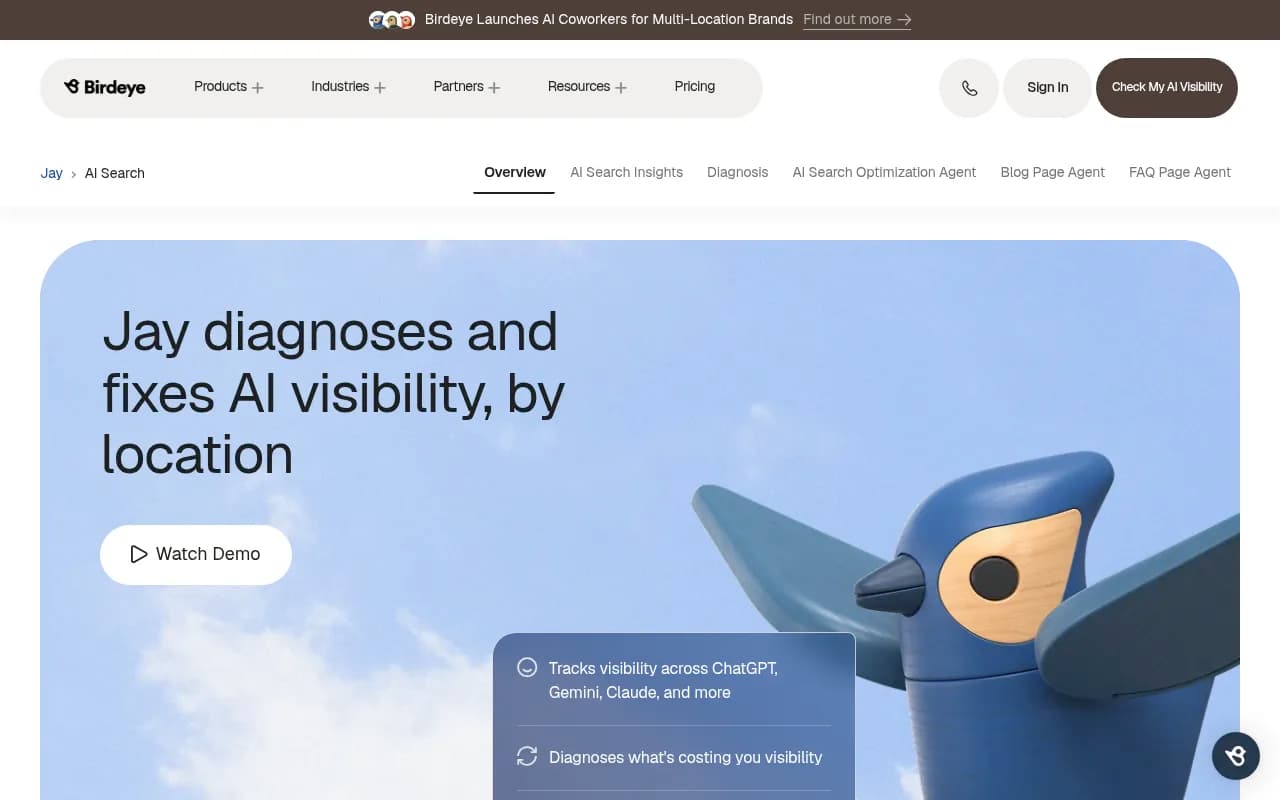
According to Birdeye's own product pages, AI Search tracks brand and location-level visibility, rankings, citations, and sentiment across seven AI surfaces: ChatGPT, Gemini, Perplexity, Google AI Overviews, Google AI Mode, Claude, and Grok. The company says it runs live queries and measures the actual answers returned to real users rather than relying purely on API sampling, with scan frequency configurable by location (weekly scans available).
The insights it reports include:
- Brand and location visibility scores
- Ranking trends across prompt clusters
- Citations used by AI engines
- Strengths and weaknesses in how AI describes the business
- Recommended actions to improve visibility
- Theme and prompt coverage
- Competitor visibility trends
Where Birdeye differentiates itself from most monitoring tools is what happens after the data comes in. Its BirdAI agents can act on the recommendations directly: updating listings, generating reviews, publishing location-specific content, all within a review workflow. Birdeye frames this as a three-step loop: consolidate the location data, use BirdAI to interpret it, then deploy agents to execute fixes at scale. In Birdeye's own case studies, this translated to a 30% increase in AI visibility, a 53% increase in lead volume, and a 74% acceptance rate on its recommended actions, according to figures published on its AI Search landing page.
Birdeye's "State of AI Search 2026" report also makes a point worth repeating regardless of which tool you use: 80% of brands get cited at least once by AI engines, but only 15% hold the top citation position with their own domain. Most visible brands still don't control their own narrative in AI answers, which is exactly the gap tools in this category are trying to close.
Where independent reviewers say Birdeye comes up short
Here's where the picture gets more complicated. Birdeye's own content, understandably, frames AI Search as comprehensive. Third-party comparisons tell a different story.
Data-Mania's 2026 ranking of 20 AI search visibility tools places Birdeye at position 19 out of 20, and its reasoning is blunt: "Birdeye doesn't track AI citations at all, and it earns a place here because reviews, ratings, and listing accuracy are inputs that AI systems weigh heavily for local and service queries." The same review lists citation intelligence and prompt discovery as "not offered" and concludes that Birdeye is "a foundation for AI visibility rather than a measurement of it."
That's a sharper take than Birdeye's marketing suggests, and it's worth sitting with for a second. There's a real tension between Birdeye's product pages (which describe citation tracking, visibility scores, and prompt coverage in detail) and an outside reviewer concluding the opposite. My read: Birdeye's AI Search product probably does query AI engines and surface citation-related data, but its core competency and most of its customer base is reputation and listings management, not AI search monitoring as a standalone discipline. If you're comparing it against purpose-built GEO platforms, it reads more like reputation management with an AI visibility layer attached than an AI visibility platform with reputation tools attached.
A competing vendor, Cheers, ran an independent 28-day citation test ending September 2, 2026 and found birdeye.com itself was cited by ChatGPT 3,462 times, Perplexity 344 times, Google AI Mode 44 times, and Gemini 25 times, mostly as a directory or citation source rather than as a business controlling its own narrative. Across Cheers' broader 356,019-citation dataset, 68.1% of citations went to business websites versus 23.0% to directories and review platforms. That's a useful reminder that being cited isn't the same as being represented the way you want.
The pricing opacity problem
Birdeye does not publish pricing for AI Search anywhere. Quotes are scoped by location count, LLMs tracked, query volume, and activated agents, and you only get a number after talking to sales. Birdeye's core (non-AI) suite has published tiers elsewhere, roughly $299 to $449 per month per location depending on the source, but AI Search pricing sits entirely behind a sales form that asks you to bucket your location count (1-3, 4-9, 10-39, 40-249, 250-999, 1000+).
For a small or mid-sized business trying to compare tools on a spreadsheet, that's a real friction point. You can't self-serve a trial the way you can with most dedicated AI visibility tools.
What Birdeye is missing compared to dedicated GEO platforms
A few gaps are worth calling out plainly:
- No AI crawler log analysis. Birdeye doesn't show you when ChatGPTBot, ClaudeBot, PerplexityBot, or other crawlers actually visit your pages, or whether they hit errors. That's a blind spot for understanding why you're visible or not at a technical level.
- No Reddit or YouTube citation tracking as a distinct feature. Given how often AI engines currently pull from these sources (reddit.com's share of ChatGPT citations actually collapsed from roughly 4% to 0.5% in mid-August 2026, per Promptwatch's data on declining Reddit citations), tracking these channels separately still matters for brands outside the local-business category.
- Narrow free tool. Birdeye's free AI Visibility Checker only evaluates ChatGPT for a single location, which isn't representative of the multi-engine, multi-location tracking the paid product claims.
- Built for local, not for everything. If you're an e-commerce brand, SaaS company, or publisher without physical locations, Birdeye's entire value proposition (fixing listings, reviews, location pages) doesn't apply to you.
For context on why breadth of monitoring matters: Promptwatch's research on how many unique domains ChatGPT cites per response found that organic prompts cite 10+ domains 52.5% of the time, while brand-specific prompts cite 10+ domains in only 21.3% of cases. A single location's citation is genuinely contested real estate, especially on ChatGPT, which cites roughly 5 sources per web-search answer versus roughly 10 for Google AI Overviews and Perplexity, according to Promptwatch's average sources per response data. A tool that only tracks presence/absence without modeling that competition for citation slots is working with a thinner picture than one that tracks prompt volume, difficulty, and citation rate together.
Birdeye vs dedicated AI visibility platforms
| Tool | Core focus | AI engines tracked | Content generation | Crawler logs | Best for |
|---|---|---|---|---|---|
| Birdeye AI Search | Reputation + location signals that feed AI visibility | ChatGPT, Gemini, Perplexity, AI Overviews, AI Mode, Claude, Grok | Listings, reviews, local pages via agents | No | Multi-location/franchise brands |
| Promptwatch | End-to-end AI visibility and GEO execution | ChatGPT, Gemini, Claude, Perplexity, Grok, DeepSeek, Copilot, Mistral, Meta Llama, AI Overviews, AI Mode | Automated Content Agents, CMS publishing | Yes, 400+ bots tracked | Brands and agencies needing full-funnel tracking plus content execution |
| Profound | Citation tracking and AEO | Multiple | Content creation agents | No | Enterprises wanting citation visibility |
| Yext Scout | Local listings + AI tracking | Google Search/Maps, AI Overviews, ChatGPT, Gemini, Claude, Perplexity | Limited | No | Local/multi-location brands |
| Semrush AI Toolkit | AI visibility inside existing SEO workflow | Multiple | Content tools | No | Teams already on Semrush |

So, does Birdeye track AI search visibility?
Yes, with caveats. Birdeye's AI Search product does query major AI engines and reports visibility scores, sentiment, and some citation data, and it's genuinely useful if your business is multi-location and your biggest lever is fixing listings, reviews, and local content at scale. The 30% visibility lift and 74% recommendation acceptance rate Birdeye cites suggest the execution loop works for the customers it's built for.
But if you strip away the marketing and look at how it's positioned by independent reviewers, Birdeye is closer to a reputation management platform with an AI layer than a dedicated AI search visibility tool. It doesn't offer prompt-level difficulty scoring, crawler log analysis, Reddit/YouTube citation tracking, or the kind of granular content gap analysis that platforms built specifically for GEO provide. And because pricing is entirely custom and gated behind a sales call, it's hard to even evaluate against alternatives without committing time upfront.
If your business lives and dies by Google Maps and local listings, consider Birdeye. If you need to understand and act on AI visibility across a broader set of content types, prompts, and channels, platforms built specifically for that job, including Promptwatch, which pairs prompt tracking, citation trends, and crawler logs with Content Agents that actually publish fixes, are worth a closer look. For a broader sweep of options in this space, the GEO software directory at bestgeosoftware.com is a reasonable place to keep comparing.