Key takeaways
- Whitespark's 2026 study of 540 local queries found AI Overviews now show up in 68% of local searches on average, compared to only 39% for the traditional local pack.
- Google's own 2026 Local Search Ranking Factors survey found GBP signals make up 32% of local pack ranking but drop to just 12% of what drives AI search visibility, where on-page content, citations, and links matter more.
- ChatGPT cites roughly 5 sources per web-search answer, while AI Overviews and Perplexity cite closer to 10, meaning the competition for a citation slot is tighter on ChatGPT and more forgiving on Google's AI surfaces.
- For branded, "is this business good" style queries, ChatGPT leans much harder on reviews and social posts than it does for generic searches, which changes what kind of content actually earns you a mention.
- A complete, verified Google Business Profile is still table stakes, but it's no longer sufficient on its own; local businesses now need on-page content, citations, and review depth built for retrieval by AI systems, not just for the Maps algorithm.
The quiet split nobody announced
For about fifteen years, local SEO had a pretty stable recipe. Claim your Google Business Profile, keep your name, address, and phone number consistent everywhere, collect reviews, build local citations, and you'd show up in the map pack for "plumber near me." Google never published its ranking formula, but practitioners reverse-engineered it well enough that the game had rules everyone understood.
That recipe still works, for the local pack. The problem is the local pack isn't the only place local answers live anymore, and increasingly it isn't even the primary one.
Whitespark ran a study across 540 queries in three US cities and six industries and found something that should worry anyone who thinks GBP optimization is the whole job: AI Overviews now appear in 68% of local business queries on average, while the classic local pack shows up in only 39% of the same query set. That's not a close race. Depending on the vertical, it got as skewed as real estate agent searches, where AI Overviews appeared 80% of the time and the local pack showed up in barely 17% of results. Even for home services like plumbers, AI Overviews beat the local pack's appearance rate.
Search Engine Journal's follow-up reporting on the same research found the split tracks query intent closely. Informational local queries like "how long does an eye exam take near me" trigger an AI Overview 92% of the time. Hybrid queries that mix a question with a location, something like "average cost of dental implants in Phoenix," hit 97%. Purely transactional queries, "tacos San Francisco," still lean on the local pack. So the gap isn't uniform, but it's real and it's wide for anything that isn't a dead-simple "show me businesses near me" lookup.
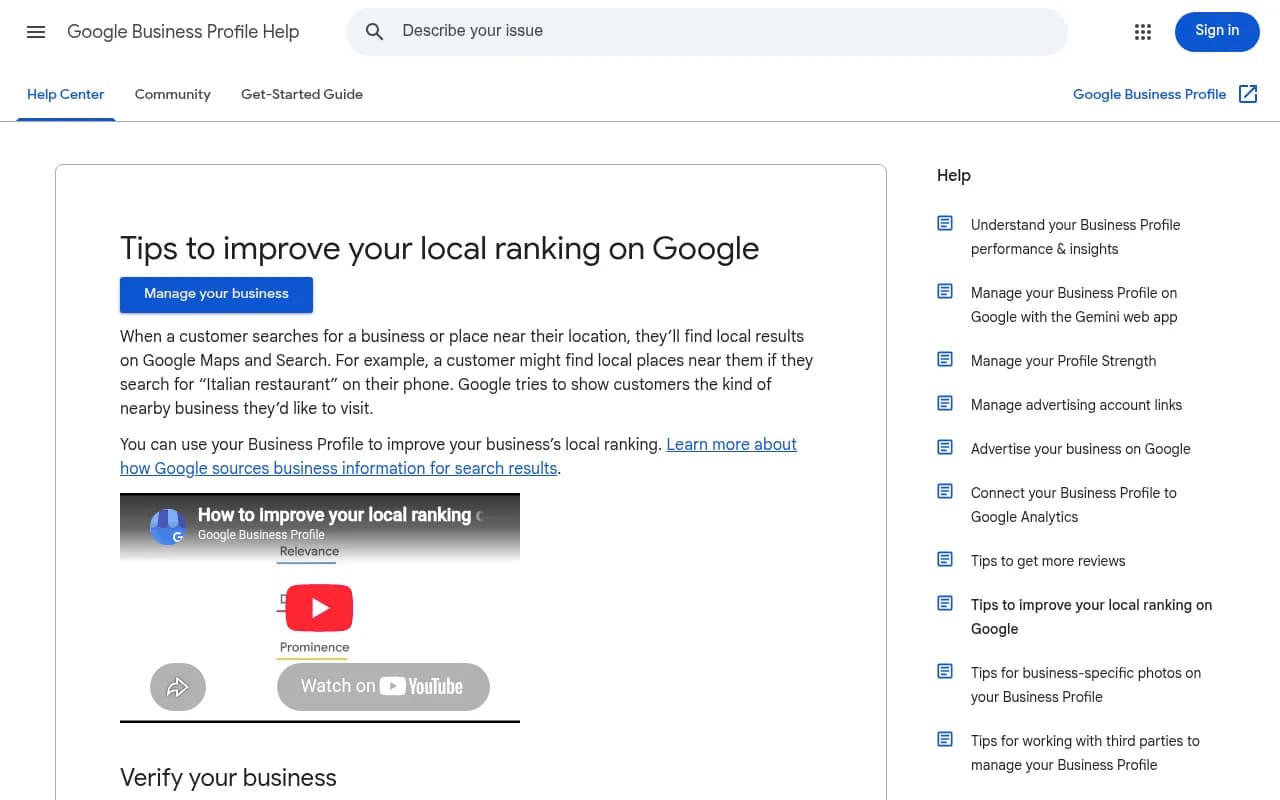
That screenshot above is Google's current help documentation for improving local ranking. It's good advice. It's also entirely about the local pack and Maps, with zero acknowledgment that a huge share of local queries now resolve through a generative answer with a completely different set of ranking inputs. That gap between what Google tells business owners to do and what's actually driving visibility is the whole subject of this article.
What actually drives local pack rankings vs. what drives AI visibility
The clearest evidence of the divergence comes from Whitespark's 2026 Local Search Ranking Factors survey, which polled 47 local SEO practitioners across 187 individual factors. For the first time, the survey split out a dedicated "AI Search Visibility" category alongside the usual Local Pack and Local Organic buckets, and the weightings are genuinely different.
| Ranking factor category | Local pack (Maps) | Local organic | AI search visibility |
|---|---|---|---|
| GBP signals | 32% | 7% | 12% |
| Review signals | 20% | 6% | 16% |
| On-page signals | 15% | 33% | 24% |
| Citation signals | 6% | 7% | 13% |
| Link signals | 8% | 24% | 13% |
| Behavioral signals | 9% | 10% | 4% |
| Personalization | 6% | 8% | 9% |
| Social signals | 4% | 5% | 9% |
The story in that table is simple once you see it. GBP signals are, by a wide margin, the single biggest lever for the local pack at 32%. For AI search visibility, GBP drops to 12%, tied for near the bottom of the list. On-page content and citation signals both become proportionally more important for AI, and three of the top five AI visibility factors relate to citations in some form, even though citations alone rank lower than reviews or on-page content.
Survey author Darren Shaw, who has run this study since 2017 (it originated with David Mihm back in 2008), calls citations "foundational" even at a lower percentage weight, because they're what establishes the baseline facts an AI system cross-references before it ever considers citing you directly. A perfectly optimized GBP listing with zero presence anywhere else on the open web just doesn't give a language model much to retrieve.
The survey also flagged two new, very concrete 2026 factors worth knowing about: businesses that are actually open at the moment of the search now rank higher (credited to local SEO expert Joy Hawkins), and being included in "Best Of" or "Top Local" listicle-style content is now its own distinct ranking signal. Both point the same direction, toward content that exists outside your own profile and gets referenced by someone else.
Why ChatGPT and Google AI handle local differently from each other
It's worth separating "AI Overviews" from "ChatGPT" here, because they don't behave the same way and the difference matters for strategy.
Promptwatch's data on source counts shows ChatGPT cites roughly 5 sources per web-search response, while Google AI Overviews and Perplexity both cite closer to 10. That's a meaningful gap. If you're trying to earn a citation, AI Overviews is simply the more forgiving surface, with roughly double the slots available compared to ChatGPT (https://promptwatch.com/data/average-sources-per-response). Microsoft Copilot, for what it's worth, has been wildly inconsistent, swinging from under 2 citations to nearly 17 in the same dataset, which tells you its retrieval approach is still unsettled.
There's also a difference in how generic versus branded local queries get answered. Promptwatch's domain-count data found 47.6% of ChatGPT responses cite 10 or more unique domains overall, but for brand-named prompts specifically that number drops to 21.3%, and 13.8% of branded responses cite three domains or fewer (https://promptwatch.com/data/chatgpt-unique-domains-per-response). Translate that to a local context: when someone asks "is [the plumbing company down the street] any good," the pool of sources ChatGPT draws from narrows sharply, which means each surviving source, often a review site or a directory listing, carries disproportionate weight. The same research found reviews make up 5.6% of citation share for branded prompts, more than three times their average share across all prompts, and social posts jump to roughly four times their baseline share (https://promptwatch.com/data/chatgpt-citation-share-by-content-type). If your review profile is thin or stale, you're not just losing star-rating credibility with a human reader, you're giving a generative model less to work with when it tries to answer a direct question about your business.
One more data point worth flagging: ChatGPT's citation behavior has been shifting toward mid-authority domains. Promptwatch found domains in the DR 46-75 range earned roughly 46% of ChatGPT citations in August 2026, while top-tier DR 91-100 domains fell to just 3-4% of citations by the end of the month (https://promptwatch.com/data/chatgpt-citation-share-by-domain-rank-august-2026). That's actually good news for small local businesses. You don't need Forbes-level domain authority to get cited; you need a site that's well-structured and genuinely relevant to the specific, narrow query someone typed.
What this means for your actual local presence
Given all that, here's a practical way to think about splitting effort between the two systems.
Keep doing the GBP basics, they're not going away. A complete profile with accurate hours, categories, service areas, and photos still drives the local pack, which still matters for the simpler transactional searches that haven't shifted to AI Overviews. BiZiq's 2026 data puts the Map Pack's appearance rate at 93% of local searches overall, and businesses with a 750+ character GBP description see 2.5x more impressions than ones without. None of that has stopped mattering.
Build content that answers the question, not just content that describes the business. The AI visibility factors table above puts on-page signals at 24%, the single biggest lever in that category. A page that says "we fix water heaters in Austin" is a description. A page that explains what a water heater repair typically costs in Austin, how long it takes, and what the warning signs are before a full replacement is needed, is an answer. The second kind is what gets pulled into a generative response.
Treat citations and third-party mentions as retrieval fuel, not just a trust signal. This includes the standard NAP-consistent directory listings, but increasingly also means getting mentioned in local "best of" roundups, industry-specific directories, and anywhere else a language model might cross-reference your business name against a location and a service.
Don't let your review profile go quiet. Reviews carry 16% weight in the AI visibility breakdown, and they punch above that weight specifically on branded queries. Respond to every review, and encourage detailed, specific feedback rather than just a star rating; AI systems pull language and context from written reviews, not just the aggregate score.
| Factor | Weight in local pack | Weight in AI visibility | What to actually do |
|---|---|---|---|
| GBP completeness | 32% | 12% | Keep it current, don't over-invest beyond the basics |
| On-page content | 15% | 24% | Write genuine answer content per service and location |
| Reviews | 20% | 16% | Prioritize detailed written reviews, respond to all |
| Citations | 6% | 13% | Expand beyond NAP directories into listicles, local press |
| Links | 8% | 13% | Local partnerships, sponsorships, community mentions |
Tracking visibility across both systems
The tooling challenge is that local pack rank trackers and AI visibility platforms are, for now, mostly separate categories. BrightLocal remains the standard for geo-grid local pack tracking, citation monitoring, and review management, with pricing starting around $31/month and scaling down to roughly $7.48 per location at volume.
Local Falcon takes a similar geo-grid approach but has added an AI visibility layer called Falcon AI, with credit-based pricing starting at $24.99/month for 7,500 credits, where each credit maps to one scanned grid point.
For the generative-answer side specifically, Promptwatch tracks how your brand shows up across ChatGPT, Gemini, AI Overviews, AI Mode, Perplexity, and other assistants, including the citation-level detail that matters for local businesses: which pages of yours get cited, what content types and sources are winning citations in your category, and AI crawler logs showing whether bots are even reading your location and service pages in the first place. It doesn't replace a geo-grid rank tracker for the local pack, but it fills the gap those tools don't cover: understanding why you are or aren't showing up when someone asks an AI assistant a local, intent-driven question.

Promptwatch doesn't have a dedicated local-business citation report the way it does for verticals like healthcare or travel, so treat any local-specific AI visibility number as directional rather than exact, and lean on Whitespark's dedicated local study for the local-pack-versus-AI-Overview prevalence numbers specifically.
| Tool | Focuses on | Starting price | Best for |
|---|---|---|---|
| BrightLocal | Local pack rank tracking, citations, reviews | $31/mo | Agencies managing many local clients |
| Local Falcon | Geo-grid rank tracking plus AI visibility | $24.99/mo | Hyper-local rank precision |
| Promptwatch | AI search citations, crawler logs, content gaps | $95/mo | Understanding and fixing AI visibility specifically |
| Semrush AI Visibility Toolkit | Prompt tracking bundled with existing SEO suite | $99/mo add-on | Teams already in the Semrush ecosystem |
The bottom line
Local SEO isn't dying, and it's not being replaced wholesale by something called "local GEO." What's happening is more specific: the query mix that used to resolve almost entirely through the local pack now splits across two systems with different inputs. The local pack still rewards a complete, verified, actively managed Google Business Profile. AI Overviews, ChatGPT, and the rest reward something closer to traditional content authority, reinforced by citations and genuine review depth, with GBP completeness playing a smaller supporting role rather than the lead.
If your entire local strategy still stops at "claim and optimize the GBP listing," you're fully covering maybe 39% of local search outcomes and leaving the larger, faster-growing 68% mostly to chance. The businesses that will own their category by 2027 are the ones treating their location pages, service content, and review profile as answer material for a model, not just decoration for a map pin.