Key takeaways
- ChatGPT ads launched in the US on February 9, 2026 and went self-serve across Europe, India, the Middle East and North Africa by the end of August, after OpenAI passed a $1 billion annualized revenue run rate in under 200 days.
- Independent research from SE Ranking found ads on 25.94% of commercial prompts tested, with 14.35% of those ads having no real connection to the prompt they appeared under.
- Ads sit below ChatGPT's answer, never inside it, and advertisers were cited organically above their own ad in only 3.63% of placements, meaning paid and organic visibility are genuinely separate competitive risks.
- A new generation of "ChatGPT ads trackers" from GrowByData, SE Ranking, and Adthena now logs which prompts trigger a sponsored card, which brand bought it, and dated evidence you can act on.
- If your category hasn't seen a competitor bid on your brand prompts yet, that's a temporary window. Early placements are cheaper, the same land-grab dynamic that made early Google Ads accounts so much cheaper than today's.
What actually changed in ChatGPT in 2026
For most of ChatGPT's life, the honest answer to "who's advertising here" was nobody. OpenAI resisted ads for years, treating the idea as a last resort. Then, in February 2026, it started testing sponsored placements with Free and Go plan users in the US. By the end of August the company said it had crossed $1 billion in annualized ad revenue in under 200 days and opened self-serve access across Europe, India, the Middle East and North Africa. Tens of thousands of advertisers are now running campaigns in more than 40 countries.
That's a fast ramp for a channel that supposedly wasn't coming. And it matters for anyone running brand monitoring, because the thing that used to be purely organic, what ChatGPT says about you unprompted, now has a paid layer sitting right underneath it.
Where ads show up, and where they don't
Ads appear as a clearly labeled sponsored card below the end of a ChatGPT response, visually separated from the answer itself. A user might see one ad, or several, from one advertiser or more than one. There's also a carousel format, introduced in August 2026, that lets an advertiser show several products in one sponsored block, pulling live pricing and star ratings straight from the site's metadata, which is the piece that matters most if you sell physical products and want to show up in ChatGPT Shopping results.
A few things worth knowing before you build a monitoring plan:
- Only Free and Go plan users see ads. Plus, Pro, Business, Enterprise, and Edu accounts don't.
- Ads never run inside the ChatGPT Atlas browser during this test.
- Temporary Chats show no ads.
- OpenAI says ads run on separate systems from the chat model and can't influence what ChatGPT actually says, and the data backs that up: independent testing found an advertiser's own content was cited organically above its own ad in just 3.63% of cases. That's a genuinely useful number because it tells you paid placement and earning an organic citation are two separate jobs, not one.
There's no keyword bidding, and that's the part people get wrong
If you've run Google Ads, the instinct is to think of this like search auction insights: bid on keywords, see where you land. ChatGPT doesn't work that way. Advertisers write plain-language "context hints," descriptions of the conversations and situations where a product is relevant, and OpenAI's system matches those hints to live chats. There's no Quality Score, no search terms report, and critically, no way for an advertiser to see exactly which prompt triggered their own ad. That opacity is precisely why third-party monitoring tools have become necessary rather than optional.
How common are these ads right now
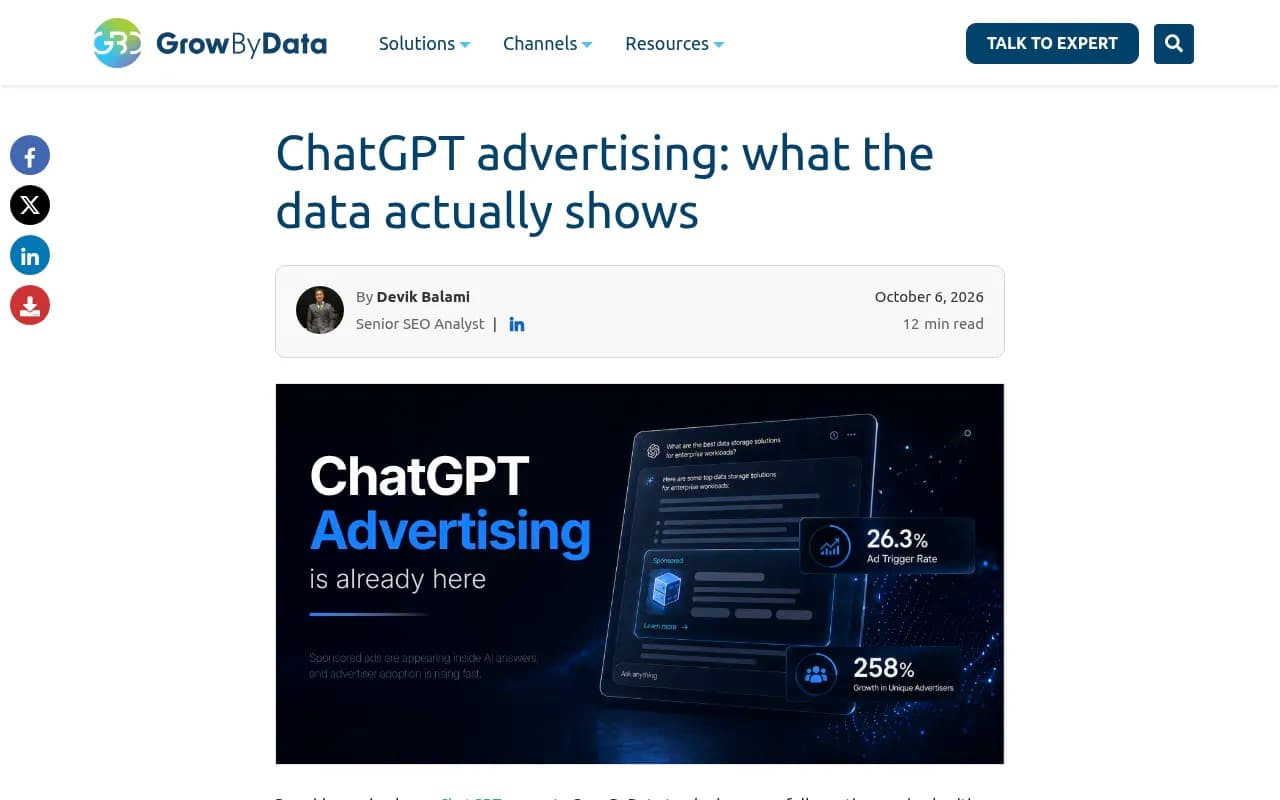
The numbers moved fast in 2026. GrowByData's panel data put sponsored placements at 9.2% of tracked ChatGPT prompts in June. By July, SE Ranking's independent test of 50,006 commercial prompts across 20 niches found ads on 25.94% of them, roughly one in four. That's not a rounding error, it's a real jump in a few months, and it tells you the ad system is scaling faster than most brand teams' monitoring habits are.
The same SE Ranking research flagged something brands should take seriously: 14.35% of the ads shown had no real connection to the prompt they appeared under, and that irrelevance rate rose above 50% in categories like Relationships and News & Politics. Translation: the targeting system is still rough around the edges in certain verticals, which is both a risk (your brand could end up next to an off-topic or low-quality ad) and an opportunity (less competition for precise context hints in your actual category).
Transactional prompts are where exposure shows up first
Across the monitoring panels I looked at, transactional, ready-to-buy prompts are showing the strongest early ad presence, stronger than purely informational or local queries. If your buyers are typing bottom-of-funnel questions into ChatGPT, "best noise-cancelling headphones under $200," "where to buy X near me," that's the layer where a competitor is most likely to already be bidding against you, or where you have the cheapest window to claim the prompt before anyone else does.
Why this is a different risk than brand mention tracking
It's tempting to fold ChatGPT ad monitoring into your existing AI visibility dashboard and call it done. Don't. Organic citation tracking answers "how does ChatGPT talk about my brand unprompted." Ad monitoring answers "who paid to show up on my highest-intent prompts." They're different budget lines and different competitive risks, and a competitor can be losing the organic battle on a prompt while still buying their way past you on the exact same query. Treating them as one problem means you miss the one that's actually costing you money in real time.
This is also the piece that most AI visibility platforms genuinely don't cover yet. Tools built to track brand mentions and citations across ChatGPT, Perplexity, Gemini, and AI Overviews weren't built to watch a sponsored card that only renders for Free and Go users on specific phrasings. A placement that lives inside a chat response is effectively invisible to anything built to parse a traditional search results page.
What ChatGPT ads monitoring tools actually show you
A handful of vendors have built dedicated ChatGPT ads trackers in 2026, separate from general AI visibility or AEO tools. The core job across all of them is the same: run a defined set of commercial prompts repeatedly, detect when a sponsored card appears, log the advertiser and destination link, and keep dated evidence over time.
| Tool | What it tracks | Notable feature | Best for |
|---|---|---|---|
| GrowByData ChatGPT Ads Monitoring | Prompts triggering ads, advertiser identity, dated screenshots | Sits alongside existing Google/Shopping visibility reporting | Brands wanting ads data in the same dashboard as paid search |
| SE Ranking ChatGPT Ads Tracker | Advertiser behind each ad, destination link, whole-market view | Shows ads triggered on a prompt even outside your tracked account | Teams that want competitor-wide visibility, not just their own campaigns |
| Adthena ChatGPT Ads Intelligence | Tracked and untracked prompts with ads, Share of Search KPI | Conversational AI analyst over the ad data, plus MCP/API access | Agencies and enterprise teams needing prompt expansion and reporting |
None of these tools can see every prompt variation a user might type, and none can guarantee they catch a placement the first time it runs. What they do give you is a repeatable, evidenced record, the same discipline paid search teams already apply to Google Auction Insights, pointed at a surface that auction insights tools were never designed to see.
Building a basic ChatGPT ads monitoring process
You don't need an enterprise contract to start. Here's a practical sequence:
- List your 15 to 30 highest-intent commercial prompts, the ones a buyer close to purchase would actually type. Prioritize transactional phrasing over informational research questions.
- Run each prompt on a logged-out or Free-tier ChatGPT session periodically, since ads only show to Free and Go users. Note whether a sponsored card appears, which brand, and the destination link.
- Screenshot and timestamp every hit. If you ever need to raise a trademark concern or just prove a pattern to leadership, a memory of "I think I saw this" doesn't hold up. A dated record does.
- Separate this log entirely from your organic brand monitoring spreadsheet or dashboard. Different risk, different owner, different budget conversation.
- Flag the prompts in your category that show no ads at all yet. Those are the cheapest to claim now, and that won't stay true once competitors catch on.
Where this fits with your broader AI visibility strategy
Paid placements inside ChatGPT are still a small slice of total visibility compared to organic citations, but they're growing fast and they sit on exactly the prompts that matter most commercially. If you're already tracking how often your brand gets cited organically in ChatGPT, Perplexity, Gemini, and Google AI Overviews, ad monitoring is the missing second layer, not a replacement for it.
For the organic side, a platform like Promptwatch tracks prompt-level citations, crawler activity, and traffic across ChatGPT, Gemini, Claude, Perplexity, and the other major AI engines, and its ChatGPT Shopping and Ads Radar specifically tracks product recommendations in ChatGPT shopping results and sponsored placements, including which competitors are bidding on your prompts and how their ad copy is positioned. That pairs the organic question (why am I cited, or not) with the paid question (who's buying the slot underneath the answer), instead of treating them as two unrelated dashboards.

If you want to compare more dedicated AI visibility and GEO platforms before picking one, the directory at bestgeosoftware.com is a reasonable place to see how different tools handle citation tracking, crawler logs, and now, increasingly, paid placement monitoring.
A few honest caveats
This is still an early, messy channel. OpenAI's own targeting system misfires often enough that over half the ads shown on some topics are off-topic. Advertisers can't see where their own ads ran, which means neither can you verify a competitor's exact spend or strategy from the outside, you can only observe the placements you happen to trigger. And because eligibility, regions, and formats are expanding monthly (carousel ads in August, European self-serve access by the end of that month, new backend features rolling out through September), any monitoring setup you build in late 2026 needs to be checked again in a few months. Treat this less like a one-time audit and more like a recurring line item, the same way you'd treat Google Ads competitive monitoring.
The prompts in your category without an advertiser yet won't stay that way for long. Whether you build the tracking yourself with a prompt list and screenshots, or hand it to a dedicated ads radar tool, the point is the same: know who's bidding on your name before you find out from a customer who clicked the wrong link.