Key takeaways
- Amazon expanded its robots.txt in late 2025 to block 47 AI bots, including the crawlers that power ChatGPT Shopping (OAI-SearchBot and ChatGPT-User). ChatGPT cited amazon.com just 6 times in a 391,073-citation sample analyzed by LLM Pulse, while Google AI Mode and AI Overviews accounted for 1,107 of Amazon's citations in the same dataset.
- Etsy and Shopify took the opposite path. Per OpenAI's own merchant page, if you sell through either platform your catalog is already integrated into ChatGPT shopping with no extra setup.
- Marketplace domains as a category are a rounding error in AI shopping answers: Amazon, Walmart, eBay, Target, Best Buy and Alibaba combined account for under 3% of citations in generic shopping queries. Brand and manufacturer sites take roughly 65%.
- Product pages are ChatGPT's single most-cited content type (22.4% of classified citations as of early October 2026), which matters more to sellers than marketplace-page citations ever will.
- OpenAI pulled back its in-chat Instant Checkout in March 2026 after low merchant adoption, shifting to redirect-based purchasing. The shopping opportunity is still real, but it looks more like product discovery and referral traffic than native in-chat sales.
The question sellers are actually asking
If you sell on Amazon or Etsy, you've probably typed some version of "best [your product category]" into ChatGPT just to see what comes back. Most sellers who do this get a quiet gut punch: their own listing doesn't show up, a competitor's blog post does, and somewhere in there is a Reddit thread from three years ago.
That reaction is useful data. It tells you something true about how AI shopping actually works right now, and it's different depending on which marketplace you sell on. Amazon and Etsy are not in the same position in ChatGPT, and the gap between them isn't a technicality. One marketplace locked the gate. The other handed over the keys.
Amazon shut the door, then Amazon built its own door
In late 2025, Amazon quietly expanded robots.txt to block 47 distinct AI bots. That list includes OpenAI's OAI-SearchBot and ChatGPT-User, the two crawlers responsible for reading pages and surfacing citations in ChatGPT's shopping and search features. It also covers several Google AI crawlers and Meta's bots. Practically, this means ChatGPT cannot read product titles, prices, specs, or reviews directly from amazon.com anymore.
The numbers back this up. LLM Pulse analyzed 391,073 citations from AI answers to generic shopping questions across ChatGPT, Google AI Mode, AI Overviews, Gemini and Perplexity, collected between April and July 2026. Amazon.com showed up as the single most-cited retail domain once balanced across topics, which sounds like good news until you see where those citations came from: 1,107 of Amazon's citations came from Google AI Mode and AI Overviews. ChatGPT cited amazon.com 6 times in the entire sample. Perplexity cited it zero times.
That split isn't an accident. Google has standing crawl access to Amazon through traditional search indexing agreements and years of structured data cooperation. ChatGPT doesn't, and now it literally can't read the page. If Amazon's main marketplace shows up in a ChatGPT answer at all, it's almost certainly because ChatGPT found the product mentioned on a third-party blog, a review site, or a listicle, not because it crawled amazon.com.
Interestingly, Amazon didn't block everything it owns. Subsidiaries like Zappos, Shopbop, and Woot remain open to AI crawlers. That looks like a controlled experiment: Amazon testing whether AI referral traffic is worth the trade-off on smaller properties before deciding whether to open the main site back up. Given that Adobe reported AI-platform referral traffic to U.S. e-commerce sites surged 4,700% year-over-year in 2025, and Digiday reported ChatGPT already drives over 20% of Walmart's referral traffic, Amazon is sitting on a real number it hasn't shared.
Why block at all, then? Because Amazon has its own answer engine. Rufus, Amazon's in-app AI shopping assistant, is used by 250 to 300 million customers, with monthly active users up 149% year over year and total interactions up 210%. Users who engage with Rufus are 60% more likely to purchase in that session. Evercore ISI projects Rufus could generate over $10 billion in incremental annual sales. Amazon doesn't need ChatGPT to recommend its products when it's building the same capability in-house and keeping the customer inside its own app the whole time.
eBay made a similar move from a different angle. In February 2026, eBay updated its user agreement to explicitly ban third-party "buy for me" agents and LLM-driven bots from placing orders without human review, and added a Robot & Agent Policy to its robots.txt blocking Perplexity, Anthropic, and Amazon's crawlers, while leaving Google's shopping bot untouched. Same pattern: block the AI competitors, keep Google's pipeline open.
Etsy and Shopify chose the opposite bet
Etsy's position is almost a mirror image. Per OpenAI's merchant documentation, sellers on Shopify or Etsy already have their catalog integrated into ChatGPT shopping, no application or setup required. Etsy was also one of the first merchants, alongside Shopify, to launch OpenAI's Instant Checkout feature on September 29, 2025, letting US shoppers complete single-item purchases directly inside a ChatGPT conversation.
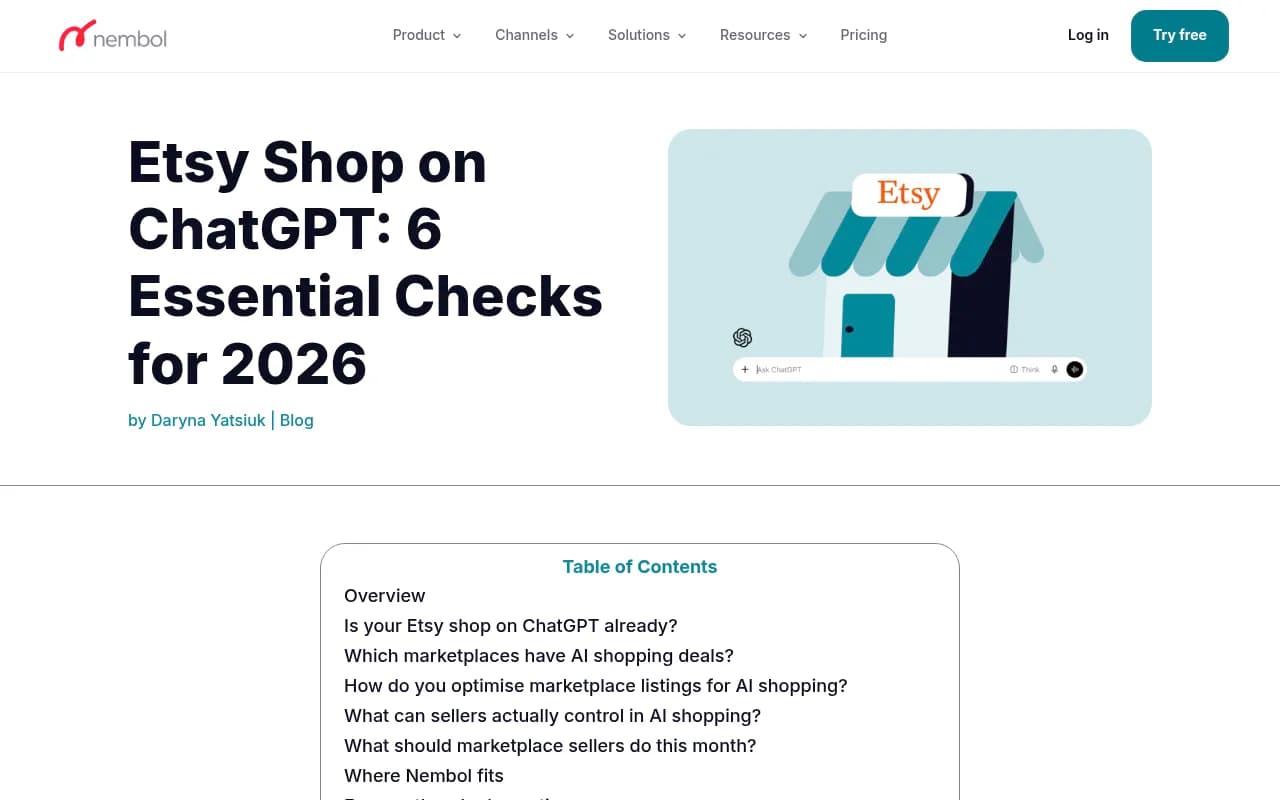
This matters for a simple reason: your visibility in AI shopping right now is decided largely by which marketplace you chose, not by how well you optimized your listing. An Etsy seller with a mediocre listing has a structural path into ChatGPT that an Amazon seller with a great listing currently does not, at least not through Amazon's own pages.
That said, Instant Checkout didn't turn into the gold rush some expected. OpenAI scaled it back on March 4, 2026, about five months after launch, pivoting from native in-chat payment to routing purchases through retailer checkout pages instead. Shopify's president said only about a dozen of Shopify's millions of merchants had actually gone live with it, and Etsy itself "did not end up seeing a large volume of sales" from the feature. Walmart's internal test reportedly found in-chat purchases converted at one-third the rate of its own website. So the open door is real, but what's walking through it so far is smaller than the headlines suggested.
Marketplaces are a small slice of the pie either way
Here's the part that should reset expectations for any seller fixated on getting their Amazon or Etsy listing directly cited. LLM Pulse's data shows all major retailer and marketplace domains combined, Amazon, Walmart, eBay, Target, Best Buy, Alibaba, account for just 2.9% of citations across generic shopping questions. Brand and manufacturer sites take roughly 64.7% of the same citations. Reddit and YouTube together out-cite every big-box retailer combined.
| Citation source category | Share of shopping-query citations |
|---|---|
| Brand/manufacturer sites | ~64.7% |
| Reddit + YouTube combined | more than all major retailers combined |
| All retailer/marketplace domains | 2.9% |
| Amazon.com specifically (ChatGPT only) | 6 citations in 391,073-citation sample |
The lesson isn't "marketplaces don't matter." It's that a direct citation of your marketplace listing is the wrong target. What actually gets cited is content about the product category: comparison posts, how-to guides, listicles, reviews. Promptwatch's data on ChatGPT citation types backs this up from the content side: product pages are ChatGPT's single most-cited content type at 22.4% of classified citations, ahead of landing pages, listicles, and how-tos. For commercial, "best X for Y" style prompts specifically, product pages, landing pages, listicles, and comparisons together make up about 70% of citations.

So the real strategy for an Amazon seller isn't begging Amazon to unblock crawlers. It's getting your product mentioned on the sites ChatGPT already trusts for that category, plus making sure the product data you control elsewhere (your own brand site, Shopify store if you run one, syndicated feeds) is clean enough to be citable on its own.
What sellers can actually control
Regardless of which marketplace you're on, OpenAI has published an official feed specification (the Agentic Commerce Protocol) at developers.openai.com that defines what a well-formed product listing looks like for AI shopping. A few details worth knowing:
- Fields like
item_id,title(max 150 characters, no all-caps),description(max 5,000 characters, factual, no marketing language),price,availability, andbrandare required. - Descriptions written like ad copy get rejected more often than plain, factual ones. OpenAI's top listed rejection reasons are pricing mismatches between feed and live page, missing required fields, and marketing language in descriptions.
- Merchants can push updates to the feed as often as every 15 minutes, versus Google Merchant Center's daily schedule, which matters if you run flash sales or dynamic pricing.
- Optional fields that meaningfully help discoverability include GTIN, structured review data, additional images, and a return policy.
About 70% of these required fields (GTIN, title, description, primary image, price, availability, brand, category) overlap across ChatGPT Shopping, Perplexity, Microsoft Copilot Checkout, and other AI shopping surfaces, so getting your product data hygiene right once pays off across channels, not just ChatGPT.
| Action | Amazon sellers | Etsy sellers |
|---|---|---|
| Catalog already in ChatGPT shopping | No, main marketplace crawler-blocked | Yes, automatic via OpenAI's merchant integration |
| Direct listing citation realistic | Rare, Google AI surfaces more likely | More plausible, but still a small share overall |
| Biggest lever | Get cited on third-party content (reviews, comparisons, YouTube) about your product category | Keep listing SEO strong, syndicate to other channels too |
| Checkout inside ChatGPT | Not applicable | Supported for single items, but low volume so far |
| Crawler strategy | Block GPTBot (training), consider allowing OAI-SearchBot if visible elsewhere | No action required for the Etsy integration itself |
Don't optimize for one AI model's crawler alone
One thing worth flagging: OpenAI's share of verified AI crawler requests dropped from 94.8% in early June 2026 to 79.8% by early September 2026, according to Promptwatch's crawler traffic tracking. Anthropic, Google, Perplexity, and Mistral are all picking up share. If you're a seller thinking purely in terms of "getting into ChatGPT," you're already behind the curve. Claude, Gemini, and Perplexity are each carving out meaningful slices of AI-driven shopping discovery, and Amazon's main marketplace is effectively invisible to most of them in the same way it's near-invisible to ChatGPT.
This is also where tracking tools earn their keep. A seller or brand manager trying to figure out which AI engines cite their category, which competitors get picked, and whether their product pages are even readable by AI crawlers needs more than a manual spot-check in ChatGPT once a week. Platforms like Promptwatch track citation patterns across ChatGPT, Gemini, Perplexity, Claude, and Google's AI surfaces, including AI crawler logs showing whether bots are actually hitting your product pages and whether they're hitting errors when they do.
A realistic 2026 checklist
For Amazon sellers:
- Stop assuming your Amazon listing itself will get cited in ChatGPT. It mostly won't, not directly, not soon.
- Build or maintain a presence outside Amazon, your own site, a Shopify storefront, a syndicated feed, where AI crawlers can actually read your product data.
- Pursue third-party coverage: reviews, comparison articles, YouTube unboxings, the content types ChatGPT actually cites for "best X" queries.
- Check whether your robots.txt and any brand site block OAI-SearchBot. If you want ChatGPT citations anywhere you control, don't accidentally wall yourself off the way Amazon's main marketplace did.
For Etsy sellers:
- Your catalog is already in the system. Use that advantage, but don't assume it's a magic switch, Etsy itself reported low sales volume from Instant Checkout so far.
- Keep listing fundamentals strong (titles, descriptions, reviews, Q&A) since those are exactly the fields OpenAI's feed spec prioritizes.
- Avoid marketing-heavy language in descriptions. Factual, specific copy performs better in AI shopping contexts than persuasive copy.
- Don't neglect other AI surfaces. Integration with ChatGPT doesn't mean you're visible in Claude, Gemini, or Perplexity, those require separate attention.
For both: track what's actually happening rather than guessing. If you're running a brand or managing multiple sellers, a tool built for AI visibility monitoring, rather than traditional rank tracking, will tell you which engines cite you, where, and why. The broader directory of options is worth a look at bestgeosoftware.com if you want to compare platforms beyond the one mentioned here.
The honest bottom line
Amazon's crawler block and Etsy's open integration tell two different stories, but they point to the same underlying truth: marketplace citations are a minor channel in AI shopping right now, no matter which platform you sell on. The sellers winning visibility in ChatGPT and its rivals in 2026 aren't the ones obsessing over their marketplace listing getting name-checked. They're the ones showing up in the reviews, comparisons, and how-to content that AI models actually trust, while keeping their own product data clean enough that when an AI crawler does find it, it reads it correctly the first time.